AI Employees vs AI Tools: The 2026 Buyer's Framework for SMB Leaders
In 2026, every AI product calls itself an agent. Most are still just tools. Here's the 7-point test for SMB leaders to tell the difference before paying twice for headcount you thought you replaced.
If you have spent the last 12 months evaluating AI vendors, you have probably noticed that every product is now described as an "AI agent." The word has lost meaning. A Chrome extension that summarizes meetings calls itself an agent. A glorified Zapier workflow calls itself an agent. A genuinely autonomous system that books meetings, handles replies, and updates your CRM also calls itself an agent.
For an SMB leader trying to make a buying decision, this is more than annoying. It is expensive. Buying the wrong category of product — a tool dressed as an employee — means paying for software that still requires the very headcount you were trying to avoid hiring.
This article is the buyer's framework we use at AI Xccelerate to separate the two. It is the same framework we walk our customers through before they sign anything — whether it's our own AI workforce or a competitor's. The goal is simple: by the end of this post, you should be able to look at any AI product, ask three questions, and know exactly what category it belongs to.
What is the difference between an AI tool and an AI employee?
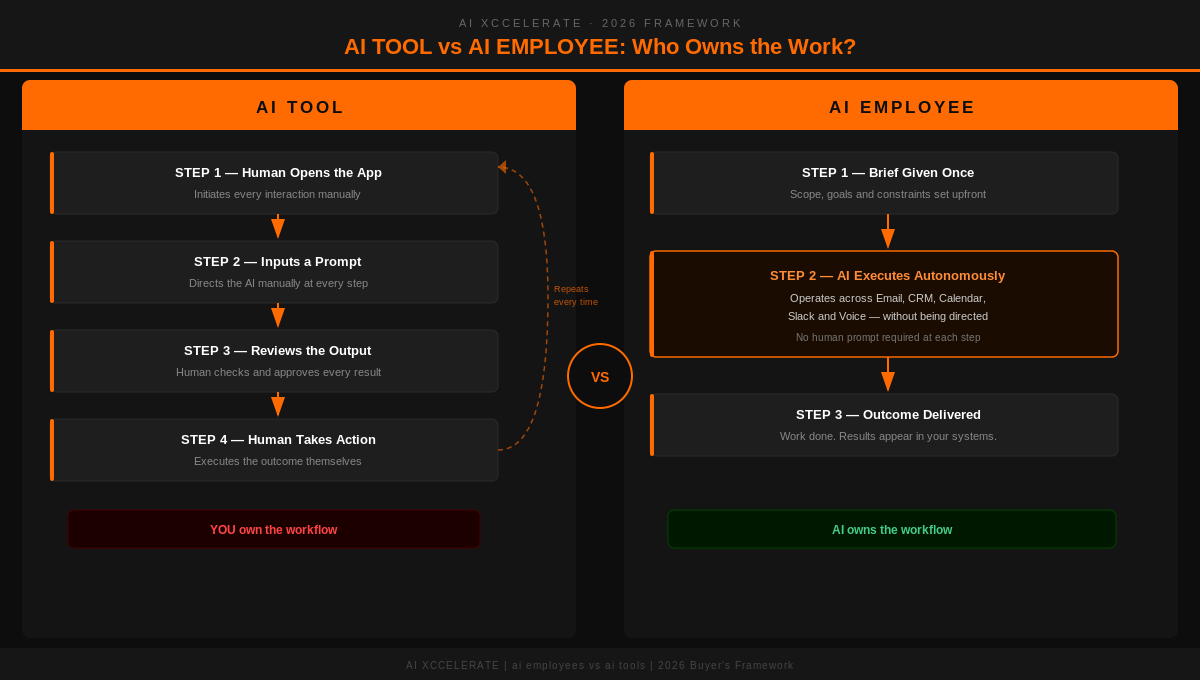
An AI tool is software that responds to a human prompt or trigger and produces an output. A human still owns the workflow. ChatGPT is an AI tool. So is a sales-email writer that drafts copy you then review and send. So is an analytics dashboard that surfaces insights you then act on.
An AI employee is an autonomous system that owns a job function end-to-end. It is given an outcome and operating constraints, and it executes the work across whatever channels and tools are required — email, CRM, calendar, voice, Slack — without a human directing each step. When you onboard an AI employee, you do not learn the software. You give it the brief, the same way you would brief a human hire.
The distinction is not about how impressive the underlying model is. GPT-5, Claude 4, and Gemini 2 are all extraordinary models. The distinction is about who owns the work. With a tool, you do. With an employee, the AI does.
This matters because the two categories solve different problems, charge differently, and produce different outcomes. Confuse them at the buying stage and you end up with a productivity-tool subscription pretending to solve a headcount problem.
Why the distinction matters more in 2026 than it did in 2024
Two years ago, almost everything in the AI category was a tool. Generative AI was new, the agentic stack was immature, and most vendors were wrapping LLM APIs in chat interfaces. Buying an AI tool was a reasonable first step.
In 2026, the agentic infrastructure has caught up. Multi-agent orchestration, tool use, persistent memory, and reliable function calling are no longer research problems — they are production capabilities. That means AI employees are not just possible, they are increasingly the right purchase for any function that involves repeated, definable work.
The economic shift is bigger than the technical one. AI tools compete for software budget — typically 3–5% of revenue for an SMB. AI employees compete for headcount budget — typically 50–60% of operating costs. A vendor selling an AI employee is not asking for $200 a seat per month. They are asking to replace a $75,000 salary with a $20,000 annual subscription that delivers comparable output. The math is structurally different. So is the buyer.
SMB leaders who are still running their AI evaluation as a software-procurement exercise — comparing feature lists, pricing per seat, integration matrices — are missing the more important question, which is whose work does this replace? If the answer is "no one's, it just makes my team faster," you are buying a tool. If the answer is "the next hire we were going to make," you are buying an employee.
The 7-point test: how to tell an AI tool from an AI employee
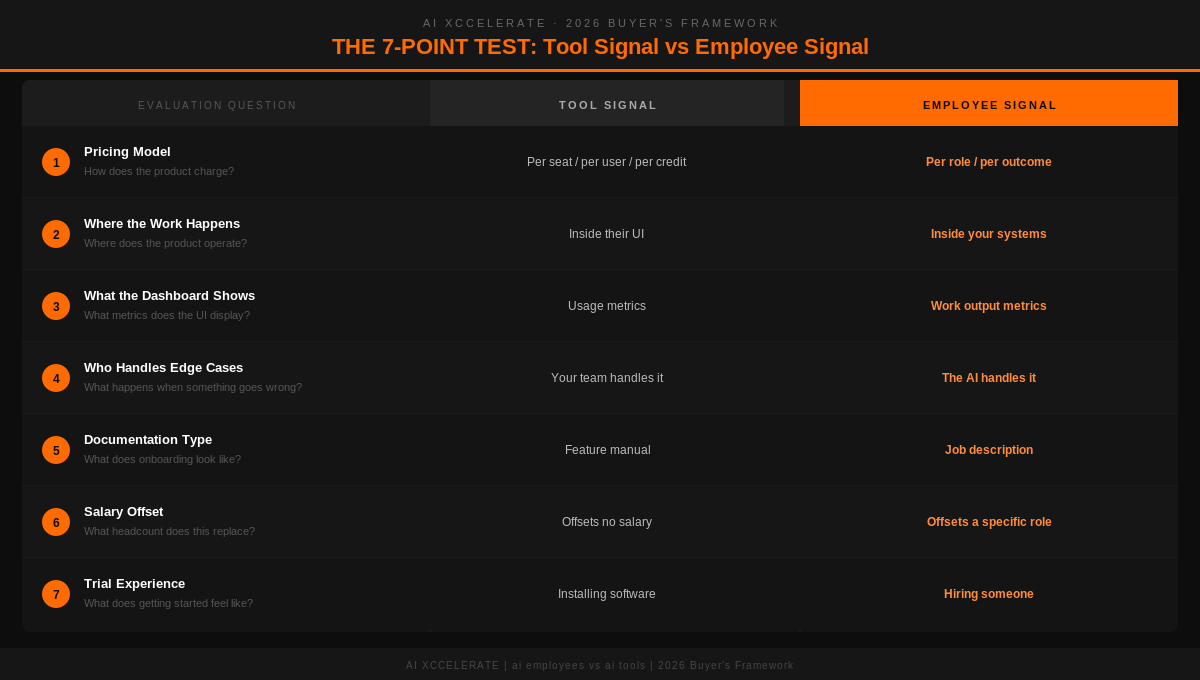
Apply these seven questions to any AI product you are evaluating. If five or more answers point to "employee," you are looking at the real thing. If three or more point to "tool," you are looking at software with marketing.
| # | Question | AI Tool | AI Employee |
|---|---|---|---|
| 1 | Where does the work happen? | Inside the product's UI | Inside your existing systems (CRM, email, Slack, calendar) |
| 2 | Who triggers the work? | A human, every time | The system itself, on schedule or signal |
| 3 | What does the buyer onboard with? | Feature training, documentation | A job description and operating brief |
| 4 | What is the pricing model? | Per seat / per usage / per credit | Per role / per outcome / flat monthly |
| 5 | What is the success metric? | Time saved, content produced | Meetings booked, deals closed, tickets resolved, accounts saved |
| 6 | Who handles edge cases? | The human user | The AI, with escalation only when policy requires |
| 7 | What does the dashboard show? | Usage analytics | Work output — like a manager would review |
Run this on the three AI products currently sitting in your stack. You will almost certainly find that one or two are tools you have been calling employees. That is fine — tools have their place. But it is the source of the productivity gap most SMBs are quietly experiencing: they bought software, but they are still doing the work.
The pricing model tells you everything
If you only have time to ask one question, ask this one: how does this AI product price?
AI tools price like SaaS — per seat, per user, per usage tier, per API credit. This makes sense because they sell capacity, and capacity is consumed by humans. The more humans use the tool, the more revenue the vendor captures.
AI employees price like labor — a fixed monthly rate per role, sometimes per outcome (per qualified meeting booked, per ticket resolved). This makes sense because they sell work, not capacity. A single AI SDR running at full tilt is one billable unit, regardless of whether one human or ten humans are reviewing its output.
The pricing model is the cleanest signal a vendor can give you about which category they are really in. Anyone selling an "AI agent" at $29 per seat per month is selling you a tool with a chat interface. Anyone selling an "AI employee" at $1,500 per month per role, with a defined scope of work, is at least making the right structural claim. You still have to evaluate whether the product delivers — but the pricing tells you they understand the category they are competing in.
What gets bought wrong: three patterns we see weekly
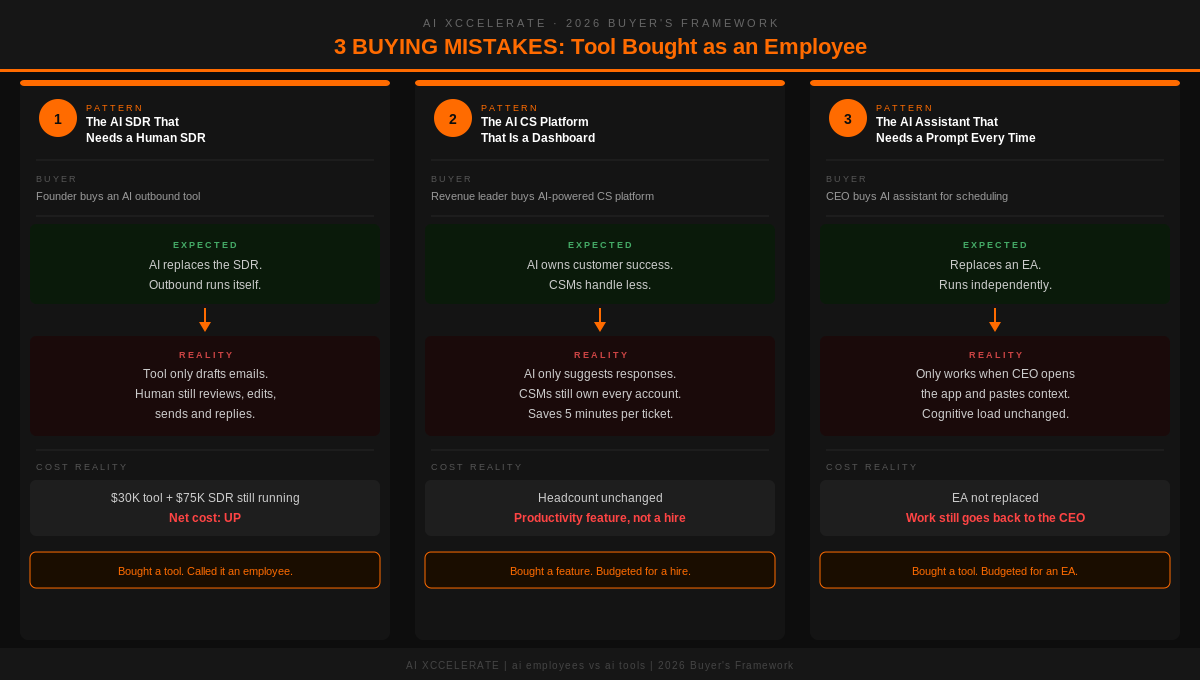
In customer conversations, we see three recurring buying mistakes that come from confusing the two categories.
Pattern 1: The "AI SDR" that requires a human SDR to operate it. A founder buys an AI outbound tool. It generates email drafts. The team still has to review, edit, send, and reply. Six months in, the company has spent $30,000 on the tool and is still paying $75,000 for the SDR. Net cost: up. They bought a tool and called it an employee.
Pattern 2: The "AI customer success platform" that is actually a ticket-routing dashboard. A revenue leader buys a CS platform with AI features. The AI suggests responses. It does not write, send, or follow up on its own. CSMs still own every account. The company saves five minutes per ticket. The headcount remains identical. They bought a productivity feature and budgeted for a workforce shift.
Pattern 3: The "AI assistant" that requires a prompt for every action. A CEO subscribes to an AI assistant product to handle scheduling and email triage. It works — but only when the CEO opens the app, asks a question, and pastes context. The cognitive load doesn't go down. They bought a tool and budgeted for an EA replacement.
In each case, the product is not bad. It is correctly categorized as a tool. The mistake is the buyer's expectation that it would behave like an employee.
When to buy a tool vs when to buy an employee
This is not an argument that AI tools are wrong. It is an argument that the two categories are different products solving different problems.
Buy an AI tool when the work involves human judgment that should not be delegated, when volume is low, when the workflow is non-repeatable, or when you want to make an existing team faster rather than reduce its size. Generative-AI writing assistants, AI analytics copilots, and AI coding tools are all good examples. The human stays in the loop because the loop is where the value is.
Buy an AI employee when the work is high-volume, definable, and repeatable. When the cost of the work — measured in salary, contractor fees, or opportunity cost — is meaningful. When you would otherwise be hiring. Outbound sales, inbound triage, customer success, content production, and sales engineering are all functions where an AI employee can take ownership of the role, not just assist it.
The economics matter. An AI tool that saves your VP of Sales an hour a week is worth maybe $5,000 a year. An AI employee that owns the outbound function and books 30 meetings a month is worth $75,000 a year — the cost of the SDR you did not hire. The category determines the ceiling.
How AI Xccelerate categorizes its own products
Because the language in our industry is so noisy, we are explicit at AI Xccelerate about what we sell. We sell AI Revenue Employees — autonomous agents that own a specific revenue function end-to-end. Six of them, today:
- Jules — AI Outbound Marketing Employee (the SDR replacement)
- Pepper — AI Inbound Handler (the first-touch sales rep)
- Tony — AI Product Expert and Sales Engineer (the SE replacement)
- Joy — AI Sales Coordinator and Assistant (the sales-ops layer)
- George — AI Customer Success Employee (the CSM replacement)
- Nick — AI Content Marketing Employee (the content-team replacement)
Each one is priced as a role — a flat monthly subscription that maps cleanly to the salary it offsets. Each one operates in your existing systems, not ours. Each one is judged by work output, not usage metrics. Each one has a defined scope of work that any SMB leader could brief in a single sitting.
We are not the only company building in this category. But we are explicit about the category itself, because the category is what changes the buying decision. You are not buying software. You are hiring an agent.
The buyer's checklist before you sign
If you are evaluating an AI product right now, here is the short version of the framework to apply before you commit:
- Read the pricing page first. Per seat = tool. Per role = employee.
- Ask where the work happens. Inside their UI = tool. Inside your systems = employee.
- Ask what the dashboard shows. Usage metrics = tool. Work output = employee.
- Ask who handles replies, edge cases, and follow-up. Your team = tool. The AI = employee.
- Ask for the operating brief. A tool comes with a feature manual. An employee comes with a job description.
- Ask what salary line this offsets. A tool offsets none. An employee should offset a specific role you would otherwise hire.
- Compare the trial to a real onboarding. Does the trial feel like installing software, or like hiring someone?
If you cannot get clean answers to those seven questions, the vendor is either selling you the wrong category or doesn't yet know which category they are in. Either way, that is a red flag.
FAQ
What is the difference between an AI employee and an AI agent?
The terms are used interchangeably in 2026, but at AI Xccelerate we use "AI employee" to emphasize that the system owns a job function, takes a brief, and is managed like a human hire. "AI agent" is the technical term — it refers to an autonomous AI system. Every AI employee is an AI agent. Not every AI agent is positioned as an employee.
Are AI employees just AI tools with better marketing?
In some cases, yes — buyer beware. The 7-point test in this article is designed to filter the real products from the rebranded tools. The pricing model is the cleanest signal: per-seat pricing almost always means tool, per-role pricing means the vendor is at least claiming the employee category.
How much does an AI employee cost in 2026?
Pricing varies by function. AI Outbound (Jules-class) is typically $1,500–$3,000/month. AI Customer Success (George-class) is typically $1,500–$2,500/month. The common pattern: 20–30% of the equivalent human salary, fully loaded. The economic case is straightforward — you offset a $75K salary with a $20K subscription.
Can SMBs really deploy AI employees without a technical team?
Yes, if the vendor has built the product correctly. A well-designed AI employee onboards through a structured brief (company knowledge, ICP, value props, lead magnets) rather than a code integration. AI Xccelerate's deployments typically take 2–4 weeks for full ramp, not months.
Will AI employees replace my team in 2026?
Most likely not entirely — and that is not the goal. The pattern we see at AI Xccelerate is that AI employees absorb the high-volume, repeatable 70–80% of a function, freeing your human team for the 20–30% that requires judgment, relationships, and creativity. The net result is usually a smaller, sharper human team plus an AI workforce alongside them. Not a layoff. A re-shape.
Want to see whether your next hire should be a human or an AI employee? AI Xccelerate runs a 30-minute scoping conversation that maps your highest-cost functions to specific AI Revenue Employees and outputs a cost comparison.