AI SDR vs Human SDR: The 2026 Cost, Output, and ROI.
In 2026, AI SDRs cost $20k/year and book 25-40 meetings monthly, while humans cost $75k+ for 12. Compare ROI, costs, and output to decide your next sales hire.
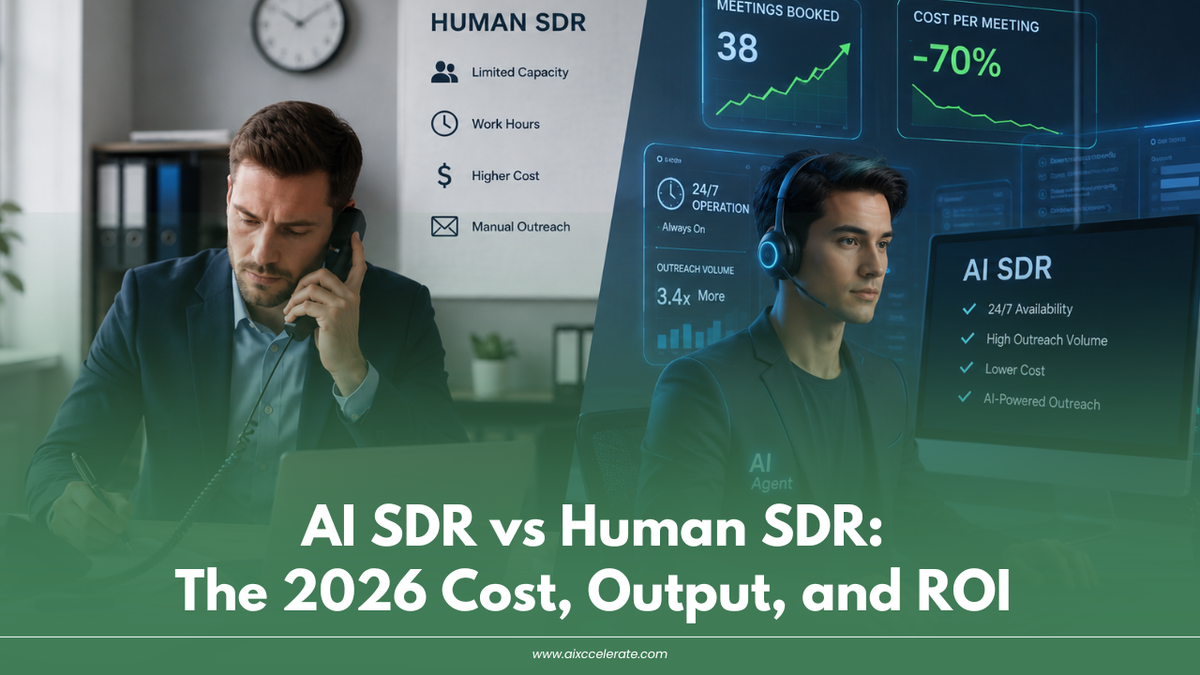
In 2026, a fully loaded human SDR in North America costs approximately $75,000 per year and books 8 to 12 qualified meetings per month. An AI SDR deployed through a managed workforce platform costs approximately $20,000 per year, books 25 to 40 qualified meetings per month, runs 24/7, and reaches break-even in roughly 4 months. AI now wins on cost and output for most SMB use cases. Humans retain the edge in complex, relationship-led, or net-new category sales.
This guide breaks down the full cost stack on both sides, the output benchmarks that matter, the ROI math worked end-to-end, and the situations where each option still wins. It is written for SMB CEOs, CROs, and CFOs who are deciding whether their next pipeline hire should be a human or an AI employee.
Why This Comparison Matters in 2026
For two decades, scaling pipeline meant scaling headcount. More meetings required more SDRs, which required more managers, which required more tools and more office space. Payroll became the dominant operating expense for revenue teams, and SDR cost per meeting only ever went up.
That coupling broke in 2025. Frontier AI models became cheap enough and reliable enough to run full SDR workflows end-to-end. AI SDRs are now deployed at production scale across thousands of SMBs, and the price of a meeting booked by an AI is 60 to 80 percent lower than the price of a meeting booked by a human. The question is no longer whether AI SDRs work. The question is which roles to keep human, which to replace, and how to model the math.
The Total Cost of a Human SDR in 2026
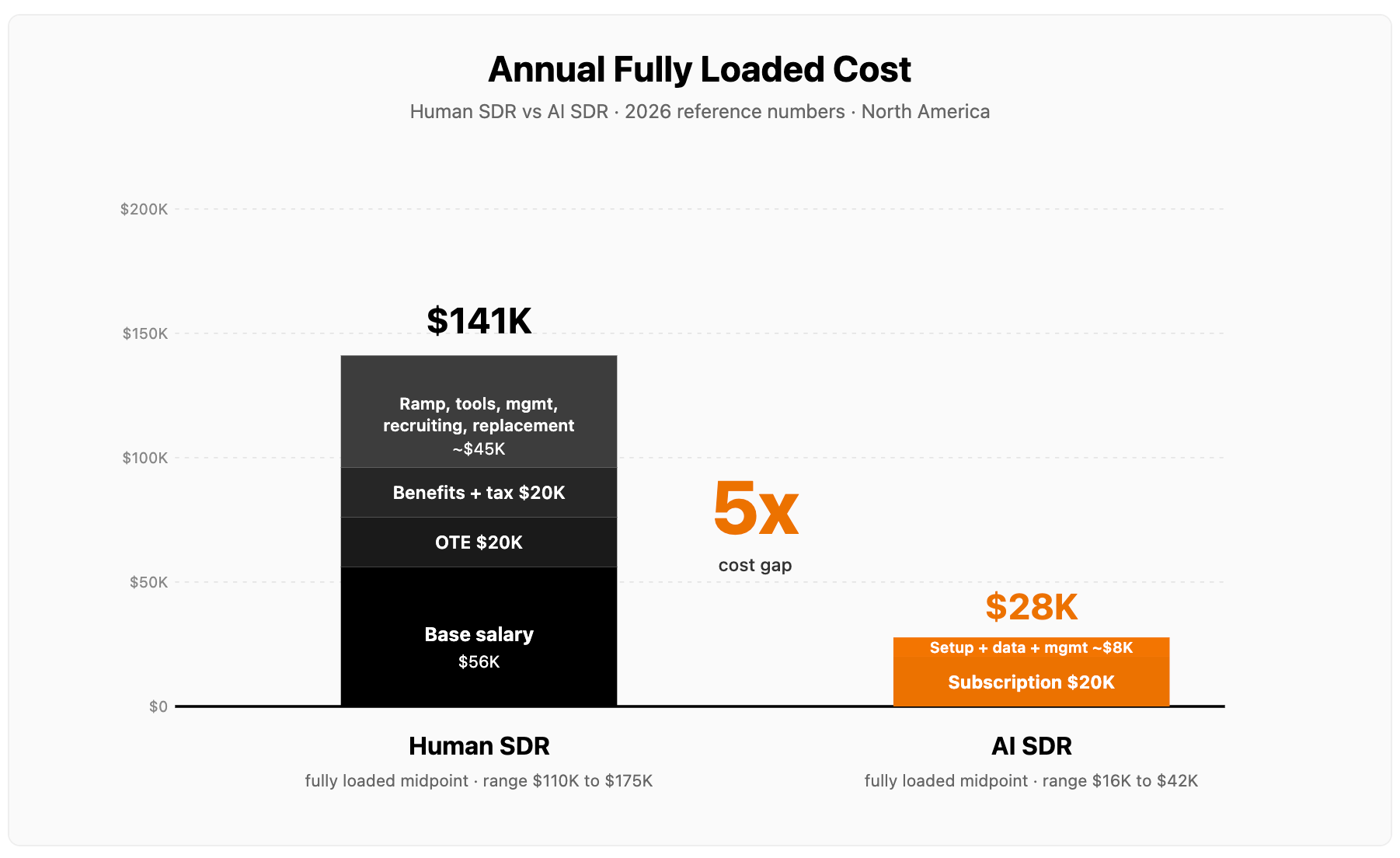
A salary number is not the cost of an SDR. The fully loaded cost of a North American SDR includes nine line items:
| Cost line | Annual range (USD) |
|---|---|
| Base salary | $45,000 to $60,000 |
| Variable compensation / OTE | $15,000 to $25,000 |
| Payroll taxes and benefits (25 to 30 percent load) | $16,000 to $24,000 |
| Sales tech stack per seat (Outreach, Apollo, ZoomInfo, LinkedIn Sales Nav, Gong) | $4,000 to $7,000 |
| Recruiting and onboarding (amortized) | $5,000 to $10,000 |
| Manager and RevOps time per rep | $5,000 to $10,000 |
| Office, equipment, software | $2,000 to $4,000 |
| Productivity loss during ramp (3 to 6 months) | $8,000 to $15,000 |
| Replacement cost (18-month average tenure) | $10,000 to $20,000 |
| Total fully loaded annual cost | $110,000 to $175,000 |
A common shorthand in SMB finance models is to use $75,000 as the "conservative fully loaded SDR cost." This number captures base, variable, and benefits cleanly. Once you add tooling, ramp loss, management time, and replacement amortization, the real number is closer to $100,000 to $130,000 for most US-based SDR teams in 2026.
The Total Cost of an AI SDR in 2026
The cost stack on the AI side is shorter and more predictable:
| Cost line | Annual range (USD) |
|---|---|
| Platform subscription ($1,000 to $2,500 per month) | $12,000 to $30,000 |
| One-time setup fee | $2,000 to $5,000 (amortized in Year 1) |
| Data enrichment (often bundled) | $0 to $2,000 |
| Internal management time (light) | $2,000 to $5,000 |
| Total fully loaded annual cost | $16,000 to $42,000 |
The reference midpoint across mature AI workforce platforms in 2026 is approximately $20,000 per AI SDR per year. There is no ramp loss, no replacement cost, no recruiting cost, and no benefits load. The setup fee is paid once. After the first year, ongoing cost drops to the subscription line only.
Side-by-Side Cost Comparison
| Cost dimension | Human SDR | AI SDR |
|---|---|---|
| Fully loaded annual cost | $110K to $175K | $16K to $42K |
| Conservative reference number | $75K | $20K |
| Setup or recruiting cost | $5K to $10K | $2K to $5K |
| Time to productive output | 3 to 6 months | 2 to 4 weeks |
| Average tenure | 14 to 18 months | Indefinite |
| Replacement cost on churn | $15K to $30K | $0 |
| Working hours | 40 per week | 168 per week |
| Sick days, PTO, holidays | 20 to 30 per year | 0 |
| Languages supported | 1 to 2 | 10 plus |
| Marginal cost to add capacity | Linear (full hire) | Modular (additional agent) |
The Output Comparison: What Each Actually Produces
Cost is half the equation. Output is the other half. The 2026 benchmarks below reflect production performance across managed AI SDR deployments and standard mid-market SDR teams.
| Output metric | Human SDR | AI SDR |
|---|---|---|
| Cold emails sent per day | 50 to 100 | 500 to 2,000 |
| Cold calls dialed per day | 30 to 60 | Available via voice agents (similar volume) |
| LinkedIn touches per day | 20 to 40 | 100 to 300 |
| Personalized sequences active simultaneously | 3 to 5 | 20 to 50 |
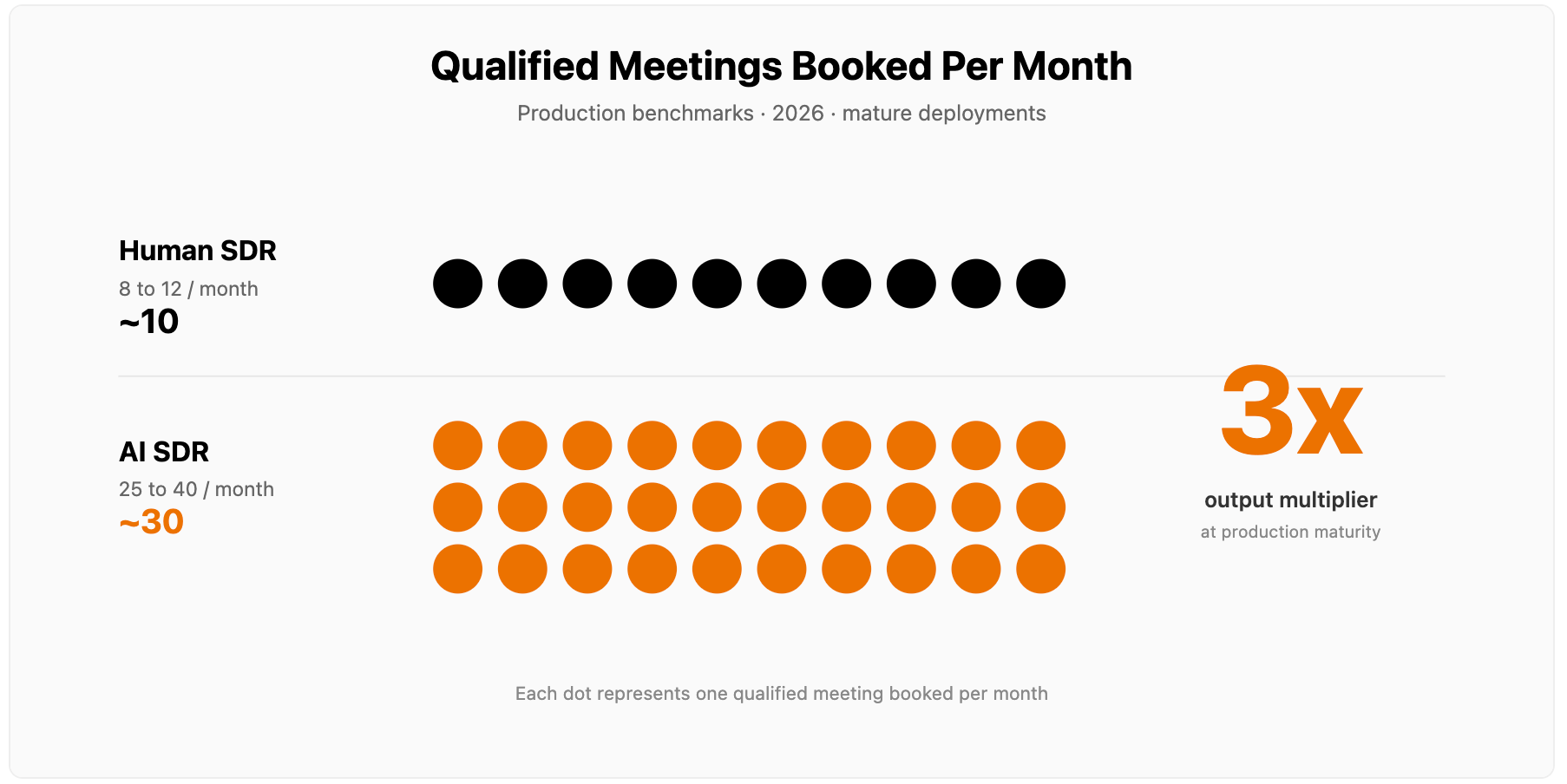
| Qualified meetings booked per month | 8 to 12 | 25 to 40 |
| Reply rate on cold email | 1 to 3 percent | 2 to 5 percent (with deep personalization) |
| Show rate on booked meetings | 60 to 70 percent | 60 to 70 percent |
| Hours worked per week | 40 | 168 |
| Languages handled in parallel | 1 to 2 | 10 plus |
| Time zone coverage | One primary | Global |
The output multiplier in mature AI SDR deployments is approximately 3x on meetings booked, with the gap widening as deployment matures because the AI continuously learns from response data.
The ROI Math, Worked End-to-End
Consider a representative scenario: a 50-person B2B SaaS company with 3 SDRs and a plan to hire 2 more to support a new outbound motion.
Option A: Hire 2 additional human SDRs
- Year 1 cost: 2 × $75,000 = $150,000 (or 2 × $115,000 = $230,000 fully loaded)
- Expected output: 2 × 10 meetings per month = 20 meetings per month = 240 meetings per year
- Time to full productivity: 3 to 6 months per rep
- Risk: average 18-month tenure means at least one of the two will likely turn over within the contract horizon
Option B: Deploy 2 AI SDRs
- Year 1 cost: 2 × $20,000 = $40,000
- Expected output: 2 × 30 meetings per month = 60 meetings per month = 720 meetings per year
- Time to full productivity: 2 to 4 weeks
- Risk: low, contracts are 12 months and agents can be reconfigured without HR overhead
The comparison
| Metric | Option A (2 humans) | Option B (2 AI SDRs) |
|---|---|---|
| Year 1 cost | $150,000 | $40,000 |
| Year 1 meetings booked | 240 | 720 |
| Cost per meeting | $625 | $56 |
| Net cost savings (A vs B) | reference | $110,000 |
| Net additional meetings | reference | 480 |
| Payback period (vs hiring) | n/a | Approximately 4 months |
| ROI multiple in Year 1 | 1.0x | 2.75x on cost, 3x on output |
The hybrid version (1 new human, 1 AI SDR) lands at $95,000 in cost for roughly 480 meetings per year, which still beats the all-human option by a wide margin while preserving a human for complex follow-up work.
When a Human SDR Still Wins
The case for AI is overwhelming for most SMB outbound use cases. It is not overwhelming for every case. A human SDR remains the better choice when:
- Average contract value sits above $250,000. Enterprise deals with multi-stakeholder buying committees still reward human rapport in early conversations.
- The product is a net-new category. Education-heavy sales where the buyer does not yet know they have the problem benefit from human framing.
- The buyer profile resists AI explicitly. Some legacy industries (parts of legal, parts of construction, parts of healthcare) still penalize AI-initiated outreach.
- The deal requires physical presence. Field sales, event-led pipeline, dinners, and on-site discovery sit outside the AI SDR remit.
- Compliance restrictions are heavy. Certain regulated environments (FINRA-supervised broker-dealers, some HIPAA contexts) still require human-attested outreach.
- The product is highly bespoke at the discovery stage. Custom engineering quotes, infrastructure deals, and complex integrations need a human who can think on a call.
In every other scenario, the AI SDR wins on cost, output, or both.
The Hybrid Model Most Winning Teams Are Landing On
The most common winning architecture in 2026 is not "all AI" or "all human." It is a layered revenue team:
- AI SDR (Jules-class agent) runs cold outbound. High volume, multi-channel, 24/7. Handles initial qualification.
- AI inbound handler (Pepper-class agent) catches every web form, chat, and after-hours call. Books qualified meetings directly to the human AE calendar.
- Human AE owns the closing conversation. Discovery, demo, negotiation, and signature.
- AI sales engineer (Tony-class agent) supports the AE. Technical questions, demo scheduling, follow-up content.
- AI coordinator (Joy-class agent) runs deal ops. Scheduling, contract movement, CRM hygiene.
- AI customer success agent (George-class agent) owns retention. Health checks, renewals, expansion triggers.
This is the org chart of an AI-native SMB revenue team. One human AE supported by five named AI employees produces the output of a 6-to-8-person human revenue team at roughly one-third the cost.
AI SDR Vendors to Consider in 2026
The AI SDR category has consolidated around a handful of viable platforms:
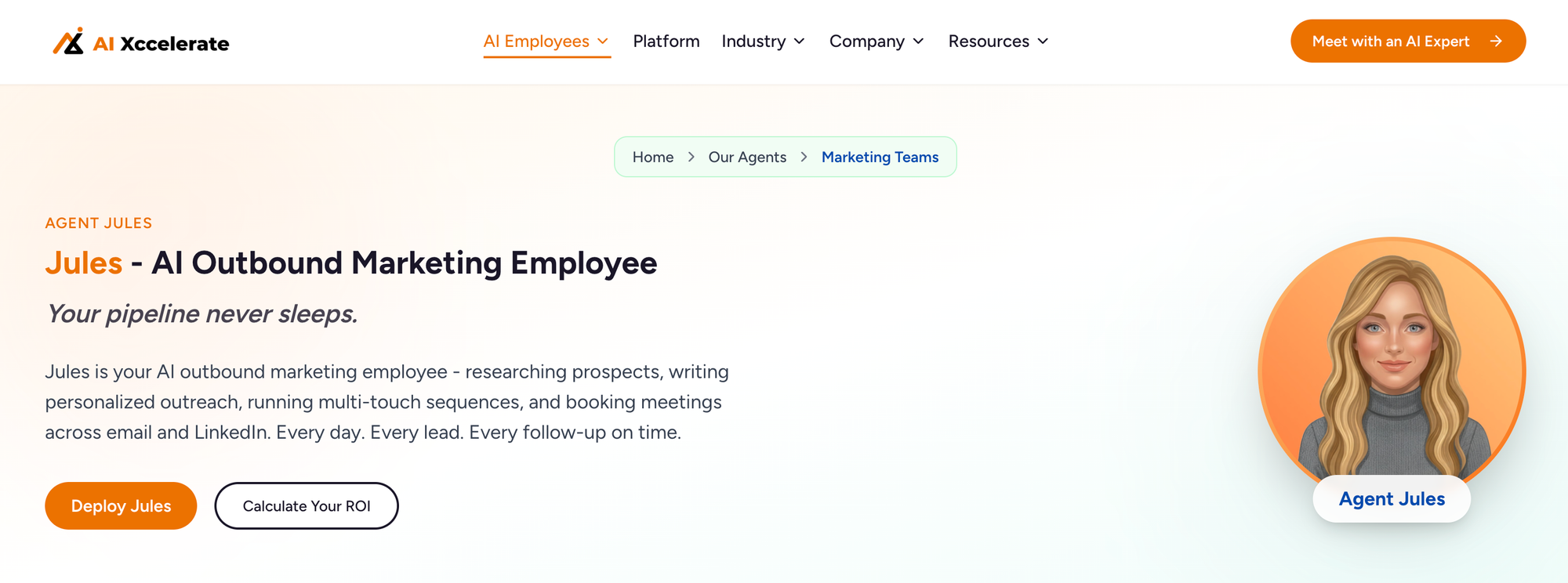
- AI Xccelerate (Jules) runs as the outbound layer of a full multi-agent Revenue Acceleration Engine. Built for SMBs with 10 to 250 employees. Annual contracts, managed deployment, multi-agent orchestration.
- 11x.ai (Alice) is a single-role AI SDR product focused on mid-market enterprise outbound.
- Artisan AI (Ava) is a single-role AI SDR with deep prospecting workflows.
- Regie.ai offers an AI SDR plus content automation, more of a content-first approach.
- Bosh.ai focuses on AI voice and conversational SDR work.
- Salesforge (Agent Frank) offers AI SDR functionality with high-volume cold email infrastructure.
- Outreach.io and Apollo.io have added AI features inside their existing sequencer products. These are tools with AI features, not full AI SDRs.
The decision between a single-role AI SDR and a full AI workforce platform depends on whether you also need inbound, sales engineering, coordination, customer success, and content. Teams that buy only an AI SDR usually return within 6 to 12 months to buy the adjacent roles. Buying the workforce platform up front avoids the second procurement cycle.
How to Make the Switch
If you are deciding between hiring an SDR and deploying an AI SDR right now, here is the 30-day path:
- Define the role precisely. Same job description you would write for a human hire: ICP, target persona, messaging, channels, success metrics.
- Audit your CRM and data. An AI SDR is only as good as the data it operates on. Clean lead lists, populated firmographics, and a defined ICP are prerequisites.
- Pick a deployment mode. Replace an open requisition, augment an existing rep, or add capacity you could not previously afford.
- Run a 60-day pilot. Benchmark against the cost and output of the equivalent human hire. Mature platforms can show output inside 30 days.
- Decide expansion path. Most teams add a Pepper-class inbound handler within 90 days, then a Joy-class coordinator within 180 days.
Frequently Asked Questions
Is an AI SDR cheaper than a human SDR?
Yes. An AI SDR costs approximately $20,000 per year fully loaded. A human SDR costs approximately $75,000 conservatively and $110,000 to $175,000 fully loaded. The AI is roughly 1/4 to 1/8 the cost.
Can an AI SDR actually book meetings?
Yes. Production AI SDR deployments in 2026 typically book 25 to 40 qualified meetings per month, compared to 8 to 12 for a human SDR. Reply rates are similar or slightly higher with deep personalization.
How does an AI SDR compare on reply rates?
Cold email reply rates for AI SDRs in 2026 average 2 to 5 percent in well-targeted campaigns, versus 1 to 3 percent for human SDRs. The advantage comes from per-prospect personalization that humans cannot match at scale.
Will my prospects know they are talking to AI?
Often not on the first touch, but mature platforms disclose AI status when asked and follow regional regulations. Buyers increasingly do not care if the output is useful, on-topic, and respectful.
What happens when the AI gets something wrong?
Mature platforms include guardrails, output review, and rollback. Error rates in production AI SDR deployments are typically below 2 percent, with manager review queues for edge cases. Hallucination is the wrong frame for outbound SDR work because the agent operates on structured prospect data, not open-ended generation.
Do I still need a human SDR if I use an AI SDR?
It depends on deal complexity. For SMB-to-SMB outbound under $50,000 ACV, you usually do not. For enterprise deals over $250,000 ACV, you usually still want a human SDR or AE running discovery.
How long does an AI SDR take to deploy?
Two to four weeks for mature platforms in 2026. Custom or single-vendor deployments can take six weeks. Multi-agent rollouts are typically phased over 60 to 90 days.
Can AI SDRs handle multi-touch sequences?
Yes. AI SDRs run multi-channel sequences (email, LinkedIn, voice) with per-prospect personalization across each touch. They handle reply detection, branching logic, and meeting booking natively.
Will an AI SDR replace my entire sales team?
No. AI SDRs replace the SDR function. Account executives, sales engineers running complex demos, and senior reps closing high-ACV deals remain human in 2026. The org chart is hybrid, not "all AI."
What is the ROI of an AI SDR vs hiring?
For a typical SMB, 2 AI SDRs in place of 2 human SDR hires saves approximately $110,000 in Year 1 and produces approximately 3x the meetings. Payback typically lands inside 4 months. ROI multiple is roughly 2.75x on cost and 3x on output.
How does my CRM data affect AI SDR performance?
Significantly. AI SDRs operate on structured data. If your CRM is missing firmographics, has duplicate accounts, or lacks ICP fit scoring, the AI's performance will be capped. A 30-minute data audit before deployment is worth the time.
Are AI SDRs allowed under spam and email compliance rules?
Yes, when configured correctly. AI SDRs follow the same CAN-SPAM, GDPR, and CASL rules as human-sent email. Mature platforms include unsubscribe handling, suppression lists, and bounce management by default.
What is the best AI SDR for SMBs in 2026?
For SMBs in the 10 to 250 employee range that want outbound plus the adjacent roles (inbound, SE, coordination, CS, content), AI Xccelerate's Jules is built for that profile and ships as part of a multi-agent platform. For single-role outbound only, 11x.ai and Artisan AI are credible alternatives.
Do AI SDRs work for outbound only, or also inbound?
Outbound is the SDR remit. Inbound is handled by a separate AI inbound handler (Pepper-class agent). Most teams deploy both together because inbound leads convert at 5 to 10x the rate of outbound.
What roles should I keep human after deploying an AI SDR?
Keep humans on closing AEs, sales engineers handling complex technical sales, sales leadership, customer-facing executives for top accounts, and any role that requires physical presence or judgment-heavy negotiation.
Further Reading
- The 6-Agent AI Revenue Team Built for SMBs
- How AI SDRs Help SMBs Scale Sales Faster
- AI SDR Mistakes That Cost SMBs Dearly
- Jules 1.0 to 2.0: Your AI SDR Grew Up
- Headcount Is a Liability. AI Workforce Is an Asset.
Replace a Hire With an AI SDR This Quarter
AI Xccelerate's Jules deploys as a managed AI SDR inside your existing revenue stack. One agent in production in under two weeks. Annual contracts. Predictable cost. Pipeline you can measure on the first invoice.