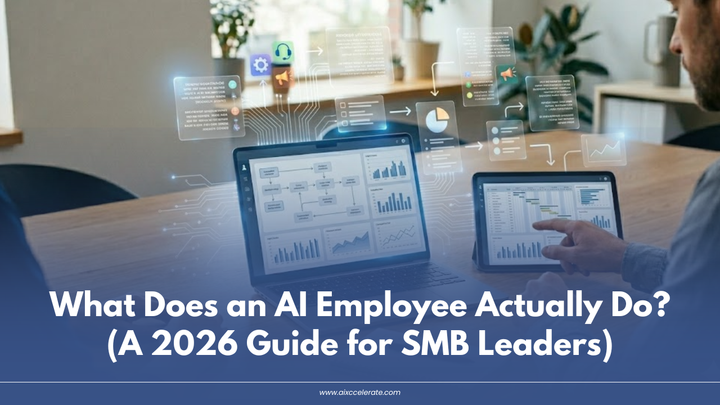
What Does an AI Employee Actually Do? (A 2026 Guide for SMB Leaders) An AI employee owns a job function end-to-end: outbound, inbound, sales ops, CS. It executes autonomously across your existing tools, 24/7.
7 Major AI Challenges Businesses Must Overcome in 2026 Artificial intelligence is revolutionizing the business world at a pace few could have imagined even a few years ago. From automating routine tasks to uncovering new growth opportunities, AI’s potential seems limitless. Yet for every success story, there are organizations struggling with complex ...
AI and Jobs in 2026: The New AI Roles Your SMB Can’t Postpone Anymore In 2026, AI isn’t just a tool—it’s your SMB’s execution layer, powered by new roles like Prompt Writer, AI Operator, and AI Workflow Architect that turn automation directly into revenue growth.
AI Workflow Redesign Builds Agentic Loops That Crush Legacy Processes Simply adding AI to old workflows fails. This blog shows how AI workflow redesign and agentic loops turn clunky, human-led processes into fast, self-optimizing systems for SMBs.
How SMBs Are Replacing SOPs With AI Revenue Employees SMBs are ditching static SOPs for autonomous AI revenue employees that own execution end-to-end, so lean teams can scale marketing, sales, and support without adding headcount or bloated tools.
The Architecture Gap Separating AI Experiments From AI-Native SMB Most SMBs can get an AI pilot live — but few can scale beyond fragile, custom deployments. This blog shows why the real unlock is architecture, and how AI-native platforms become a lasting moat.
Why SMBs That Don't Deploy AI Employees Will Lose the Next Decade of Business AI employees are breaking the old rule that more revenue needs more headcount. SMBs that deploy a managed AI workforce now will scale output, protect margins, and outcompete slower, human-only teams.