
Google, OpenAI, and Anthropic Are Changing Enterprise AI Forever
Frontier AI, voice agents, and enterprise AI workforces are replacing tools as Fortune 500 companies race to scale AI adoption.
IN THIS ISSUE
- Claude Mythos goes private to six mega-buyers.
- OpenAI + Microsoft solve the AI voice layer.
- Google ships an AI agent embedded into Gemini to 900M people.
- Deep Dive: Three reports, one verdict the AI reckoning is here.
- ServiceNow, the Pentagon, and CAISI all moved on AI the same week.
- AI Xccelerate's Named AI Employees: the architecture for what comes next.
01 · FRONTIER ACCESS
Anthropic's Claude Mythos goes private to SIX mega-buyers.

This week, Anthropic confirmed Project Glasswing a private-preview program that hands its unreleased frontier model, internally referred to as Claude Mythos, to six hand-picked organizations: AWS, Apple, Cisco, Google, JPMorgan Chase, and Microsoft. At the same time, a $30B raise at a valuation north of $900B is under negotiation as of May 18, on the back of Q1 2026 ARR already over $44B.
The sequencing is the story. Until this cycle, frontier models followed a predictable arc: research preview → public API → enterprise adoption. Glasswing inverts it. The largest buyers on earth are now first-in-line, the public hears about it second, and competing enterprises have to catch up to a model they have never touched.
For SMB revenue leaders, the practical translation is sharp: the cost of not being a strategic buyer at one of the labs is rising. You will not be in the Glasswing six. You can, however, decide today which workflow you would put on the next frontier model the moment it lands and start preparing the eval data, the playbook, and the integration architecture now, so you are deploying in week one of general availability instead of evaluating in month three.
"The frontier just picked its customers. Everyone else gets to catch up."
➡️ Your Move This Week:
Pick one revenue workflow where a smarter model would meaningfully change the output outbound personalization, deal qualification, or RFP response. Capture a week of real inputs and outcomes into a clean eval set. The next frontier release is weeks, not quarters, away. The companies with eval data ready will deploy in days. The ones still scoping will lose the quarter.
02 · MODEL & PRODUCT
OpenAI and Microsoft Just Shipped the AI Voice Stack
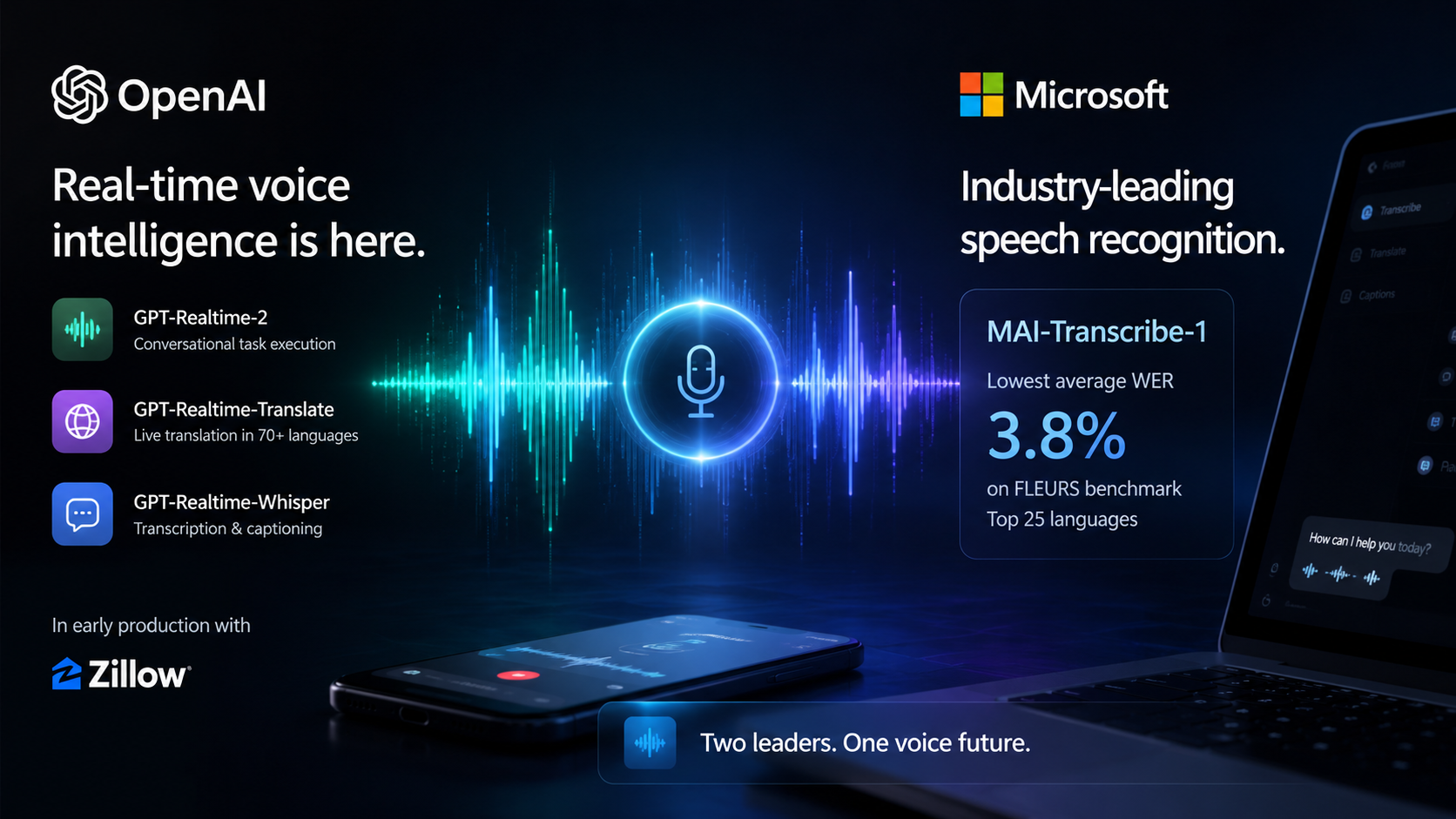
OpenAI introduced three new real-time audio models in May: GPT-Realtime-2 for conversational task execution, GPT-Realtime-Translate for live multilingual translation across 70+ languages, and GPT-Realtime-Whisper for transcription and captioning. Early production partners include Zillow. The same week, Microsoft launched MAI-Transcribe-1 a speech-to-text model with the lowest average Word Error Rate on the FLEURS benchmark (3.8%) across the top 25 languages by Microsoft product usage, beating OpenAI's Whisper-large-v3 on every one.
Two labs, two layers of the same stack, in the same window. The voice quality gap that justified "a human still has to take the call" closed. Multilingual is no longer the premium tier it is the default tier. Real-time is no longer an engineering project it is an API call.
If you run a B2B revenue function and have not run a single voice workflow on the new stack by end of May, you are ceding the lowest-friction productivity gain available in the market right now.
"Inbound is no longer a hiring problem. It is a deployment decision and the deployment cost just dropped again."
➡️ Your Move This Week:
Pick the single highest-volume voice touchpoint in your funnel — inbound qualification, post-demo callback, or appointment confirmation. Pull one week of recorded calls. Run them through GPT-Realtime-2 or MAI-Transcribe-1 against your CRM and measure two numbers: minutes of human labor saved, and prospects captured outside business hours. That is your inbound business case, written by your own data.
03 · AGENT AT SCALE
Google Launched A Built-in AI Agent in Gemini
Google I/O 2026 dropped May 19th. In a two-hour keynote that covered everything from AI-powered smart glasses to a new operating system that merges Android and Chrome, one message ran through all of it: the model era is over. The agent era has started.
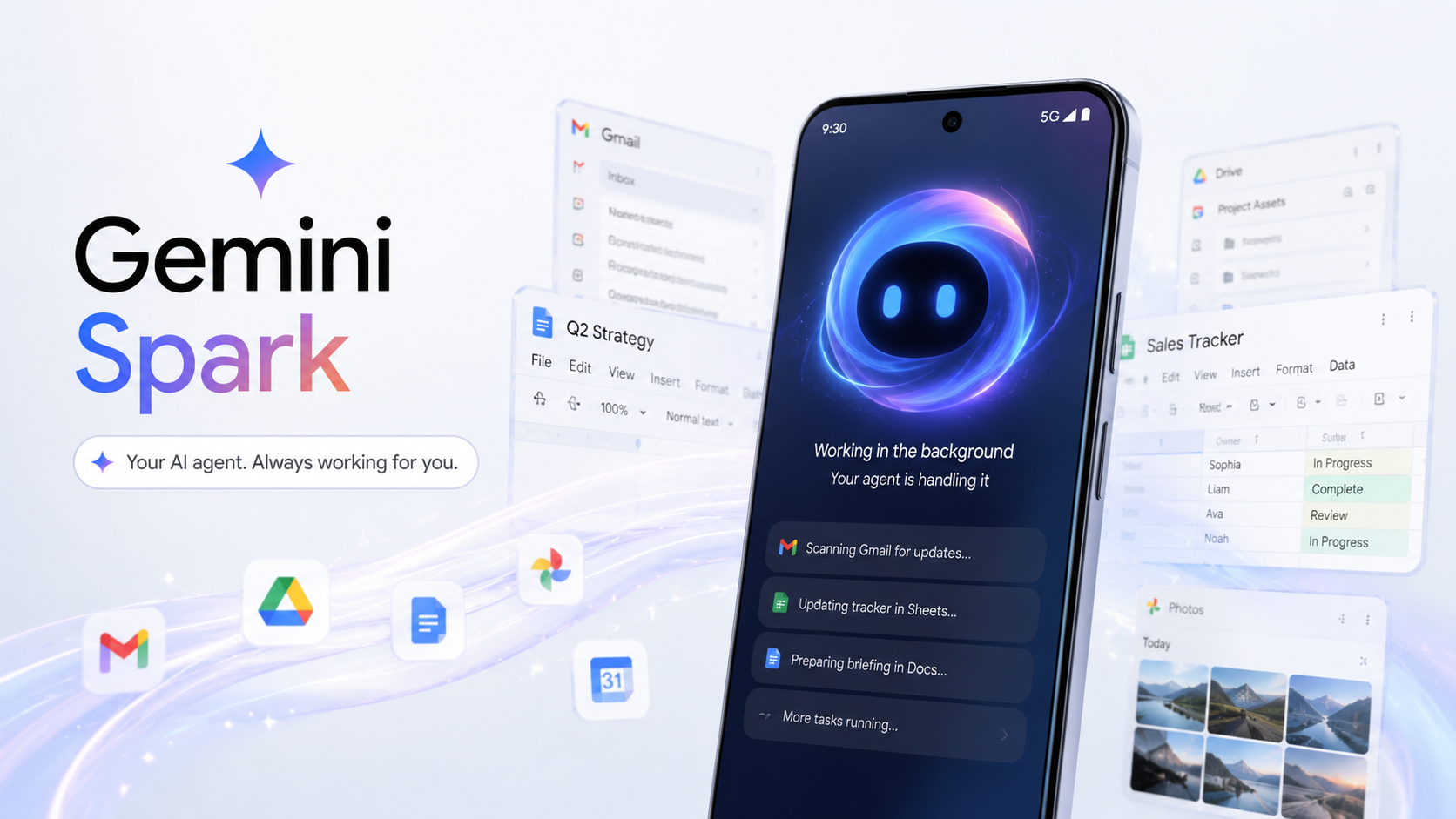
The headline model was Gemini 3.5 Flash — rebuilt for agentic execution. But the real announcement was Gemini Spark: a new AI agent built directly into the Gemini app that stays active in the background and handles tasks on behalf of users — even when your device is inactive. Google didn't ship a better chatbot. They shipped a digital employee. And they shipped it to 900 million people.
What Gemini Spark Actually Is?
Most AI tools respond when asked. Spark operates behind the scenes, anticipating needs and acting without requiring constant input — the difference between asking a friend for directions and handing them your keys and letting them drive you there.
Under the hood, Spark is built from Gemini's base models and an agentic harness from Google Antigravity — Google's internal team dedicated to autonomous AI systems. It runs 24/7. It connects across your entire Google ecosystem. Via an opt-in menu, Spark can access data across Gmail, Docs, Photos, and Drive — and Deep Research features pull from all of them simultaneously.
Spark is currently in beta and rolling out first to Google AI Ultra subscribers starting next week.
Gemini Spark maps directly onto the biggest friction points in B2B revenue workflows by monitoring inboxes, reasoning across apps, executing tasks in the background, generating proactive daily briefs, and operating natively inside Workspace tools teams already use. The result is faster response times, less tab-switching, better rep preparation, and AI-driven execution embedded directly into the flow of work.
"Google didn't ship a better chatbot. They shipped a digital employee. And they shipped it to 900 million people."
➡️ Your Move This Week:
Pick the one rep on your team closest to drowning in inbox + tab-switching overhead. The moment Spark beta opens to AI Ultra subscribers, have them run a one-week test: every morning, ask Spark for a Daily Brief on their top 10 accounts; every afternoon, have it draft three follow-ups based on the day's email signals. Compare pipeline output to the prior week. If Spark recovers even four hours of selling time, it has paid for itself before the seven-day mark. The cost of testing is the Ultra subscription. The cost of not testing is your competitor moving first.
04 · DEEP DIVE
The AI Adoption Boom Just Ran Into an ROI Reckoning
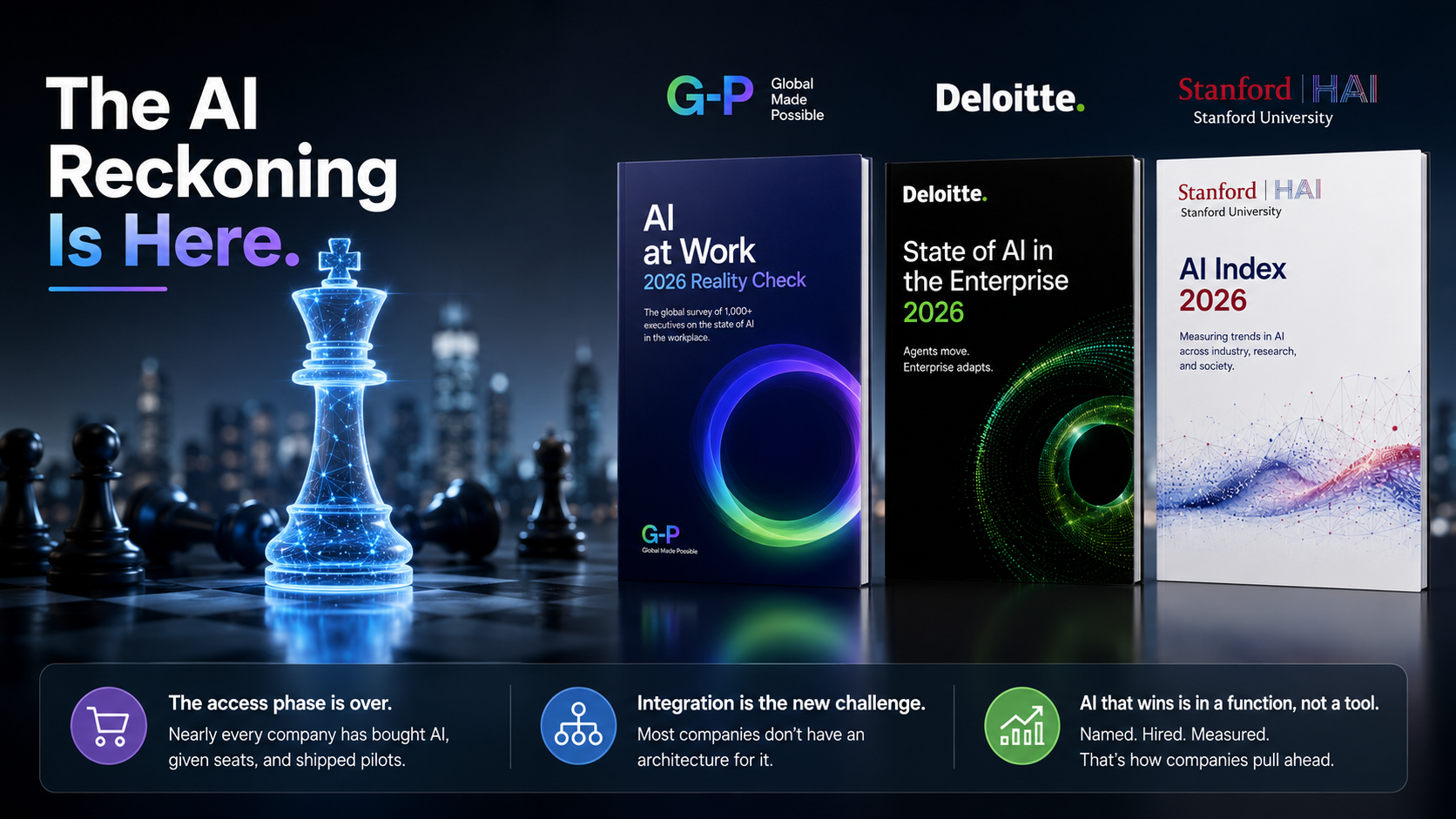
On May 12, 2026, G-P released its AI at Work 2026 Reality Check and called the moment by its name: an AI reckoning. 73% of executives report that at least some of their AI investments fell short of expectations over the past 12 months. Nearly 70% are prepared to scale back AI budgets if 2026 goals aren't met. This is the first wave of data hitting the desk exactly when Q2 reviews start.
Deloitte's State of AI in the Enterprise 2026 confirmed G-P wasn't an outlier. 97% of executives say their company deployed an AI agent in the past year. 52% of employees actively use them. But 79% face adoption challenges, a double-digit jump from 2025, and 54% of C-suite leaders said AI adoption is "tearing the company apart." Only 20% of organizations are currently growing revenue from AI, against 74% who hoped to.
Stanford's AI Index 2026 closed the triangle. 88% of organizations now use AI in at least one business function. Fewer than 10% have fully scaled AI in any single function. Where the productivity gains do show up, they are concentrated and striking: 14–15% in customer support, 26% in software development, 50% in marketing output, exactly where AI owns a function end-to-end, rather than sitting beside a human as a copilot.
"73% of executives report AI investments fell short of expectations. Nearly 70% are prepared to scale back if 2026 goals aren't met." — G-P, AI at Work 2026 Reality Check, May 12
The access phase is over. Nearly every company has bought AI, given seats to employees, and shipped pilots. The integration phase has started — and most companies don't have an architecture for it. The companies pulling ahead are the ones whose AI lives inside a function with a name, a job description, and a number on a scorecard. The companies falling behind are the ones still treating AI as a tool category, not a hiring category.
➡️ Your Move This Week:
Thirty-minute audit. List every AI tool your team pays for. Next to each, fill in two columns:
(a) which named person on your team owns the outcome it produces, and
(b) which KPI it moves on the scorecard.
Any row where you can't fill in both columns is a budget line that will not survive your next quarterly review — and exactly the row to convert into a named, accountable AI employee. The reports just made that conversation inevitable. The audit gets you ready for it.
05 · SIGNAL WATCH
ServiceNow, the Pentagon, and CAISI All Adopted AI in the Same Week.
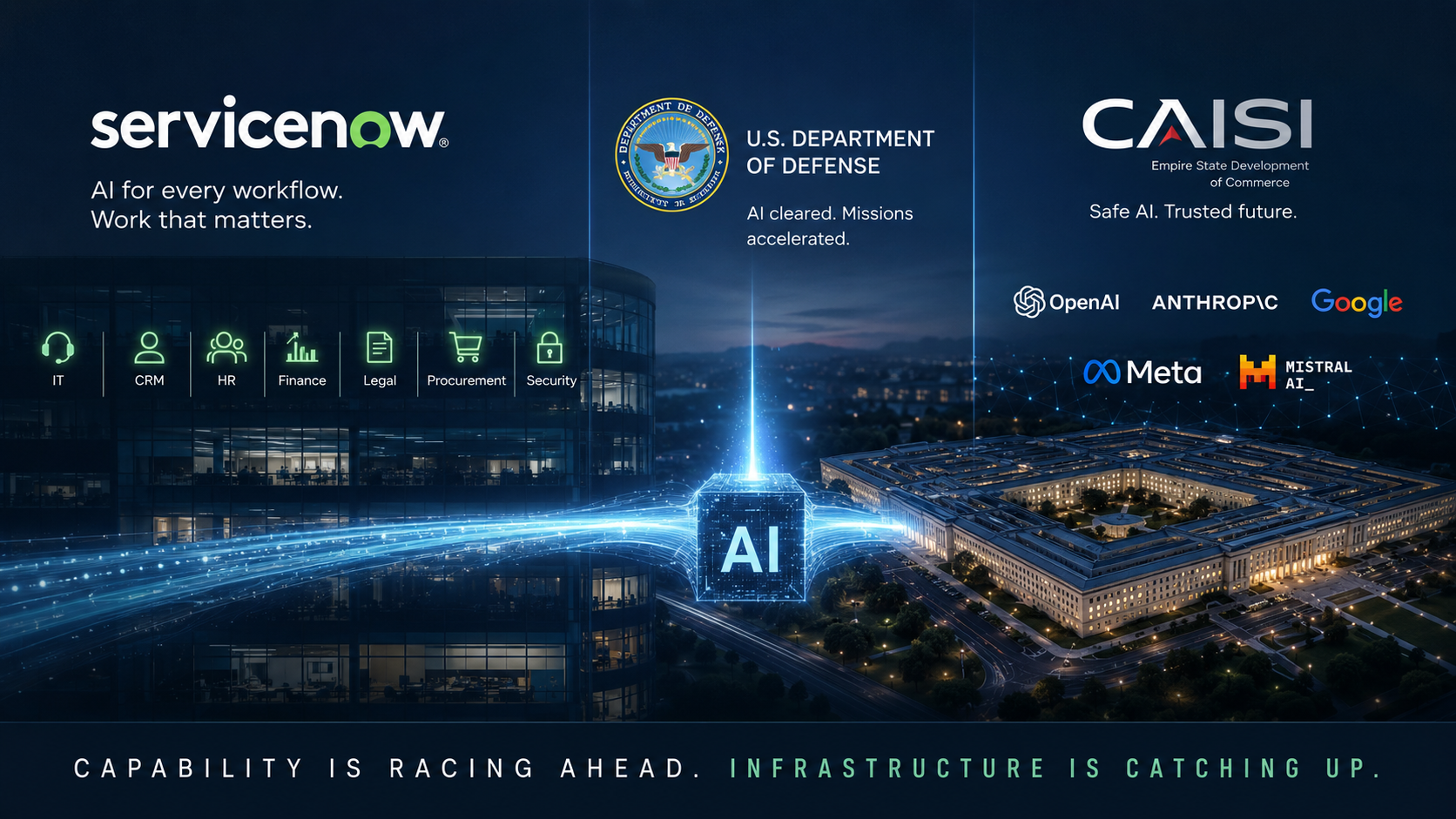
At Knowledge 2026, ServiceNow expanded its Autonomous Workforce to span IT operations, CRM, HR, finance, legal, procurement, and security — a suite of AI specialists designed to complete entire business processes start-to-finish, not assist a human through them. The Pentagon cleared eight tech firms to deploy AI on its classified networks. The US Commerce Department's CAISI finalized pre-deployment evaluation agreements with all five major frontier labs — every major model now goes through government evaluation before public launch.
The pattern is the same one the three reports just exposed at the buyer level, mirrored at the infrastructure level: capability is racing ahead, governance and deployment scaffolding is sprinting to catch up. The companies winning this year are not just buying models — they are buying into platforms that come with the safety, the integration, and the operational layer pre-wired.
➡️ Your Move This Week:
Ask your AI vendors one question this week: "What does your pre-deployment evaluation look like, and who governs the agents after they go live?" Vendors who can answer that crisply are the ones who will still be in your stack in 2027. Vendors who can't are the line items that will get cut in the next review cycle.
06 · AI XCCELERATE · NAMED AI EMPLOYEES
The Reports Just Described the Problem. Named AI Employees Are the Architecture for the Answer.
The Stanford finding verifies that productivity gains comes from AI that owns a workflow end-to-end. 14–15% in customer support. 26% in software development. 50% in marketing output. The pattern is consistent. The lifts show up where AI is the operator, not the assistant.
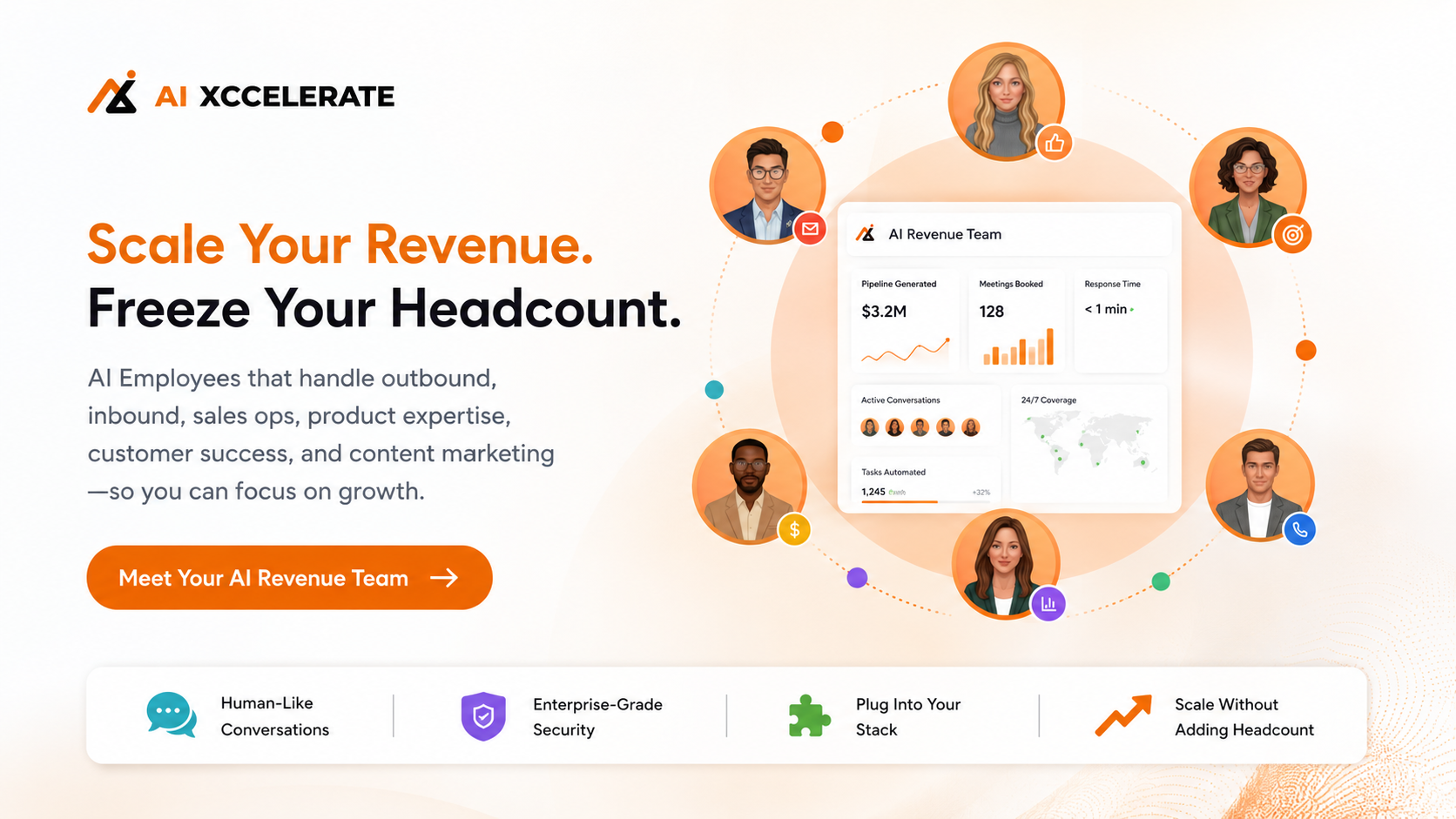
That is exactly what AI Xccelerate's named AI Revenue Employee are built for. Jules for outbound. Pepper for inbound. Tony for sales engineering. Joy for sales coordination. George for customer success. Nick for content marketing. Each one is accountable. Each one has a number on the scorecard. Each one is the system of record for its function. None of them are seats your team has to remember to log into.
"79% struggling. 73% disappointed. <10% fully scaled. That is not an AI problem — it is a workforce design problem."
If your AI line items are about to face the same scrutiny G-P and Deloitte just documented, the Pipeline Diagnostic is how you walk into that review with an architecture, not an apology. Thirty minutes, your numbers on the table. Our team maps which functions in your revenue motion are best suited to a named AI employee first, and what the ROI looks like before you commit to anything.