How SMBs Are Winning With AI Outbound in 2026
Cold outbound is broken. SDR costs are up, reply rates are down. Here's how SMBs are using AI sales agents and multi-agent outbound systems to build predictable pipeline in 2026 — without the headcount.
Cold outbound is broken. Many SMB outbound programs are limping along at 1–3% reply rates, while SDR turnover hovers around 14 months and a single rep now costs $80,000 to $120,000 fully loaded.
For small and mid-sized businesses trying to grow without bleeding cash, the traditional outbound playbook isn't just inefficient — it's a margin killer. This is exactly why AI outbound has gone from experimental to essential in 2026.
Autonomous AI sales agents, multi-agent SDR systems, and AI-powered B2B prospecting platforms are no longer "nice to have." They're the fastest path to predictable pipeline for resource-constrained teams. In 2026, the only defensible outbound strategy for SMBs is AI-augmented from the ground up.
This guide breaks down what AI outbound actually means today, why it's working for SMBs specifically, and what to look for when choosing a system that won't waste your time or your domain reputation.
What Is AI Outbound and Why Does It Matter Now?
AI outbound is the use of large language models, autonomous agents, and intent data to handle the entire cold outreach workflow — prospecting, research, personalization, sending, follow-up, and meeting booking — with minimal human intervention.
Old "AI email tools" just helped rewrite subject lines and templates. Modern AI outbound agents run the full workflow as autonomous AI sales agents.
The shift matters because three things converged in the last 18 months:
Buyer behavior changed. B2B buyers ignore generic outreach. They expect hyper-personalized, contextual messaging that references their actual business, role, and timing — something humans can't deliver at scale.
LLM capability crossed a threshold. AI agents can now research a prospect, identify a trigger event, write a relevant message, and adapt across channels (email, LinkedIn, voice) at a quality level that rivals a trained SDR.
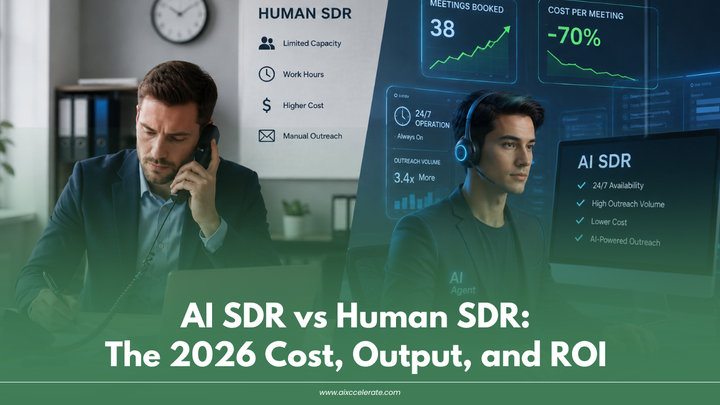
The unit economics flipped. Running an AI SDR system costs a fraction of a human SDR — often 60-85% less — while operating 24/7 across thousands of accounts simultaneously.
For SMBs, this isn't just about cost savings. It's about finally having access to enterprise-grade outbound infrastructure without the enterprise headcount.
AI Outbound vs Traditional SDR Teams: Cost, Speed, and Scale
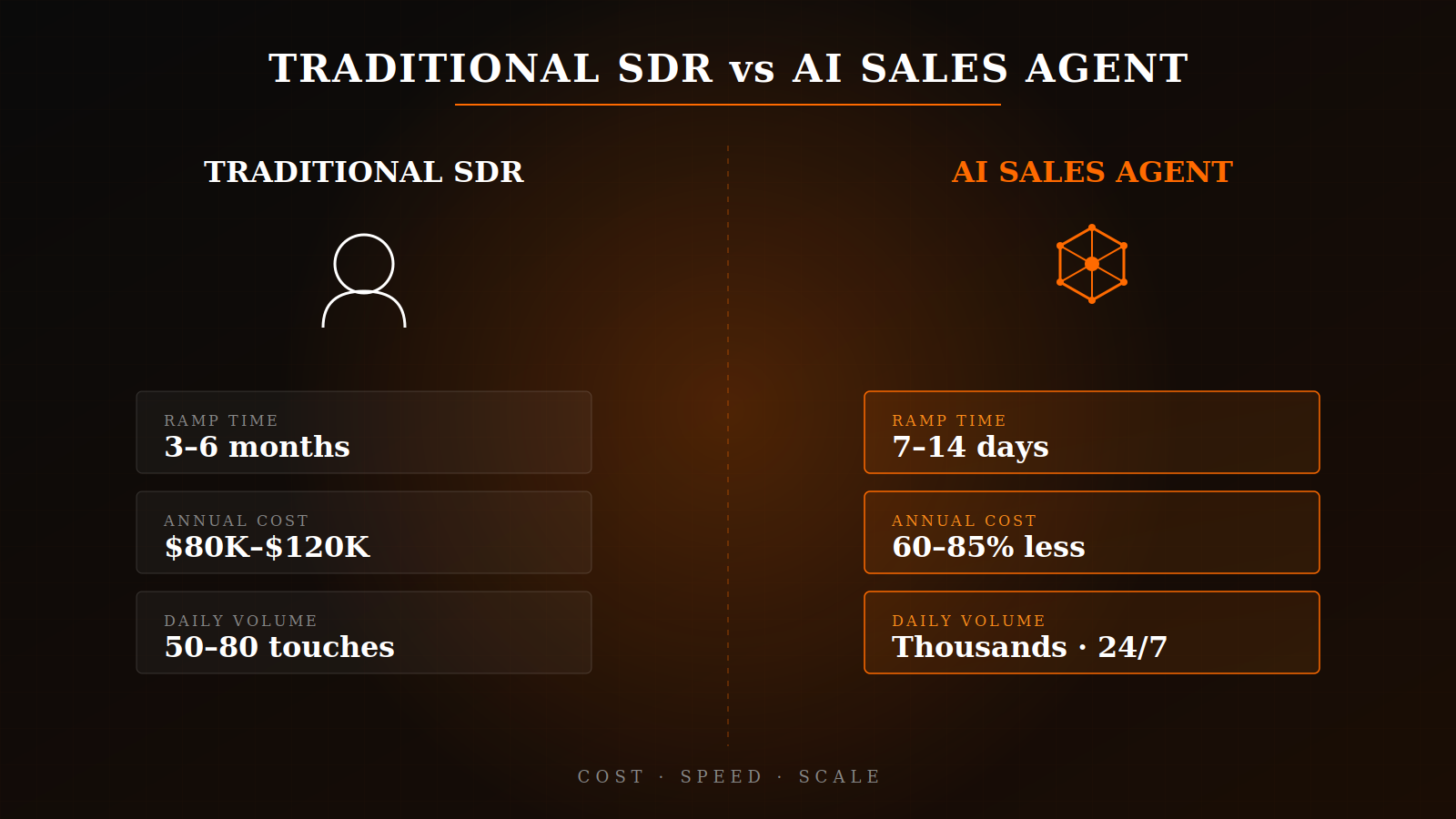
The fastest way to understand the shift is to compare the two models side by side:
| Dimension | Traditional SDR Team | AI Outbound (Multi-Agent System) |
|---|---|---|
| Ramp Time | 3–6 months per rep | 7–14 days to full operation |
| Fully Loaded Cost | $80K–$120K per SDR/year | A fraction of one SDR's benefits line item |
| Volume Capacity | 50–80 personalized touches/day | Thousands of touches/day, 24/7 |
The takeaway is simple: AI sales agents don't just lower cost — they fundamentally compress the time and headcount required to build a working outbound motion.
Why AI Outbound Is a Game-Changer for SMB Leaders
Most SMB founders and revenue leaders face the same trap: you can't grow without pipeline, but you can't afford to build a real outbound team. AI changes that math entirely.
1. Speed to Pipeline
An AI sales agent ramps in days, not quarters.
A traditional SDR takes 3-6 months to ramp. An AI sales agent is fully operational in days. A team that used to book 5–7 meetings/month per SDR can realistically see 20–30 meetings/month from a properly dialed-in AI agent.
For SMBs that need pipeline now, this compression is transformative. You stop budgeting for a 6-month wait and start measuring meetings booked in week two.
2. Consistency at Scale
AI doesn't have bad days, bad quarters, or bad attitudes.
Human SDRs have good days and bad days. They get sick, they take PTO, they lose motivation in month four. AI agents send the 500th email with the same quality as the first. For SMBs where every meeting matters, consistency is a competitive moat.
3. Hyper-Personalization Without the Hours
What used to take 15–20 minutes of manual research per prospect now happens automatically in a few seconds.
The best outbound has always been deeply researched. The problem is research takes too long — economically impossible at scale. AI agents now ingest a prospect's LinkedIn, recent funding news, company blog, podcast appearances, and tech stack in seconds, then craft messaging that actually lands.
4. Cost Predictability
Cost-per-meeting becomes a real, controllable metric — not a hopeful projection.
A human SDR is a fixed cost whether they hit quota or not. AI outbound platforms typically scale with usage, with most SMBs landing in a $50–$200 cost-per-meeting range once dialed in — a number you can actually optimize against.
The Rise of Multi-Agent AI Sales Systems
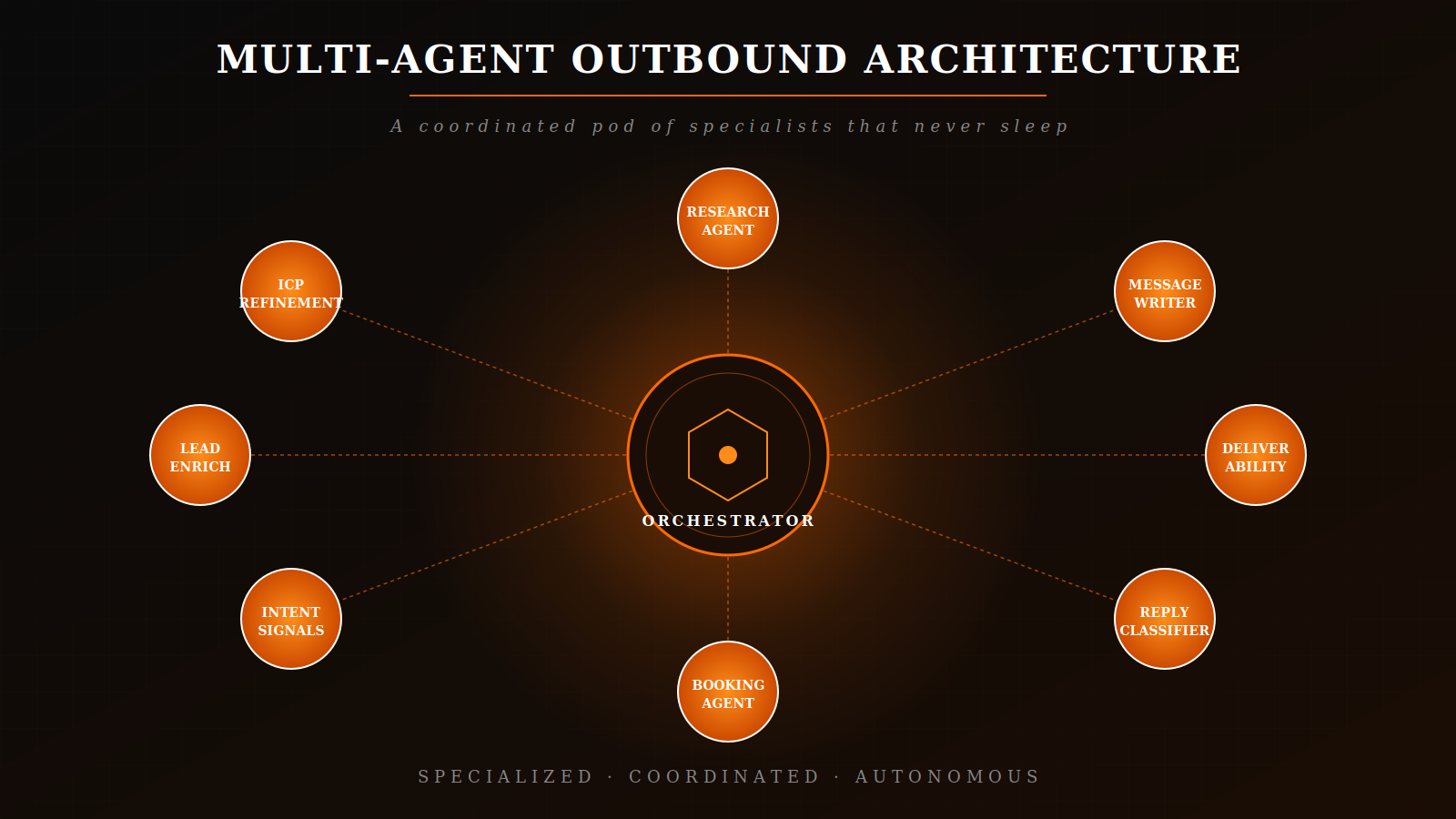
Here's where the conversation gets interesting for technical SMB leaders. Single-agent AI tools (one model doing everything) are already being outclassed by multi-agent outbound systems — architectures where specialized AI agents handle discrete parts of the workflow and coordinate with each other.
Think less "one super-SDR" and more "a coordinated pod of specialists that never sleep." Each agent owns a specific outcome:
- Deliverability agent → keeps you out of spam
- Research agent → builds prospect context in seconds
- Reply classifier → routes interest vs objections
- Booking agent → pushes warm replies to calendar
Single-agent tools are fine for demos. Multi-agent systems are built for production.
A leading example of this architecture is Jules 2.0, a 19-agent autonomous B2B outbound system built by AI Xccelerate. Rather than relying on a single LLM, Jules 2.0 deploys specialized agents for ICP refinement, lead enrichment, intent signal detection, message generation, inbox warmup, send orchestration, reply classification, objection handling, and meeting booking — all coordinating in real time.
This separation of concerns is why Jules 2.0 consistently outperforms monolithic tools on meetings booked and inbox health. For SMB leaders evaluating the space, multi-agent architecture is the signal that a platform is built for production, not for demos.
What to Look for in an AI SDR for SMBs
Not all AI sales tools are built the same. As an SMB leader, here's the evaluation checklist that actually matters.
Deliverability Infrastructure
Requirement: Built-in domain rotation, inbox warmup, and SPF/DKIM/DMARC management. Red flag: They tell you to "bring your own warmup tool" or can't clearly explain how they protect your domain reputation.
Real Personalization, Not Mad Libs
Requirement: Genuine AI personalization that references why something matters to that specific prospect. Red flag: Every sample email follows the same visible template with one swapped sentence.
Intent and Trigger Data
Requirement: Native integrations with intent providers, hiring signals, funding alerts, and tech stack changes. Red flag: No integrations with hiring, funding, tech signals, or website intent.
Reply Handling and Meeting Booking
Requirement: AI that classifies replies, handles objections conversationally, and books meetings without human babysitting. Red flag: The "AI" stops at sending — humans still handle every reply manually.
Deployment Speed
Requirement: Live and producing meetings in under two weeks. Red flag: 60–90 day onboarding timelines or heavy implementation requirements for a small team.
Jules 2.0, for instance, is positioned around rapid deployment specifically because SMB and mid-market teams can't afford long ramp cycles. The platform handles the entire stack — from ICP to booked meeting — without requiring a dedicated ops hire to run it.
Common Misconceptions SMB Leaders Have About AI Outbound
"AI outbound feels spammy." It can be — if implemented poorly. But teams that constrain AI to a well-defined ICP and real triggers routinely see higher reply quality than human-only outbound. The spam problem isn't AI; it's volume without judgment.
"My business is too niche for AI." Niche is actually where AI shines. Specialized verticals have well-defined ICPs, predictable trigger events, and clearer personas — all of which are easier for AI to encode than broad, fuzzy markets.
"We need a human touch." You still do — at the demo, at close, at expansion. AI outbound isn't replacing your salespeople. It's removing the soul-crushing top-of-funnel work so they can focus on actually selling.
"It's too expensive for an SMB." This was true in 2023. In 2026, many AI outbound platforms cost less than a single SDR's benefits line item.
How to Get Started With AI Outbound in Your SMB
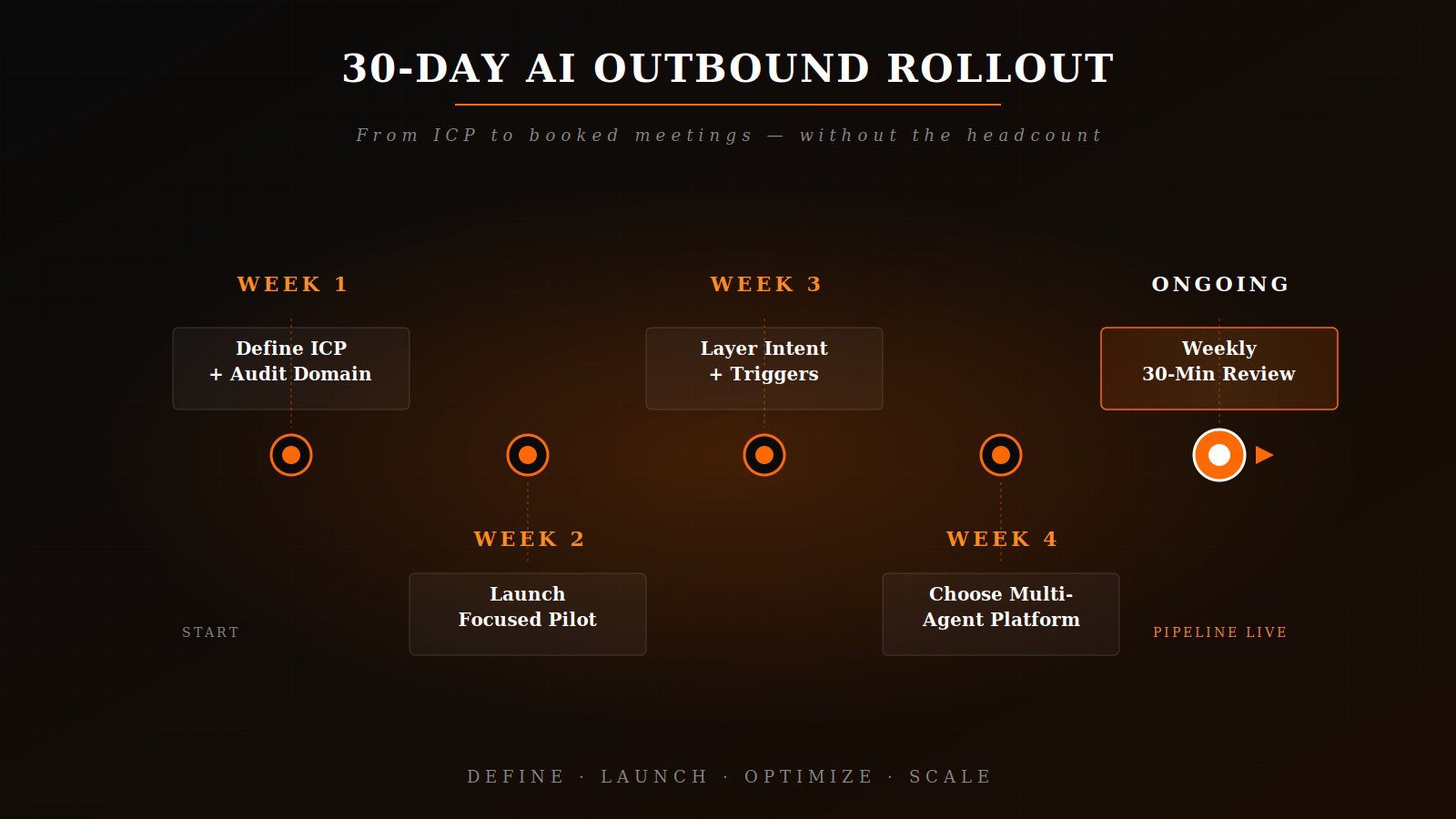
Here's a 30-day rollout path that doesn't overwhelm a small team.
- Week 1: Define your ICP and audit domain health. Get specific on industry, size, role, geography, and trigger events. In parallel, make sure your sending infrastructure is clean before a single AI-generated email goes out.
- Week 2: Launch a focused pilot. Pick one ICP segment, one offer, and one channel. Measure meetings booked, not emails sent.
- Week 3: Layer in intent and triggers. Add hiring signals, funding events, or tech stack changes to sharpen timing and lift reply rates.
- Week 4: Choose a platform built for SMB scale and multi-agent autonomy. Avoid enterprise tools with 6-month implementations. Systems like Jules 2.0 go from ICP to booked meetings without requiring a RevOps hire.
- Ongoing: Run a weekly 30-minute review. Audit messages, ICP, and offer performance every week. Treat the AI like a new employee in training — feedback compounds fast.
The Bottom Line for SMB Leaders
AI outbound is no longer a future bet — it's the current frontier of B2B sales. For SMB leaders, the question isn't whether to adopt AI sales agents, but how fast you can do it without sacrificing quality, deliverability, or brand reputation.
The companies winning in 2026 aren't the ones with the biggest sales teams. They're the ones running lean, AI-augmented revenue engines that book meetings while the founders sleep. Multi-agent outbound systems like Jules 2.0 represent where the category is heading — full automation of the SDR function, deployed in days, priced for businesses that need pipeline more than they need overhead.
If you've been waiting for the right moment to bring AI into your outbound motion, this is it. The tools are ready. The economics work. And your competitors are already deploying.
The only real risk now is moving too slow.