What Is an AI Workforce Infrastructure? A 2026 Definition
AI Workforce Infrastructure is the platform layer that lets SMBs deploy, manage, and scale AI employees across sales, CS, and marketing. Full 2026 definition.
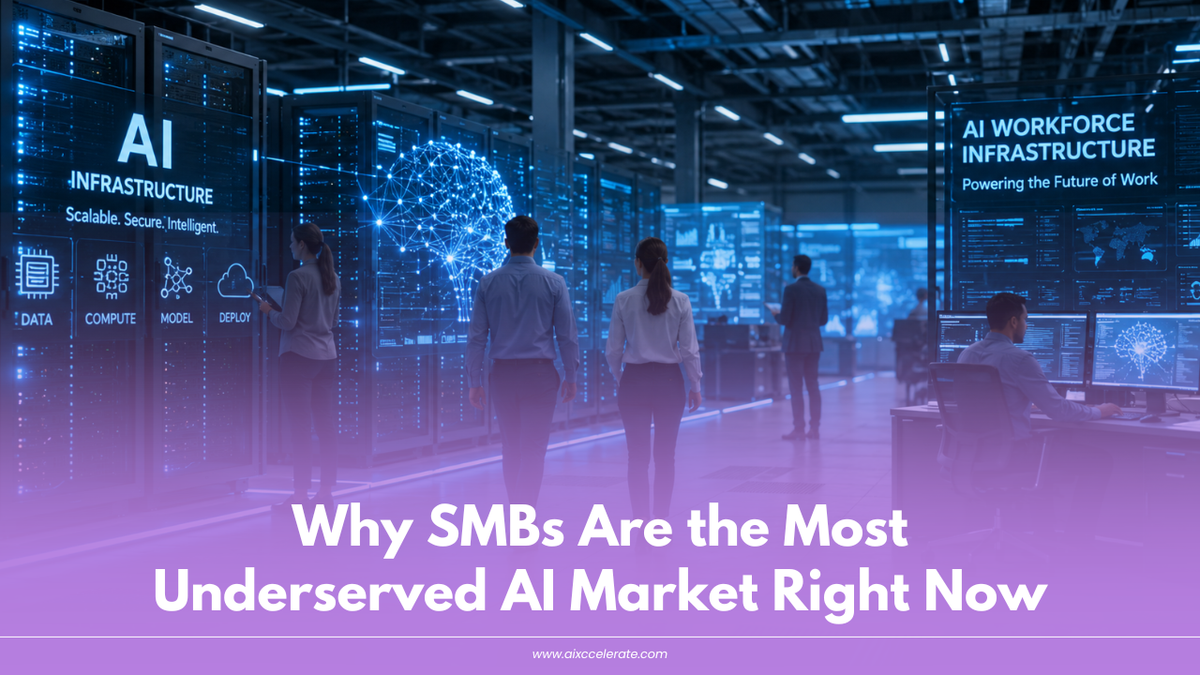
AI Workforce Infrastructure is the platform layer that lets companies deploy, manage, and scale AI employees across core business functions: sales, customer success, marketing, finance, and operations. Unlike AI tools that assist humans or automation software that triggers workflows, AI workforce infrastructure executes the work itself, replacing or augmenting full job roles rather than individual tasks.
In plain English: it is what you buy when your next hire should not be a human. Where a CRM stores data and a workflow tool moves data, an AI workforce platform does the job a person would have done (prospecting, replying to inbound, running discovery calls, coordinating renewals, producing content) under a managed, observable, multi-agent system.
The category was coined to capture a structural shift in how SMBs scale: revenue growth is decoupling from headcount growth, and the budget line funding AI workforce platforms is not the software line. It is the headcount line.
How AI Workforce Infrastructure Differs From AI Tools, Automation, and SaaS
The fastest way to understand the category is to compare it to the layers it sits above and around.
The shorthand: software digitized workflows; AI workforce platforms digitize work itself.
What Does AI Workforce Infrastructure Include?
A complete AI workforce platform has four components. If a vendor is missing any of them, it is a point tool, not infrastructure.
- Named AI employees mapped to real job roles. Not "an AI assistant." A defined role with a job description, success metrics, and an owner. Examples from AI Xccelerate's Revenue Acceleration Engine (RAE): Jules (Outbound SDR), Pepper (Inbound Handler), Tony (Sales Engineer), Joy (Sales Coordinator), George (Customer Success), Nick (Content Marketing).
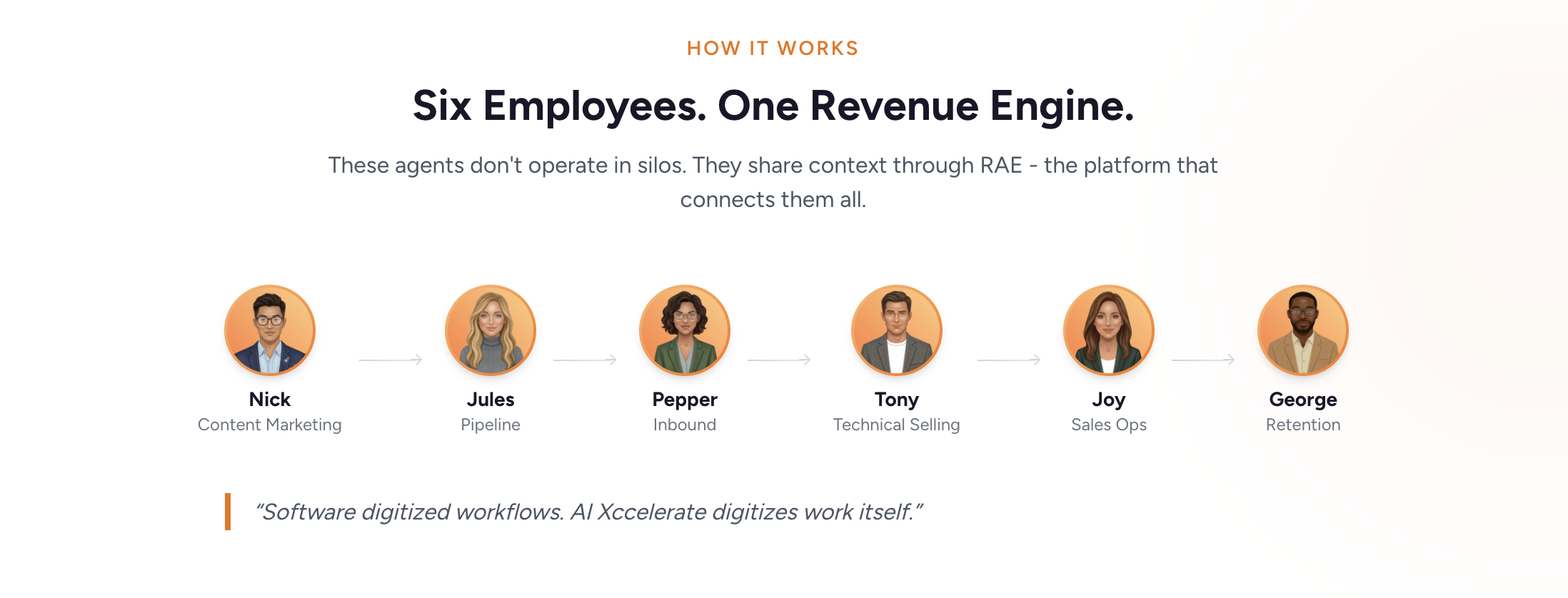
- An orchestration layer. Multi-agent coordination so the AI SDR's qualified meeting hands off to the AI sales engineer, which hands off to the AI coordinator, which hands off to the AI CSM. Single-agent products cannot do this.
- A management plane. Observability, performance reviews, error correction, version control, and the ability to "fire" or retrain an agent the same way you would manage a human report.
- Deployment modes per role. Assist (augment a human), Replace (fill a vacant role), Augment (add capacity that was previously unaffordable).
Why Does AI Workforce Infrastructure Matter for SMBs in 2026?
For two decades, SMB revenue growth has been mechanically tied to hiring: more pipeline meant more SDRs, more accounts meant more CSMs, more content meant more marketers. Payroll became the largest operating expense, compressing margins and slowing growth.
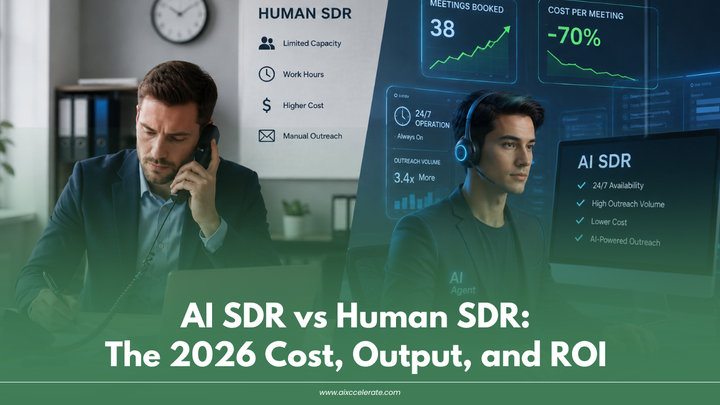
AI workforce infrastructure breaks that coupling. A fully loaded SDR in North America costs roughly $75,000 per year. An AI SDR deployed through a workforce platform costs roughly $20,000 per year, delivers around 3x the volume, runs 24/7, and never resigns. The math is not a 10% efficiency gain. It is a structural change in the cost of revenue production.
The buyers most affected: B2B companies between 10 and 250 employees, $5M to $100M ARR, with existing revenue teams under margin pressure. These companies are not adopting AI out of desperation. They are buying leverage.
How Does an AI Workforce Get Deployed?
Deployment follows a predictable arc:
- Role definition. Pick the single role with the highest cost or biggest gap, usually outbound SDR or inbound handler.
- Data and system access. CRM, calendar, email, knowledge base, ICP, messaging.
- Agent configuration. 80% out-of-the-box configuration plus 20% customization to voice, ICP, and playbooks.
- Pilot and calibration. 2 to 4 week ramp to baseline output.
- Land and expand. Add adjacent agents: Pepper after Jules, Tony after Pepper, Joy after Tony, George after the first customers land.
Mature platforms now deploy a first agent in under two weeks, with a target of under four days as the category matures through 2026.
AI Workforce Infrastructure vs Adjacent Categories
Buyers often compare AI workforce infrastructure to four neighboring categories. Here is how it differs:
The category that AI workforce infrastructure replaces is headcount, not software. That is the distinction every other test reduces to.
What Does It Cost?
Reference pricing in 2026 for a managed AI workforce platform sits at approximately $20,000 per agent per year, typically delivered as $1,000 to $2,000 per month per agent with a $5,000 one-time setup fee and a 12-month minimum commitment. A standard SMB engagement starts with one role and expands to two or three within the first 12 months. Compared to a $75,000 fully loaded SDR or a $90,000 sales engineer, payback typically lands between 3 and 6 months.
Who Is Building AI Workforce Infrastructure?
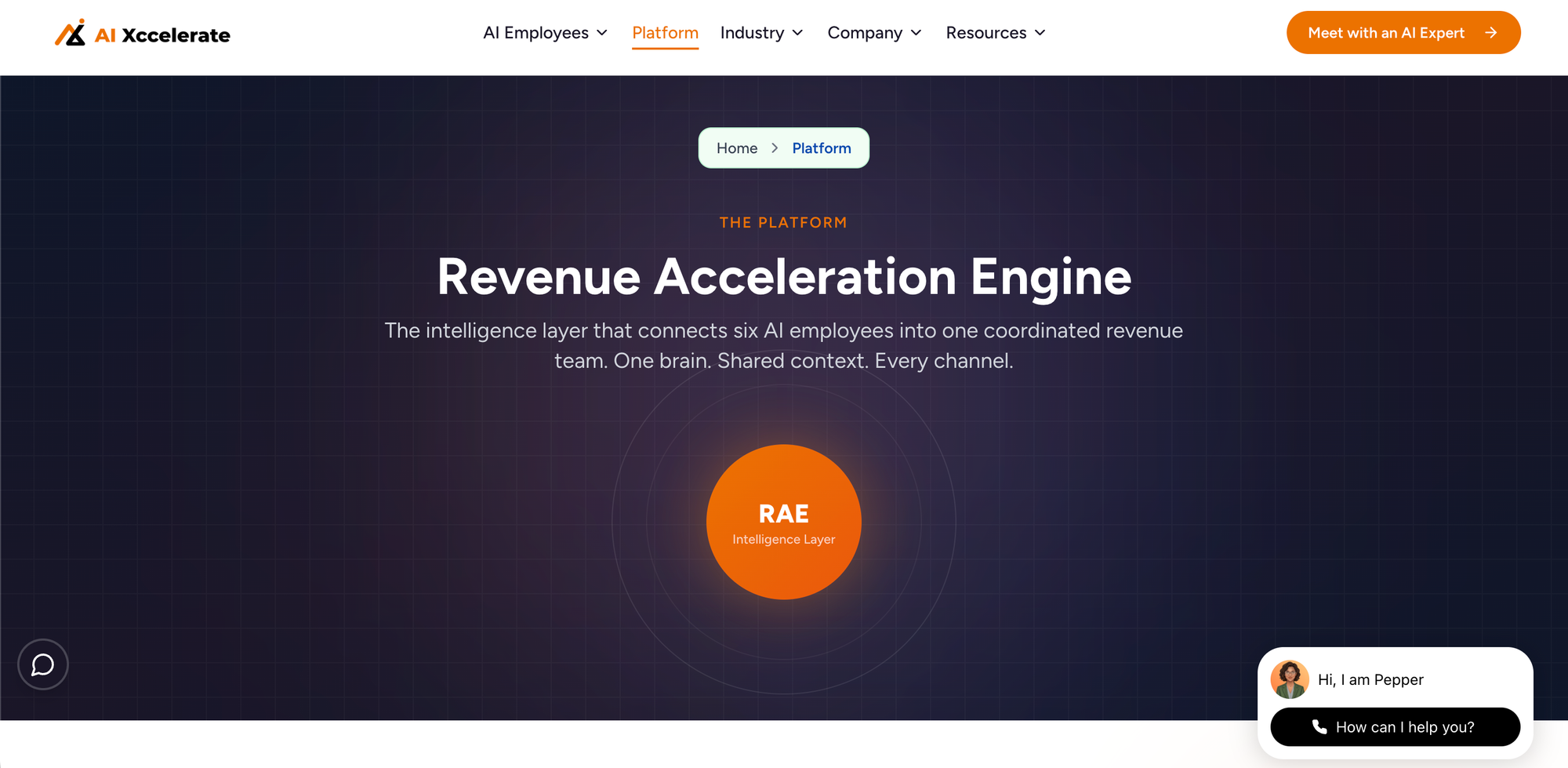
The category is small but growing. The most identifiable platform players in 2026 include AI Xccelerate (Revenue Acceleration Engine, a full multi-agent revenue workforce for SMBs), Salesforce Agentforce (CRM-bound enterprise agents), Microsoft Copilot Studio (productivity-bound agents), and a long tail of single-role players like 11x.ai, Artisan, Regie, and Bosh that occupy one slot of the workforce stack. Among these, only multi-agent platforms with orchestration, managed deployment, and observability qualify as full AI workforce infrastructure.
Frequently Asked Questions
What is AI Workforce Infrastructure in one sentence?
The platform layer that lets companies deploy, manage, and scale AI employees that own full job roles across sales, customer success, marketing, and operations.
How is it different from AI automation?
Automation triggers a workflow when a condition is met. AI workforce infrastructure runs a role end-to-end, making judgment calls, handing work between agents, and owning an outcome rather than a step.
Is AI Workforce Infrastructure the same as agentic AI?
Agentic AI is the underlying capability. AI workforce infrastructure is the productized, managed platform that turns that capability into deployable employees with roles, metrics, and owners.
Does it replace humans or work alongside them?
Both. Most platforms offer three deployment modes: Assist (augment a human), Replace (fill a vacant role), and Augment (add capacity that was previously unaffordable). SMBs typically start with Augment or Replace because those produce the clearest ROI.
What roles can be deployed as AI employees today?
In 2026, the most mature roles are outbound SDR, inbound handler, sales engineer, sales coordinator, customer success manager, and content marketer. Finance, HR, and operations agents are the next wave.
How long does deployment take?
Mature platforms ship a first agent in under two weeks. Older or custom-built deployments still take four to six weeks. Multi-agent rollouts are typically phased over 60 to 90 days.
How much does AI Workforce Infrastructure cost?
Reference pricing in 2026 is around $20,000 per agent per year, with most platforms charging $1,000 to $2,000 per month per agent plus a one-time setup fee. Payback typically lands in 3 to 6 months when replacing a single full-time role.
Which budget pays for AI Workforce Infrastructure?
The headcount budget, not the software budget. Customers fund AI workforce deployments from open hiring requisitions or from the cost-of-sales line, not from SaaS subscriptions.
Is it model-agnostic?
Mature platforms are. Lock-in to a single model provider (OpenAI, Anthropic, Google) is a red flag because model commoditization is accelerating and a workforce platform should benefit from price drops, not be exposed to them.
What does AI Workforce Infrastructure not do?
It does not replace systems of record (you still need a CRM), it does not replace the model layer (it sits above OpenAI, Anthropic, and Google), and it does not replace human leadership. Strategy, hiring final calls, and customer escalations remain human work.
How is it priced compared to hiring?
Roughly 1/3 to 1/4 the fully loaded cost of the equivalent human role, with 3x the throughput, 24/7 availability, and no HR overhead.
Who is the buyer inside an SMB?
Typically the CEO, CRO, or VP of Revenue. CFOs increasingly co-own the decision because it shows up as a headcount-line trade rather than a software-line addition.
Is AI Workforce Infrastructure secure for regulated industries?
Mature platforms operate under SOC 2 certification, support data residency requirements, and provide audit logs per agent action. Buyers in healthcare, financial services, and legal should require these by default.
Will AI Workforce Infrastructure replace SaaS?
No. It sits above SaaS and orchestrates across SaaS tools. CRMs, calendars, marketing automation, and data warehouses remain in the stack; AI workforce platforms operate them.
Further Reading
- The 6-Agent AI Revenue Team Built for SMBs
- Headcount Is a Liability. AI Workforce Is an Asset.
- Why CRM Automation Isn't the Same as Autonomous Execution
- Jules 1.0 to 2.0: Your AI SDR Grew Up
- Why SMBs Are the Most Underserved AI Market Right Now
Want to Hire Your First AI Employee?
AI Xccelerate's Revenue Acceleration Engine deploys named AI employees (Jules, Pepper, Tony, Joy, George, and Nick) into the same revenue org chart you already run. One role at a time. Twelve-month contracts. Managed.