Why SMBs Are the Most Underserved AI Market Right Now (And What They Actually Need)
A billion-dollar company spent $11 million on an AI project in 2024 and came out the other side less confident in AI than when they started. That is not a hypothetical. That is a real outcome from a real engagement, and it points directly at what is broken in how the industry sells AI.
The assumption driving most AI investment is that bigger budgets produce better results. Build the data lake. Hire the ML team. Run the BCG engagement. Layer generative AI on top of years of structured data. The use cases will follow.
For the companies that can absorb that kind of spend, the model might eventually work. For everyone else, the 100 to 500 person business running on a capable team, a CRM, and a lot of manual process, it is the wrong conversation entirely.
That is the market AI Xccelerate is built for. And the reason it is such a clear opportunity right now is simple: no one else is talking to them in language they can act on.
The Market Split Nobody Is Talking About
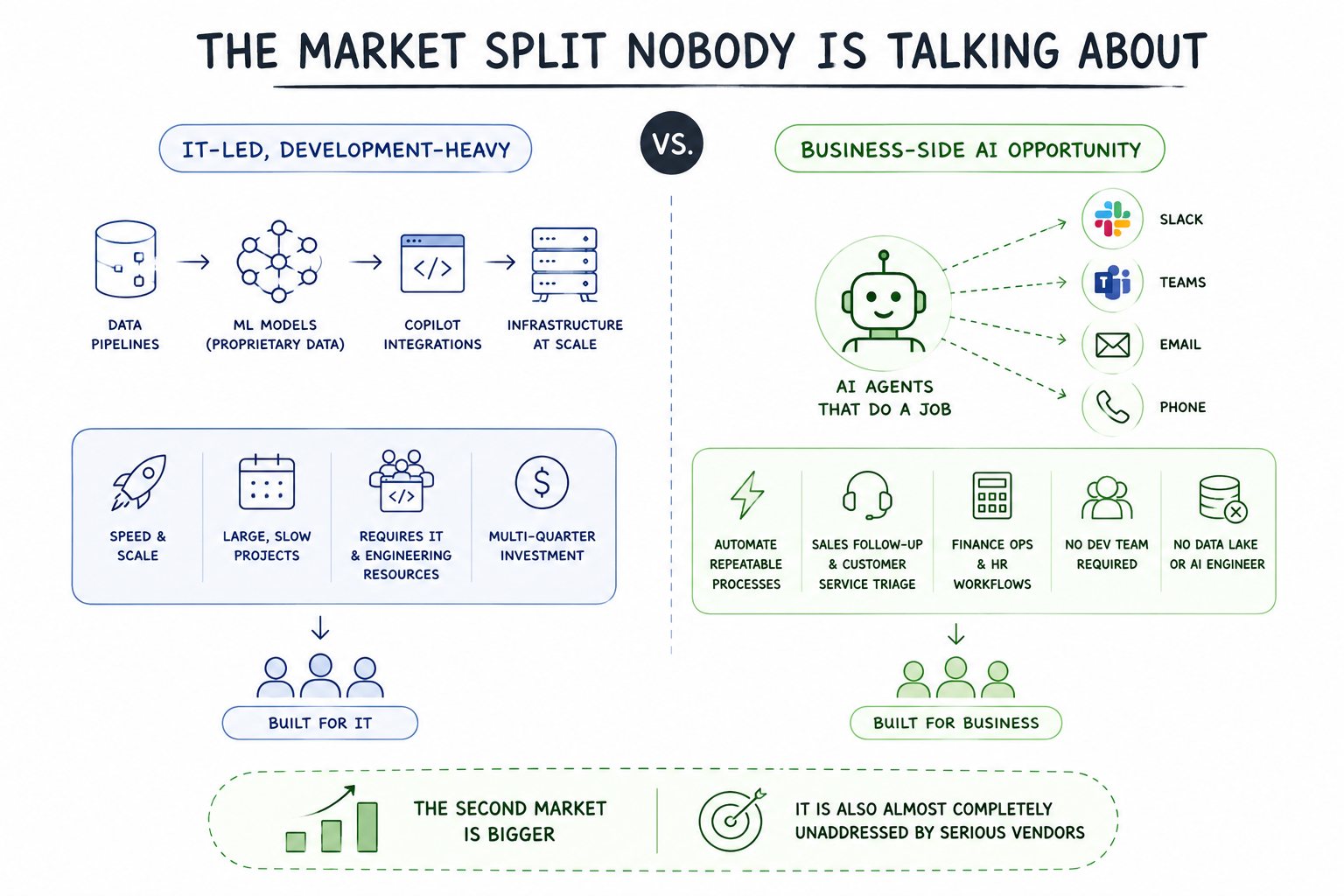
There are two fundamentally different AI markets, and most vendors are only serving one of them.
The first market is the IT-led, development-heavy AI implementation. It is about speed, scale, and infrastructure. Data pipelines. Machine learning models trained on years of proprietary data. Copilot integrations across enterprise tooling. These engagements are large, slow, and require internal technical resources to run. They are appropriate for companies with dedicated engineering teams and the budget to sustain a multi-quarter project.
The second market is the business-side AI opportunity. Automation of repeatable processes. AI agents handling sales follow-up, customer service triage, finance operations, HR workflows. AI employees that show up in Slack, Teams, email, or on a phone line and do a job. This market does not require a development team. It does not require a data lake. It does not require an internal AI engineer.
The second market is bigger. It is also almost completely unaddressed by serious vendors.
Most of our active engagements are with companies under 500 employees. Not because we cannot serve larger organisations, but because the fit is most precise here. These companies feel the pressure of AI most acutely, they have the clearest process-level problems to solve, and they have exactly zero internal capacity to figure it out themselves.
What SMBs Actually Need (Hint: It Is Not a Platform Demo)
If you ask a CEO at a 200-person company what their AI strategy is, most of them will give you a version of the same answer: we know we need to do something, we just do not know where to start.
That is not a knowledge gap. It is a translation gap.
They understand their business problems perfectly well. They know their sales team spends three hours a day on follow-up that should be automated. They know their customer service inbox has a backlog every Monday morning. They know their finance team is manually reconciling reports that a well-configured agent could handle in minutes.
What they do not have is someone who can connect those specific problems to a specific AI solution, deploy it without a six-month implementation, and own the outcome on their behalf.
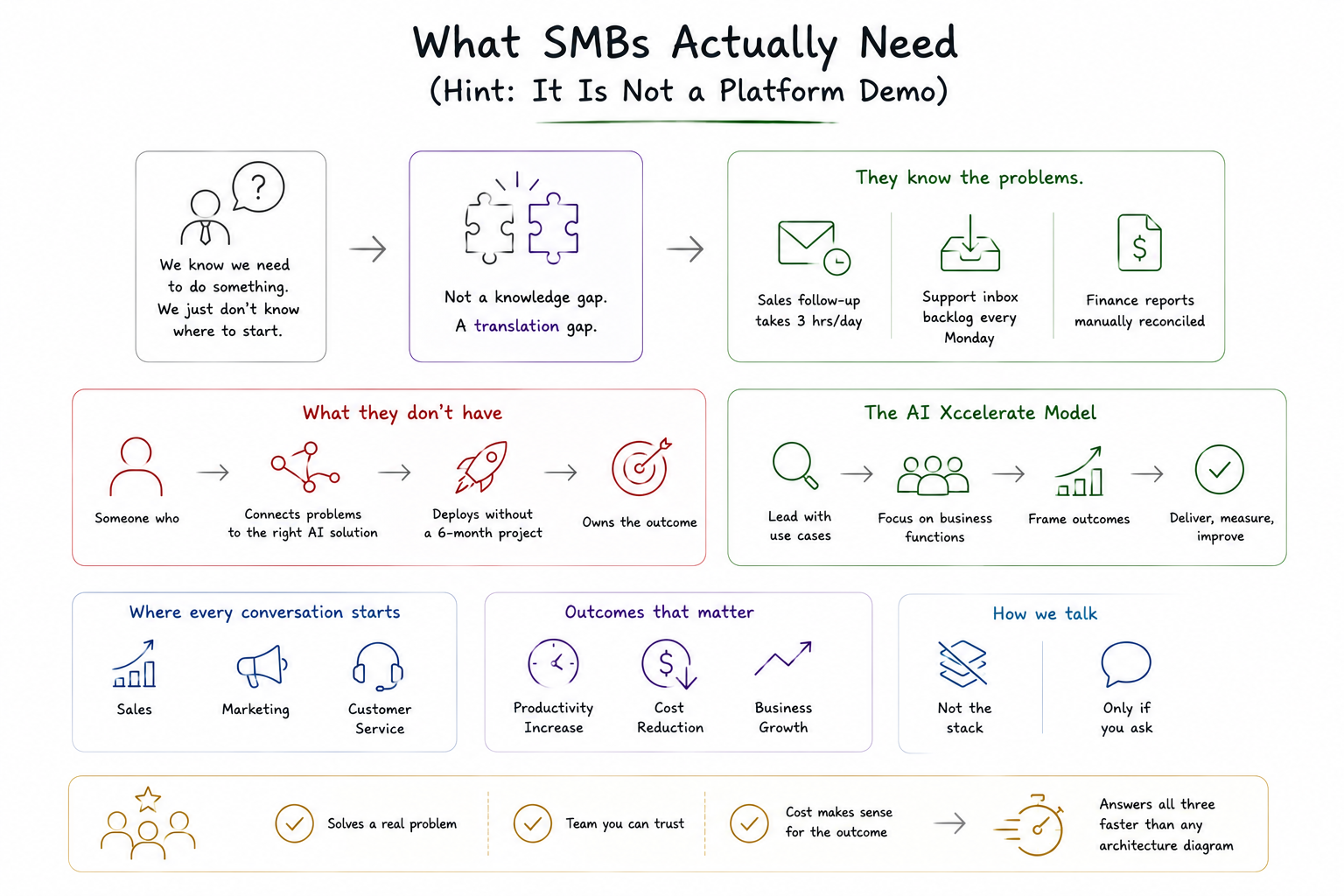
That is the AI Xccelerate model. We lead with use cases, not technology. Every conversation starts with a business function: sales, marketing and customer service. Every proposal frames outcomes in three terms: productivity increase, cost reduction, or business growth. We do not talk about the stack unless asked.
This approach works because it respects how SMB leaders actually make decisions. They are not evaluating platforms. They are evaluating whether a solution will solve a real problem, whether the team delivering it knows what they are doing, and whether the cost makes sense relative to the outcome. A use-case-led conversation answers all three questions faster than any architecture diagram.
The $11 Million Lesson
The clearest argument for leading with simple, high-impact use cases came from a project that went the other direction entirely.
In 2024, a large company spent $11 million assembling a full enterprise AI initiative. The goal was to build a data lake, run machine learning models on it, and layer generative AI tools on top to produce customer propensity models, upsell and cross-sell scoring, and a range of complex use cases. BCG was involved. The infrastructure was real. The ambition was right.
The outcome was a company that lost confidence in AI altogether.
Not because AI does not work. Because the project was too complex, too expensive, and too disconnected from the immediate business problems that actually needed solving. When you spend $11 million and cannot point to a clear, measurable win, the instinct is to stop investing, not to iterate.
The retrospective lesson is sharp: the same outcomes could likely have been achieved for a fraction of that cost, starting from focused use cases with clear ROI, and building from there.
This is not an argument against sophisticated AI implementations. It is an argument for sequencing them correctly. Start with what is practical. Build confidence. Demonstrate measurable results. Then expand.
For an SMB that cannot write an $11 million check, this sequencing is not optional. It is the only path that makes sense. And it happens to produce better early results anyway.
Why Function-First Beats Industry-First
Most AI vendors segment their market by vertical. Healthcare AI. Finance AI. Retail AI. The pitch is specialisation: we know your industry, we have seen your data problems, we built for your compliance environment.
AI Xccelerate segments by function instead. Sales. Marketing. Customer service.
The reason is practical: the underlying process problems in these functions look remarkably similar regardless of whether the company sells industrial components, provides professional services, or runs a logistics operation. A sales follow-up workflow is a sales follow-up workflow. An invoice reconciliation task is an invoice reconciliation task. The industry wrapping changes; the function does not.
This means we can move faster. A use case we have deployed for a professional services firm translates directly to a distribution company or a healthcare services business. The vocabulary adjusts. The core workflow does not.
For the SMB buyer, this also removes a common objection. They do not need us to be experts in their vertical. They need us to be experts in the function they are trying to fix. That is a much easier credibility bar to clear, and a much faster path to a signed agreement.
AI Employees: The Model That Changes the Conversation
The most effective positioning we have found for the SMB market is the AI employee frame.
Consider the position a 150-person company is in right now. Headcount pressure is real. Adding full-time staff is expensive and slow. Cutting staff creates operational gaps. The CFO is asking for efficiency. The CEO is being asked by the board why AI is not yet part of the operating model.
The conversation shifts completely when you offer them a 24/7 AI employee instead of a software implementation.
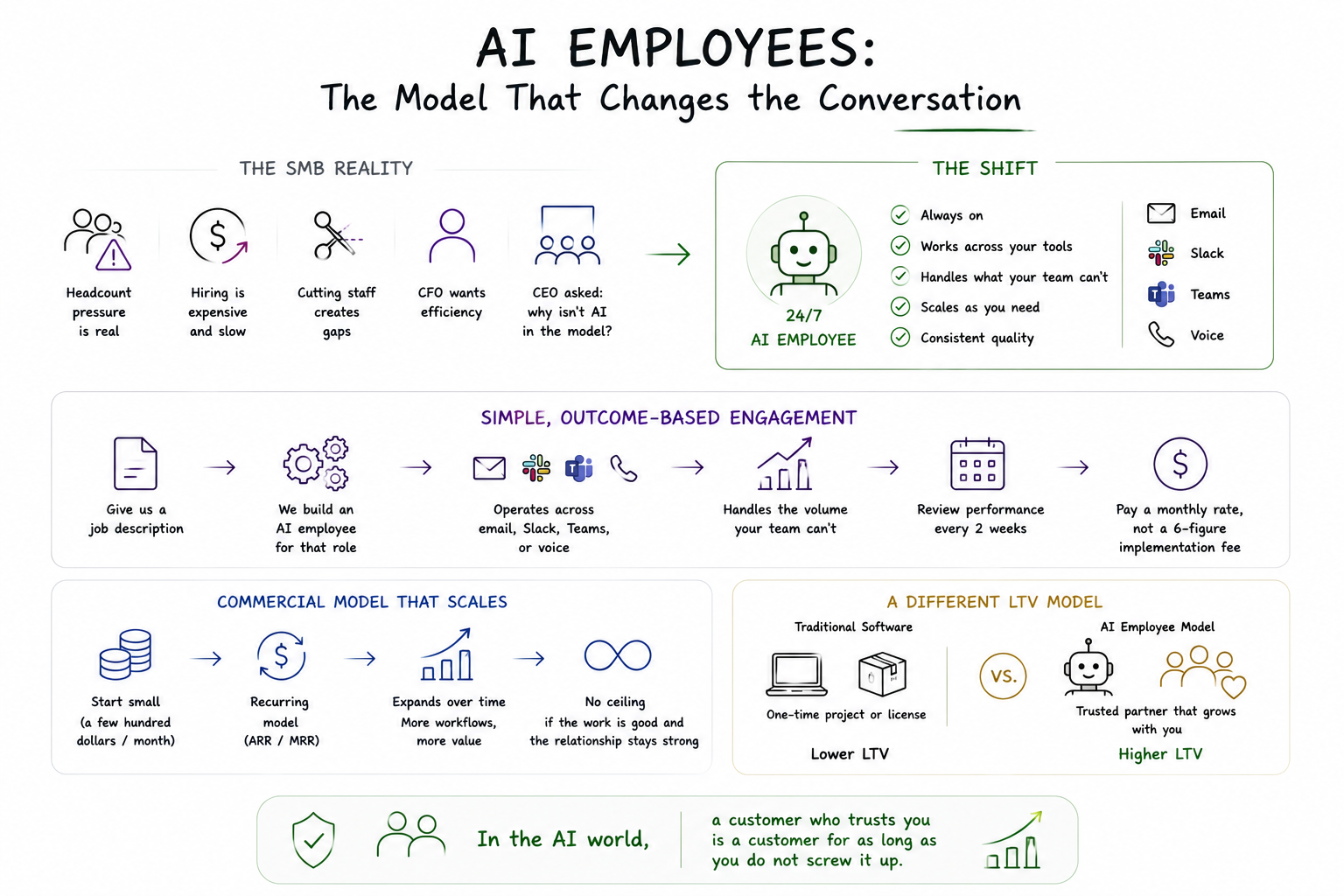
Give us a job description. We will build an agent for that role. It will operate across email, Slack, Teams, or voice, depending on how the team works. It will handle the volume that your human team currently cannot. You will review its performance every two weeks. You will pay a monthly rate, not a six-figure implementation fee.
This is not a SaaS product. It is a workforce model. And it maps directly onto how SMB leaders already think about their operational constraints.
The commercial structure matters here too. This is an ARR and MRR conversation. Not a one-time project. Not a license. A recurring service that delivers ongoing value and expands as the customer's confidence grows. A customer who starts with a single automated workflow paying a few hundred dollars a month has no ceiling for where that engagement can go, provided the work is good and the relationship stays strong.
In the AI world, a customer who trusts you is a customer for as long as you do not screw it up. That is a very different LTV model than traditional software.
The Gap This Creates for AI Xccelerate
Here is the market reality: the companies best positioned to serve SMBs with AI are not the platform vendors, who are selling infrastructure to technical buyers. They are not the enterprise consultancies, who need minimum contract sizes that most SMBs cannot reach. And they are not the one-person automation freelancers, who lack the breadth and reliability to be a strategic partner.
The gap is for a firm that combines genuine technical capability with a business-first sales motion, operates at SMB-appropriate price points, and takes ownership of the outcome rather than handing a client a tool and walking away.
That is exactly the position AI Xccelerate is building toward. Business-focused conversation. Use-case-led entry. Function-agnostic deployment. AI employee framing for recurring revenue. And a clear philosophy: we are not here to explain AI to you. We are here to deploy it for you and make it work.
The SMBs that figure out AI in the next 18 months will not be the ones who hired a data scientist. They will be the ones who found the right partner, started with one concrete use case, and built from there.
Where to Start
If you run a company between 100 and 500 people and AI feels like an obligation you have not yet acted on, the most useful thing you can do is not read more about it. It is to have one conversation about a specific business function that is costing you time or money right now.
Most companies think they need more software. They need a different kind of hire.
Learn more at aixccelerate.com