
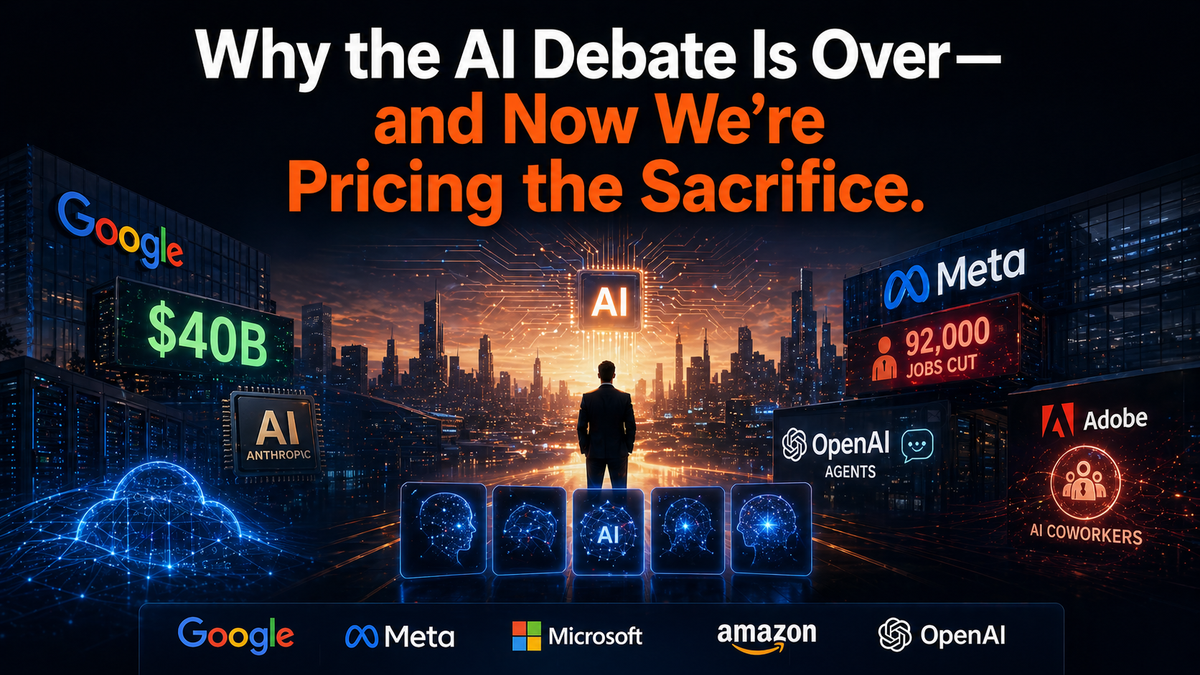
Why the AI Debate Is Over—and Now We’re Pricing the Sacrifice.
Google gave up $40B. Meta gave up 8,000 people. Five AI models launched in nine days and cut the cost of frontier intelligence in half. And we have an upgraded AI outbound launch next week!
IN THIS ISSUE
- Google's $40B: What the Money Is Actually Buying
- 92,000 Jobs Cut. Both Companies Reported Record Revenue.
- OpenAI Stopped Selling a Chat Model
- The Model Map: 5 Launches in 9 Days: Your Buying Guide
- Adobe Erased a 20-Year Brand to Survive What's Coming
01 · CAPITAL & INFRASTRUCTURE
Google Put $40B on AI Bets.
On April 24, Google confirmed a $40B investment in Anthropic, $10B in immediately, $30B tied to performance. Anthropic's annualized revenue crossed $30B this year, up from $9B at end of 2025. Google also committed five new gigawatts of compute capacity over five years. Amazon separately pledged $25B. Four companies: Amazon, Google, Meta, Microsoft, will spend a combined $700B on AI infrastructure in 2026.
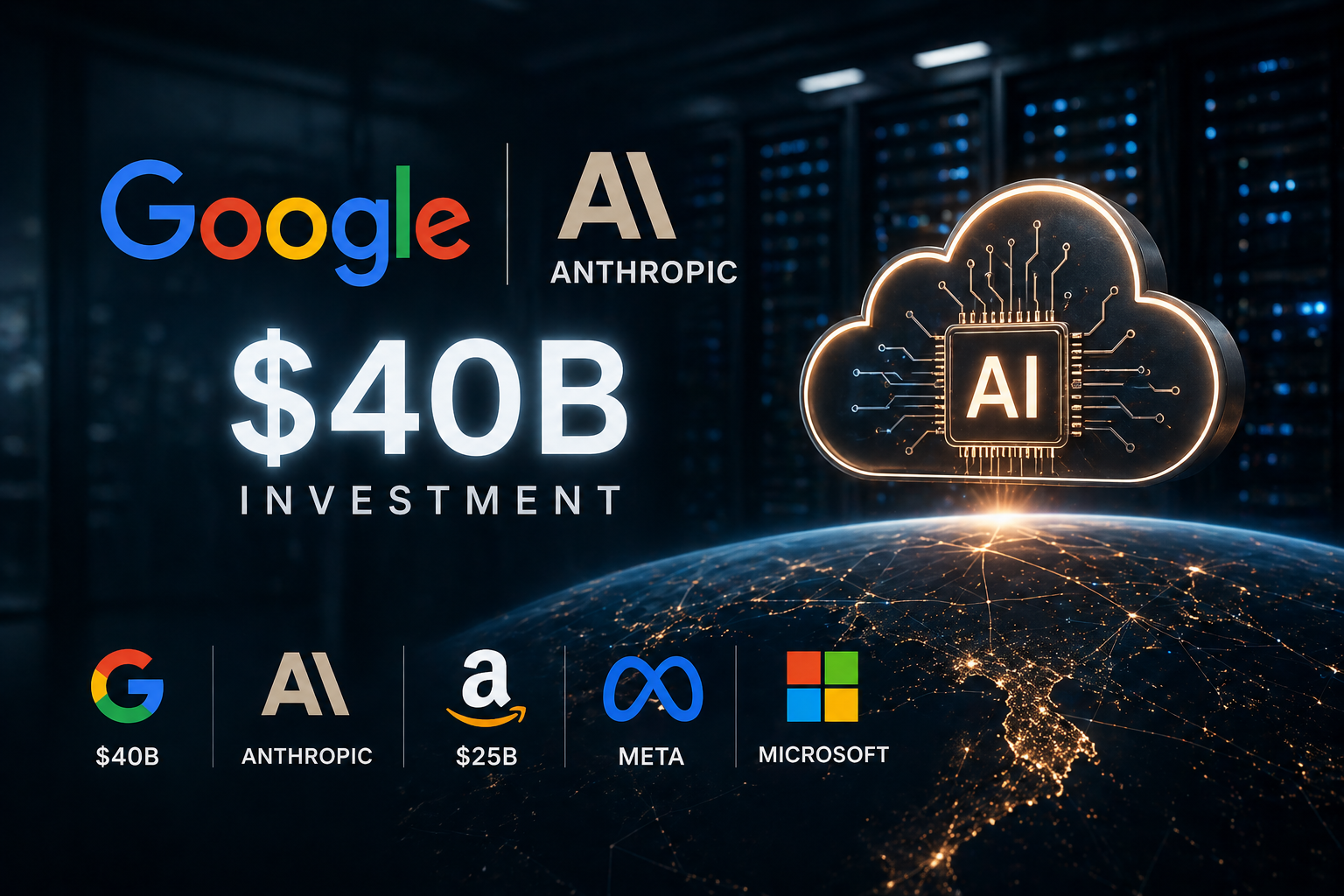
"The companies competing to build the best AI are the same companies competing to be the infrastructure those models run on. That's not a tech story. It's an economy being rebuilt from the foundation up."
For SMB and mid-market leaders: the tools your business runs on today are now backed by the same capital that built the internet. The infrastructure debate is over. The only debate left is whether your business is building on top of it or waiting to see what happens.
How to Bridge This Gap
- Map your AI dependency stack. For every tool you pay for, identify who owns the underlying model. Concentration risk is real, if one provider changes pricing or goes dark, what breaks first?
- Ask which layer you're buying. Feature (chatbot), workflow (agent), or infrastructure (model API)? The further down the stack you operate, the more durable your advantage becomes.
- Run a 90-day AI business audit, not a tech audit. What decisions are still manual that a well-configured AI system could own? Those are your highest-return line items right now.
02 · WORKFORCE & LABOR
92,000 Tech Jobs Cut in 2026. The Companies Doing It Posted Record Revenue.
On April 23, Meta and Microsoft moved within hours of each other. Meta: 8,000 jobs cut, 6,000 open roles frozen. Microsoft: voluntary retirement buyouts for ~8,750 employees, first time in 51 years. Total tech sector cuts in 2026 crossed 92,000 across 95 companies.
92K+ tech jobs cut in 2026 · $700B AI infrastructure spend by 4 companies · $135B Meta's AI capex, nearly 2× last year
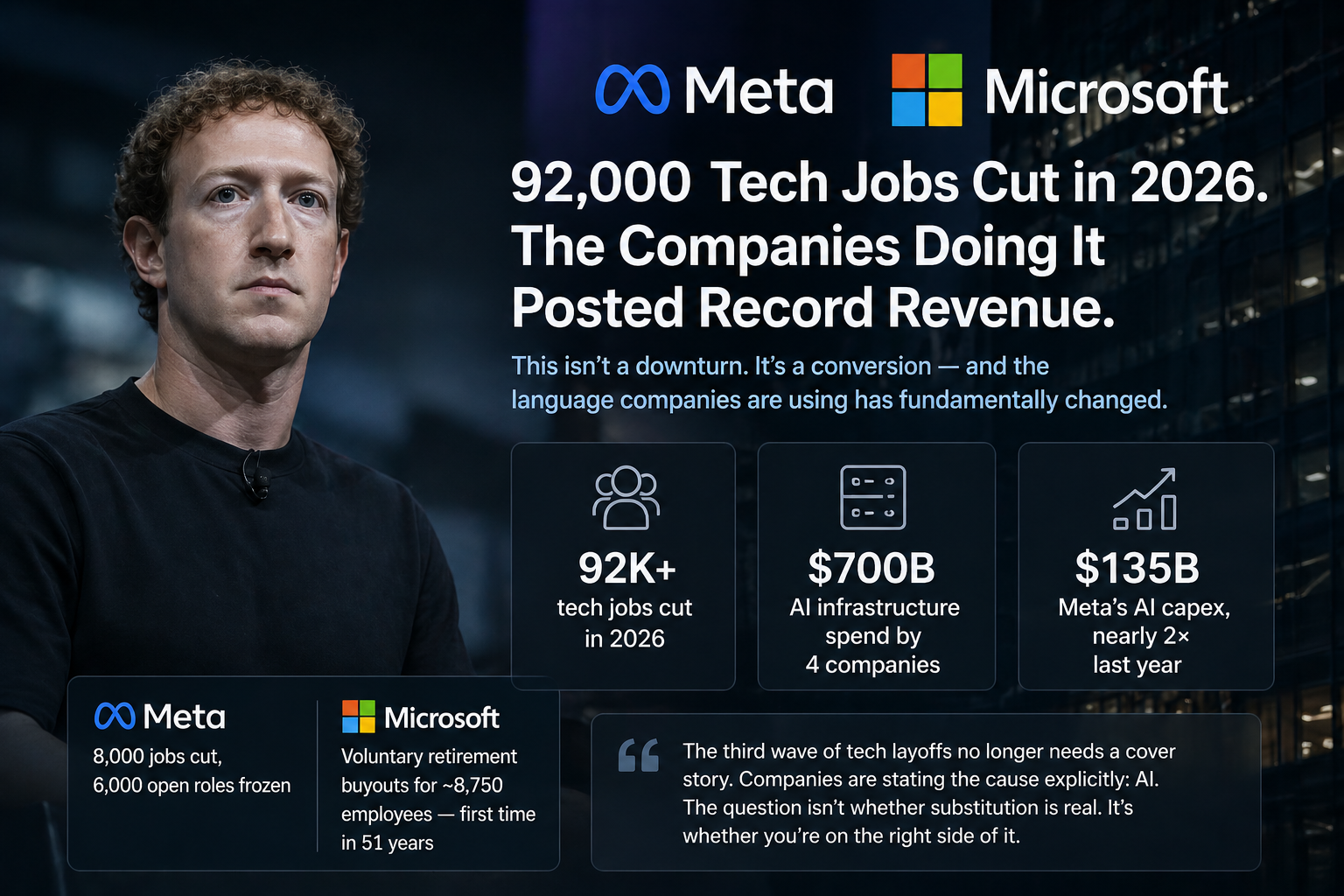
Both companies reported record revenues before cutting. The framing shifted too: in 2025, Zuckerberg called it removing "low performers." In 2026, the memo said "efficiency", acknowledging the people leaving aren't underperforming. They're in the wrong part of the company. That's a categorically different statement. The day before the memo leaked, Meta's top six executives were each awarded stock options worth up to $921M. The trade is not subtle.
"The third wave of tech layoffs no longer needs a cover story. Companies are stating the cause explicitly: AI. The question isn't whether substitution is real. It's whether you're on the right side of it."
How to Bridge This Gap
- Run a leverage audit on every role. What percentage of each person's work is repetitive, rule-based, or data-driven? Anything above 40% is an AI integration opportunity, not a replacement conversation, a scope expansion one.
- Retire "we don't have capacity" as a hiring justification. The new bar is: "We've fully leveraged AI on this function and still can't keep up." If you haven't hit that ceiling, you're hiring prematurely.
- Redesign your org chart around a new axis. Human roles: judgment, relationship, accountability. AI roles: volume, consistency, speed. That's the model winning companies are using in 2026.
03 · MODEL & PRODUCT
OpenAI Stopped Selling a Chat Model. Here's What It's Selling Instead.
April 22: OpenAI launched Workspace Agents, shared, cloud-based agents that run workflows across Slack and Gmail even when no one is logged in. April 23: GPT-5.5 shipped. Both released with identical framing: not a model you query. A system you hand a problem and walk away from.
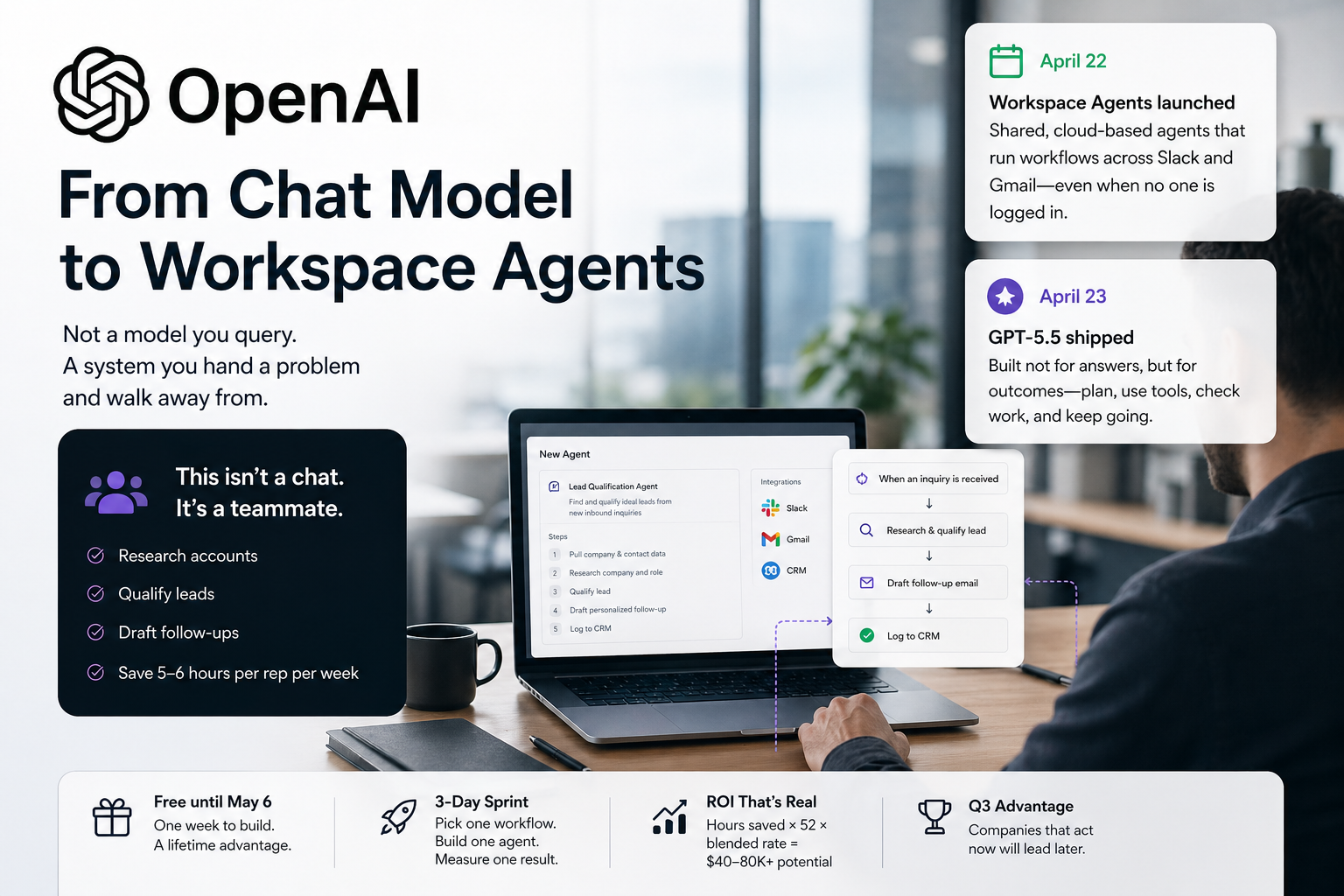
OpenAI's own description of GPT-5.5: "give it a messy, multi-part task and trust it to plan, use tools, check its work, navigate through ambiguity, and keep going." That's not how you describe a language model. That's how you describe an employee. OpenAI's own sales team already uses one to pull account research, qualify leads, and draft follow-ups, work that previously took 5–6 hours per rep per week.
"Six weeks from GPT-5.4 to GPT-5.5. That's product launch cadence, not model release cadence. When a frontier lab moves that fast, they're trying to lock down a category. The category is agents. The question for your business isn't which model wins, it's whether your workflows are built to run on any of them."
Workspace Agents are free until May 6. One week. The plays worth building right now: lead qualification, weekly metrics reporting, vendor risk screening, product feedback routing.
How to Bridge This Gap
- Name one workflow your team repeats every single week. That's your first agent candidate. ROI calc: hours/week × 52 × blended hourly rate. Most teams find a $40–80K/year line item on the first pass.
- Understand the architecture shift. A GPT answers questions. An agent owns outcomes. If your AI tooling is still primarily in Q&A mode, you're running 2023 architecture in 2026.
- Use the free window, it closes May 6. Three-day sprint: pick one workflow, build one agent, measure one result. The companies that prove this before the pricing starts will have a Q3 advantage their competitors can't buy back.
04 · THE MODEL MAP · RECURRING
5 Major AI Models in 9 Days. This is Your Non-Technical Buying Guide.
April 2026 was the densest model release month in the history of AI. Here's what was actually in those launches, in simple English.
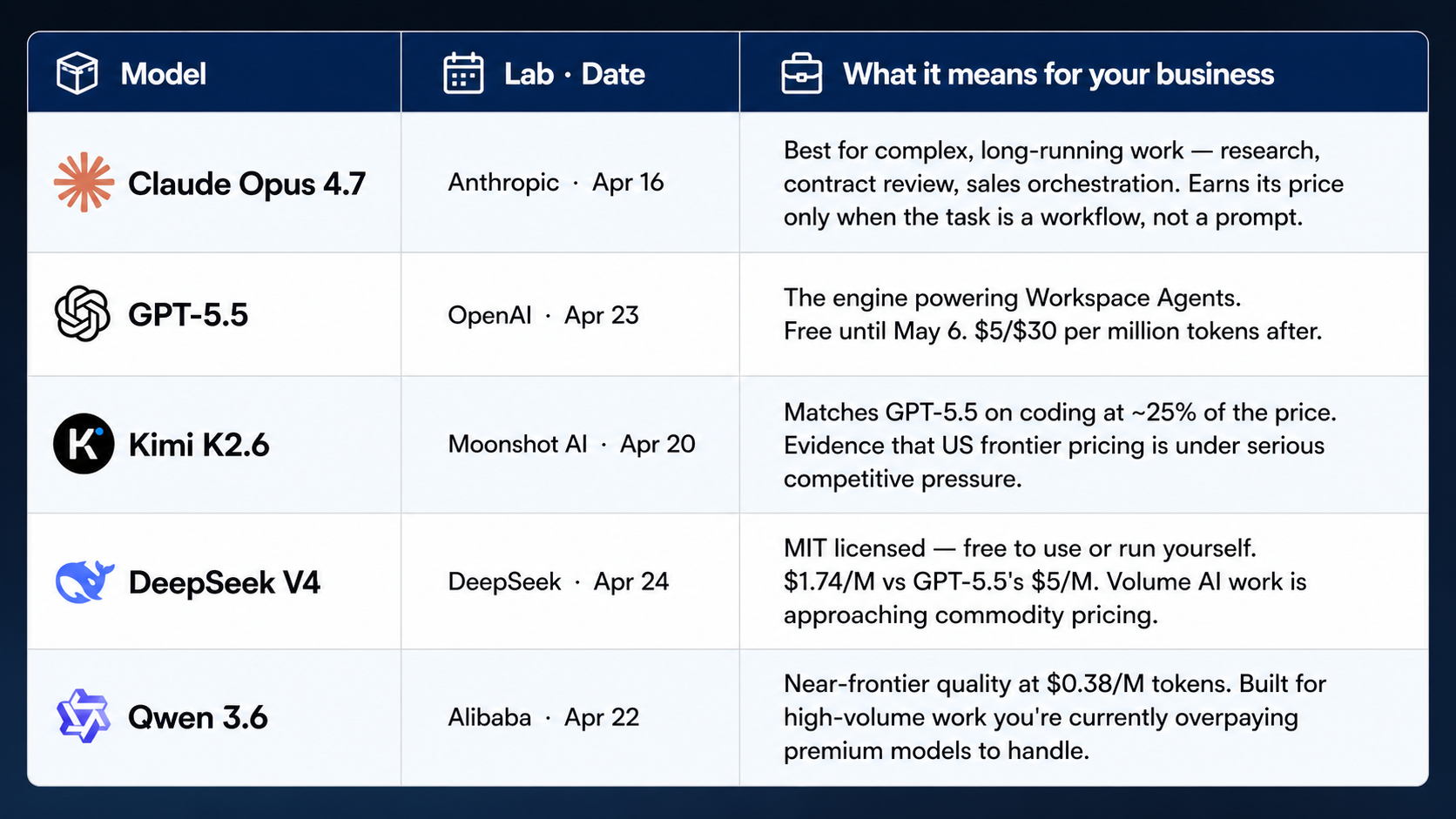
AI inference dropped roughly 50% between January and April 2026. The tools you're paying for were priced against a market that no longer exists.
The framework that matters: not every task needs the best model. Most tasks need the right one. Frontier models for judgment and orchestration. Commodity models for volume and execution. AI-native companies are cutting per-task costs by 60–80% without touching output quality using exactly this stack.
How to Bridge This Gap
- Audit your AI spend by task type, not tool. Most teams discover they're paying 10× more than they need to for 40% of their AI workload.
- Ask your AI vendors what model is underneath. The underlying model determines what you can ask it to do, and whether your vendor's margins grew 10× in Q1 while your subscription price didn't move.
- Cut your vendor re-evaluation cycle to 90 days. A contract signed in Q4 2025 was built on a completely different pricing landscape. The market has moved. Your contracts may not reflect that yet.
05 · ENTERPRISE & MARTECH
Adobe Killed Experience Cloud. It Spent 20 Years Building That Name.
On April 20, Adobe replaced its entire Experience Cloud suite with Adobe CX Enterprise, an agentic AI system built around persistent AI "Coworkers" that orchestrate tasks toward defined business goals. Not task-by-task. Goal-by-goal. Over 1,770 enterprise customers already run its production agents. WPP, Publicis, Dentsu, Omnicom, the agencies managing your marketing, are all standardizing on this platform. The same infrastructure being designed to reduce their role.
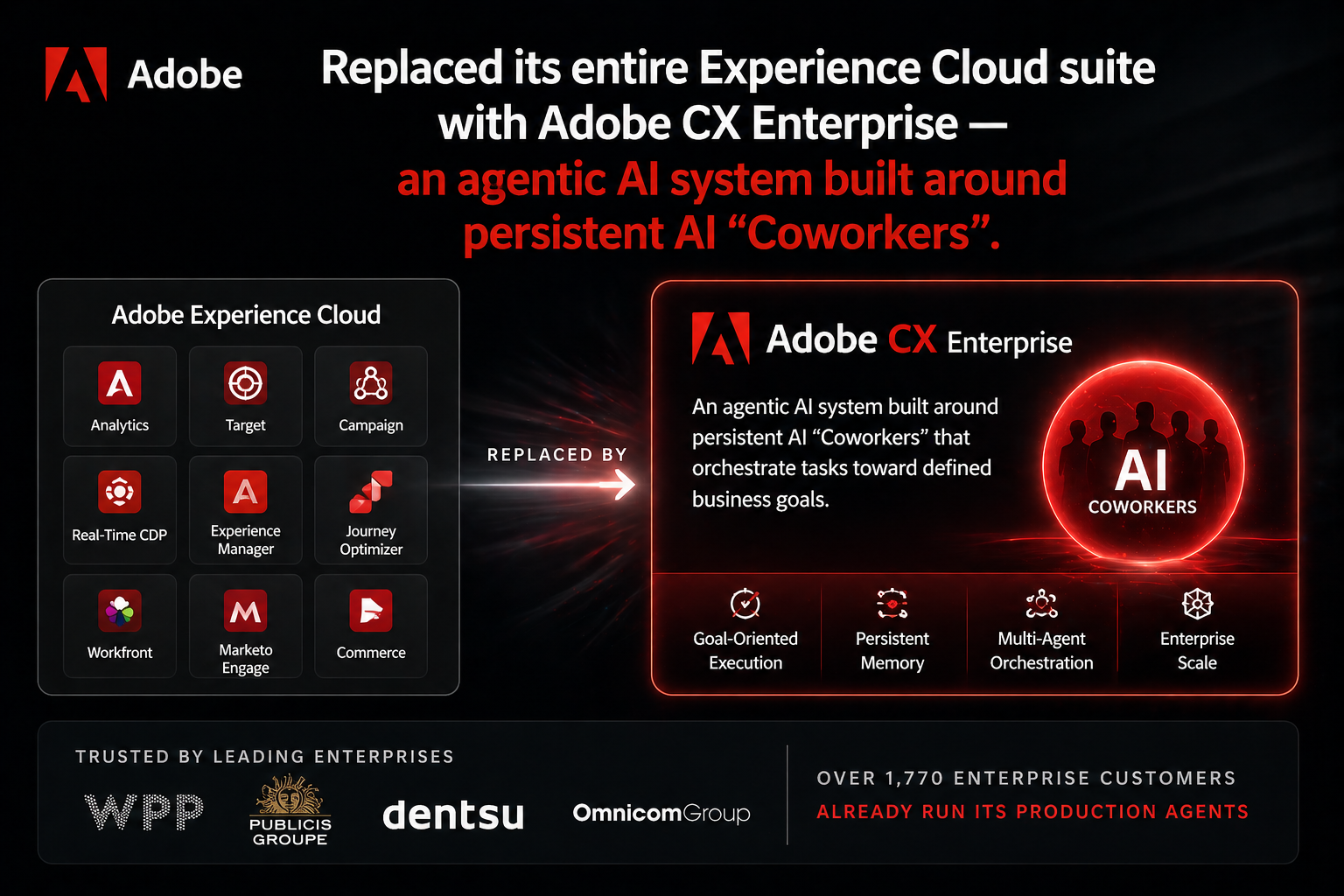
Adobe's own research: 75% of organizations cite data integration as their top AI challenge. 71% cite talent gaps. 68% cite unclear ROI. These aren't adoption blockers. They're execution gaps, and the companies closing them this year will be the ones everyone else is buying from in 2028.
How to Bridge This Gap
- Test your brand's AI visibility right now. Ask ChatGPT or Gemini to recommend a vendor in your category. If you don't appear, you're invisible to a fast-growing buyer segment.
- Name one marketing workflow that's still entirely human-led. Anything running manually in 2026 is a cost center getting more expensive relative to automated alternatives every quarter.
- Have the platform conversation before your vendor has it for you. Adobe, Salesforce, HubSpot, Microsoft, all rebuilding around agents. If you're not choosing your orchestration layer, your vendors are choosing it for you.
AI Xccelerate AI Agent Launch Announcement:
Our Customer Favourite AI Outbound Marketing Agent Jules, Just Got a Significant Upgrade
Every section of this newsletter this week points to the same conclusion: the companies pulling ahead aren't waiting for the right tool, they're deploying AI that owns outcomes, not assists with tasks.
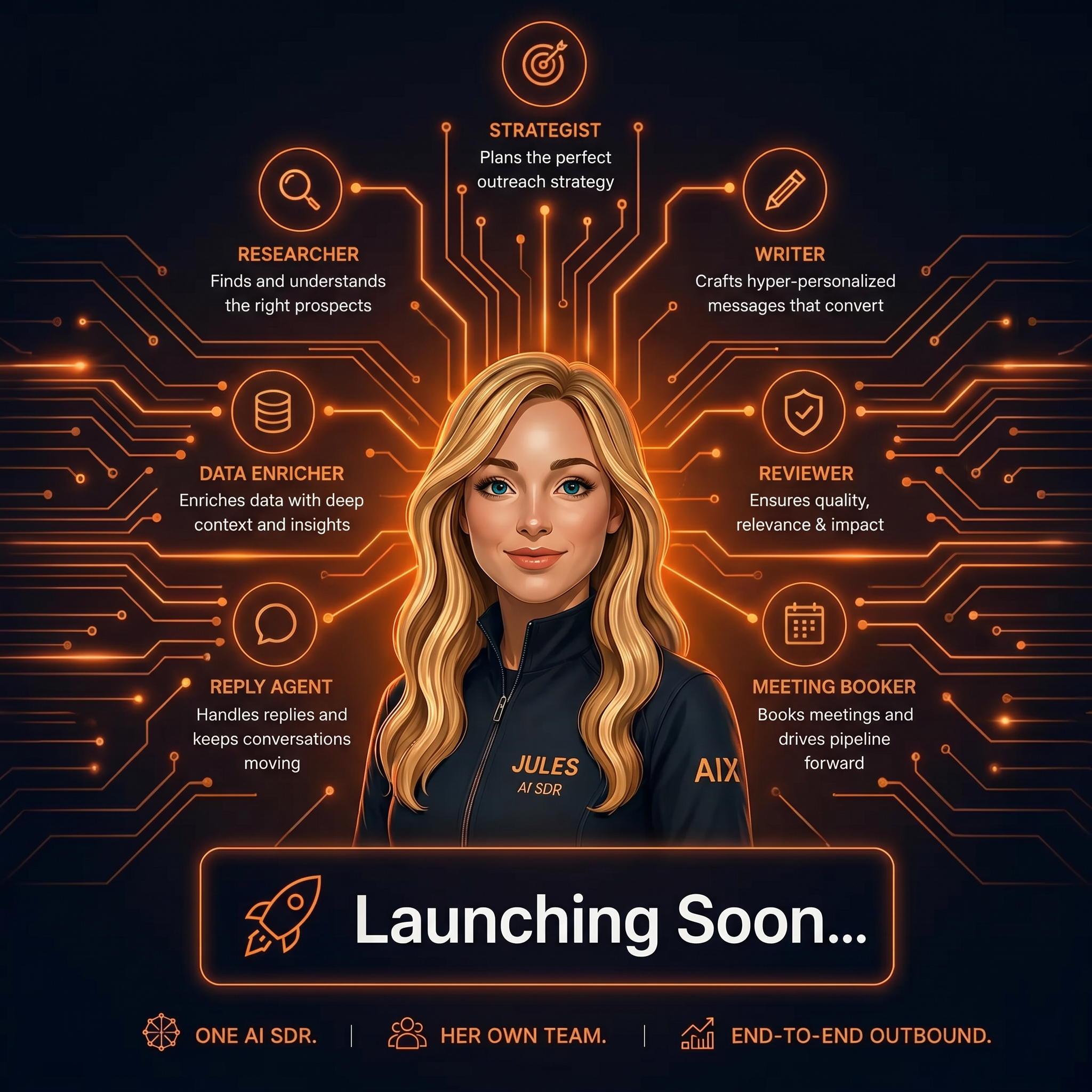
That gap between AI as a tool and AI as a revenue employee is exactly what's been getting wider. On May 4, Jules 2.0 AI Xccelerate's outbound marketing agent — launches with capabilities built for the environment described in this very issue. Smarter prospecting. Sharper personalization. A fuller understanding of the buyer journey at every stage.
If the model map section made you think about what you're currently overpaying for, and the labor math section made you ask what work your team is doing that shouldn't require a human, Jules 2.0 is worth paying attention to.
Agent Jules 2.0, drops May 4. Watch this space.
Join the Waitlist Today!