AI for Small Businesses Versus Traditional Solutions 2026
Discover how ai for small businesses compares to traditional solutions in 2026 with data driven insights on efficiency, cost, ROI, and implementation strategies.
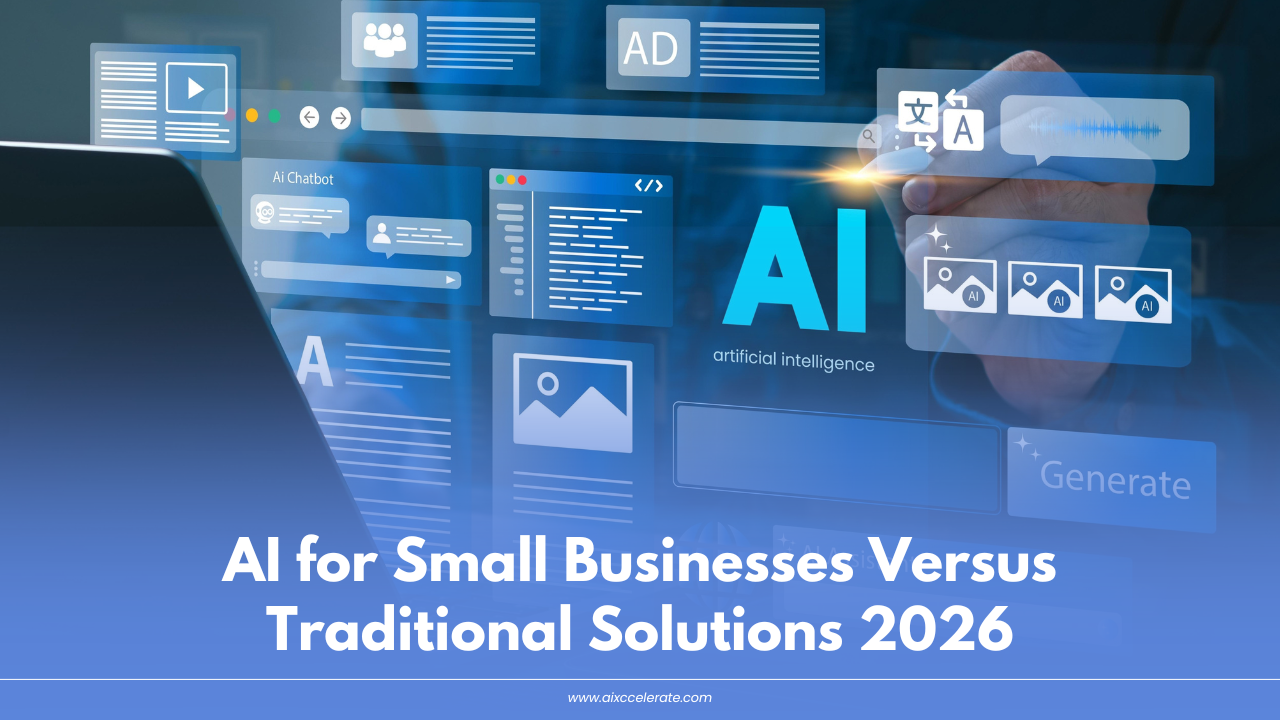
In 2026, small businesses face a defining crossroads as artificial intelligence technology becomes more accessible and affordable than ever before. This shift has sparked a crucial debate: should small teams embrace ai for small businesses, or continue relying on tried-and-true traditional business tools?
Making the right choice can profoundly influence efficiency, operational costs, and growth potential. This article aims to provide a balanced, data-driven comparison of both approaches, helping business owners navigate the decision with confidence.
We will explore the key differences between AI and traditional solutions, weigh their benefits and drawbacks, analyze costs and ROI, address implementation challenges, share real-world industry examples, and look ahead to what the future holds for small business success.
The Evolution of Business Solutions for Small Businesses
Adopting the right tools has always defined success in small business operations. As technology advances, the conversation increasingly focuses on ai for small businesses, contrasting traditional methods with innovative AI-driven solutions.
![[object Object]](https://resources.aixccelerate.com/content/images/2026/03/ctf-1773511830580-fdfvgqbj1jm.jpg)
Historical Context: Traditional Solutions
For decades, small businesses relied on manual processes and basic digital tools. Bookkeeping was often done by hand or with spreadsheets like Excel. Customer relationships were managed using simple contact lists, and marketing involved flyers, radio ads, or in-person networking. Operations depended heavily on staff expertise, with phone-based customer support being the norm.
This approach offered several benefits. Owners enjoyed direct control over every process, and the initial cost of entry was low. Familiarity with these tools made onboarding straightforward, especially for teams with limited technical skills.
However, as businesses grew, these traditional methods revealed significant drawbacks. Manual processes were time-consuming and prone to human error. Scaling required hiring more staff, adding to overhead costs. Data insights were limited, making it hard to forecast trends or identify new opportunities. In fact, Google reports that small businesses may spend up to 30 percent of their time on repetitive administrative tasks.
A comparison of common traditional tools:
Tool | Purpose | Limitation |
|---|---|---|
Paper Invoices | Billing | Hard to track |
Excel Spreadsheets | Finances | Error-prone |
Phone Support | Customer Service | Limited hours |
Flyers/Radio | Marketing | Hard to measure |
Today, as AI for small businesses becomes more accessible, these legacy tools are being re-evaluated for their effectiveness.
Rise of AI Solutions (2020–2026)
The landscape shifted dramatically as ai for small businesses began to take center stage. Between 2020 and 2026, a wave of AI-powered tools transformed how small companies operate. Automation, analytics, and decision support became available to businesses of all sizes.
Modern AI solutions include chatbots like Zendesk and Intercom for instant customer support, marketing assistants such as Jasper and Canva, and advanced CRMs powered by Salesforce Einstein. These tools automate data entry, lead scoring, and even content creation, freeing staff to focus on strategic tasks.
Several key trends fueled this rise: advances in cloud computing, falling costs of AI technologies, and the shift to remote work. Efficiency became a necessity, not a luxury. By 2025, 60 percent of small and medium businesses had already adopted at least one AI tool, driven by the need to stay competitive. According to a recent survey, AI adoption among small businesses surged 41 percent in 2025 alone.
This transition marks a pivotal moment, as intelligent automation gradually replaces manual workflows. The adoption of ai for small businesses now signals a shift toward smarter, more scalable operations.
Core Differences: AI vs. Traditional Solutions
The landscape of business solutions has shifted rapidly, especially with the rise of ai for small businesses. Understanding the core differences between AI-driven and traditional methods is crucial for any small business owner looking to stay competitive in 2026. Let us explore these distinctions in detail.
![[object Object]](https://resources.aixccelerate.com/content/images/2026/03/ctf-1773511831710-awhjzjo0e6q.jpg)
Automation and Efficiency
AI solutions automate repetitive tasks such as data entry, scheduling, and lead scoring. This means tasks that once took hours can now be completed in minutes. For example, AI chatbots respond to customer queries instantly, while traditional support often leaves customers waiting.
In contrast, traditional business tools rely heavily on manual processes. Employees handle data entry and customer support, which can be time-consuming and prone to errors.
Process | AI Approach | Traditional Approach |
|---|---|---|
Customer Support | AI chatbots, 24/7 | Phone/email, limited |
Data Entry | Automated | Manual |
Scheduling | AI assistants | Staff-managed |
Data Utilization and Insights
With ai for small businesses, real-time data analysis and predictive analytics become accessible. AI tools provide instant insights, allowing owners to make informed decisions quickly. Personalized recommendations further enhance marketing and sales strategies.
Traditional systems, on the other hand, generate static reports. Insights often arrive after the fact, and forecasting is limited to manual projections in spreadsheets. This delay can hinder timely decision-making.
Scalability and Flexibility
AI solutions offer unmatched scalability. As your business grows, AI tools can adapt without the need to hire more staff or overhaul processes. For instance, managed AI agents can be integrated rapidly, supporting expansion with minimal disruption. To explore how this works in practice, see these AI solutions for small businesses.
Traditional approaches require increased hiring, training, and infrastructure whenever the business scales. This process is not only expensive but also slows down growth.
User Experience and Accessibility
AI-powered platforms deliver intuitive interfaces and self-service options. Employees and customers can access information anytime, improving satisfaction and reducing wait times. For ai for small businesses, this means better customer engagement and streamlined workflows.
Traditional solutions often limit access to business hours and depend on staff availability. This can result in missed opportunities and longer resolution times.
Cost Structure
The cost structure is another key difference. AI tools typically operate on a subscription or usage-based model, which can lower long-term expenses. Businesses save on labor costs as automation reduces the need for manual work.
Traditional solutions, by contrast, involve upfront investments in hardware or software, ongoing staff salaries, and training expenses. These costs can add up quickly, especially as the business grows.
Security and Compliance
Modern AI systems are built with advanced security protocols and automate compliance monitoring. This reduces the risk of data breaches and ensures regulatory requirements are met.
Traditional methods rely on manual checks. Human error increases the risk of non-compliance or security lapses, which can be costly for ai for small businesses.
Human Collaboration
AI augments human roles, allowing staff to focus on strategic and creative tasks. By handling routine work, AI can help prevent employee burnout and improve job satisfaction.
Traditional solutions place the entire workload on humans. This can lead to fatigue, reduced productivity, and higher turnover, especially as businesses scale.
Benefits and Drawbacks of AI for Small Businesses
Adopting ai for small businesses is transforming how entrepreneurs operate in 2026. With new technologies, companies can automate daily tasks, analyze data faster, and reach customers around the clock. However, the choice between AI and traditional approaches still carries significant implications for efficiency, cost, and growth.
![[object Object]](https://resources.aixccelerate.com/content/images/2026/03/ctf-1773511832814-4nr5eupdjys.jpg)
Advantages of AI Solutions
AI for small businesses provides a range of tangible benefits. Automation of repetitive tasks, such as data entry or scheduling, frees up valuable time for team members to focus on growth activities. With AI-driven analytics, owners gain actionable insights and can make smarter decisions, often in real time.
AI chatbots and virtual assistants enable 24/7 customer engagement, handling up to 80% of routine support queries. This ensures customers get quick answers, even outside regular business hours. Personalized marketing campaigns and product recommendations can be scaled effortlessly, leading to higher conversion rates.
Cost savings are another key advantage. By reducing manual labor, businesses can lower operational expenses and redirect resources to strategic initiatives. For more on real-world results, see Customer success with AI tools.
Limitations and Risks of AI
Despite its potential, ai for small businesses comes with challenges. There is an initial learning curve for teams adapting to new AI-powered platforms. Successful implementation depends on the quality and structure of business data, which can be a hurdle for some organizations.
AI systems may occasionally misinterpret customer sentiment or misroute support tickets, leading to errors that require human intervention. Concerns about job displacement arise as automation changes traditional roles, prompting the need for skill development.
Privacy and ethics are critical considerations. Businesses must ensure that customer data is handled securely and in compliance with regulations. Ongoing oversight is necessary to maintain trust and avoid unintended consequences.
Advantages of Traditional Solutions
Some small businesses prefer traditional solutions because of the human touch. Personal interactions can build strong customer relationships and foster loyalty. Owners maintain complete control over every process, allowing for customization and quick adjustments.
For non-tech-savvy business owners, manual methods often feel more comfortable and carry a lower perceived risk. There is no need to worry about complex system integrations or data migration challenges. This approach can be especially effective for businesses with unique workflows or a strong local presence.
Drawbacks of Traditional Solutions
However, relying solely on traditional tools limits the potential of ai for small businesses. Manual processes are time-consuming and prone to human error. As businesses grow, scaling operations becomes difficult without hiring additional staff or increasing overhead.
Data-driven decision-making is limited, as static reports and delayed insights hinder response times. Costs can escalate quickly, especially when more employees are needed to manage repetitive tasks. In today’s fast-paced market, slow adaptation can put businesses at a disadvantage.
Cost, ROI, and Scalability: AI vs. Traditional Approaches
Navigating the financial and operational landscape in 2026 means small businesses must weigh costs, returns, and scalability when choosing between AI for small businesses and traditional methods. The right investment can define a company’s competitiveness and future growth. Let’s examine how these two approaches compare across these critical factors.
![[object Object]](https://resources.aixccelerate.com/content/images/2026/03/ctf-1773511833936-8mj36amyrvx.jpg)
Upfront and Ongoing Costs
The initial and ongoing costs for AI for small businesses differ significantly from traditional solutions. AI typically involves subscription fees, integration expenses, and, most importantly, a noticeable reduction in manual labor costs. Many AI platforms offer pay-as-you-go models, making them accessible even for businesses with limited capital.
Traditional systems, by contrast, require purchasing hardware, software licenses, and budgeting for staff salaries and training. Over time, these costs can add up, especially as a business grows and needs to hire more employees to handle increasing workloads. For many, this means higher fixed costs and less flexibility.
ROI Analysis
AI for small businesses often delivers a faster return on investment. Automation of repetitive tasks, real-time analytics, and streamlined workflows translate into immediate productivity gains. According to AI Can Improve US Small Business Productivity, companies leveraging AI report up to 50% productivity increases within months.
Traditional solutions depend on staff performance and manual processes, so ROI tends to be slower and less predictable. The chart below summarizes the key differences:
Factor | AI for Small Businesses | Traditional Solutions |
|---|---|---|
Initial Cost | Low/Subscription | High/Upfront |
Ongoing Cost | Lower (automation) | Higher (labor, upgrades) |
ROI Speed | Fast | Slow |
Scalability Considerations
Scaling is another area where AI for small businesses excels. Adding new users or features is as simple as updating a subscription or integrating a new module. This makes it easy to adapt to changing business needs or rapid growth without major changes to infrastructure.
With traditional tools, scaling usually means hiring more employees, expanding office space, and increasing management complexity. These requirements can slow growth and limit a business’s ability to respond quickly to new opportunities.
Flexibility and Adaptability
AI for small businesses stands out for its agility. Providers release regular updates, new features, and integrations, ensuring that businesses always have access to the latest capabilities. This flexibility allows organizations to pivot quickly and stay ahead of competitors.
Traditional approaches, on the other hand, require significant time and resources to implement new processes or upgrade technology. Change often involves retraining staff and rewriting procedures, which can disrupt daily operations.
Long-Term Value
Long-term, AI for small businesses supports continuous improvement and helps future-proof operations. AI systems learn and evolve, providing ongoing optimization and efficiency gains. As competitors adopt AI, those relying solely on traditional tools risk falling behind and facing obsolescence.
Making the right investment today can ensure ongoing growth and relevance in a rapidly changing market.
Implementation Challenges and Success Factors
Adopting ai for small businesses can be transformative, but the journey is not without obstacles. Understanding the common challenges and the factors that drive successful implementation is crucial for small business leaders aiming to leverage AI effectively.
Overcoming Barriers to AI Adoption
Many small businesses face significant hurdles when integrating ai for small businesses into their operations. The most common barriers include:
- Skills gap: Most teams lack in-house AI or data science expertise.
- Change management: Staff may resist new technology, preferring familiar routines.
- Integration issues: AI tools need to work seamlessly with existing software and processes.
- Data readiness: Cleaning and structuring data for AI use can be time-consuming.
- Cost concerns: Owners often worry about the expense compared to perceived benefits.
A recent Google survey found that 40 percent of SMBs cite lack of expertise as a primary obstacle to adopting ai for small businesses. Addressing these barriers early helps create a smoother transition.
Success Factors for AI Implementation
Effective ai for small businesses deployment relies on a few critical success factors:
- Leadership buy-in: Owners and managers must champion AI initiatives and set a clear vision.
- Step-by-step rollout: Begin with small pilot projects, then expand as confidence grows.
- User-friendly tools: Select scalable AI solutions that are intuitive for staff.
- Ongoing training: Provide regular training and support to build team competence.
- Performance monitoring: Track results and adjust strategies as needed.
Businesses can also benefit from AI resources and guides that offer step-by-step instructions for implementation. Leveraging vendor support and managed services reduces complexity and helps teams realize the full potential of ai for small businesses.
Traditional Implementation Challenges
Traditional approaches still present familiar challenges for small businesses, especially when compared to ai for small businesses. Common issues include:
Challenge | Impact |
|---|---|
Recruiting skilled staff | Time-consuming, costly |
Training and onboarding | Slows productivity, increases expenses |
Manual oversight | Higher risk of errors, inefficiency |
Process documentation | Requires constant updates |
Relying on manual processes often leads to slower response times and increased operational risk. In a rapidly evolving business environment, these traditional hurdles can limit growth and adaptability.
Industry Examples: AI vs. Traditional Solutions in Action
Across industries, the comparison between AI for small businesses and traditional methods reveals clear differences in efficiency, agility, and customer impact. Let us explore real-world examples in key business areas, highlighting how AI is reshaping small business operations.
Marketing and Sales
AI for small businesses is revolutionizing marketing and sales by automating lead scoring, generating personalized content, and enabling targeted campaigns. Tools like Jasper and HubSpot streamline tasks that once required hours of manual effort. In contrast, traditional approaches rely on manual prospecting and generic outreach, often limiting reach and effectiveness.
For more on how AI is transforming marketing and sales, see AI for marketing and sales.
Customer Support
With AI-powered chatbots such as Zendesk and Intercom, small businesses can now offer 24/7 support, instantly resolving most customer queries. Traditional phone or email support, limited to business hours, often leads to longer wait times and lower satisfaction. Notably, AI chatbots can deflect up to 70 percent of routine inquiries, highlighting a key advantage of AI for small businesses.
Finance and Operations
AI for small businesses enables automated bookkeeping, predictive cash flow analysis, and smart inventory management. This reduces human error and accelerates financial insights compared to spreadsheet-based tracking and manual entry. Tools like Google Gemini offer real-time forecasting, while traditional methods lag behind in speed and accuracy.
HR and Employee Management
AI-driven onboarding, performance analytics, and sentiment analysis help small businesses optimize hiring and retention. Automated workflows reduce paperwork and speed up new hire ramp-up times by up to 50 percent. In contrast, traditional HR depends on manual evaluations and paper-based processes, consuming more resources and time.
Lessons Learned and Best Practices
Blending AI for small businesses with traditional strengths leads to the best outcomes. Early adopters report higher efficiency and customer satisfaction. Ongoing training, adaptation, and choosing the right partners are critical. For more data on AI adoption and its impact, the Empowering Small Business: AI Use Among Small Businesses report offers valuable insights.
Future Outlook: What’s Next for Small Business Solutions in 2026 and Beyond
The future of business solutions is rapidly evolving, with hybrid models that combine AI and traditional approaches becoming the new standard. As we look ahead, small businesses will find it easier than ever to access advanced technologies. No-code platforms and managed AI services are removing barriers, making ai for small businesses both practical and affordable—even for companies with limited technical expertise.
A growing focus on data privacy, ethics, and responsible human-AI collaboration is shaping best practices across industries. Regulatory guidance and industry standards are also emerging to ensure that the integration of ai for small businesses aligns with legal and societal expectations. According to recent trends highlighted in the AI adoption by small and medium-sized enterprises report, more than 75 percent of small businesses are projected to use AI in at least one core function by 2026.
Continuous learning and adaptation will be essential as technology advances. Business owners must stay informed and choose partners who align with their long-term goals and values. Embracing change, investing in ongoing training, and fostering a culture of innovation will set forward-thinking small businesses apart in a competitive landscape.
As you reflect on the real differences between AI-powered and traditional business solutions, it’s clear that making the right choice will shape your company’s future efficiency and growth. If you’re curious about how a managed AI approach can work in your unique context, I encourage you to take the next step. You don’t have to navigate this technology shift alone—let’s talk through your needs, explore practical strategies, and see how AI Xccelerate can help your business achieve measurable results. Ready to unlock new opportunities? Book a meeting with our expert and start your journey toward smarter business operations.
Frequently Asked Questions
What is AI for Small Businesses Versus Traditional Solutions 2026?
Adopting the right tools has always defined success in small business operations. As technology advances, the conversation increasingly focuses on ai for small businesses, contrasting traditional methods with innovative AI-driven solutions. Histor...
How does the evolution of business solutions for small businesses work?
Adopting the right tools has always defined success in small business operations. As technology advances, the conversation increasingly focuses on ai for small businesses, contrasting traditional methods with innovative AI-driven solutions. Histor...
How does core differences: ai vs. traditional solutions work?
The landscape of business solutions has shifted rapidly, especially with the rise of ai for small businesses. Understanding the core differences between AI-driven and traditional methods is crucial for any small business owner looking to stay comp...
How does benefits and drawbacks of ai for small businesses work?
Adopting ai for small businesses is transforming how entrepreneurs operate in 2026. With new technologies, companies can automate daily tasks, analyze data faster, and reach customers around the clock. However, the choice between AI and traditiona...
How does cost, roi, and scalability: ai vs. traditional approaches work?
Navigating the financial and operational landscape in 2026 means small businesses must weigh costs, returns, and scalability when choosing between AI for small businesses and traditional methods. The right investment can define a company’s competi...
Related Articles
- AI Security for Small Business: 3 Pillars Every Leader Must Know Before 2026
- AI for Small Business Guide: Unlock Success in 2026
- 7 Major AI Challenges Businesses Must Overcome in 2026
- The AI Growth Model That's Making Traditional Hiring Obsolete
- AI Adoption in North American Corporate Business: 2026 Insights
- What Makes Goal-Based AI Agents Smarter Than Traditional AI?