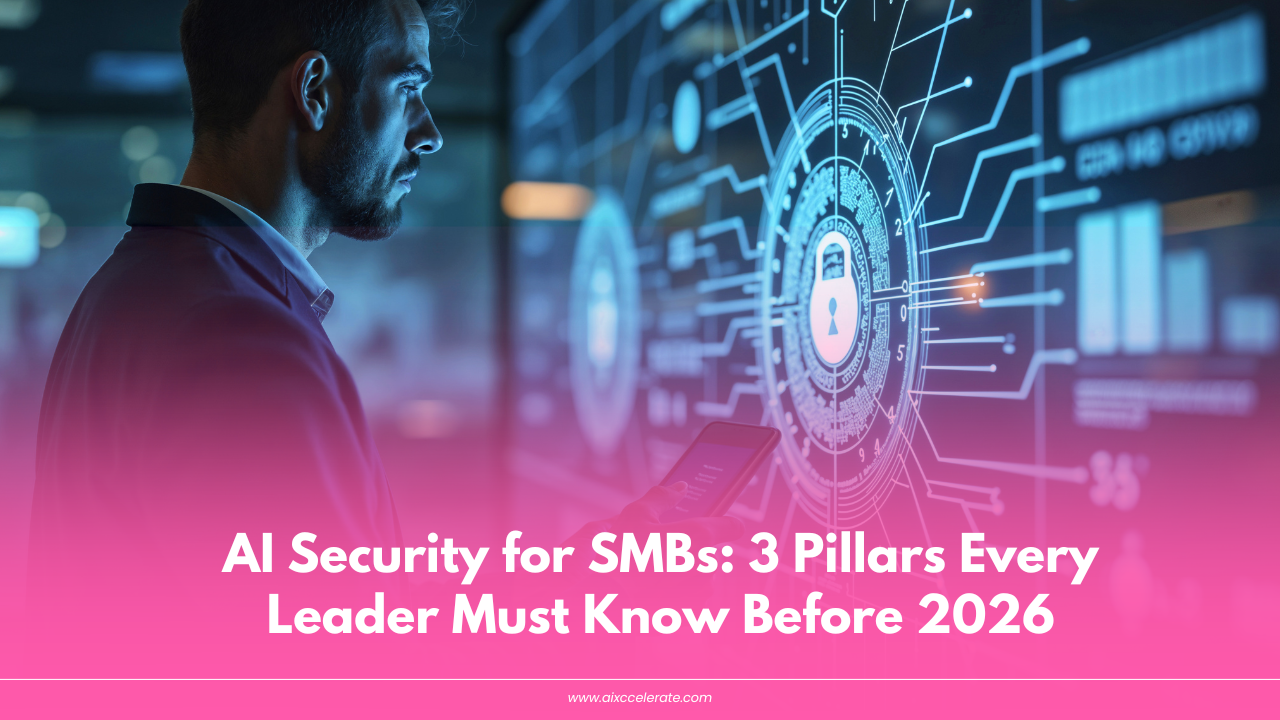
AI Security for Small Business: 3 Pillars Every Leader Must Know Before 2026
AI is transforming small businesses, but security concerns hold many leaders back. Learn the three pillars—Security, Privacy, and Data Protection, you must understand before adopting AI with confidence.
Artificial intelligence is no longer a luxury reserved for tech giants. It's becoming essential for small and medium-sized businesses looking to stay competitive. But as AI adoption accelerates, a critical question keeps business leaders awake at night: How do I know my data is safe?
If you're considering AI agents or automation for your business, you're probably excited about the possibilities: faster operations, better customer service, reduced costs. Yet beneath that excitement likely sits a layer of concern about security, privacy, and what could go wrong if sensitive information falls into the wrong hands.
This isn't just paranoia. It's smart business thinking. The good news? Understanding AI security doesn't require a computer science degree. It comes down to three fundamental pillars that every business leader can grasp and act on: Security, Privacy, and Data Protection. Master these, and you'll be equipped to confidently adopt AI while protecting what matters most: your business and your customers.
Why AI Security Matters More Than Ever
Small businesses are moving faster than ever to embrace AI tools and agents. Recent data shows that AI adoption among SMBs jumped from 35% to over 41% in just one year. This rapid growth brings tremendous opportunity, but also risk.
Unlike traditional software that simply follows instructions, AI systems learn from data, connect to multiple tools, and make autonomous decisions. This power is precisely what makes AI valuable, and what makes security so critical. An AI agent might access your customer database, integrate with your email system, process payments, and communicate with clients, all without human oversight for every action.
The stakes are high. A security breach doesn't just mean lost data anymore. It can mean exposed customer information, violated compliance regulations, damaged reputation, and significant financial penalties. For small businesses operating on tight margins, a single security incident can be devastating.
Yet many business owners delay AI adoption entirely because they feel overwhelmed by security concerns. The reality is that with the right knowledge and approach, AI can be implemented safely and effectively, even by small teams without dedicated IT departments.
The Three Pillars of AI Security
Pillar 1: Security (Control Before Intelligence)
Security in AI is fundamentally about control. Before you get dazzled by what AI can do, you need to establish who can use it, what it can access, and where it operates.
Think of security as the protective bubble surrounding your AI systems. Key questions to answer include:
- Who can activate the AI agent? Not every employee should have access to every AI tool
- Which systems can the AI touch? Define clear boundaries for what data and applications the AI can interact with
- Where is the AI running? Is it on your servers, in the cloud, or on a third-party platform?
- What code is it generating? If AI creates software or scripts for your business, those outputs need security review too
For small businesses, practical security starts with simple steps: use corporate AI accounts with proper licenses rather than free personal tools, keep AI activities within your organization's admin controls, and never input sensitive business data into personal chatbots like the free version of ChatGPT.
If you're using Microsoft infrastructure, stick to Copilot with your business license. Google Workspace users should use Gemini through their corporate account. These enterprise tools come with guardrails that personal versions lack.
The bottom line: Security is about knowing exactly what your AI can and cannot do, and having the ability to enforce those limits.
Pillar 2: Privacy (Protecting Sensitive Information)
Privacy focuses on keeping sensitive information confidential and preventing it from being exposed where it shouldn't be. This is especially critical because AI systems exchange data constantly by taking input and producing output.
The challenge is that once you provide data to an AI system, there's often no telling where that data travels next. Personal information, financial details, trade secrets, intellectual property: all of this needs protection.
Here's what privacy means in practice:
Know your data classification. Not all data is equally sensitive. Customer names might be low-risk, but social security numbers or medical records require maximum protection.
Understand training vs. processing. Commercial AI providers like OpenAI, Anthropic, and Google distinguish between data used to train their models and data simply processed to give you answers. With proper business licenses, your data typically isn't used for training, but this must be verified in your agreement.
Implement AI governance policies. Your team needs clear guidelines on what information can and cannot be shared with AI tools. This isn't just about rules on paper; it requires education and regular reminders.
Verify vendor commitments. When selecting AI partners, demand transparency about data handling. Where is data stored? How long is it retained? Who has access? Can you request deletion? These answers must be clear, not buried in vague terms of service.
Remember: chatting with AI is one thing, but giving an AI agent autonomous access to your systems is entirely different. Agents have memory, make decisions, and connect to other tools. That's why choosing the right AI model and ensuring proper data protections is non-negotiable.
Pillar 3: Data Protection (Preventing Leakage and Unauthorized Use)
Data protection is about actively preventing sensitive information from leaving your organization without authorization or being absorbed into AI training datasets where it could resurface later.
This pillar overlaps with privacy but focuses specifically on data leakage prevention (DLP), which means stopping your confidential information from escaping your control.
Key considerations include:
Storage location matters. Know exactly where your AI's knowledge base and outputs are stored. Is it in your country's data center? On a reputable cloud platform like AWS, Azure, or Google Cloud? Or sitting on an unknown third-party server?
Integration awareness. AI agents often connect to multiple systems: your CRM, email, accounting software, and more. Map out every integration and understand what data flows where.
Containerized deployment. Advanced solutions deploy AI agents in secure containers within your own infrastructure, ensuring data never leaves your control. This approach significantly reduces exposure risk.
Regular audits. Data protection isn't a one-time setup. Review access logs, monitor AI activities, and verify that protections remain effective as your business evolves.
For businesses handling regulated data like healthcare (HIPAA), finance (PCI-DSS), or EU customer information (GDPR), data protection becomes even more critical. In these cases, working with AI providers who understand compliance requirements is essential.
Building a Security-First AI Strategy
Understanding these three pillars is just the beginning. Putting them into practice requires a thoughtful approach:
Start with policy development. Create clear AI governance and acceptable use policies. These documents should outline what AI tools employees can use, what data can be shared, and what actions require approval. Even a basic policy provides crucial guardrails.
Invest in education. Security policies only work when people understand and follow them. Provide training tailored to different roles. Executives handling strategic information need different guidance than frontline staff.
Choose partners carefully. Look for AI vendors who can explain their security measures in plain English, not technical jargon. Transparency about data handling, storage location, and compliance should be readily available.
Implement in phases. You don't need to perfect everything before starting. Begin with lower-risk use cases, learn from experience, and expand gradually as you build confidence and expertise.
Get expert support. Small businesses don't need to navigate AI security alone. Specialized firms can help develop policies, assess risks, provide training, and ensure compliance, often more affordably than businesses expect.
The goal isn't to eliminate all risk, because that's impossible. The goal is to understand your risks, implement reasonable protections, and make informed decisions about what level of risk your business can accept.
Moving Forward With Confidence
AI represents a massive opportunity for small businesses to compete more effectively, serve customers better, and operate more efficiently. Security concerns shouldn't paralyze you; they should inform you.
By focusing on these three pillars (Security, Privacy, and Data Protection), you can adopt AI with confidence. Start by asking the right questions: Where will my data be stored? Who can access it? What happens if I want to delete it? How is this system protected against breaches?
If potential AI partners can't answer these questions clearly and directly, that's your red flag. The best partners bring transparency, proper credentials, and a genuine commitment to protecting your business.
The businesses that will thrive in 2026 and beyond won't be those that avoided AI out of fear. They'll be those that understood the risks, implemented proper safeguards, and moved forward strategically. With the right foundation in place, AI can transform your business while keeping your data secure.
The future belongs to informed action, not paralyzed hesitation. Now that you understand the fundamentals of AI security, you're ready to take that next step confidently and safely.
Frequently Asked Questions
What is AI Security for Small Business 3 Pillars Every Leader Must Know Before 2026?
Small businesses are moving faster than ever to embrace AI tools and agents. Recent data shows that AI adoption among SMBs jumped from 35% to over 41% in just one year. This rapid growth brings tremendous opportunity, but also risk. Unlike traditi...
Why AI Security Matters More Than Ever?
Small businesses are moving faster than ever to embrace AI tools and agents. Recent data shows that AI adoption among SMBs jumped from 35% to over 41% in just one year. This rapid growth brings tremendous opportunity, but also risk. Unlike traditi...
How does the three pillars of ai security work?
Pillar 1: Security (Control Before Intelligence) Security in AI is fundamentally about control . Before you get dazzled by what AI can do, you need to establish who can use it, what it can access, and where it operates. Think of security as the pr...
What are the building a security-first ai strategy?
Understanding these three pillars is just the beginning. Putting them into practice requires a thoughtful approach: Start with policy development. Create clear AI governance and acceptable use policies. These documents should outline what AI tools...
How does moving forward with confidence work?
AI represents a massive opportunity for small businesses to compete more effectively, serve customers better, and operate more efficiently. Security concerns shouldn't paralyze you; they should inform you. By focusing on these three pillars (Secur...
Related Articles
- AI for Small Business Guide: Unlock Success in 2026
- AI for Small Businesses Versus Traditional Solutions 2026
- 7 Major AI Challenges Businesses Must Overcome in 2026
- Why SMBs That Don't Deploy AI Employees Will Lose the Next Decade of Business
- AI Adoption in North American Corporate Business: 2026 Insights
- 7 Ways AI for Business Operations Will Reshape 2026