AI Workflow Redesign Builds Agentic Loops That Crush Legacy Processes
Simply adding AI to old workflows fails. This blog shows how AI workflow redesign and agentic loops turn clunky, human-led processes into fast, self-optimizing systems for SMBs.
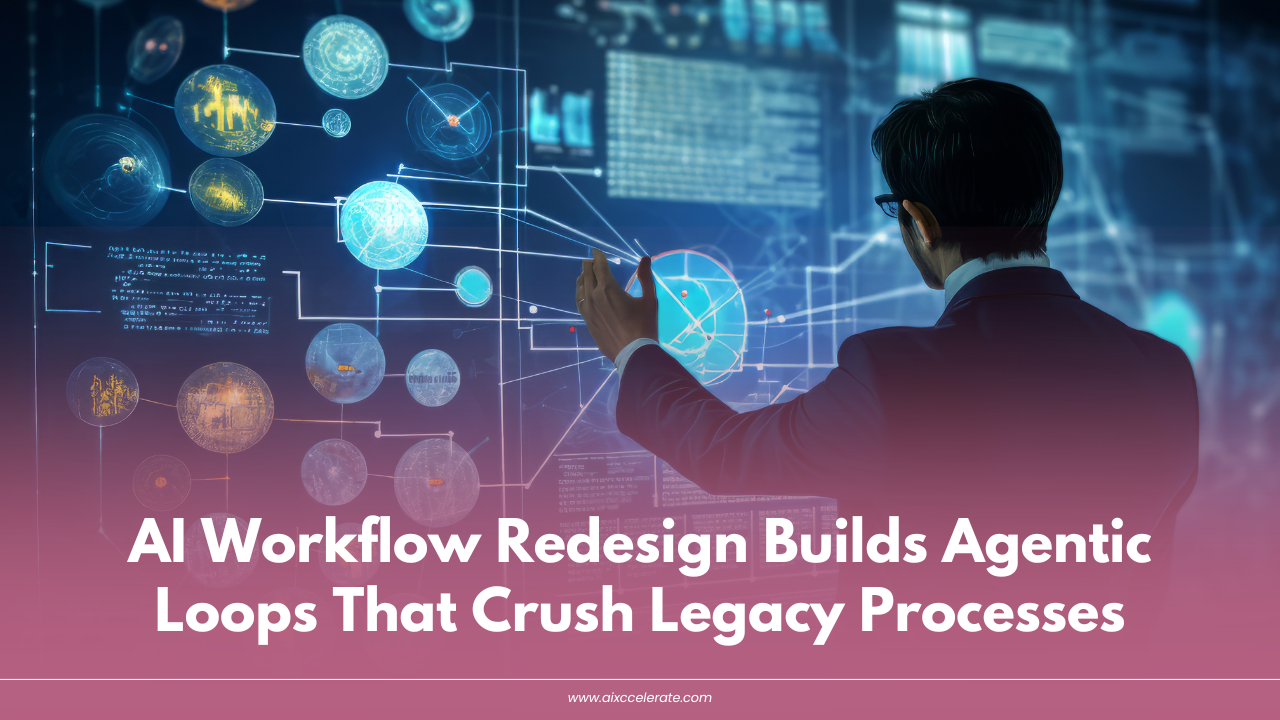
In today's fast-evolving business landscape, SMB leaders are racing to harness AI agents and agentic AI for competitive edge. But here's the harsh truth: simply bolting generative AI tools onto legacy processes will not cut it. As top agentic AI trends for 2026 reveal, the first teams building AI-native workflows will dominate enterprise automation.
This blog dives deep into AI workflow redesign, showing you how to rethink work from scratch for self-optimizing AI agents. We will use a real marketing workflow example involving content creation and campaign launch to contrast "before AI" drudgery with agentic AI-native efficiency. SMBs adopting these strategies can slash costs by 40-60%, boost output five times, and outpace rivals stuck in outdated loops.
Why Legacy Workflows Fail with AI Agents
Traditional workflows treat humans as the central cog, with rigid steps such as emails, meetings, and manual reviews. Adding AI agents to these workflows, for example by using ChatGPT for drafting, only creates bottlenecks. Data silos persist, handoffs multiply errors, and the potential of agentic AI remains untapped.
Agentic AI trends for 2026 highlight a shift. AI agents are not merely tools. They function as autonomous decision-makers within self-optimizing AI workflows. McKinsey reports that enterprise AI automation using agentic systems could automate 70% of knowledge work by 2027. However, 80% of SMBs fail because they do not redesign workflows from the ground up.
The solution is AI workflow redesign, which begins by shifting from tasks to loops. Linear processes are replaced with cyclical, adaptive systems where AI agents sense, plan, act, and learn. These cycles form AI-native processes that evolve without continuous human intervention.
Before AI vs. Agentic AI-Native Marketing Workflow
To understand this better, consider your SMB's monthly content marketing workflow that includes blog posts, social campaigns, and lead nurturing. The difference between the traditional workflow and the agentic AI-native approach is striking.
Before AI: The Clunky Human-Led Grind (2–3 Weeks, $5K+ Cost)
- Week 1: Ideation.The team brainstorms during a three-hourZoommeeting while a marketer researches trends manually on Google, which takes around eight hours.
- Week 2: Drafting.A writer produces the first draft in ten hours. An editor reviews the draft in Word for five hours. Email exchanges lead to four additional revisions.
- Week 3: Optimization and Launch.An SEO specialist adjusts keywords for six hours. A designer creates graphics for eight hours. A social media manager schedules posts across five platforms in four hours. Analytics review requires manual Excel pivot tables and takes three hours.
Pain Points: Silos lead to 20% rework. Teams experience burnout from repetitive tasks. Trends such as real-time AI workforce trends are often missed.
Total: More than 44 hours of work, a high error rate, and stagnant ROI.
Agentic AI-Native: Self-Optimizing Loop (48 Hours, Less Than $500 Cost)
Now consider the same workflow powered by AI agents operating within an AI-native workflow. Imagine a coordinated "Marketing Agent Swarm."
Sense Phase: A lead AI agent, powered by tools such as Grok or Claude, scans real-time data including Google Trends, competitor websites, and your CRM to identify relevant topics.
Plan Phase: An orchestrator agent breaks the work into subtasks and launches specialized agents such as an SEO agent and a writer agent.
Act Phase: The writer agent drafts an optimized post. A visual agent generates images using the Midjourney API. A social agent runs A/B tests on captions.
Learn Loop: After launch, an analytics agent evaluates performance based on clicks and conversions. Insights feed back into the system to refine the next cycle.
Result: The workflow runs ten times faster and adapts dynamically to trends in agentic AI in marketing, with built-in compliance checks. Meetings are replaced by dashboards that display ROI improvements.
This approach is not hypothetical. Companies across industries are already proving that AI workflow redesign can outperform legacy systems.
Core Principles of AI Workflow Redesign for SMBs
To build AI-native processes, SMBs should follow several proven principles designed for organizations with limited resources.
1. Map Work as Closed Loops Instead of Linear Tasks
Every process should be reframed as a feedback loop consisting of input, AI agent action, evaluation, and iteration. Tools such as LangChain or CrewAI enable agentic AI swarms where agents collaborate dynamically.
SMB Example: Customer Support
Traditional workflow: Ticket submission followed by human triage and response.
AI-native workflow: A support agent triages requests, resolves 70% autonomously, and escalates complex cases with summarized context.
2. Empower AI Agents with Autonomy and Tools
AI agents perform best when equipped with tool calling capabilities that integrate APIs for email, databases, and analytics. SMBs can use platforms such as Zapier combined with OpenAI to enable no-code enterprise AI automation.
Key capabilities include:
- Multi-agent collaboration
- Persistent memory for context
- Human oversight for critical decisions
3. Prioritize Data Flows Over Application Silos
Successful AI workflow redesign depends on unified data access. SMBs can start with cost-effective tools such as Airtable and Make.com to supply structured data to AI agents.
Pro Tip: Implement Retrieval-Augmented Generation (RAG) so agents can access proprietary knowledge, improving accuracy significantly.
4. Measure Using Agentic Metrics
Instead of traditional productivity metrics, track:
- Loop velocity (cycles per hour)
- Autonomy rate (percentage of tasks completed without human intervention)
- Optimization delta (performance improvement per cycle)
![[object Object]](https://resources.aixccelerate.com/content/images/2026/03/ctf-1773512002290-yassr5ioo0n.png)
Step-by-Step Guide: Redesign Your First AI-Native Workflow
SMB leaders can launch agentic AI workflows within a week using this five-step blueprint.
Step 1: Audit and Deconstruct (Day 1)
Choose a workflow with the most friction, such as lead qualification.
Step 2: Convert Tasks into Agents (Days 2–3)
Assign AI agents to specific tasks like prospecting or lead scoring.
Step 3: Build Feedback Loops (Day 4)
Introduce evaluation agents that analyze outcomes and retrain workflows.
Step 4: Test and Iterate (Day 5)
Pilot the workflow on a small scale and add guardrails.
Step 5: Scale with Governance
Deploy across teams with role-based access and monitoring.
Expected SMB gains include faster operations, reduced manual effort, and better real-time decision making.
![[object Object]](https://resources.aixccelerate.com/content/images/2026/03/ctf-1773512003230-lbf9o25tsri.png)
Overcoming SMB Challenges in Agentic AI Adoption
Budget limitations often stop SMBs from experimenting with AI. However, lightweight AI agents running on modern infrastructure cost only cents per run.
Skill gaps are shrinking because no-code automation platforms make AI deployment accessible to non-engineers.
Security concerns can be addressed by choosing enterprise-grade AI providers with strong compliance frameworks.
Ready to Build Your First AI-Native Workflow?
Reading about agentic AI workflows is one thing. Building them inside your business is where the real advantage begins.
At AI Xccelerate, we help SMBs transform traditional operations into AI-native workflows powered by autonomous agents. Instead of experimenting endlessly with disconnected AI tools, we design and deploy AI automation, agentic workflows, and digital AI employees that integrate directly into your marketing, sales, operations, and support systems.
Our approach focuses on:
- Identifying high-impact workflows slowing your business down
- Designingagentic AI systemsto automate decisions and repetitive tasks
- DeployingAI agents and automationthat work alongside your team
- Delivering measurable ROI through faster and more intelligent operations
Whether you want to automate marketing, streamline lead qualification, optimize operations, or deploy digital AI employees, our team helps you move from AI experimentation to real business results.
Start Your AI Transformation
If you are an SMB leader ready to redesign workflows for the agentic AI era, the best place to begin is with a strategy conversation.
👉 Visit **https://www.aixccelerate.com/** to learn how AI Xccelerate helps businesses build AI-native operations.
👉 Or schedule a discovery call to identify the first workflow your business should automate.
The companies redesigning workflows today will become tomorrow’s AI-native businesses.
The Bottom Line: Build AI-Native Now or Risk Falling Behind
For SMB leaders, the era of simply adding AI to existing workflows has ended. Agentic AI agents require AI-native processes built around adaptive loops that sense, respond, and scale.
Start with one workflow today. Over time, these intelligent loops can transform the way your business operates and allow you to move far ahead of competitors.
The only question that remains is simple:
Which workflow will you redesign first?
Frequently Asked Questions
What is AI Workflow Redesign Builds Agentic Loops That Crush Legacy Processes?
Every process should be reframed as a feedback loop consisting of input, AI agent action, evaluation, and iteration. Tools such as LangChain or CrewAI enable agentic AI swarms where agents collaborate dynamically. SMB Example: Customer Support Tra...
How does 1. map work as closed loops instead of linear tasks work?
Every process should be reframed as a feedback loop consisting of input, AI agent action, evaluation, and iteration. Tools such as LangChain or CrewAI enable agentic AI swarms where agents collaborate dynamically. SMB Example: Customer Support Tra...
How does 2. empower ai agents with autonomy and tools work?
AI agents perform best when equipped with tool calling capabilities that integrate APIs for email, databases, and analytics. SMBs can use platforms such as Zapier combined with OpenAI to enable no-code enterprise AI automation . Key capabilities i...
How does 3. prioritize data flows over application silos work?
Successful AI workflow redesign depends on unified data access. SMBs can start with cost-effective tools such as Airtable and Make.com to supply structured data to AI agents . Pro Tip: Implement Retrieval-Augmented Generation (RAG) so agents can a...
How does 4. measure using agentic metrics work?
Instead of traditional productivity metrics, track: Loop velocity (cycles per hour) Autonomy rate (percentage of tasks completed without human intervention) Optimization delta (performance improvement per cycle) Step-by-Step Guide: Redesign Your F...