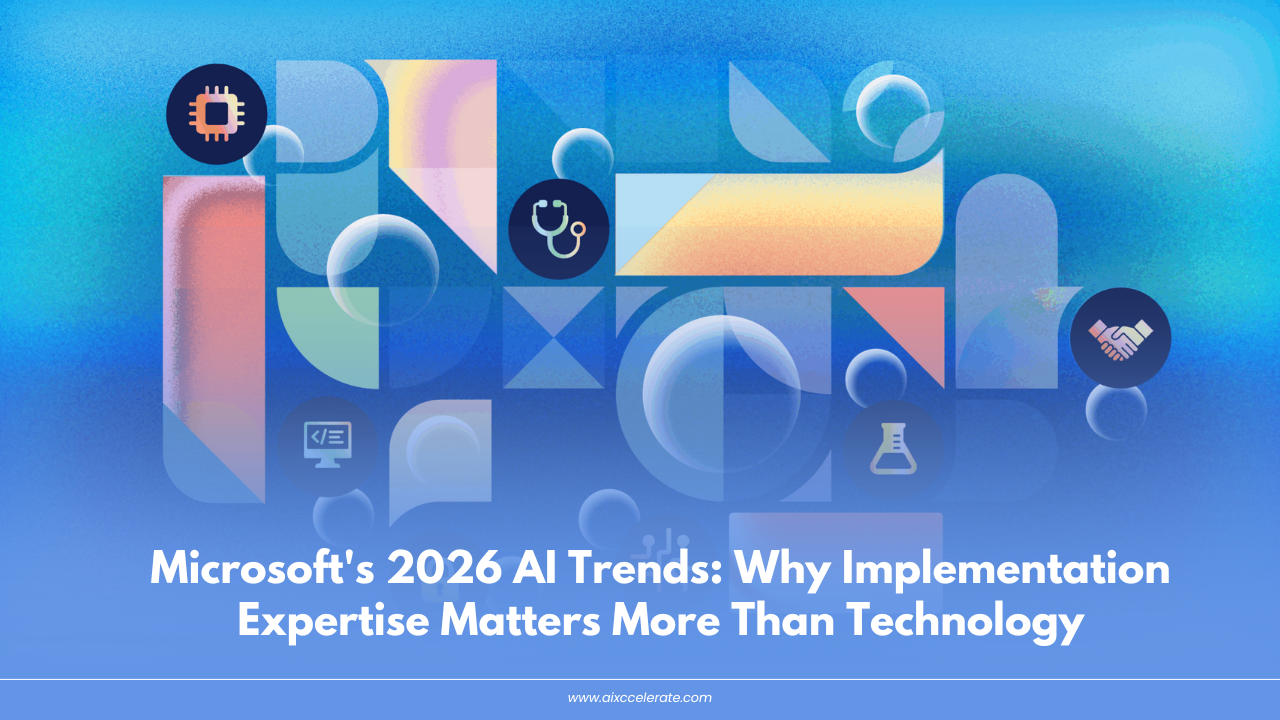
Microsoft's 2026 AI Trends: Why Implementation Expertise Matters More Than Technology
Microsoft identifies 7 AI trends for 2026, but 95% of AI pilots fail at implementation. The gap isn't technology—it's execution. As AI becomes a digital coworker, deployment expertise matters more than awareness.
Microsoft just published their outlook on seven AI trends defining 2026, and one line from their chief product officer stood out: "The future isn't about replacing humans. It's about amplifying them."
It's a compelling vision. But there's a substantial gap between understanding where AI is headed and actually capturing that value. According to industry research, 95% of AI pilots never make it to production.
The bottleneck isn't the technology—it's implementation.
Let's break down what Microsoft's trends actually mean for businesses, and more importantly, why execution matters more than awareness.
The Central Shift: AI as Collaborator
Microsoft's research points to a fundamental evolution. If 2023-2024 was about AI answering questions and 2025 was about AI reasoning through problems, 2026 is shaping up to be about genuine collaboration.
AI agents are becoming digital coworkers.
Not tools you consult. Not software you open occasionally. Teammates that handle specific functions while you maintain strategic control.
Aparna Chennapragada, Microsoft's chief product officer for AI experiences, frames it this way: AI could enable a three-person team to launch a global campaign in days, with AI managing data analysis, content generation, and personalization while humans guide strategy and creativity.
It's an appealing vision. The practical challenge? Getting from concept to deployment.
The Seven Trends and What They Actually Require
Microsoft identified seven key trends. Each one highlights not just what's possible, but what businesses need to execute successfully:
1. AI Amplifying Human Teams
- The Trend: AI agents taking on specific tasks at human direction, enabling small teams to achieve enterprise-level output.
- The Implementation Reality: This requires careful workflow integration, role definition, and change management. Teams need to understand what to delegate to AI and what requires human judgment—and that's not always obvious.
2. Security at Scale
- The Trend: As AI agents proliferate, they need identity management, access controls, and threat monitoring similar to human employees.
- The Implementation Reality: Vasu Jakkal, Microsoft's corporate VP of Security, emphasizes that "every agent should have similar security protections as humans." Building that security infrastructure requires expertise in both AI systems and enterprise security frameworks.
3. AI Closing Capability Gaps
- The Trend: Using healthcare as an example, Microsoft highlights how AI can extend expertise when skilled professionals are scarce—with WHO projecting an 11-million healthcare worker shortage by 2030.
- The Implementation Reality: Every industry faces some version of this challenge. The question isn't whether AI can help—it's how to deploy it without creating new risks or overwhelming existing teams.
4. AI in the Research Process
- The Trend: AI actively participating in discovery—generating hypotheses, controlling experiments, collaborating with researchers.
- The Broader Pattern: If AI can accelerate breakthrough research, it can certainly enhance your business analysis, competitive research, and strategic planning. But unlocking that value requires AI that understands your specific business context.
5. Smarter Infrastructure
- The Trend: Moving from "build bigger datacenters" to "optimize computing power distribution"—creating flexible, global AI systems that reduce costs while improving efficiency.
- The Implementation Reality: The infrastructure barrier to AI adoption is dropping, but navigating the options (cloud providers, model selection, architecture decisions) requires technical expertise most businesses don't have internally.
6. Repository Intelligence
- The Trend: AI learning not just code, but the context behind it—understanding relationships, history, and patterns to make smarter suggestions.
- The Key Insight: Context is everything. Generic AI tools provide generic value. AI that understands your specific business context—your processes, constraints, and goals—delivers exponentially more impact.
7. Quantum + AI Convergence
- The Trend: Quantum computing moving from "decades away" to "years away," especially with hybrid systems combining quantum, AI, and classical computing.
- What It Signals: The pace of AI advancement is accelerating, not slowing. The gap between early adopters and laggards will widen faster than most organizations expect.
Why Most Businesses Struggle with Implementation
Microsoft's trends are well-researched and credible. But acknowledging what's happening and successfully capitalizing on it are different challenges.
The implementation barriers are real:
Skills Shortage: AI expertise is expensive and hard to find. Even when you can hire, training someone on your specific business context takes months.
- Integration Complexity: Connecting AI to existing systems, data sources, and workflows isn't plug-and-play. Each business has unique technical debt and legacy systems.
- Change Management: Teams resist new workflows, especially when they're uncertain about job security or skeptical of AI's reliability.
- Measurement Challenges: Proving ROI requires baseline metrics, attribution frameworks, and ongoing analysis—work that often falls to already-stretched teams.
- Security and Compliance: Data privacy, regulatory requirements, and risk management become more complex when AI is involved.
This is where the 95% failure rate comes from. Not because the technology doesn't work, but because implementation is genuinely difficult.
The Pattern Among Successful Adopters
The businesses making meaningful progress with AI share a common characteristic: they recognized early that this isn't a DIY project.
Some built internal AI teams—a path that requires significant investment (typically 18+ months and millions in budget) with no guarantee of success.
Others partnered with specialized firms that handle the complexity—deployment, integration, security, training, and optimization.
The specific path matters less than the recognition that expertise matters. A lot.
The question isn't whether to use AI. It's whether to build that expertise internally or access it externally.
What "Amplifying Humans" Actually Looks Like
When AI implementation works well, it's almost invisible. Teams don't talk about "using AI"—they just notice they're accomplishing more with the same resources.
A three-person customer success team handles what used to require six people. A small finance team maintains controls that typically require double the headcount. A lean marketing team produces content volume that rivals agencies.
The AI isn't replacing these teams—it's handling the repetitive, data-intensive work while humans focus on judgment, strategy, and relationship building.
But getting to that state requires navigating the implementation challenges: integration, security, training, optimization, and ongoing management.
The Decision Point
Microsoft's trends outline where AI is heading. The harder question is how your organization captures that value.
You essentially have three paths:
- Continue experimentingwithout committing real resources—the approach 95% of businesses are currently taking, with predictable results.
- Build internal capabilities—hire AI experts, invest in infrastructure, develop deployment processes. This works for larger organizations with substantial budgets and long time horizons.
- Partner with specialistswho've already solved the implementation challenges and can deploy proven solutions quickly.
There's no universal right answer. The choice depends on your resources, timeline, competitive pressure, and risk tolerance.
But the one approach that clearly doesn't work? Waiting for AI to somehow become simpler while competitors gain 18-24 months of learning and optimization advantage.
Moving from Awareness to Action
The gap between knowing AI is important and actually deploying it successfully is where most businesses get stuck.
Microsoft's trends provide valuable context on where AI is heading. But trends don't deliver ROI—implementation does.
If you're serious about moving from experimentation to execution, the critical step is honest assessment:
- Do you have the internal expertise to deploy AI successfully?
- Can you dedicate the resources (time, budget, people) this requires?
- How much competitive advantage are you leaving on the table by delaying?
For some businesses, the answer is building internal capabilities over 18+ months. For others, the faster path is partnering with experts who've already navigated these challenges.
The companies that will lead in 2026 aren't the ones with the best AI strategy decks. They're the ones who recognized that implementation expertise is the actual competitive advantage.
At AI Xccelerate, we've built specialized AI agents for sales, marketing, and customer success—and more importantly, we've solved the implementation challenges that prevent most deployments from reaching production. If you're exploring whether external expertise makes sense for your organization, we're happy to share what we've learned.
But regardless of the path you choose, the key is choosing one. The window for competitive advantage won't stay open indefinitely.
Find the full report here: https://news.microsoft.com/source/features/ai/whats-next-in-ai-7-trends-to-watch-in-2026/
Frequently Asked Questions
What is Microsoft's 2026 AI Trends Why Implementation Expertise Matters More Than Technology?
Microsoft's research points to a fundamental evolution. If 2023-2024 was about AI answering questions and 2025 was about AI reasoning through problems, 2026 is shaping up to be about genuine collaboration. AI agents are becoming digital coworkers....
How does the central shift: ai as collaborator work?
Microsoft's research points to a fundamental evolution. If 2023-2024 was about AI answering questions and 2025 was about AI reasoning through problems, 2026 is shaping up to be about genuine collaboration. AI agents are becoming digital coworkers....
How does the seven trends and what they actually require work?
Microsoft identified seven key trends. Each one highlights not just what's possible, but what businesses need to execute successfully: 1. AI Amplifying Human Teams The Trend: AI agents taking on specific tasks at human direction, enabling small te...
Why Most Businesses Struggle with Implementation?
Microsoft's trends are well-researched and credible. But acknowledging what's happening and successfully capitalizing on it are different challenges. The implementation barriers are real: Skills Shortage: AI expertise is expensive and hard to find...
How does the pattern among successful adopters work?
The businesses making meaningful progress with AI share a common characteristic: they recognized early that this isn't a DIY project. Some built internal AI teams—a path that requires significant investment (typically 18+ months and millions in bu...