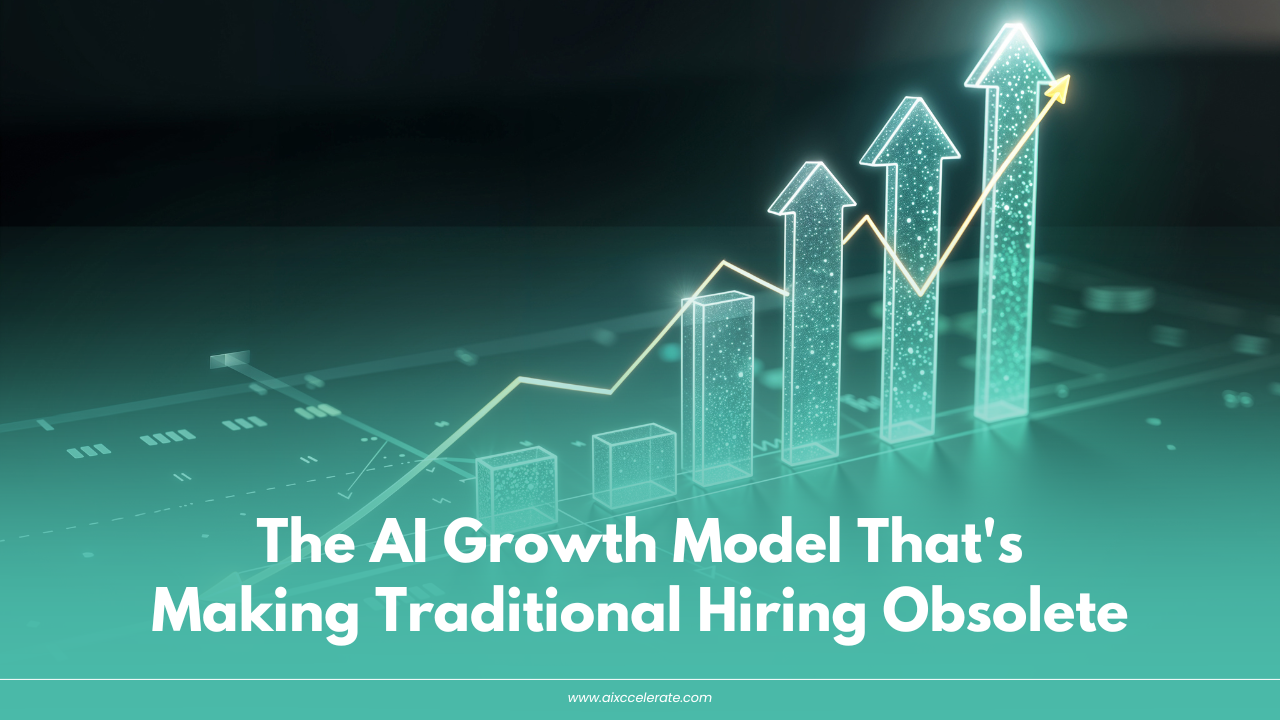
The AI Growth Model That's Making Traditional Hiring Obsolete
The hidden cost of traditional hiring is crushing SMB margins. AI workforces now let 20-person teams unlock the output of 100-person orgs without matching payroll, transforming how modern businesses scale.
For decades, the growth equation for small and medium businesses has been brutally simple: more revenue requires more people. Want to close more deals? Hire another SDR. Growing your customer base? Add a customer success manager. Launching a new market? Bring on a sales coordinator.
This model worked — until it didn't.
Today, payroll is the single largest operating expense for every growing SMB, steadily compressing margins and limiting competitiveness. And yet, most business leaders continue to treat hiring as the only path to scaling revenue. In 2026, that assumption is not just outdated — it is existentially dangerous.
AI workforce platforms are decoupling revenue growth from headcount growth. And the SMB leaders who grasp this early will structurally outcompete those who do not.
The Linear Growth Trap That's Quietly Killing SMB Margins
If you run a B2B business with 10 to 250 employees, you already feel this pain. Every time revenue targets go up, the instinct is to add headcount. More pipeline? More SDRs. More customers? More support staff.
The math seems logical until you look at the fully loaded cost of a single revenue hire in North America — between $60,000 and $80,000 per year, once you factor in salary, benefits, taxes, training, and overhead. Scale that across a 5-person revenue team and you are looking at $300,000 to $400,000 annually just to maintain your current operations, let alone grow them.
Meanwhile, those same human roles come with inherent limitations: they work 8 hours a day, operate in a single language, take sick days, need onboarding time, and require constant management bandwidth.
This is the linear growth trap. And for SMBs, there is no escape from it — unless you fundamentally change the equation.
What AI Is Actually Changing: It's Not Automation, It's Workforce Economics
There is a critical distinction that most business leaders miss when they think about AI adoption.
AI is not just about automating tasks. It is about restructuring the economics of how work gets done.
The real shift is this: for the first time in history, a 20-person company can operate with the revenue execution power of a 100-person organization — without the payroll to match. AI workforce platforms deploy what are effectively AI revenue employees: agents that execute marketing campaigns, handle sales coordination, manage customer success, and work 24 hours a day, 7 days a week, in multiple languages, at roughly one-third to one-fourth the cost of a comparable human role.
This is not incremental efficiency improvement. This is a structural shift in how SMBs scale.
The companies that adopt AI-native workforce models early will not just be more efficient — they will be structurally impossible to compete with for businesses that are still scaling the old way.
The Real Cost Comparison: AI Revenue Employees vs. Human Hires
Let's make this concrete. Consider a typical B2B company with 50 employees planning to expand its sales team by hiring two additional SDRs over the next 12 months.
Traditional Hiring Model:
- 2 SDRs × $75,000 fully loaded cost = $150,000 annual incremental payroll
AI Workforce Model:
- 2 AI revenue agents × $20,000 per year = $40,000 annual investment
That is $110,000 in net annual savings — a 2.75x ROI with an estimated payback period of around 4 months.
But the financial case goes deeper than just cost savings. AI revenue agents bring capabilities that no single human hire can match:
- 3–5x output multiplier compared to a comparable human role
- Zero downtime — no sick days, no vacation, no turnover
- Multilingual execution across markets without additional headcount
- Consistent, scalable performance that improves over time rather than degrading
For SMB leaders facing margin pressure and increasing competition, this is not a nice-to-have. It is a competitive necessity.
Why "We'll Try AI Tools" Is Not Enough
Many business leaders have experimented with AI point tools — ChatGPT for content, a chatbot for the website, some automation workflows in their CRM. And while these tools can add value, they miss the fundamental opportunity entirely.
Here is why: AI tools assist. AI employees execute.
A tool gives your human team a capability boost. An AI workforce platform replaces the need for incremental headcount altogether. These are completely different value propositions — and they capture completely different budget lines.
When you buy a software tool, you are spending from a discretionary software budget. When you deploy an AI workforce platform, you are redirecting budget that would have gone to payroll. Payroll budgets are existential. Software budgets are discretionary. That distinction matters enormously — both for the ROI calculation and for the staying power of your investment.
The SMBs that are winning right now are not the ones experimenting with AI chatbots. They are the ones restructuring their revenue operations around AI workforce infrastructure — replacing incremental hiring with scalable AI execution.
The Five Forces Making This the Right Moment for SMBs
The timing of this shift is not accidental. Five forces have converged to make AI-native workforce models viable right now:
- LLM Capability Has Crossed the Execution Threshold Large language models can now reason, plan, and reliably execute complex multi-step tasks. The gap between what AI could do and what businesses actually needed closed in 2025.
- Multimodal AI Is Production-Ready Voice-based AI, video, and real-time conversational agents are no longer experimental features. They are deployable, reliable, and scalable across customer-facing revenue operations.
- Integration Ecosystems Are Mature CRMs like HubSpot and Salesforce, communication platforms, and business tools all have open APIs. AI agents can now be deeply embedded into existing revenue systems rather than sitting on top of them.
- SMB Cost Pressure Is Intensifying Payroll inflation, competitive pressure from larger enterprises, and tightening margins are forcing SMBs to find new ways to scale output without scaling cost.
- Revenue Role Talent Shortages Persist Finding, training, and retaining SDRs, sales coordinators, and customer success managers remains expensive and time-consuming. AI workforce deployment eliminates the hiring bottleneck entirely.
The infrastructure required to make all of this work — multi-agent orchestration, system-level integration, continuous management and optimization — is now technically available. The window to adopt early and gain competitive advantage is open right now.
What an AI-Native Revenue Team Actually Looks Like
An AI-native SMB revenue team does not replace every human in the organization. It restructures how the team is composed — embedding AI agents alongside human talent to multiply execution capacity.
In practice, this means deploying specialized AI agents across the three core revenue functions:
Marketing Agent (Jules): Executes fully autonomous, contextually intelligent outreach campaigns, drives content-based marketing, replaces SDR functions and agency spend on marketing execution.
Sales Agent (Joy): Handles sales coordination, fills expertise gaps with product knowledge, supports presales functions, and accelerates deal closure without adding human sales coordinators.
Customer Success Agent (George): Manages customer onboarding, maintains customer health metrics, handles support requests around the clock in multiple languages, and grows accounts through proactive engagement.
Each of these agents is not a chatbot bolted onto your website. They are deeply integrated into your existing systems — your CRM, your communication platforms, your customer data — and continuously managed and optimized for performance.
What SMB Leaders Need to Do Right Now
The structural shift is underway. The question is not whether AI workforce platforms will change how SMBs compete — it is whether your business will be positioned to benefit or get left behind.
Here is where to start:
Audit your next hire. Before you post your next revenue role job description, ask whether that function could be executed by an AI workforce agent. Calculate the real cost comparison. The math is often overwhelming.
Stop thinking tools, start thinking workforce. Evaluate AI vendors not on what features they offer, but on whether they are positioning you to replace incremental headcount or simply adding another software subscription.
Prioritize integration depth. The value of AI workforce platforms comes from deep system integration — agents that work inside your CRM, your communication stack, your customer data. Surface-level automation will not move the needle.
Think long term about switching costs. Once AI workforce infrastructure is embedded in your revenue operations, it becomes very difficult to unwind. Choose your platform carefully, because it will become your competitive architecture.
The next generation of winning SMBs will not be the ones with the largest human revenue teams. They will be the ones that built AI-native revenue organizations early — and used that structural advantage to outcompete businesses still scaling the old way.
The equation has changed. Revenue scales. Headcount does not have to.
Ready to Stop Scaling Payroll and Start Scaling Revenue?
See exactly what an AI revenue employee would cost versus your next hire — and what it would deliver.
👉 Book an AI Discovery Session
The next generation of winning SMBs will not be the ones with the largest human revenue teams. They will be the ones that built AI-native organizations first. Don't let your competitors get there before you.
Frequently Asked Questions
What is AI Growth Model That's Making Traditional Hiring Obsolete?
If you run a B2B business with 10 to 250 employees, you already feel this pain. Every time revenue targets go up, the instinct is to add headcount. More pipeline? More SDRs. More customers? More support staff. The math seems logical until you look...
How does the linear growth trap that's quietly killing smb margins work?
If you run a B2B business with 10 to 250 employees, you already feel this pain. Every time revenue targets go up, the instinct is to add headcount. More pipeline? More SDRs. More customers? More support staff. The math seems logical until you look...
What AI Is Actually Changing: It's Not Automation, It's Workforce Economics?
There is a critical distinction that most business leaders miss when they think about AI adoption. AI is not just about automating tasks. It is about restructuring the economics of how work gets done. The real shift is this: for the first time in ...
How does the real cost comparison: ai revenue employees vs. human hires work?
Let's make this concrete. Consider a typical B2B company with 50 employees planning to expand its sales team by hiring two additional SDRs over the next 12 months. Traditional Hiring Model: 2 SDRs × $75,000 fully loaded cost = $150,000 annual incr...
Why "We'll Try AI Tools" Is Not Enough?
Many business leaders have experimented with AI point tools — ChatGPT for content, a chatbot for the website, some automation workflows in their CRM. And while these tools can add value, they miss the fundamental opportunity entirely. Here is why:...