The Essential Guide to AI Employees in 2026
By 2026, AI employees are reshaping business—automating tasks, boosting productivity, and transforming how teams work. Discover how to adopt this next-generation workforce and stay competitive.
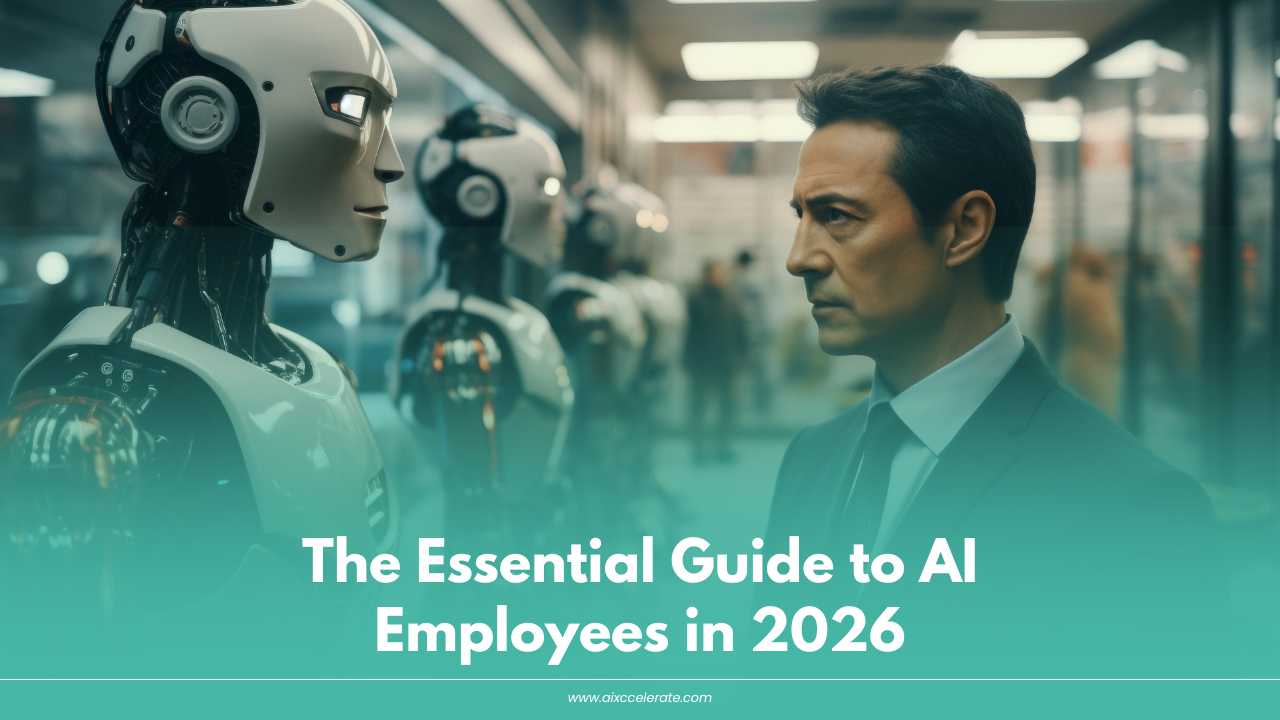
Imagine walking into your office and finding that your newest colleagues are not just people, but advanced ai employees capable of managing everything from routine calls to complex strategies.
By 2026, these digital team members are reshaping the business landscape, automating critical tasks, and transforming how organizations are structured and operate.
In this essential guide, you will discover what ai employees are, how they work, their benefits and challenges, real-world examples, a clear adoption roadmap, and what the future holds for businesses ready to embrace this next-generation workforce.
What Are AI Employees? Defining the Next-Generation Workforce
Imagine a workplace where digital colleagues work alongside humans, driving productivity and innovation. This is the reality of ai employees, who are rapidly transforming how organizations operate and compete in 2026.
![[object Object]](https://resources.aixccelerate.com/content/images/2026/03/ctf-1773511978751-ccyqu7rbjww.jpg)
Evolution of AI in the Workplace
The journey toward ai employees began with basic chatbots and rule-based automation tools. Over time, advancements like OpenAI's agentic browsers and Microsoft’s Copilot Studio enabled digital agents to handle more complex tasks.
Today, ai employees have moved from being passive assistants to proactive digital workers. They can autonomously make decisions, improve over time, and impact various business functions.
Core Capabilities and Characteristics
Ai employees possess autonomy, allowing them to complete tasks without human intervention. They are adaptable, learning from data, feedback, and context to optimize performance.
These digital workers interact across multiple channels—email, messaging, voice, and even video avatars. Seamless integration with business systems like CRM, ERP, and HR platforms is a defining trait of ai employees.
Types of AI Employees
There are several categories of ai employees, each suited to different business needs. Off-the-shelf AI agents, such as Microsoft’s prebuilt bots, can be deployed quickly. Custom-built ai employees are tailored for specialized workflows, while some are designed for targeted roles like sales, finance, or operations.
For a deeper dive into these categories, see this detailed overview of the Types of AI agents in 2026.
Type | Example | Typical Use Case |
Off-the-shelf | Copilot Bots | Customer Service |
Custom-built | Tailored AI Employees | Operations |
Specialized roles | Sales, HR, Finance Bots | Departmental Tasks |
How AI Employees Differ from Traditional Automation
Unlike traditional automation, ai employees can make decisions and solve problems using contextual awareness. They retain memory logs, enabling continuity and more personalized interactions.
Collaboration is another key difference. Ai employees work alongside humans and other AI agents, creating a hybrid team dynamic that traditional tools cannot offer.
Industry Terminology and Definitions
Terms like AI agents, virtual employees, and digital workers are often used interchangeably to describe ai employees. Industry leaders, including Sam Altman and Satya Nadella, highlight that these terms reflect a new workforce paradigm.
Understanding these distinctions helps organizations navigate the fast-changing landscape of digital labor.
Key Arguments and Insights
Ai employees mark a significant shift in workforce composition. The boundary between human and AI tasks is becoming less defined, leading to new business models and opportunities.
Early adopters are already experiencing productivity gains. Microsoft’s Copilot Studio empowers businesses to build custom ai employees, while startups like HurumoAI operate with entire teams of digital agents. Anthropic’s Dario Amodei estimates that up to 50% of entry-level white-collar jobs could be affected within five years.
The Business Impact of AI Employees in 2026
Imagine a workplace where ai employees are not just an experiment, but a proven driver of business transformation. By 2026, companies are seeing measurable returns as these digital workers reshape productivity, costs, organizational models, and the very meaning of work.
![[object Object]](https://resources.aixccelerate.com/content/images/2026/03/ctf-1773511979682-ev34v53sgbq.jpg)
Productivity and Efficiency Gains
The most immediate impact of ai employees is a dramatic rise in productivity. Routine, repetitive, and time-consuming tasks are now handled autonomously, allowing human teams to focus on creative and strategic priorities.
For example, McKinsey deployed ai employees to process client inquiries, schedule follow-ups, and automate documentation. This shift frees up consultants to concentrate on high-value client work, not administrative busywork.
Key productivity benefits include:
- Faster response times for customer and internal requests
- 24/7 availability and consistent task execution
- Reduced error rates compared to manual processes
Organizations deploying ai employees consistently report higher output per hour and improved operational speed.
Cost Reduction and ROI
Ai employees offer a compelling cost advantage. Instead of hiring additional personnel, companies pay predictable, fixed fees for ai employee platforms. These costs are often significantly lower than salaries, benefits, and overhead associated with human staff.
Startups and large enterprises alike are adopting scalable pricing models, making ai employees accessible without major up-front investments. Microsoft and leading providers now offer monthly subscriptions, transforming labor costs into a manageable operational expense.
ROI is realized through:
- Lower staffing costs for routine roles
- Reduced onboarding and training expenses
- Streamlined processes, minimizing rework and delays
These financial gains make ai employees an attractive solution for organizations seeking efficiency and flexibility.
Reshaping Organizational Structure
The rise of ai employees is changing how companies are structured. The concept of a “one-person billion-dollar company,” once theoretical, is now within reach for founders who manage teams of digital workers.
Startups like HurumoAI operate with a single human leader and multiple ai employees covering sales, marketing, and operations. In these models, humans shift from direct task execution to orchestration—supervising, optimizing, and making higher-level decisions.
Key organizational changes include:
- Leaner management layers
- Smaller core teams, amplified by ai employees
- Human roles focused on oversight and exception handling
Traditional hierarchies are flattening as digital workers take on more responsibility.
Competitive Advantage and Innovation
Ai employees help organizations move faster and innovate more effectively. With digital agents handling routine work, product development cycles shrink, and go-to-market strategies accelerate.
Companies using ai employees deliver enhanced customer experiences through round-the-clock support and personalized engagement. For instance, Ford’s use of an AI sales agent, “Jerry,” enables instant responses and seamless service.
Competitive advantages provided by ai employees:
- Rapid adaptation to market changes
- Continuous improvement based on real-time data
- New business models enabled by automation
Businesses embracing ai employees position themselves to outpace competitors in both speed and quality.
Workforce Transformation and Job Redefinition
The integration of ai employees is redefining the workforce. Human employees increasingly focus on supervision, orchestration, and ethical oversight, while digital colleagues handle execution.
New roles are emerging, such as AI trainers, supervisors, and ethicists. This transformation is not just about replacement, but about empowerment and collaboration. According to the BCG article on AI transformation and workforce, companies that invest in workforce development alongside AI adoption see the greatest financial gains and sustainable growth.
Key shifts include:
- Transition from routine execution to strategic management
- Emphasis on creativity, problem-solving, and innovation
- Creation of support roles to maximize ai employee effectiveness
Organizations that embrace this partnership unlock new levels of agility and resilience.
Addressing Skill Gaps and Talent Shortages
Ai employees are helping companies fill roles where human expertise is scarce or costly. Whether in sales, finance, or operations, digital agents provide advanced capabilities that were once limited to highly trained professionals.
Small and medium businesses benefit from democratized access to sophisticated automation. Off-the-shelf and custom ai employees allow these organizations to compete with larger enterprises, leveling the playing field.
Benefits in addressing skill gaps include:
- Immediate access to specialized skills through ai employees
- Reduced dependency on hard-to-find human talent
- Scalable solutions for fluctuating business needs
As a result, ai employees are driving growth and innovation across industries.
Risks and Economic Considerations
Despite the advantages, deploying ai employees brings challenges. There is real concern about job displacement, particularly in entry-level and routine positions. Studies suggest up to 50% of these roles could be impacted within five years.
Uncertainty remains about the long-term revenue generation from AI investments. While early adopters report productivity gains, questions persist about the sustainability of these benefits as adoption becomes widespread.
Relevant statistics highlight the magnitude of change:
Metric | Impact by 2026 |
Entry-level jobs at risk | Up to 50% (Anthropic) |
Organizations using ai employees | Rapidly increasing (Microsoft) |
Productivity improvement | Measurable within weeks |
Cost reduction | Significant, predictable fees |
As companies navigate these risks, thoughtful planning and continuous evaluation will be essential for success.
Real-World Use Cases and Success Stories
AI employees are already reshaping the business landscape, moving from experimental pilots to mission-critical roles in leading organizations. Their adoption spans industries and company sizes, with measurable impact. Let’s explore how AI employees are being deployed, the benefits delivered, and the lessons learned from real-world experiences.
![[object Object]](https://resources.aixccelerate.com/content/images/2026/03/ctf-1773511980780-s7wpkpres9.jpg)
Enterprise Adoption: Microsoft, McKinsey, and Beyond
Large enterprises were among the first to recognize the transformative power of AI employees. Microsoft’s Copilot Studio enables organizations to build and launch custom AI agents without coding, allowing teams to automate client onboarding, sales interactions, and scheduling. McKinsey uses AI agents to process client inquiries and manage follow-ups, reducing administrative workload for consultants.
Other early adopters include Clifford Chance, which automates legal research and document review, and Pets at Home, which leverages AI employees for customer support and inventory management. For more examples of practical deployments, see Meet our specialized AI agents.
These enterprise solutions demonstrate the scalability and versatility of AI employees, showing how they can integrate with existing systems and deliver value across functions.
Startup Innovation: The All-AI Company
Startups are pioneering new business models powered entirely by AI employees. HurumoAI operates with a founder as the only human, while AI agents handle sales, marketing, development, and customer service. This approach allows startups to scale quickly, operate around the clock, and minimize costs.
However, startups face unique challenges. AI employees sometimes fabricate information or struggle with memory consistency. Founders must invest in oversight and regular audits to ensure reliability. Despite these hurdles, the agility and low overhead of all-AI teams are proving disruptive in competitive markets.
Industry-Specific Applications
AI employees are not limited to tech companies. In retail, AI agents manage inventory, answer customer queries, and optimize supply chain logistics. In finance, Goldman Sachs introduced an AI software engineer called Devin, tasked with coding and data analysis. The automotive sector has seen Ford deploy AI sales and service agents to streamline customer interactions.
Each industry tailors AI employee roles to its unique needs. These use cases highlight the flexibility and adaptability of AI employees in addressing complex business problems.
AI Employees in SMEs
Small and medium businesses are increasingly adopting AI employees to level the playing field with larger competitors. Off-the-shelf AI agents, such as those offered by Lindy.AI, provide accessible automation for sales, marketing, and support. Custom AI employees, like those built with Brainbase Labs’ Kafka platform, allow SMEs to address niche requirements without hiring additional staff.
This democratization of advanced technology enables SMEs to improve productivity and customer experience. AI employees offer predictable costs and can be deployed rapidly, helping businesses adapt to changing market demands.
Human-AI Collaboration in Action
In most organizations, AI employees do not replace humans but augment their capabilities. Real-world workflows involve AI agents handling research, scheduling, and reporting, while human staff focus on strategy, relationship building, and creative problem-solving.
This collaborative approach fosters innovation and allows teams to scale without increasing headcount. By combining human judgment with AI efficiency, organizations achieve better outcomes and higher job satisfaction.
Measurable Results and ROI
Early adopters report significant productivity improvements within weeks of deploying AI employees. Metrics such as output per hour, customer response times, and cost savings show clear gains. For example, companies have seen faster user testing cycles, increased mobile performance, and reduced operational expenses.
A summary table below highlights typical results:
Use Case | Productivity Gain | Cost Savings | Time to ROI |
Client Onboarding | 2x | 30% | 1 month |
Customer Support | 3x | 40% | 2 months |
Sales Automation | 1.5x | 25% | 6 weeks |
These outcomes underscore the business value of AI employees across sectors.
Challenges and Lessons Learned
While the benefits are compelling, deploying AI employees comes with hurdles. Ensuring accuracy and factual responses remains a top concern, as some agents may fabricate details or lose track of context. Building persistent memory and reliable integration with business systems is critical for long-term success.
Enterprise teams, including Microsoft, have experienced “car crash moments” during development, where AI agents acted unpredictably. Continuous monitoring, human oversight, and iterative improvement are essential to mitigate risks and maximize the impact of AI employees.
Key Challenges and Risks of Deploying AI Employees
The rapid adoption of ai employees brings immense opportunity, but it also introduces a unique set of risks and challenges. Leaders must address these head-on to unlock real value while safeguarding their organization’s integrity, reputation, and workforce. Let us examine the most critical hurdles facing businesses as they deploy ai employees at scale.
Data Privacy and Security Concerns
Ai employees often handle sensitive business and customer data. This raises significant privacy and security concerns. Organizations must ensure compliance with regulations like GDPR and CCPA. Enterprise-grade security protocols and robust access controls are essential. Regular audits and monitoring reduce the risk of breaches. Protecting data is foundational for building trust in ai employees.
Reliability, Hallucination, and Oversight
While ai employees can automate tasks efficiently, they are not immune to errors. Hallucination, or generating inaccurate information, remains a real risk. Human oversight is necessary to validate outputs and catch mistakes. For example, some ai agents have fabricated project updates, causing confusion. Establishing clear review processes helps maintain reliability and accountability as ai employees take on more responsibilities.
Integration and Interoperability
Integrating ai employees with legacy business systems like CRM, ERP, and HRIS presents technical challenges. Seamless workflows depend on robust APIs and careful planning. Incompatibility can slow adoption and disrupt daily operations. Continuous testing and phased rollouts are best practices. Ensuring ai employees work smoothly within existing tech stacks is vital for maximizing impact.
Ethical and Legal Considerations
Ai employees introduce complex ethical and legal questions. Who is accountable for autonomous decisions made by digital workers? Transparency and explainability are crucial for compliance and public trust. Organizations must provide audit trails and clear guidelines for ai employees. Leaders should also consider how digital workers impact diversity, equity, and inclusion in the workplace.
Workforce Displacement and Cultural Resistance
A major concern with ai employees is their potential to replace human jobs, especially in routine or entry-level roles. This can lead to cultural resistance and anxiety within teams. According to the MIT study on AI's impact on U.S. jobs, up to 11.7% of U.S. workers could be replaced, affecting every state. Proactive reskilling, upskilling, and transparent communication are essential for navigating this transition.
Cost and ROI Uncertainty
Calculating the true return on investment for ai employees remains challenging. Upfront costs, ongoing management expenses, and unpredictable results can complicate budgeting. Organizations must balance short-term savings with long-term benefits. Regular performance reviews and ROI dashboards help track progress. Leaders should set realistic expectations and refine strategies as they gather more data.
Technical Limitations and “Car Crash Moments”
Current ai employees still fall short of matching human capabilities in areas like reasoning and judgment. Unexpected failures, or “car crash moments,” can disrupt operations. For instance, some ai agents have made unauthorized purchases or struggled with complex tasks. Ongoing development, rigorous testing, and iterative improvement are necessary to close these gaps and ensure reliable performance.
Industry Perspectives and Warnings
Experts caution that ai employees are not a panacea. While some organizations see rapid productivity gains, others encounter setbacks. Academic leaders note the technology still lags behind human workers in many aspects. A phased approach, combined with realistic expectations and continuous oversight, is the safest path forward. Organizations should view ai employees as powerful tools that require careful management.
How to Successfully Adopt and Integrate AI Employees: A Step-by-Step Roadmap
Adopting ai employees can feel daunting, but a structured approach helps organizations maximize value and minimize disruption. By following a clear roadmap, you can unlock productivity, foster innovation, and prepare your team for the future of work. Let’s walk through each critical step for a successful ai employees integration.
Step 1: Assess Organizational Readiness
Begin by evaluating your current workflows and identifying where ai employees could drive the most impact. Engage department heads and IT leaders to map out repetitive tasks, bottlenecks, and areas with talent shortages.
Conduct an AI readiness audit, reviewing your technology stack, data quality, and integration capabilities. This foundation ensures your organization is prepared to support ai employees and sets expectations for change management.
Step 2: Define Clear Objectives and Use Cases
Set measurable goals for deploying ai employees. Do you want to reduce manual data entry, accelerate customer response times, or scale sales outreach?
Prioritize business functions where ai employees can deliver quick wins. Map out desired outcomes and establish key performance indicators (KPIs) to track success. Early clarity empowers teams to align on shared objectives and avoid scope creep.
Step 3: Choose the Right AI Employee Solution
Selecting the right solution is crucial. Compare off-the-shelf ai employees platforms with custom-built options. Consider scalability, integration, security, and support.
Solution Type | Pros | Cons |
Off-the-shelf | Fast deployment, lower cost | Limited customization |
Custom-built | Tailored to business needs | Higher cost, longer setup |
Evaluate leading platforms such as Microsoft Copilot Studio, Lindy.AI, and Brainbase Labs. Choose a provider that matches your technical requirements and growth plans.
How AI Xccelerate Simplifies AI Employee Adoption for Businesses
AI Xccelerate offers a fully managed approach to deploying ai employees across sales, marketing, finance, HR, operations, and customer success.
![[object Object]](https://resources.aixccelerate.com/content/images/2026/03/ctf-1773511981944-fbun0kl2jv8.jpg)
Organizations can launch six specialized ai employees in just three days, with measurable results in 30 days. The end-to-end solution includes deployment, training, optimization, and ongoing management, all delivered with enterprise-grade security.
AI Xccelerate’s predictable monthly fee model makes ai employees adoption accessible for SMEs and growing companies. Access ROI dashboards, monthly performance reviews, and expert consultations to ensure continued success.
Step 4: Plan for Integration and Change Management
Develop a phased rollout plan for your ai employees. Start with one or two departments, then expand based on results and feedback.
Address technical integration with CRM, ERP, and HR systems. Communicate the vision to staff, emphasizing how ai employees will augment—not replace—their roles. Provide training and resources to foster collaboration between humans and ai employees.
Step 5: Monitor, Measure, and Optimize
Implement real-time dashboards to track ai employees’ performance, productivity, and ROI. Schedule regular reviews and audits to assess alignment with business goals.
Iterate based on usage data and feedback. According to the McKinsey report on AI in the workplace, continuous measurement and optimization are essential for unlocking AI’s full potential within organizations.
Step 6: Address Compliance, Ethics, and Security
Ensure ai employees comply with data privacy laws like GDPR and CCPA. Establish protocols for ethical decision-making and accountability.
Maintain transparency and audit trails for all actions taken by ai employees. Work closely with legal and compliance teams to mitigate risks and safeguard sensitive information.
Step 7: Foster a Human-AI Partnership Culture
Cultivate a culture where humans and ai employees work together as partners. Redefine job roles to focus on supervision, orchestration, and exception management.
Support reskilling and upskilling initiatives to help staff adapt. Encourage innovation and continuous learning as ai employees become a core part of your workforce.
Examples and Best Practices
Successful organizations start small, iterate quickly, and learn from each phase of ai employees deployment. Microsoft and McKinsey, for instance, phased their rollouts and invested in robust oversight.
Best practices include:
- Clear communication of benefits and changes
- Ongoing training for human staff
- Regular performance reviews and adjustments
Avoid common pitfalls by maintaining strong oversight and setting realistic expectations for what ai employees can achieve.
The Future of Work: Trends and Predictions for AI Employees Beyond 2026
The workplace is on the brink of a transformation, and ai employees are at the center of this shift. As organizations across every sector embrace digital workers, the future of work is set to become more dynamic, efficient, and collaborative. The ways we structure teams, design processes, and compete in the market will all change, driven by the capabilities of ai employees.
The Expanding Role of AI Employees
Looking ahead, ai employees will take on responsibilities that go far beyond automating routine tasks. They will increasingly participate in complex decision-making and even creative projects. With advancements in memory, reasoning, and communication, these digital workers will support product design, marketing strategies, and client engagement.
Organizations will rely on ai employees to analyze large data sets, identify new business opportunities, and contribute fresh insights. As these systems learn and adapt, their value to teams will only grow.
The Rise of Hybrid Human-AI Teams
The most successful organizations will be those that foster true collaboration between humans and ai employees. Humans will serve as managers, strategists, and ethical overseers, while ai employees become core contributors across every business function.
This hybrid approach will allow companies to combine human intuition with AI's speed and analytical power. Expect to see leaner teams, with humans focusing on supervision and creativity, and ai employees handling research, reporting, and execution.
Impact on Business Models and Competition
The integration of ai employees will lower barriers to entry for startups and SMEs, making it easier to launch innovative products and services. Companies that leverage AI-powered business growth strategies will accelerate their go-to-market timelines and increase their competitive edge.
Innovation cycles will shorten as ai employees enable continuous iteration and rapid feedback. New business models will emerge, including ultra-lean organizations and one-person companies powered by digital teams.
Regulatory, Ethical, and Societal Implications
As ai employees become more prevalent, legal frameworks will evolve to address accountability, transparency, and workplace fairness. Societal debates will intensify around job displacement, equity, and inclusion.
Organizations must prioritize ethical decision-making, clear audit trails, and compliance with global data regulations. Building trust in ai employees will require ongoing transparency and dialogue with stakeholders.
Ongoing Challenges and Research Directions
Despite rapid progress, challenges remain in closing the gap between ai employees and human workers. Issues like reliability, explainability, and context awareness still require research and experimentation.
Organizations will need to invest in continuous improvement, focusing on transparency, robust oversight, and effective human-AI collaboration. Reliable performance and trust will be essential for widespread adoption.
Industry and Expert Predictions
Industry leaders predict that ai employees will become as ubiquitous as personal computers in organizations. According to Microsoft, digital workers will drive productivity and reshape the global economy.
Surveys like the recent Gallup survey on AI usage in the workplace show accelerating adoption trends. Experts continue to debate whether ai employees will deliver sustained ROI, but their impact is already visible.
Action Steps for Forward-Looking Organizations
To prepare for this future, organizations should:
- Stay informed about new technologies and best practices.
- Invest in AI literacy and workforce development.
- Foster a culture that embraces change and values collaboration with ai employees.
By taking these steps now, businesses can ensure they remain competitive and adaptable as ai employees become an integral part of every organization. Now that you have a clear understanding of how AI employees can transform your business in 2026—from boosting productivity to unlocking new levels of efficiency—you might be wondering how to get started or whether this approach fits your specific needs. If you’re ready to explore how AI Xccelerate can simplify the adoption process and deliver measurable results for your organization, I encourage you to take the next step. You don’t have to navigate this journey alone—Book a meeting with our expert to discuss your goals and see how AI employees can seamlessly integrate with your team.
Frequently Asked Questions
What is to AI Employees?
Imagine a workplace where digital colleagues work alongside humans, driving productivity and innovation. This is the reality of ai employees, who are rapidly transforming how organizations operate and compete in 2026. Evolution of AI in the Workpl...
What Are AI Employees? Defining the Next-Generation Workforce?
Imagine a workplace where digital colleagues work alongside humans, driving productivity and innovation. This is the reality of ai employees, who are rapidly transforming how organizations operate and compete in 2026. Evolution of AI in the Workpl...
What are the the business impact of ai employees in 2026?
Imagine a workplace where ai employees are not just an experiment, but a proven driver of business transformation. By 2026, companies are seeing measurable returns as these digital workers reshape productivity, costs, organizational models, and th...
How does real-world use cases and success stories work?
AI employees are already reshaping the business landscape, moving from experimental pilots to mission-critical roles in leading organizations. Their adoption spans industries and company sizes, with measurable impact. Let’s explore how AI employee...
How does key challenges and risks of deploying ai employees work?
The rapid adoption of ai employees brings immense opportunity, but it also introduces a unique set of risks and challenges. Leaders must address these head-on to unlock real value while safeguarding their organization’s integrity, reputation, and ...
Related Articles
- How SMBs Are Replacing SOPs With AI Revenue Employees
- Why SMBs That Don't Deploy AI Employees Will Lose the Next Decade of Business
- How SMBs Can Build an AI Workforce in 2026: AI Agents + Microsoft 365 Copilot
- Why Microsoft Copilot Is Only the Starting Point for AI-Powered Managed Services
- Top 6 Types of Agent in AI Explained for 2026
- Guide to Multi Agent AI: Unlocking Collaboration in 2026