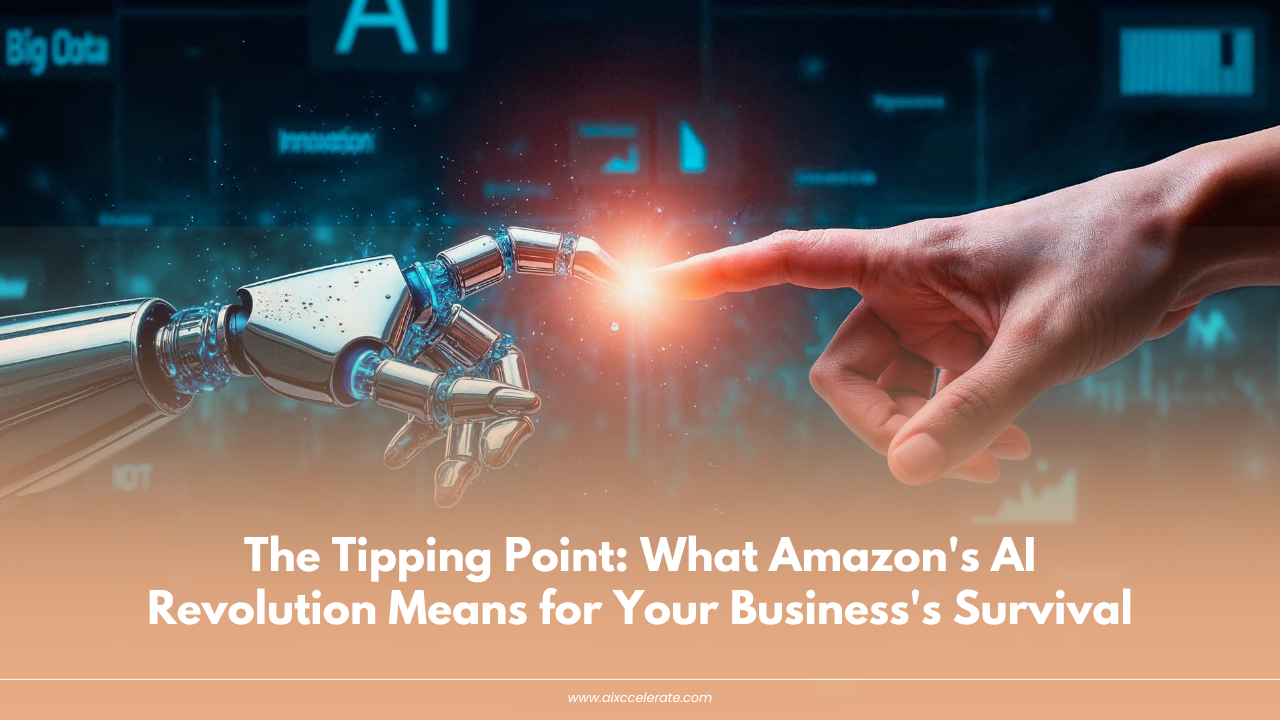
The Tipping Point: What Amazon's AI Revolution Means for Your Business's Survival
Everyone saw the 14,000 Amazon layoffs. Most scrolled past. They missed the real story. The one that should keep every CEO and business owner awake at night.
I’m sure you saw the headlines.
It’s easy to see a story like "Amazon lays off 14,000 employees" and just... scroll past. You might feel a brief pang of sympathy, but you quickly move on. It’s just another day in the chaotic news cycle.
But as a leader who lives and breathes Artificial Intelligence every day at AI Xccelerate, I have to tell you: you are missing the real story. Not even close.
Buried in that news is a tectonic shift. It’s not a distant forecast or a "futurist" prediction. It's a warning shot fired right at the feet of every single business owner, and most of them didn't even hear it.
What you do with this information today will determine whether your business even exists in five years.
The Real Story: What Actually Happened at Amazon
Let’s break down what really happened, because the revolution is happening on two fronts at once.
First, those 14,000 layoffs weren't just on the warehouse floor. They were corporate roles. Middle managers, data analysts, operations planners, and HR coordinators. These were the "safe," comfortable, white-collar jobs—the planners, the forecasters, the reporters—the very people everyone assumed were immune to automation.
Amazon’s CEO was transparent about it, calling it an effort to "reduce management layers" and operate more efficiently.
As an AI strategist, I'll give you the plain-English translation: They are systematically replacing human-led analysis and decision-making with AI systems.
These new AI systems can generate reports, analyze data, and make complex operational decisions faster, cheaper, and with more precision than their human counterparts.
And just as that news was sinking in, the real bombshell dropped. Leaked internal documents revealed Amazon's full plan: a strategic initiative to replace 600,000 warehouse workers with AI-powered robots by 2033.
This isn't a long-term dream. They are actively testing facilities right now with a 75% robot workforce, where the few remaining humans are there for one reason: to monitor the machines and fix their mistakes.
This is a two-front war on inefficiency. AI is automating both manual and cognitive labor. At the exact same time.
The Problem: An Unsurvivable Gap
If you're running a small or mid-sized business, I know what you’re thinking: "That’s an Amazon problem. A big tech problem. It doesn’t affect me."
I’m here to tell you that this is a dangerously comforting, and completely wrong, assumption.
For Amazon, the math is what the video's host rightly called a "no-brainer." Let's be blunt about it, because Amazon certainly is. A $50,000-a-year human worker is an ongoing, escalating operational cost. A $50,000 robot is a one-time capital expense.
The robot works 24/7. It never calls in sick. It never takes a vacation. It never asks for a raise.
And—this is the most important part—it learns and gets smarter every single day.
This creates what I call the "AI Amazon Effect." We’ve seen this movie before. Remember when Amazon normalized 2-day Prime shipping? It set a new standard for a generation. Every other retailer, from global giants like Walmart and Target down to the smallest mom-and-pop e-commerce shop, was forced into a simple choice: adapt or die.
That same "adapt or die" moment is happening right now with AI automation.
Your competitors are not waiting. Walmart has already poured over a billion dollars into its own automation strategy. DHL is rolling out AI-powered logistics. Banks are quietly replacing loan officers and customer service reps with AI.
This isn't some far-future sci-fi scenario. This is Q4, right now.
As a business leader, you need to understand that you are no longer just competing on price or service. You are competing against an AI.
Think about your daily operations:
- While you are manually managing inventory, their AI is predicting demand weeks in advance.
- While your customer service team is struggling to answer emails, their AI is responding to a thousand inquiries simultaneously, 24/7.
- While you and your team are crunching numbers in Excel, their AI is analyzing patterns you can't even see.
- While you make critical decisions based on last quarter's report and a "gut feeling," their AI is running thousands of simulations on every possible outcome.
It’s not a fair fight. And the gap is getting wider by the second.
But here’s what truly keeps me up at night, and what should concern you most: the illusion of time.
Most business owners I talk to think they can "wait and see." They’ll "figure it out" when it becomes more mainstream. This is a fatal illusion. The companies that are implementing AI today are building a 3-to-5-year competitive advantage. They are training their models, optimizing their data, and streamlining their operations.
By the time you finally realize you need to adapt, they will be so far ahead in efficiency, price, and speed that you will never, ever catch up.
In three years, I firmly believe there will be only two types of businesses: those that are AI-powered, and those that are obsolete.
The Solution: Start Now, Start Small, Start Smart
Okay, that was the "doom and gloom." But I’m not writing this to scare you. I’m writing this to prepare you.
Because here is the good news: you don't need Amazon's R&D budget to win.
The same revolutionary tools are available to you, right now. And they are more accessible and more powerful than you can possibly imagine.
At AI Xccelerate, when we talk about AI implementation, we aren't talking about gentle 10-20% improvements. We are seeing clients achieve 50-80% reductions in customer service costs. We are seeing 30-40% increases in lead conversion. We are saving teams thousands of hours per year, allowing them to focus on high-value work instead of repetitive, manual-entry tasks.
This isn't futuristic. It's our day-to-day work.
So, where do you start? You don't start by trying to boil the ocean. You start with smart, strategic, high-impact steps. Today.
- Customer Service & Sales:This is the easiest win. Implement an AI chatbot that can genuinely handle 95% of your customer inquiries, 24/7. Automate your sales follow-ups and lead qualification. A great example from the video was a business saving $90,000 a year by replacing an $8,000-a-month service rep with a $300-a-month AI system that did the job better.
- Operations & Efficiency:Use AI to look into your own business. Let it analyze your workflows and pinpoint the real bottlenecks. Automate all your data entry, your report generation, and your inventory management.
- Marketing:Stop guessing. Let AI drive your email campaigns, generate your social media content, and dynamically optimize your ad spend for the highest possible ROI.
- Decision-Making:This is the real game-changer. Use AI to analyze your own business data. Let it tell you which products to stock, which marketing channels are actually profitable (not just driving clicks), and, most powerfully, which of your customers are most valuable and how to keep them.
We are all at a crossroads. As a leader, you have a simple choice.
Option one: You can wait. You can do nothing. You can treat this as "business as usual," hope it won't affect your industry, and risk becoming a case study in obsolescence.
Option two: You can adapt. You can start today. Not by overhauling your entire company, but by taking that first, intelligent step. Automate one repetitive task this month. Implement one AI tool that saves your team five hours a week. Use AI to find one new insight from your data.
Amazon's move wasn’t a threat. It was a signal.
It's the starting gun for a new era of business. At AI Xccelerate, our entire mission is to make sure our partners aren't just in the race, but are equipped to win it.
The only real question left is: are you ready to start?
Related Articles
- Can an AI Agent Really Run Your Operations Better Than a Human?
- Why Your Next Hire Should Be an AI Agent...
- AI-Driven Marketing Automation: What Most Businesses Get Wrong in 2025
- Why SMBs That Don't Deploy AI Employees Will Lose the Next Decade of Business
- Why Microsoft Copilot Is Only the Starting Point for AI-Powered Managed Services
- AI Adoption in North American Corporate Business: 2026 Insights