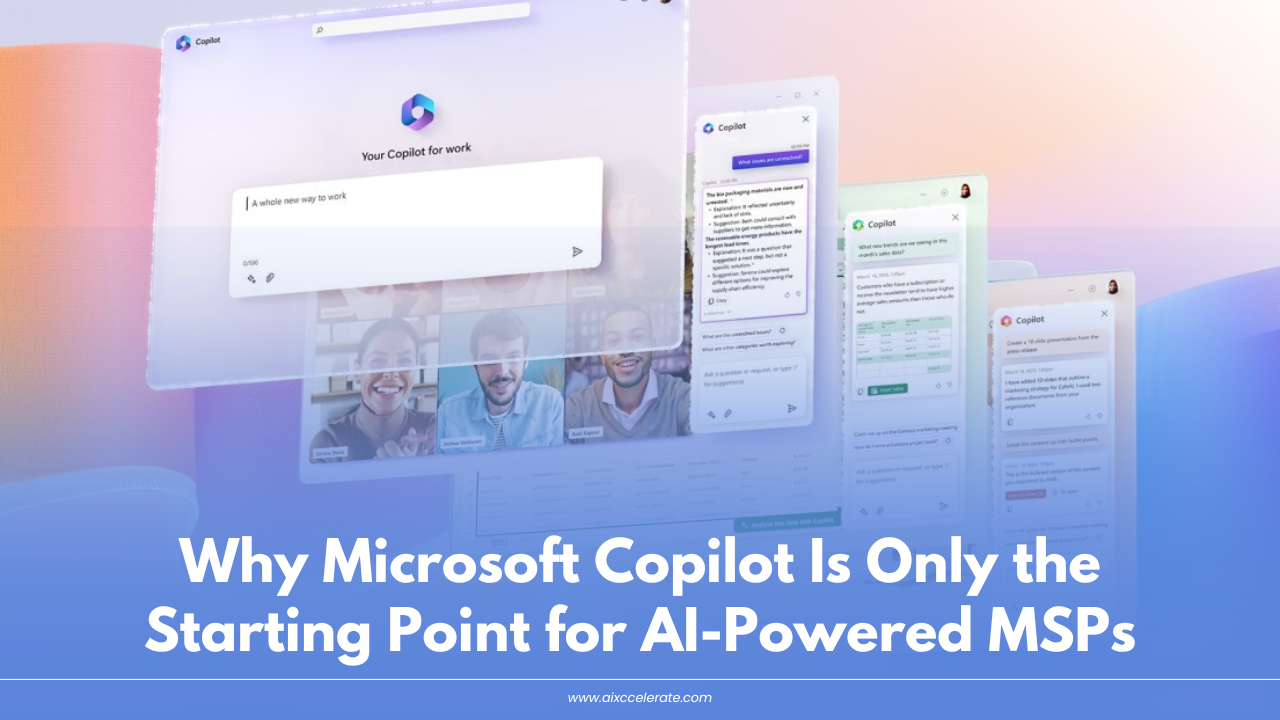
Why Microsoft Copilot Is Only the Starting Point for AI-Powered Managed Services
Microsoft Copilot is a brilliant starting point — but if it's the only AI tool in your arsenal, you're already falling behind. The AI landscape is evolving fast.
The businesses that thrive in the next five years won't just be the ones that adopted AI — they'll be the ones that went beyond the basics.
Microsoft Copilot has been a brilliant starting point. It introduced millions of businesses to the power of AI in a familiar, accessible environment. Partners embraced it. Customers loved it. And rightfully so — it works.
But here's the uncomfortable truth: if Copilot is the only AI tool in your arsenal, you're already falling behind.
The AI landscape is evolving at breakneck speed, and managed service providers (MSPs) who stop at Copilot are like businesses in the early 2000s who thought building a website was enough to "do the internet." The ones who went further — into e-commerce, SEO, mobile — are the ones who won.
This blog explores what it truly means to go beyond Copilot, why the Microsoft partner ecosystem needs to evolve fast, and what the future of AI-powered managed services actually looks like.
First, Let's Give Copilot Its Due
Before we push forward, it's worth understanding why Copilot matters — and why it was the right place to start.
Microsoft Copilot is designed to be accessible. It works within tools people already use — Word, Excel, Teams — and draws on both company data and public sources to assist users in real time. No complex setup. No steep learning curve. Just AI, where you already work.
For MSPs, it became the perfect conversation starter with customers. It's easy to demo, easy to explain, and delivers visible productivity gains quickly.
But accessibility also means it has limits.
Copilot is a generalist tool. It's built to work broadly across many scenarios, which means it isn't purpose-built for any one specific business process. And when you're running a managed services business — where precision, speed, and trust are everything — "broad" often isn't enough.
Think of Copilot as your on-ramp to the AI highway. You absolutely need it to get started. But once you're on the highway, you need to pick up speed.
The Three Big Shifts MSPs Need to Make
1. From General AI to Specific, Purpose-Built AI
There's a critical difference between AI that knows a little about everything and AI that knows everything about one thing.
General AI tools like Copilot are powerful for day-to-day productivity. But when you need AI to handle complex licensing questions, detailed compliance checks, or technical assessments — you need something purpose-built on a specific, curated knowledge base.
Purpose-built AI works on a prescribed data set with a prescribed outcome. That means:
- Fewer hallucinations and errors
- Higher accuracy for specialized tasks
- Greater trust from both partners and end customers
- Easier human oversight when needed
For MSPs, this could mean deploying AI that's deeply trained on Microsoft licensing, on cybersecurity protocols, or on industry-specific compliance requirements. The result? Faster answers, fewer escalations, and a dramatically better customer experience.
2. From AI Tools to AI Agents
This is where things get genuinely exciting — and where most MSPs haven't yet ventured.
There's a big difference between an AI that answers questions and an AI that gets things done.
AI agents don't just respond — they act. They can handle workflows, generate leads, follow up with customers, process assessments, and complete tasks end-to-end without constant human input. Think of them as digital teammates, each with a defined role and the intelligence to carry it out.
One powerful way to think about this shift: in the near future, a business's size won't just be measured in headcount. It will be measured in how many people and how many agents it deploys.
MSPs who start building their "agent workforce" now will be able to scale faster, serve more customers, and do it at a fraction of the traditional cost. Those who don't risk being out-competed by leaner, AI-powered rivals.
3. From Selling Software to Delivering Outcomes
This might be the most important shift of all — and it goes beyond AI.
For years, MSPs sold products: hardware, software licenses, subscriptions. They explained what the technology could do, and customers figured out the rest.
That model is changing fast.
Customers today — and even more so tomorrow — don't want to buy technology. They want to buy results. They want fewer support tickets, faster sales cycles, smoother onboarding, and lower operational costs. They want outcomes.
AI is accelerating this expectation. An MSP that can say "our AI solution reduced your licensing help desk inquiries by 50%" is speaking a very different language than one that says "here's a new software tool."
The MSPs that win will be the ones who take ownership of outcomes — not just delivery of tools.
What This Looks Like in the Real World
Let's make this concrete.
Imagine an MSP that handles Microsoft licensing support for dozens of business customers. Traditionally, they'd rely on a small team of licensing experts to field questions — a bottleneck that limits how many customers they can serve.
Now, with purpose-built AI:
- 60–80% of incoming licensing questionsare answered instantly and accurately by AI, without human intervention
- The licensing team focuses only on complex, high-value scenarios
- The MSP sees a50% reductionin support inquiries requiring human handling
- Customer satisfaction goes up, costs go down
Or consider a partner pursuing larger deals — say, a 1,000-seat Microsoft environment. In the past, doing a thorough assessment of that environment might take 80–100 hours of skilled labour. Today, with the right AI tools, that same assessment can be completed in minutes — making previously unpursued deals suddenly worth chasing.
One MSP recently closed a deal worth close to $1 million that they would have walked away from in the past, simply because AI made the assessment fast and affordable enough to justify the pursuit.
These aren't futuristic scenarios. They're happening now.
MSPs and IT Partners Aren't Going Anywhere — But They Have to Evolve
Some people worried that cloud computing would make IT partners and MSPs redundant. It didn't. If anything, they became more important as customers needed trusted guidance navigating an increasingly complex landscape of cloud products and services.
AI will follow the same pattern — but faster.
With hundreds of AI tools flooding the market, customers need trusted advisors more than ever. They need someone who understands their business, can cut through the noise, and can recommend the right solution. That's exactly where MSPs and IT partners come in.
But to play that role effectively, they need to:
- Use AI internally first— become their own best case study
- Build knowledge and expertiseacross AI tools beyond just Copilot
- Shift their value propositionfrom technology delivery to business outcome delivery
The managed service providers that make this transition will become what some in the industry are calling Managed Intelligence Providers — trusted partners who don't just keep the lights on, but actively drive smarter, faster, more profitable businesses for their customers.
The Bottom Line
Microsoft Copilot is a great start. But it was never meant to be the finish line.
The AI era is moving fast, and the MSPs who will lead it are the ones asking bigger questions right now: What AI tools should I be building on? What outcomes can I deliver that I couldn't before? How do I become an "agent boss" — leveraging AI agents to scale my business and my customers' businesses in ways that weren't possible even a year ago?
The good news? The playbook is being written in real time, and there's still plenty of room to get ahead.
The shift from Copilot to comprehensive AI strategy isn't just an upgrade. It's the difference between surviving the next wave of transformation — and leading it.
We unpack this exact topic — why MSPs need to think beyond Copilot and how AI agents are reshaping managed services — in our latest podcast episode.
Watch the full conversation here: https://youtu.be/csVj2-wn3BA?si=zqE44GNQHYfeBtjP
Frequently Asked Questions
What is Why Microsoft Copilot Is Only Starting Point for AI-Powered Managed Services?
Before we push forward, it's worth understanding why Copilot matters — and why it was the right place to start. Microsoft Copilot is designed to be accessible . It works within tools people already use — Word, Excel, Teams — and draws on both comp...
How does first, let's give copilot its due work?
Before we push forward, it's worth understanding why Copilot matters — and why it was the right place to start. Microsoft Copilot is designed to be accessible . It works within tools people already use — Word, Excel, Teams — and draws on both comp...
How does the three big shifts msps need to make work?
1. From General AI to Specific, Purpose-Built AI There's a critical difference between AI that knows a little about everything and AI that knows everything about one thing. General AI tools like Copilot are powerful for day-to-day productivity. Bu...
What This Looks Like in the Real World?
Let's make this concrete. Imagine an MSP that handles Microsoft licensing support for dozens of business customers. Traditionally, they'd rely on a small team of licensing experts to field questions — a bottleneck that limits how many customers th...
How does msps and it partners aren't going anywhere — but they have to evolve work?
Some people worried that cloud computing would make IT partners and MSPs redundant. It didn't. If anything, they became more important as customers needed trusted guidance navigating an increasingly complex landscape of cloud products and services...
Related Articles
- How SMBs Can Build an AI Workforce in 2026: AI Agents + Microsoft 365 Copilot
- The AI Vendor Selection Guide: Red Flags, Green Flags, and Questions That Expose the Truth
- AI-Powered Growth Strategies for North American SMBs in 2026
- The Tipping Point: What Amazon's AI Revolution Means for Your Business's Survival
- How SMBs Are Replacing SOPs With AI Revenue Employees
- Why SMBs That Don't Deploy AI Employees Will Lose the Next Decade of Business