The Essential Guide to Workforce AI in 2026
Unlock the power of workforce AI in 2026 with this essential guide covering top use cases, adoption strategies, challenges, and future trends for your business.
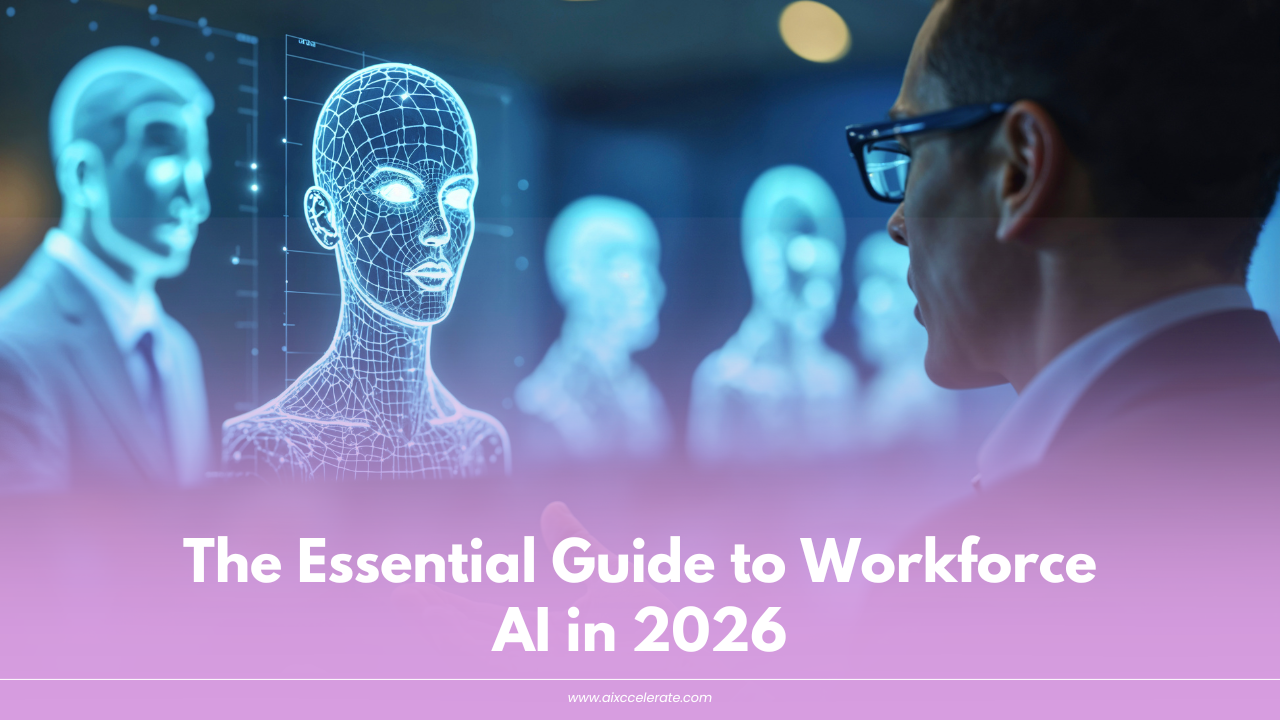
Imagine stepping into a 2026 office where teams and intelligent AI agents work side by side, driving innovation and taking productivity to new heights. The rapid evolution of workforce ai is transforming how businesses operate, making it essential for leaders to understand its impact and opportunities.
This guide is designed for business leaders, IT professionals, and decision-makers seeking a comprehensive roadmap for adopting and optimizing workforce ai. You will discover the current landscape, practical use cases, technology trends, proven adoption strategies, common integration challenges, and future predictions.
Ready to unlock efficiency, agility, and growth? Dive into this essential guide to future-proof your workforce and business for 2026.
Understanding Workforce AI: Definition, Evolution, and Impact
Workforce ai is transforming how organizations operate in 2026, shaping the future of work across every industry.
![[object Object]](https://resources.aixccelerate.com/content/images/2026/03/ctf-1773511773377-zixv23i5we.jpg)
What is Workforce AI?
Workforce ai refers to an integrated suite of artificial intelligence technologies, agents, and tools designed to boost employee productivity and collaboration within organizations. Unlike traditional automation, which focuses on repetitive tasks, workforce ai leverages generative AI, virtual assistants, workflow automation, data analytics, and multi-agent systems to deliver intelligent support across roles.
Key components include:
- Generative AI for content creation and ideation
- Virtual assistants for scheduling and task management
- Automated analytics for actionable insights
- Multi-agent orchestration for complex workflows
Examples like Microsoft Copilot, AI BDR Agents, and virtual HR assistants highlight workforce ai’s versatility. Its primary role is to enhance the digital employee experience, making workflows seamless compared to consumer-facing AI. By 2026, over 60% of enterprises are expected to use AI agents in core workflows, reflecting a major shift in the workplace.
The Evolution of Workforce AI (2020-2026)
The journey of workforce ai began with basic automation and chatbots around 2020, rapidly evolving into sophisticated, autonomous agents by 2026. Early milestones included the widespread adoption of chatbots, followed by generative AI breakthroughs in 2023, and the rise of multi-agent orchestration by 2025.
Remote and hybrid work models significantly accelerated workforce ai adoption, prompting organizations to seek digital solutions for distributed teams. Enterprises initially launched pilot programs to test AI agents before rolling them out company-wide. For example, large enterprises saw a spike in AI agent pilots in 2025, often comparing the impact of limited pilots versus enterprise-wide rollouts to measure effectiveness.
This timeline underscores workforce ai’s progression from simple automation to intelligent, interconnected agents that now drive business transformation at scale.
The Impact on Organizations and Employees
The impact of workforce ai on organizations and employees is profound. Productivity gains are among the most visible benefits, with real-world examples showing that days of manual work can now be completed in hours. For instance, studies reveal that workers could save up to 122 hours annually by adopting AI for administrative tasks, as highlighted in Workers could save 122 hours annually with AI.
Workforce ai also enables better decision-making through data-driven insights and reduces daily friction for employees, resulting in higher engagement and satisfaction. However, concerns remain about trust, adoption gaps, and the need for effective change management. Despite challenges, workforce ai is driving new revenue streams and operational efficiency, with some organizations reporting up to 10x productivity gains from these solutions.
Key Drivers of Workforce AI Adoption in 2026
Several forces are fueling the rapid adoption of workforce ai in 2026. Talent shortages and widening skills gaps are pushing organizations to turn to AI agents for support. The demand for greater agility and scalability in business operations is another major factor, as is the competitive pressure to accelerate digital transformation.
Advancements in technology, such as large language models, cloud infrastructure, and seamless integrations, have made workforce ai more accessible and cost-effective. Organizations also see measurable ROI through cost reductions and performance improvements. Additionally, regulatory, security, and compliance enhancements are making it safer for businesses to deploy workforce ai at scale, ensuring both innovation and responsible adoption.
Core Use Cases and Applications of Workforce AI
The applications of workforce ai in 2026 span every department and workflow, reshaping how businesses operate. From automating tedious tasks to driving strategic decisions, workforce ai is unlocking new possibilities for organizations ready to harness its full potential.
![[object Object]](https://resources.aixccelerate.com/content/images/2026/03/ctf-1773511774445-nymn0eil6dp.jpg)
Automating Repetitive and High-Volume Tasks
Workforce ai excels at automating routine, high-volume tasks that once consumed valuable employee hours. In sales, AI agents handle CRM enrichment, prospect outreach, and lead qualification. Marketing teams use ai for content generation and campaign scheduling. Finance departments rely on automation for invoice processing and expense management.
- Data entry and reporting are streamlined
- Scheduling and calendar management become autonomous
- AI BDR agents accelerate sales pipelines
A notable case is WWT’s RFP Assistant, which reduced project completion time from days to hours. Industry estimates show that by 2026, 40 percent of work tasks are automatable by workforce ai. For a deeper dive into real-world examples, explore these Workforce AI use cases.
Enhancing Communication and Collaboration
AI-powered meeting assistants and notetakers are now standard in the digital workplace. Workforce ai tools automatically transcribe meetings, highlight action items, and distribute follow-ups. Real-time translation and chatbots bridge language gaps and streamline cross-team communication.
- Inbox managers sort and prioritize emails
- Knowledge management agents organize resources
- Microsoft 365 Copilot automates meeting summaries
These solutions drive higher employee engagement and reduce miscommunication. By integrating workforce ai across collaboration platforms, teams work more efficiently, regardless of location or time zone.
Intelligent Decision Support and Analytics
With workforce ai, organizations unlock actionable insights from vast enterprise data. AI-driven analytics support predictive modeling for sales, HR, and operations. Leaders use ai as a strategic advisor, running scenario planning and forecasting with greater speed and accuracy.
- Glean AI delivers real-time business intelligence
- Predictive analytics inform resource allocation
- AI augments 70 percent of business decisions by 2026
Workforce ai empowers decision-makers to act confidently, backed by data and advanced algorithms. This results in faster, smarter choices across all levels of the organization.
Personalized Employee and Customer Experiences
Workforce ai personalizes interactions for both employees and customers. AI agents customize onboarding, training, and support to individual needs. In marketing, hyper-personalized outreach increases engagement and conversion rates.
- Lifecycle Marketer AI tailors communication
- Dynamic persona mapping optimizes user journeys
- AI-powered support boosts satisfaction and loyalty
By leveraging workforce ai, companies create memorable experiences that drive retention and advocacy. Personalization is no longer a luxury, it is a competitive necessity.
Advanced Use Cases: Multi-Agent Systems and Autonomous Workflows
The future of workforce ai lies in orchestrating teams of specialized AI agents. Multi-agent systems manage complex projects, handing off tasks from sales to customer success seamlessly. Platforms like Relevance AI’s Agent Teams coordinate workflows, ensuring security and compliance.
- End-to-end process automation is achievable
- Human-in-the-loop controls maintain oversight
- Autonomous departments continuously optimize performance
As workforce ai matures, expect entire business functions to be managed by coordinated AI teams, driving efficiency and innovation to new heights.
The Workforce AI Technology Stack in 2026
The workforce ai technology stack in 2026 forms the backbone of digital transformation for organizations of every size. As AI agents become embedded in daily operations, businesses need a robust, secure, and scalable foundation to maximize their benefits. Understanding the essential layers and tools of the workforce ai stack is key to driving successful adoption and measurable impact.
Key Components of the Modern Workforce AI Stack
A modern workforce ai stack is built on several critical components. Large language models (LLMs) like OpenAI, Claude, Gemini, LLaMA, and Mistral AI provide the intelligence behind text, conversation, and decision support.
Next, AI agent frameworks enable the creation of custom or off-the-shelf AI agents, tailored for unique business needs. Automation platforms, such as Zapier and Make, connect these agents with cloud APIs and enterprise systems for seamless workflow execution.
Security and compliance layers safeguard data, ensuring privacy and regulatory alignment. Finally, analytics dashboards deliver actionable insights, helping leaders track workforce ai performance and ROI.
For a deeper dive into how AI transforms business operations, see AI solutions for business operations.
Leading Workforce AI Tools and Platforms
Selecting the right tools is crucial for workforce ai success. Industry leaders include Microsoft Copilot, Glean, and Relevance AI, each offering unique capabilities.
Platform | Role Model | Best For | Scalability | Security |
|---|---|---|---|---|
Microsoft Copilot | Intern | General productivity | High | Strong |
Glean | Contractor | Data analytics, search | Medium | Robust |
Relevance AI | Employee | Multi-agent workflows | High | Advanced |
When choosing workforce ai platforms, consider scalability, ROI, and integration with existing systems. Industry-specific solutions for sales, HR, marketing, and finance are also available. Successful enterprise-wide deployments often start with pilot projects before scaling up.
Human + AI Collaboration: Augmentation, Not Replacement
The future of workforce ai is not about replacing people, but empowering them. AI agents act as teammates, supporting human employees in HR, finance, and operations. Human oversight remains vital, with approvals and escalation workflows in place.
Upskilling programs ensure staff can leverage new tools effectively. By combining automation with human creativity and judgment, organizations achieve greater agility and innovation. This collaborative approach is essential for sustainable workforce ai adoption.
Security, Compliance, and Ethical Considerations
Security and compliance are foundational to any workforce ai deployment. Enterprises require strict standards, including GDPR and CCPA compliance, and regular audits to protect sensitive data.
Bias mitigation and transparency in AI decision-making are top priorities. Ethical practices involve deploying guardrails, continuous monitoring, and clear accountability. Industry best practices help organizations navigate real-world challenges while maintaining trust in workforce ai systems.
How AI Xccelerate Empowers Businesses with Managed AI Agents
AI Xccelerate offers a fully managed workforce ai solution, enabling rapid deployment of specialized AI agents for sales, marketing, finance, HR, operations, and customer success.
![[object Object]](https://resources.aixccelerate.com/content/images/2026/03/ctf-1773511775409-7pal7c0vilm.jpg)
The platform handles deployment, training, optimization, and performance monitoring, allowing human teams to collaborate with AI agents without increasing headcount. Businesses benefit from measurable ROI, with performance dashboards and results guaranteed within 30 days.
Enterprise-grade security and compliance ensure peace of mind. AI Xccelerate is ideal for SMBs and enterprises seeking seamless, low-risk workforce ai integration.
Step-by-Step Guide to Adopting Workforce AI in 2026
Adopting workforce ai in 2026 requires a strategic, phased approach. Success is not just about deploying technology—it is about aligning people, processes, and tools to unlock the full benefits of workforce ai. The following step-by-step guide will help organizations navigate this transformative journey with confidence.
![[object Object]](https://resources.aixccelerate.com/content/images/2026/03/ctf-1773511776543-u7z86qkjpip.jpg)
Step 1: Assess Organizational Readiness and Identify Use Cases
Begin by evaluating your current workflows and pinpointing productivity gaps. Engage stakeholders from IT, HR, and business units to map key personas and user journeys. This collaborative approach ensures that workforce ai adoption addresses real business pain points.
Prioritize high-impact use cases by considering areas where automation and ai agents can deliver measurable ROI. For example, analyze tasks that are repetitive or data-heavy. A leading practice is persona mapping and friction point analysis, as seen in WWT’s approach.
Remember, many organizations face a gap between rapid AI adoption and workforce preparedness. According to a recent report, effective learning strategies are crucial to bridge this divide and maximize workforce ai benefits.
Step 2: Select the Right Workforce AI Tools and Partners
Define clear “job descriptions” for your ai agents. Will they act as interns, contractors, or full-time digital employees? This clarity helps in choosing between building custom solutions, buying off-the-shelf tools, or customizing existing platforms.
Evaluate vendors on scalability, security, integration, and support. Pilot leading solutions—such as chatbots, virtual assistants, and workflow automation tools—before full deployment. Keep in mind that 60 percent of organizations encounter challenges aligning tools with business needs.
Selecting the right partners and platforms ensures your workforce ai initiative is both robust and future-proof.
Step 3: Design, Test, and Pilot AI Solutions
Develop a phased rollout plan, beginning with pilot programs in targeted departments. Test how workforce ai integrates with existing systems like CRM, ERP, or HRIS. Involve end-users in the feedback loop to refine capabilities and workflows.
Set clear success metrics such as productivity improvements, adoption rates, and ROI. For instance, WWT’s pilot programs demonstrated how workforce ai can reduce workdays to just a few hours.
Iterative testing and stakeholder engagement are essential for building trust and ensuring a smooth transition to workforce ai.
Step 4: Accelerate Adoption and Scale Across the Enterprise
Upskilling is a cornerstone of successful workforce ai adoption. Provide targeted training programs tailored to different roles and workflows. Launch virtual and on-demand resources to support ongoing learning.
Change management is vital. Address trust gaps and cultural resistance by promoting open communication and highlighting quick wins. Scale successful pilots to additional teams, regions, or business units.
Despite widespread interest, few organizations achieve true enterprise-wide workforce ai adoption. Investing in people and culture is as important as the technology itself.
Step 5: Monitor Performance, Optimize, and Ensure ROI
Continuous monitoring is required to sustain workforce ai success. Implement ROI dashboards and conduct monthly performance reviews to track progress. Collect user feedback and usage analytics to identify areas for improvement.
Ongoing optimization involves retraining ai agents and updating workflows as business needs evolve. Adjust goals and metrics regularly to reflect the growing capabilities of workforce ai platforms.
This approach ensures long-term value, enabling organizations to adapt quickly and maintain a competitive edge.
Step 6: Address Security, Compliance, and Ethical Challenges
Robust security measures are non-negotiable for workforce ai deployments. Implement enterprise-grade protocols, conduct regular audits, and adhere to data privacy regulations such as GDPR and CCPA.
Communicate transparently with employees about ai usage and data handling. Establish escalation and approval workflows to manage sensitive decisions. Stay informed about evolving regulations that could impact your workforce ai strategy in 2026 and beyond.
Ethical considerations, including bias mitigation and accountability, must remain front and center to build trust and protect your brand.
Step 7: Foster a Human + AI Culture for Sustainable Success
The future of workforce ai lies in collaboration, not replacement. Promote a culture where human teams and ai agents work side by side, each complementing the other's strengths.
Recognize and reward achievements driven by ai-enabled innovation. Encourage experimentation with new tools and celebrate creative problem-solving. Maintain a balance, ensuring human creativity, empathy, and oversight remain integral to business success.
A future-ready organization is one that embraces continuous learning and adapts its workforce ai strategies as technology and business needs evolve.
Overcoming Challenges and Maximizing Workforce AI ROI
Common Barriers to Workforce AI Adoption
Despite the transformative potential of workforce ai, organizations face several barriers on the path to successful implementation. Skills shortages and a lack of in-house expertise remain top challenges, making it difficult for businesses to fully leverage advanced AI technologies.
Cost constraints and uncertainty regarding ROI often slow decision-making. According to AI revolution driving talent acquisition trends, cost pressures are shaping how organizations prioritize investments in AI. Other hurdles include data privacy and regulatory compliance, cultural resistance, fears of job displacement, and integration complexity. Notably, 70% of AI projects stall at the pilot stage, underscoring the need for focused strategies.
Strategies for Change Management and Employee Buy-In
Effective change management is crucial for workforce ai success. Transparent communication about AI’s goals and benefits helps address skepticism and builds trust among employees.
Involving staff in the planning and pilot phases fosters a sense of ownership and reduces resistance. Upskilling and reskilling initiatives prepare teams for new workflows. Identifying change champions within departments and securing leadership support can accelerate adoption. Treating the introduction of workforce ai as a core component of workforce planning, rather than a side project, creates a culture of innovation and adaptability.
Measuring and Demonstrating ROI from Workforce AI
To justify continued investment, organizations must clearly measure the impact of workforce ai initiatives. Establishing KPIs—such as productivity improvements, revenue growth, and employee satisfaction—provides a foundation for objective evaluation.
Utilize ROI calculators and performance dashboards to track progress over time. Industry benchmarks and external data, like those from AI's impact on employment statistics, offer valuable context for comparison. Case studies highlight new revenue streams and cost savings, while regular performance reviews ensure that workforce ai delivers meaningful business value.
Future-Proofing Your Workforce AI Investment
Keeping workforce ai investments future-ready requires ongoing learning and adaptability. Monitor technology trends and vendor roadmaps to stay current. Build flexible, modular AI architectures that can evolve with changing needs.
Encourage continuous improvement through training and feedback loops. Prepare for multi-agent ecosystems and more autonomous workflows as the technology matures. Stay proactive regarding regulatory and ethical developments to maintain trust and compliance. By taking these steps, organizations can maximize long-term value from workforce ai and remain competitive in a rapidly changing landscape.
The Future of Workforce AI: Trends and Predictions for 2026 and Beyond
The coming years will reshape how organizations harness workforce ai, blending advanced automation with evolving human roles. As we look ahead, several clear trends are emerging that will define the workplace of 2026 and beyond.
Multi-Agent Ecosystems and Autonomous Workflows
By 2026, workforce ai will enable complex agent teams to manage entire business functions. Companies will see a shift from isolated AI tools to orchestrated multi-agent systems. These systems will autonomously handle processes like sales, customer support, and project management.
For example, Relevance AI’s multi-agent orchestration allows coordinated workflows across departments. This approach leads to improved efficiency, fewer manual handoffs, and continuous optimization. Forecasts predict that by 2027, 80% of large enterprises will deploy multi-agent systems, fundamentally altering business structures and management styles.
As a result, organizations will need to rethink roles and oversight as workforce ai matures.
AI-Driven Personalization and Employee Experience
Workforce ai will transform employee experience through hyper-personalization. Advanced AI agents will tailor workflows, training, and support to individual preferences and roles.
Imagine AI serving as a digital coach, offering personalized onboarding and learning journeys. This creates dynamic adaptation to employee needs and fosters greater satisfaction. Industry surveys indicate that 65% of employees already prefer AI-augmented experiences.
For HR leaders seeking to leverage these advancements, exploring AI agents for human resources can provide a practical starting point. As workforce ai personalizes the employee journey, engagement and retention are poised to rise.
Integration with Emerging Technologies
The future of workforce ai will be closely tied to other cutting-edge technologies. Integration with IoT, blockchain, and edge computing will enable real-time data flows and faster decision-making.
AI agents will access live operational data, delivering instant insights and automating responses across platforms like cloud and SaaS. Cross-platform integration unlocks new levels of productivity, allowing businesses to move swiftly in dynamic markets.
This convergence will lay the groundwork for fully autonomous enterprises, where workforce ai orchestrates processes end-to-end with minimal human intervention.
Evolving Ethical, Security, and Regulatory Landscape
As workforce ai adoption accelerates, organizations must address rising ethical, security, and regulatory challenges. Stricter regulations and global standards are emerging, requiring transparency and accountability in AI systems.
Advances in explainable AI and bias mitigation will help build trust with employees and stakeholders. Ethical frameworks will guide responsible use, ensuring human oversight remains central.
Preparing for these shifts is essential. Companies that prioritize ethical deployment and compliance will position themselves for long-term success as workforce ai continues to evolve. Now that you’ve explored how Workforce AI is reshaping productivity and collaboration for forward-thinking businesses, you might be wondering what the next step looks like for your own organization. If you’re ready to discuss how AI agents could fit seamlessly into your team—boosting efficiency, driving measurable ROI, and keeping you ahead of the curve—I invite you to connect with an expert who understands both the technology and your business needs. Let’s build a future-ready workforce together. Book a meeting with our expert
Frequently Asked Questions
What is to Workforce AI?
Workforce ai is transforming how organizations operate in 2026, shaping the future of work across every industry. What is Workforce AI? Workforce ai refers to an integrated suite of artificial intelligence technologies, agents, and tools designed ...
What are the understanding workforce ai: definition, evolution, and impact?
Workforce ai is transforming how organizations operate in 2026, shaping the future of work across every industry. What is Workforce AI? Workforce ai refers to an integrated suite of artificial intelligence technologies, agents, and tools designed ...
How does core use cases and applications of workforce ai work?
The applications of workforce ai in 2026 span every department and workflow, reshaping how businesses operate. From automating tedious tasks to driving strategic decisions, workforce ai is unlocking new possibilities for organizations ready to har...
How does the workforce ai technology stack in 2026 work?
The workforce ai technology stack in 2026 forms the backbone of digital transformation for organizations of every size. As AI agents become embedded in daily operations, businesses need a robust, secure, and scalable foundation to maximize their b...
How does step-by-step guide to adopting workforce ai in 2026 work?
Adopting workforce ai in 2026 requires a strategic, phased approach. Success is not just about deploying technology—it is about aligning people, processes, and tools to unlock the full benefits of workforce ai. The following step-by-step guide wil...
Related Articles
- How SMBs Can Build an AI Workforce in 2026: AI Agents + Microsoft 365 Copilot
- How SMBs Are Replacing SOPs With AI Revenue Employees
- Why SMBs That Don't Deploy AI Employees Will Lose the Next Decade of Business
- Why Microsoft Copilot Is Only the Starting Point for AI-Powered Managed Services
- The Essential Guide to AI Employees in 2026
- Top 6 Types of Agent in AI Explained for 2026