AI SDR Cost in 2026: A Real TCO Breakdown vs a Human SDR
A side-by-side cost breakdown of AI SDRs vs human SDRs for SMBs in 2026 — fully loaded TCO, hidden costs, break-even math, and how to evaluate vendors before you sign anything.
If you are running an SMB and you have ever priced out a new SDR hire, you already know the headline number — somewhere between $60,000 and $80,000 in base salary, plus 20–30% in benefits and overhead, plus a 4–6 month ramp before they hit quota. The fully loaded annual cost lands between $95,000 and $130,000 in most US markets, and meaningfully higher in coastal cities.
What is harder to find is an honest, line-item comparison of what an AI SDR actually costs in 2026 — total cost of ownership, not vendor sticker price. The vendor pricing pages give you a monthly subscription number. They do not show you the ramp cost, the tooling cost, the management cost, or the opportunity cost. They especially do not show you the comparison side by side with what you would have paid for a human.
This post fixes that. The numbers below come from real AI Xccelerate deployments across SMB customers in the 100–500 employee range.
How much does a human SDR actually cost an SMB in 2026?
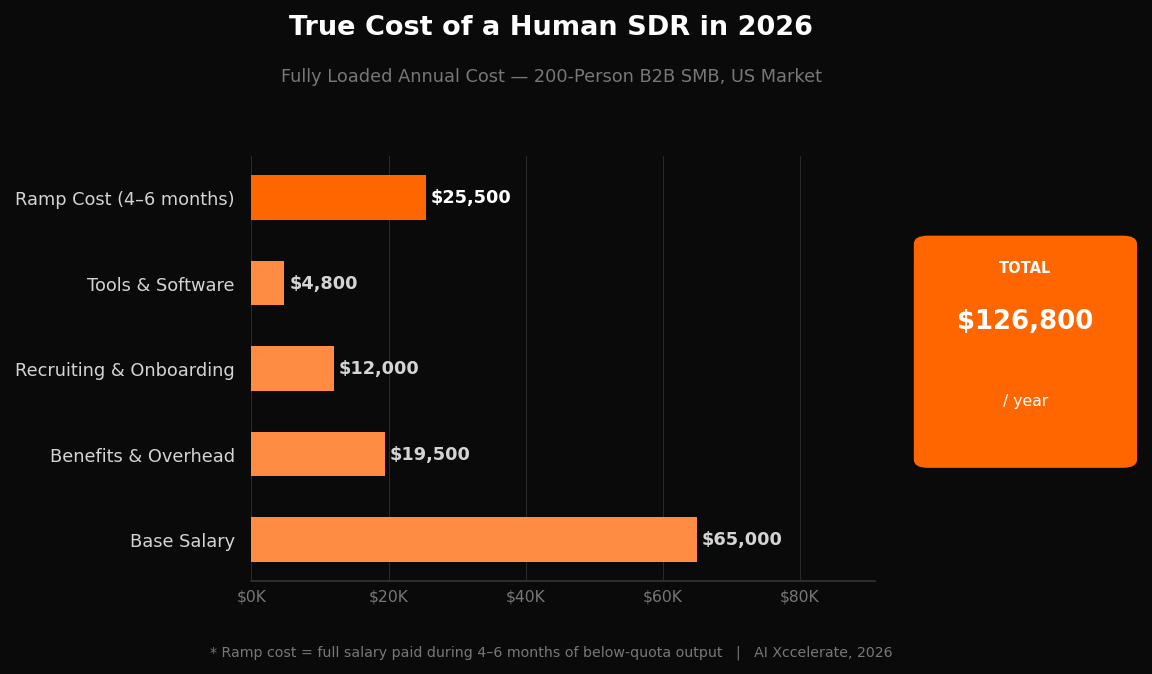
The salary line is the smallest part of the total. Here is the full stack for a US-based SDR at a 200-person B2B SMB, fully loaded for 2026:
| Cost component | Annual amount | Notes |
|---|---|---|
| Base salary | $65,000 | Median for SDR with 1–2 years of experience |
| Variable comp (OTE) | $20,000 | Typical commission/bonus structure |
| Benefits + payroll tax | $25,500 | ~30% of total comp (health, 401k, PTO, taxes) |
| Tools (LinkedIn Nav, Apollo, etc.) | $4,800 | $400/month average per rep |
| CRM seat | $1,200 | $100/month per seat |
| Email/calendar/Slack | $600 | $50/month per seat |
| Equipment + IT | $2,000 | Laptop amortization, IT support |
| Management overhead | $12,000 | ~15% of a manager's salary attributed |
| Ramp cost (months 1–4 at full pay) | $25,500 | Productivity ramp loss at full salary |
| Total Year 1 cost | $156,600 | |
| Total ongoing cost (Year 2+) | $131,100 | Excludes ramp |
The eye-opening number for most SMB founders is the ramp cost. A new SDR is paid full salary from day one but does not hit full productivity until month 4–6. For a $65K base SDR, that is roughly $25,500 in compensation paid for ramp-period output that is meaningfully below quota. Most SMBs absorb this as a normal cost of doing business — but it is real, it is recurring with every new hire, and it widens the gap with AI.
How much does an AI SDR actually cost in 2026?
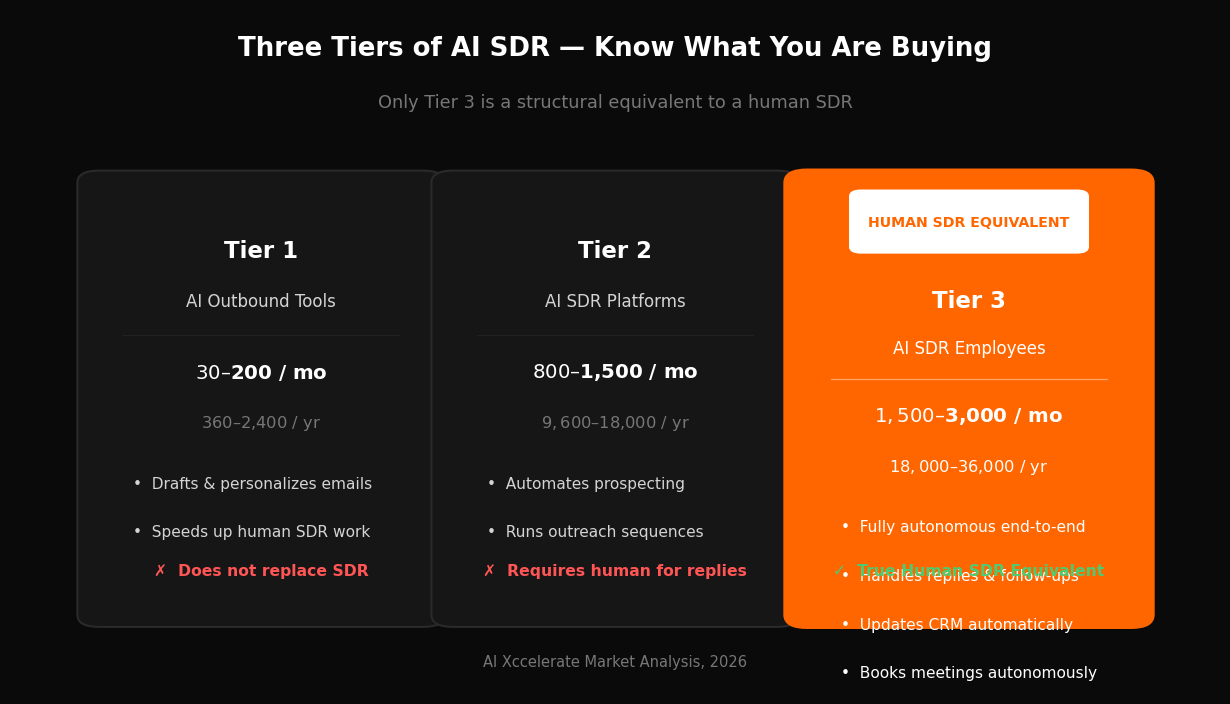
The honest answer depends on the product category, and there are three meaningfully different tiers in the market.
Tier 1 — AI outbound tools ($30–$200/month per seat). Productivity tools that draft emails or auto-personalize. They do not replace SDR work; they make a human SDR faster. Annual cost: $360–$2,400 per seat.
Tier 2 — AI SDR platforms ($800–$1,500/month). Mid-tier products that handle prospecting and outreach but require human SDRs to manage replies, edge cases, and CRM hygiene. Annual cost: $9,600–$18,000.
Tier 3 — AI SDR employees ($1,500–$3,000/month). Fully autonomous AI agents that own the outbound function end-to-end, including reply handling, follow-up, and CRM updates. Annual cost: $18,000–$36,000.
For an honest comparison against a human SDR, only Tier 3 is structurally equivalent. Below is the fully loaded TCO for a Tier 3 AI SDR (such as Jules at AI Xccelerate) for an SMB in 2026.
| Cost component | Annual amount | Notes |
|---|---|---|
| AI SDR subscription | $24,000 | $2,000/month — mid-range Tier 3 pricing |
| Data sources (Apollo, LinkedIn Nav) | $4,800 | Sometimes included; pricing if separate |
| CRM seat | $1,200 | Same as human |
| Email warmup + infrastructure | $600 | Typically included in modern AI SDR products |
| Onboarding / setup (one-time) | $3,000 | Amortized over year 1 only |
| Management overhead | $3,600 | ~30 min/week of revenue ops time |
| Ramp cost | $0 | Productive in 2–4 weeks at full output |
| Total Year 1 cost | $37,200 | |
| Total ongoing cost (Year 2+) | $34,200 |
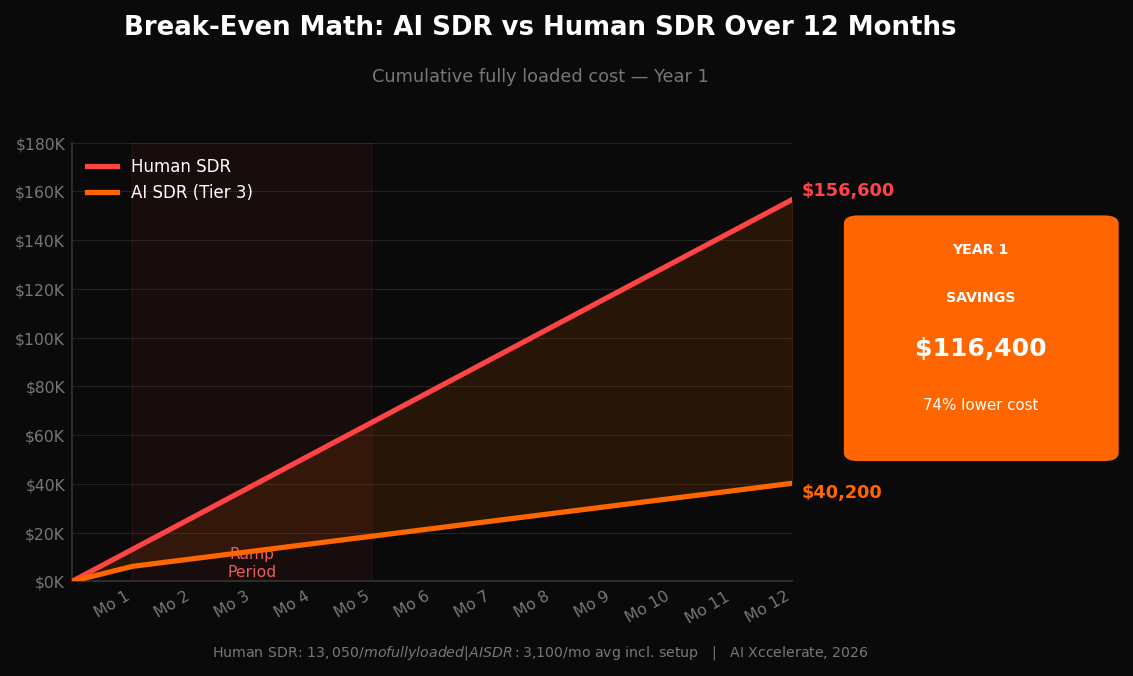
Annual saving vs human SDR (Year 2 onwards): $96,900 — roughly 74% of the fully loaded human cost.
The break-even math: when does an AI SDR pay for itself?
For an SMB replacing a single SDR hire with a Tier 3 AI SDR:
- Monthly cost differential: $11,150/month (human at $13,050 fully loaded vs AI at $1,900 fully loaded after Year 1)
- Setup cost to recover: $3,000 (Year 1 only)
- Break-even point: ~9 working days of pipeline activity
The mistake some buyers make is comparing the AI subscription against the SDR's base salary and concluding the math is close. It is not close. The AI subscription is being compared against a fully loaded cost — and the AI's ramp is measured in weeks, not months.
For an SMB scaling an existing SDR team — say, deciding whether to add SDR #4 or deploy an AI SDR — the math is even more compelling. The next human hire costs $156,600 in Year 1 (including ramp). The AI SDR costs $37,200 in Year 1. You can deploy four AI SDRs for the cost of one human, and they all ramp in weeks rather than months.
What the AI SDR does and does not do well
Where AI SDRs win:
- Volume and consistency. A Tier 3 AI SDR runs 800–1,200 prospects through a sequence every month, every touch on schedule. Human SDRs abandon ~44% of sequences after one touch.
- 24/7 operation. No nights, weekends, holidays, or PTO.
- Quality floor. The first email is always reviewed, personalized, and on-brand because a quality-gate AI reviews every send.
- Speed of ramp. 2–4 weeks to full productivity, vs 4–6 months for a human.
- Cost per touch. Roughly $0.20 per touch on a Tier 3 AI SDR, vs $4–$6 per touch on a human SDR.
Where humans still win:
- Complex, high-stakes deals where relationships are everything. A six-figure enterprise deal is still a human SDR's job.
- Genuinely novel sales situations. AI SDRs follow patterns; humans invent them.
- The cultural and political layer.
The right deployment model for most SMBs is therefore not "all human SDRs" or "all AI SDRs." It is AI SDRs owning the volume-based, repeatable outbound motion, with a small number of senior human reps handling strategic accounts and complex deals.
Hidden costs of a human SDR that vendors don't tell you about
Three costs of a human SDR are routinely under-counted by SMB finance teams when they build their hiring model:
1. Attrition cost. SDR roles have ~30–40% annual attrition in B2B SMBs. Every time an SDR leaves, you absorb 4–6 months of accumulated learning, the cost of rehire (typically $8K–$15K in recruiter fees and time), and another full ramp cycle. AI SDRs do not quit.
2. Pipeline gap during ramp and during transitions. When a human SDR ramps or transitions out, pipeline drops. For an SMB running on 6–8 months of sales cycle, that pipeline gap shows up as missed revenue 6–8 months later. AI SDRs ramp in weeks and do not transition out.
3. Management distraction. Every SDR consumes ~15–20% of a sales manager's time. AI SDRs require management — but the management is at the operating-model level, not the per-rep level. A revenue ops person can manage an AI SDR team in 30 minutes a week.
These three costs together typically add another 15–25% to the true cost of a human SDR over a 3-year horizon.
Hidden costs of an AI SDR that you should not ignore
In the interest of honesty, here are the costs that AI SDR vendors do not put on their pricing page:
1. The onboarding investment. A Tier 3 AI SDR requires meaningful upfront work — your team has to define ICP precisely, contribute lead magnets, set positioning, and configure campaigns. This is typically 20–40 hours of internal time.
2. The "AI manager" role you may need. Even though AI SDRs do not need a frontline manager, someone in your org needs to own the outcome — review performance, adjust campaigns, approve new motions. This is usually 4–6 hours per week of a senior revenue ops or marketing person.
3. The change management cost. Your existing sales team may push back on AI SDR deployment, especially if they feel it threatens their roles. The cultural change is rarely budgeted. Be explicit with the team about what is changing and why.
These are real costs. They are still meaningfully smaller than the costs of a human SDR. But they are not zero.
How to evaluate AI SDR vendors in 2026
Three filters before signing anything:
Filter 1: Pricing model. Per seat = tool (Tier 1). Per workflow = augmentation (Tier 2). Per role / per agent = employee (Tier 3). Only Tier 3 is structurally equivalent to a human SDR.
Filter 2: Reply handling. Ask explicitly: "When a prospect replies, what happens?" If the answer is "we draft a response for your team to send," you are in Tier 2. If the answer is "the AI classifies intent, strategizes a response, deploys lead magnets, and books the meeting," you are in Tier 3.
Filter 3: Learning loop. Ask: "Does the AI get better over time, and what is the mechanism?" If the answer is vague, the system is rule-based. If the answer is specific, you have a real agentic SDR.
FAQ
How much does an AI SDR cost per month?
Tier 3 AI SDRs (true AI employees, not just outbound tools) cost between $1,500 and $3,000 per month in 2026, depending on volume, data sources, and feature set. Fully loaded including data, infrastructure, and management time, expect $2,500–$3,000/month total. That works out to $30,000–$36,000 per year — roughly 25–30% of a fully loaded human SDR.
Is an AI SDR cheaper than hiring an SDR?
Yes, by a wide margin. A fully loaded human SDR costs $130,000–$156,000 per year (Year 1 with ramp). A fully loaded AI SDR costs $35,000–$40,000. The annual saving is ~$95,000–$110,000, and the AI SDR is productive in weeks rather than months.
Can an AI SDR replace my human SDR team entirely?
For most SMBs in volume-based outbound motions, yes — AI SDRs can own the function. For SMBs with strategic, complex, enterprise-account motions, a hybrid model is more realistic: AI SDRs for volume, human reps for strategic accounts.
What is the ROI of an AI SDR?
The clean ROI metric is cost per qualified meeting booked. Top-quartile Tier 3 AI SDRs in 2026 book qualified meetings at $200–$400 each, vs $800–$1,500 for a human SDR. The 3–4x cost advantage compounds quickly once the AI is in production.
How long does it take to deploy an AI SDR?
A well-designed Tier 3 AI SDR deploys in 2–4 weeks for an SMB with reasonable ICP clarity. The bottleneck is usually not the technology — it is the internal time required to define ICP precisely, contribute lead magnets, and finalize positioning.
If you’re exploring what AI agents could do for your business, you can book a live walkthrough with our team here: book.aixccelerate.com.
AI Xccelerate's AI Outbound Employee (Jules) deploys in 2–4 weeks and books meetings at a fraction of human SDR cost.