What AI Can (and Can't) Do in Customer Success in 2026
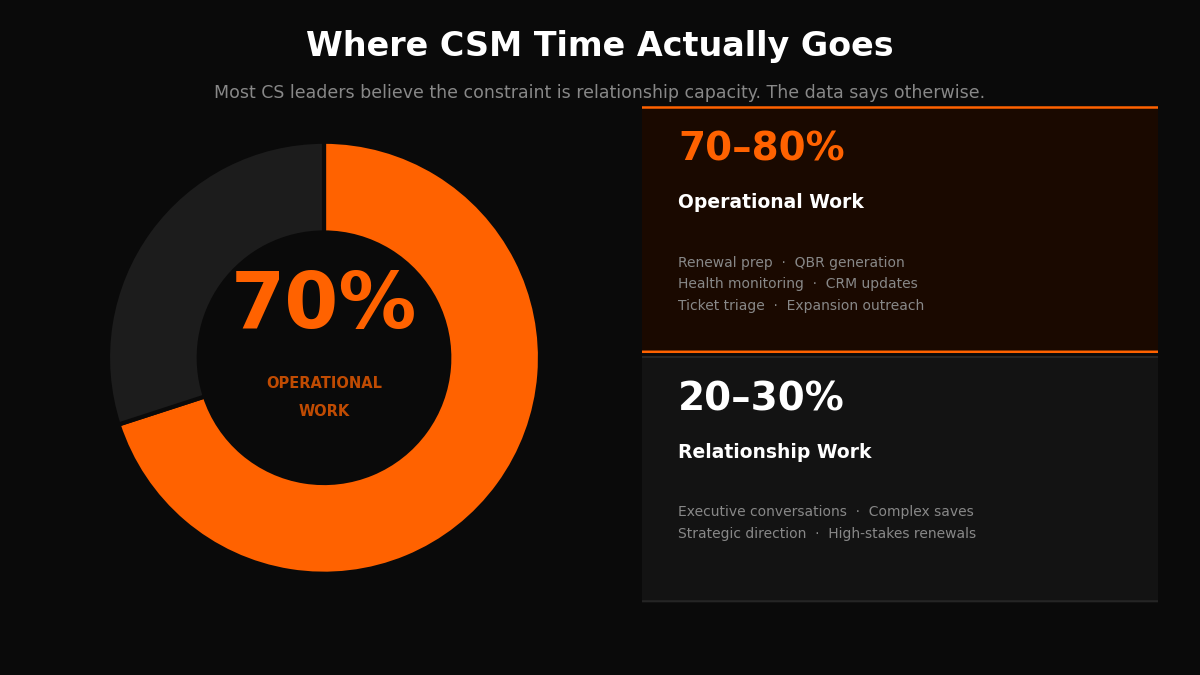
Your CS team isn't under pressure because of weak relationships. It's because 70% of their time goes to operational work — tracking, prepping, updating — not the relationships they were hired for.

Customer success is the function where AI gets the most skeptical reactions from B2B leaders. The intuition is sharp: customer success is about relationships, and relationships are exactly what AI is bad at. A founder who has spent years building trust with a 7-figure account is not going to hand the relationship to a machine.
That intuition is correct — and it is also incomplete.
The 70/30 problem nobody names out loud
Most of what a CSM actually does day-to-day is not relationship work. It is operational work that surrounds the relationship: tracking usage, prepping QBRs, monitoring health scores, chasing renewal paperwork, sending check-in emails, updating the CRM, building expansion plays, escalating tickets.
The relationship is the 20–30%. The operational scaffolding is the 70–80%.
This is the core problem with how most B2B companies think about customer success capacity. When a CS team is stretched — and most are — they do not cut the relationship work. They cut the operational work. QBRs get deprioritized. Health monitoring becomes reactive. Renewal prep gets compressed to 30 days instead of 90. Check-ins with lower-tier accounts go weeks between touchpoints.
The result is not that customers feel like they're dealing with a machine. It is that customers feel neglected, period.
What actually breaks when CS is under-resourced
Here is what we keep seeing across mid-market B2B companies running CS teams of three to six people covering 150 to 300 accounts:
Renewal conversations start late. By the time the CSM has bandwidth to prep, the renewal is 45 days out — not 90. The brief is incomplete. The ROI story is underdeveloped. The customer goes into the conversation without context on their own usage. These are not lost deals, but they are harder closes than they should be.
QBRs happen for the top 20% of accounts. The remaining 80% get a check-in call, if they're lucky. The customers who need the most attention — the ones with declining usage, the ones with unresolved support tickets — are often the ones receiving the least.
Health monitoring is reactive, not proactive. A CSM finds out an account is at risk when the customer says so, not before. By then, the churn conversation has already started internally on the customer's side. The CSM is responding to a decision that is already in motion.
CRM hygiene degrades. Call notes don't get logged. Contact records go stale. Renewal dates are wrong. When a CSM leaves, the institutional knowledge of their accounts leaves with them.
None of this is a performance problem. It is a capacity problem. A team of five people covering 250 accounts cannot do the operational work and the relationship work at the same time. Something gets cut. It is always the operational work.
What the operational layer of CS actually involves
When you break down what CSMs spend their time on, the operational work is not a minor side task. It is the majority of the job — and it is also the part that is most consistent, most repeatable, and most clearly defined.
The operational layer includes: tracking product adoption milestones during onboarding, running ongoing health score analysis across all accounts, generating renewal briefs 90 days out, drafting QBR decks from usage and financial data, running expansion outreach when adoption signals indicate readiness, triaging and resolving inbound support requests, and keeping CRM records current across a full book of business.
None of this requires a relationship. All of it requires reliability, consistency, and the capacity to run the same process across every account without shortcuts.
The question worth asking is: what happens to your CS team's strategic output if they no longer spend 70% of their time on this operational layer?
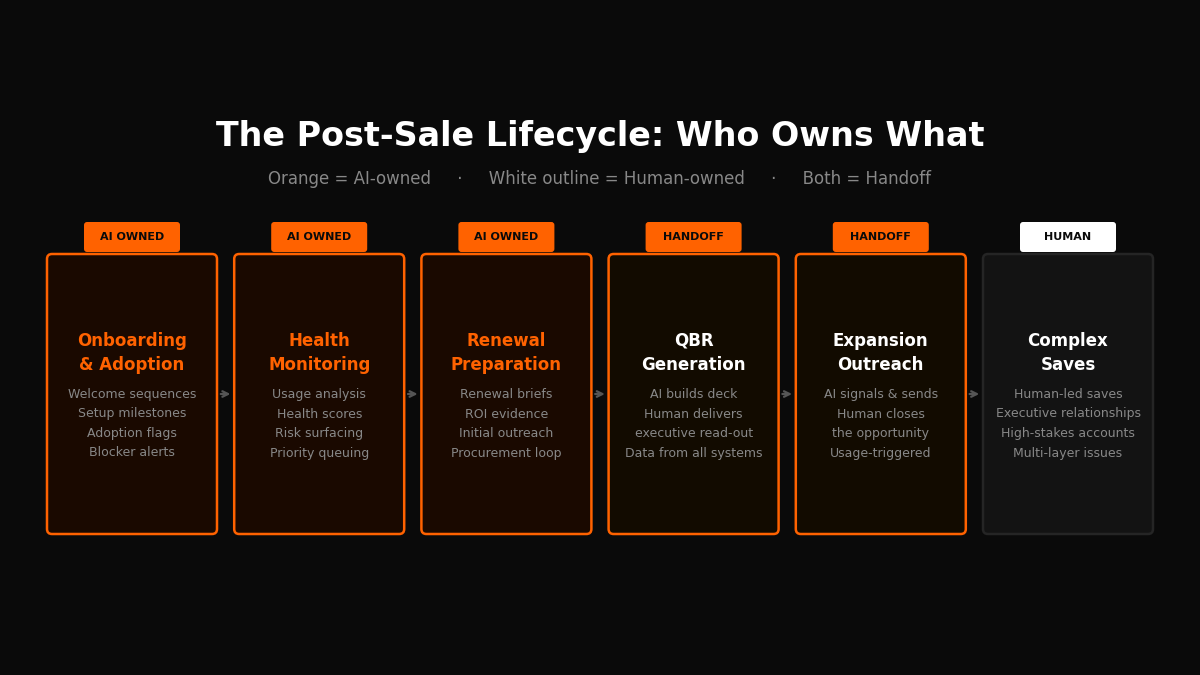
What AI-assisted CS is actually doing in 2026
The category has moved. AI-assisted customer success in 2026 does not mean an FAQ assistant sitting in your help center. It means operational workflows in the post-sale lifecycle being run autonomously — without a human initiating each step.
The typical scope looks like this:
Onboarding and adoption tracking. Welcome sequences sent, kickoff calls scheduled, setup milestones tracked, adoption blockers flagged, intervention triggered when a customer has been stalled for more than a defined period.
Health monitoring. Continuous analysis of product usage, support ticket volume, inbound communication sentiment, NPS responses, and renewal proximity. A composite health score per account, updated in real time. Accounts trending toward risk surfaced to the human CSM team in priority order — not when someone remembers to check.
Renewal preparation. 90 days before renewal, a brief generated per account: usage trajectory, ROI evidence, expansion opportunities, risk factors, recommended path. Initial outreach sent. Back-and-forth coordinated. Strategic accounts escalated to a human CSM with full context already prepared.
QBR generation. Usage data, support data, financial impact data, and roadmap relevance pulled from existing systems. A full QBR deck drafted per account. The human CSM does the executive read-out. The operational prep is already done.
Expansion plays. Usage patterns monitored for the signals that precede expansion readiness. Initial conversation triggered when signals warrant. Qualified opportunity routed to a human CSM for close.
Ticket triage and Tier 1 resolution. Inbound requests classified by intent and severity. Tier 1 issues resolved. Tier 2 and Tier 3 routed to the human team with full context attached — not a raw ticket, but a briefed handoff.
CRM hygiene. Account records updated after every interaction. Contact lists maintained. Call notes logged. Renewal dates kept current. The 5–8 hours per week that most CSMs describe as the most frustrating part of the job — gone.
The honest reframe: this is almost all of the operational work that has been silently consuming CSM capacity for the last decade. The relationship work — which is what CSMs got into the role for — remains.
What AI cannot do in customer success — and probably will not in 2026
Executive relationships. The CFO renewal conversation. The CEO-to-CEO strategic alignment call. AI can prepare the materials and surface the talking points. It cannot replace the relationship.
Complex retention saves. When a $400K account is threatening to leave over a multi-layered set of grievances, that is a human-led intervention. Every time.
Genuinely novel situations. A customer using your product in a way you did not anticipate. A partnership opportunity surfacing through a CS conversation. A strategic discussion about where the relationship goes in year three.
Emotional intelligence in difficult moments. A customer who just went through a layoff. A customer navigating an acquisition. A customer who is frustrated in a way that requires a human to hold the conversation.
The deployment model that works is augmentation, not replacement. The operational majority is handled by the AI. The strategic minority remains with the human CSM — and that CSM now has the capacity to actually do the strategic work instead of spending their week on prep and admin.
The coverage problem that does not get talked about enough
Cost efficiency is a real part of the story. But it is not the most interesting part.
The most interesting part is coverage consistency.
A CSM with 40 accounts has favorites. The accounts they have history with. The ones that are highest-stakes. The ones that are easiest to get on the phone. Those accounts get proactive attention. The remaining 30 get reactive attention.
This is not a failure of character or management. It is just how human attention works.
The pattern we keep seeing: when operational AI is deployed across a CS function, every account gets the same process. The same health check runs on every account. The same renewal brief gets generated at the same threshold. The same expansion outreach goes out when the same signals appear. The variance in coverage that is normal in human CS teams disappears.
For most mid-market B2B companies, that consistency translates into a measurable improvement in net revenue retention — typically 3–7 percentage points. On a $20M ARR base, that is $600K–$1.4M of additional retained revenue per year, without adding headcount.
How deployment goes wrong
Three failure patterns that come up consistently:
Deploying the AI only for ticket handling. Companies that implement only the inbound triage layer see a 10% productivity improvement. The full value is in owning the operational workflows — health monitoring, renewal prep, QBR generation, expansion outreach. Ticket handling is a small piece of that.
Keeping every action behind a human approval gate. If every email the AI drafts has to be reviewed before it sends, the CSM workload has shifted, not reduced. The AI needs a defined autonomy envelope — specific workflows where it acts without per-action approval.
Not redefining the human CSM role. When operational AI is deployed into CS, the human CSM's job description effectively changes. They are now the strategic relationship layer for a larger book of business, with the operational layer handled separately. Teams that do not make that shift explicit — new metrics, new expectations, new skill development — find that their CSMs feel displaced rather than freed up.
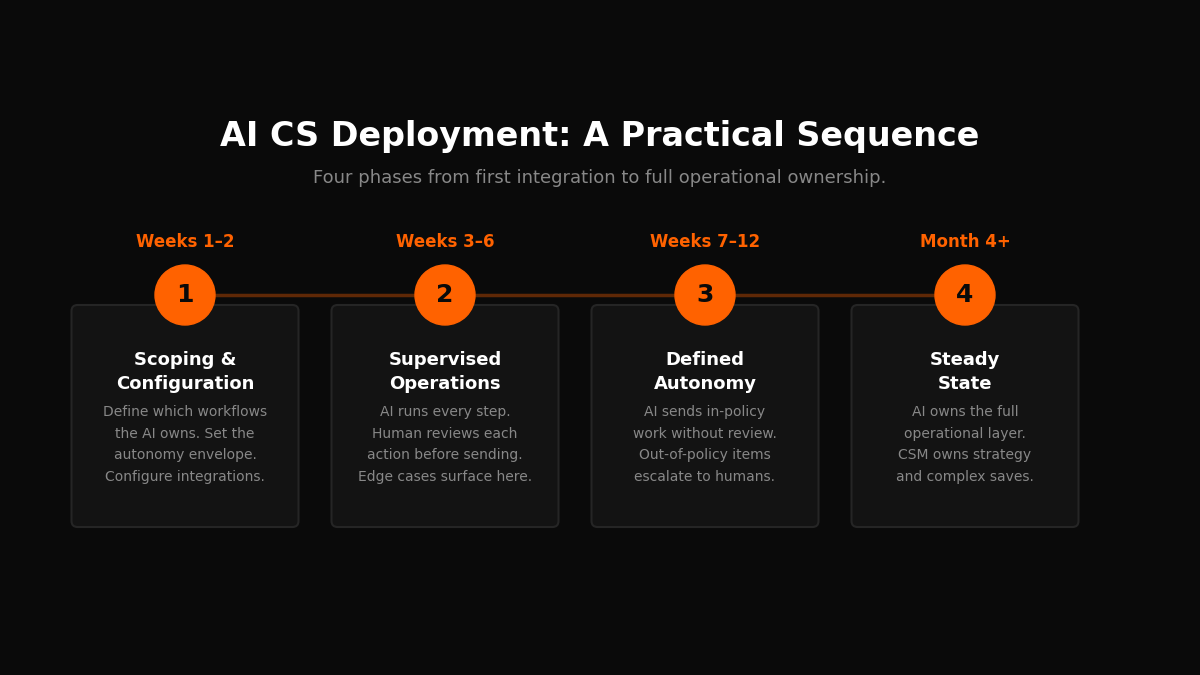
What a staged deployment looks like
The companies that deploy this well tend to follow a similar sequence.
Weeks 1–2: Scoping and configuration. Define which workflows the AI owns. Define the autonomy envelope. Configure integrations with CRM, product analytics, and support systems.
Weeks 3–6: Supervised operations. The AI runs the workflows, but routes every action for human review before sending. This phase surfaces edge cases and builds the team's confidence in the system before autonomy is extended.
Weeks 7–12: Defined autonomy. The AI sends in-policy actions without per-action review. Out-of-policy situations continue to route to humans. The human CSM team focuses on the cases that need them.
Month 4 onward: Steady state. The AI owns the operational layer. Human CSMs own the strategic layer — the conversations that require judgment, history, and relationship.
At AI Xccelerate, we build AI workers for post-sale teams — including a customer success agent that handles the full operational layer described above. If you want to understand what this looks like mapped to your current CS setup, we publish practical guides on deployment, role design, and what actually moves NRR. Subscribe to our newsletter to get them when they ship.
FAQ
Can AI replace customer success managers? Not in the roles that matter most. AI handles the operational layer well — renewal prep, QBR generation, health monitoring, ticket triage, expansion outreach. The strategic and relational layer remains human. The right model is augmentation: the AI takes the operational majority, the CSM takes the strategic minority.
What separates an operational AI CS system from a basic automated helpdesk? An automated helpdesk responds to inbound requests. An operational AI CS system initiates outbound workflows — it monitors accounts on a schedule, generates renewal briefs before anyone asks, flags health risks before they become churn conversations, and sends expansion outreach when adoption signals warrant. The difference is proactive ownership versus reactive response.
Will customers notice? If deployed well, customers will notice that QBRs are better-prepared, response times are faster, and renewal conversations start earlier with more data. They will not notice that an AI generated the renewal brief or ran the health analysis. The relationship touchpoints remain human.
What happens to the CS team? The team tends to get smaller and more senior over time. CSMs whose role was primarily operational coverage are no longer needed at the same volume. Senior CSMs handle larger books of business and focus on the strategic layer — the work they got into the role for in the first place.
What integrations does this require? At minimum: CRM, product analytics, and support ticketing. Most implementations also include email, calendar, and billing systems. The integrations determine how much the AI can act autonomously versus flag for human review — more data access means tighter health scores and more accurate renewal briefs.