How to Calculate ROI on an AI Workforce: The 2026 SMB Framework
The single-variable AI ROI comparison works in a pitch deck. It won't survive finance-team scrutiny. Here's the four-variable framework that will — with math, a worked example, and stress tests.
TL;DR — Key Takeaways
- AI workforce ROI has four variables: labor cost offset, productivity multiplier, revenue lift, and onboarding investment. Most SMBs only model the first one.
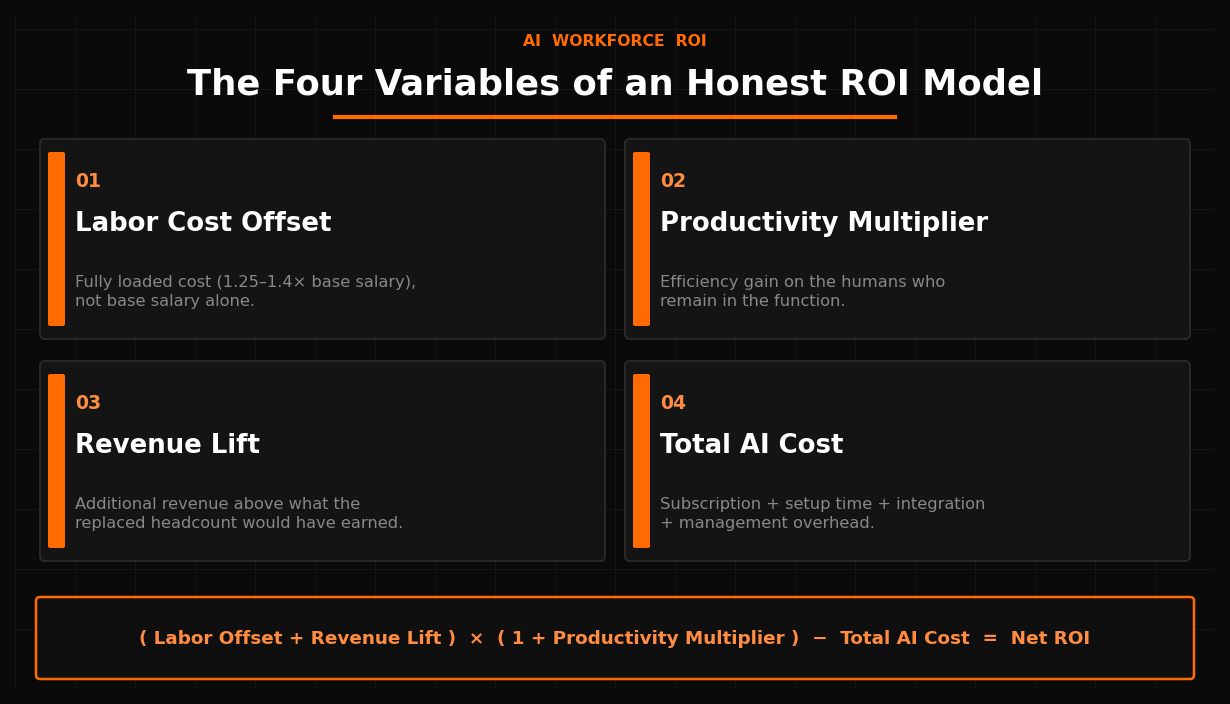
- The right framework is (Labor Offset + Revenue Lift) × (1 + Productivity Multiplier) − Total AI Cost = Net ROI.
- A typical AI Revenue Employee deployment for an SMB in 2026 produces a 300–600% Year 1 ROI when all four variables are honestly modeled.
- The biggest mistake: comparing AI agent subscription to base salary instead of fully loaded labor cost (1.25–1.4× base).
- The honest hidden cost vendors don't show: 20–40 hours of internal time in the first 30 days for ICP definition, knowledge base setup, and configuration.
If you are building a business case for AI workforce deployment to take to a board, a CFO, or a co-founder, you need an ROI model that does more than compare a subscription price to a salary. The single-variable comparison is the marketing version. It works in a pitch deck. It does not survive five minutes of finance-team scrutiny.
This article is the framework AI Xccelerate uses with SMB customers when they are running their own internal ROI model. It is four variables, three formulas, and a worked example.
The four variables in an honest AI workforce ROI model
A complete ROI model has four inputs. The vendor pricing page usually shows you one. The other three are where the real value (and the real risk) lives.
Variable 1: Labor cost offset. What human cost does the AI workforce reduce or avoid? Calculated on fully loaded labor cost (1.25–1.4× base salary), not base salary alone.
Variable 2: Productivity multiplier. What efficiency gain does the AI workforce produce on the work that remains with humans? An AI sales agent does not just offset SDR cost — it also makes the remaining AE more productive by handing off better-qualified meetings.
Variable 3: Revenue lift. What additional revenue does the AI workforce produce, above and beyond what the headcount it replaces would have produced? Coverage consistency, 24/7 operation, faster ramp, and learning effects all produce revenue lift over time.
Variable 4: Total AI cost. What is the fully loaded cost of the AI workforce deployment? Not just the subscription. Setup time, integration cost, data sources, management overhead, and change management all count.
The full formula:
Net Year 1 ROI = (Labor Offset + Revenue Lift) × (1 + Productivity Multiplier) − Total AI Cost
Variable 1: How to calculate the labor cost offset honestly
Most SMBs under-count this number because they use the salary line item rather than the fully loaded cost.
For a US-based SDR with $65K base, the math looks like:
| Component | Amount |
|---|---|
| Base salary | $65,000 |
| Variable comp at quota | $20,000 |
| Benefits + payroll tax (~30%) | $25,500 |
| Tools (LinkedIn Nav, Apollo, etc.) | $4,800 |
| Equipment + IT amortized | $2,000 |
| Management overhead | $12,000 |
| Ramp cost (Year 1 only) | $25,500 |
| Year 1 fully loaded | $154,800 |
| Year 2+ fully loaded | $129,300 |
Common error: using $65,000 (base) as the labor offset. This understates ROI by ~58%.
Variable 2: How to calculate the productivity multiplier
This is the variable most SMBs miss entirely. AI workforce deployments produce second-order productivity gains on the humans who remain in the function.
Example: an AI SDR books qualified meetings at higher quality and consistency than a human SDR. The AE who takes those meetings closes at a higher rate because the meetings are better qualified, the prospect is better informed (from the AI's lead-magnet deployment), and the CRM is fully updated. The AE's productivity goes up — typically 15–25% in closed-won rate or deal velocity.
For our worked example, we will assume a 15% productivity multiplier on the human revenue team's output.
Variable 3: How to calculate the revenue lift
This is the largest and most variable input. It comes from several sources:
Coverage lift. AI agents do not abandon sequences, miss check-ins, or take PTO. For most SMBs, worth 10–20% additional pipeline volume.
24/7 operation. Inbound leads get faster first-touch. Typically lifts response rates 15–25%.
Faster ramp. AI agents ramp in 2–4 weeks, not 4–6 months. The pipeline generated in months 1–6 vs. a human alternative is a one-time but significant lift.
Learning effects. Tier 3 AI agents track which campaigns, hooks, and lead magnets convert best per ICP segment. 5–10% performance improvement per quarter for the first 12 months.
For a worked model, revenue lift can be estimated conservatively as 15–25% of the labor offset for revenue-generating functions.
Variable 4: How to calculate total AI cost (including hidden costs)
The vendor's pricing page shows you the subscription. The full cost includes more:
| Cost component | Typical range (Year 1) |
|---|---|
| AI agent subscription | $18,000–$36,000 |
| Data sources (if not bundled) | $3,000–$6,000 |
| Setup and onboarding | $2,000–$5,000 |
| Internal time (ICP, knowledge base, config) | $4,000–$8,000 (at $200/hr loaded) |
| CRM seat | $1,200 |
| Management overhead | $3,000–$6,000 |
| Change management / training | $2,000–$4,000 |
| Year 1 total fully loaded | $33,200–$66,200 |
| Year 2+ total fully loaded | $27,200–$55,200 |
The midpoint for a typical SMB deployment: ~$45,000 in Year 1, ~$38,000 in Year 2+.
The full worked example
Let us run the full model for an SMB choosing between hiring SDR #4 vs deploying an AI Outbound Employee.
Inputs:
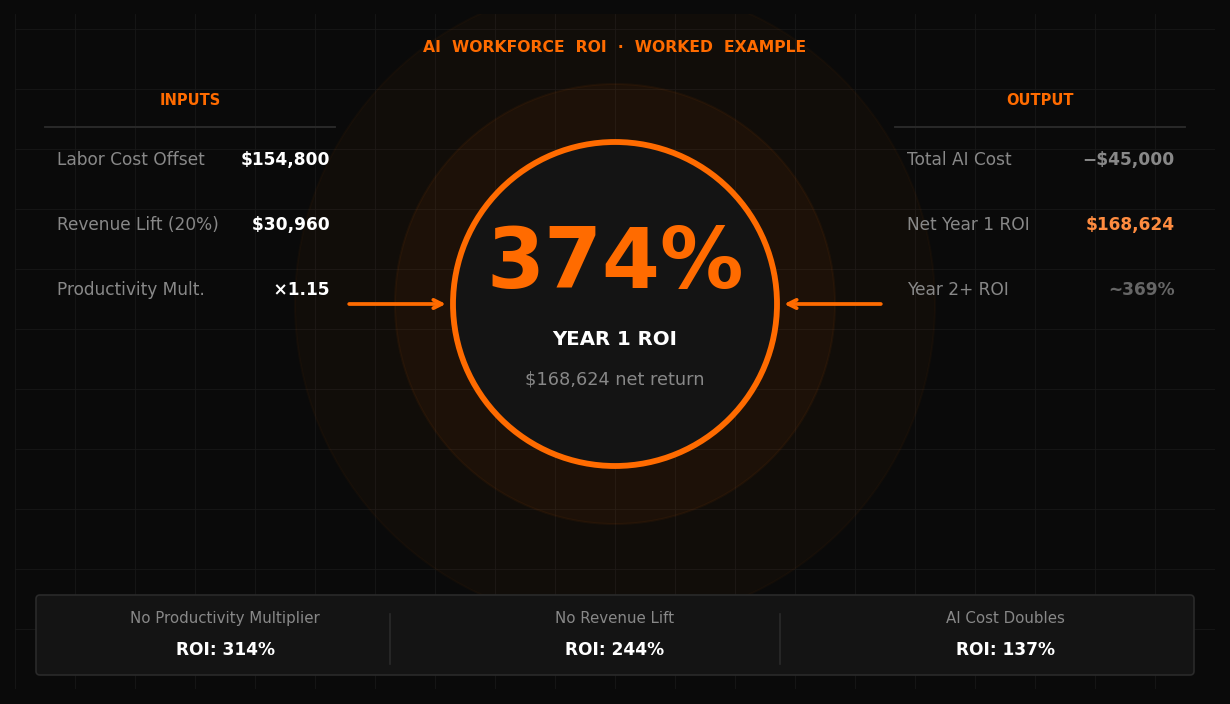
- Fully loaded SDR cost (Year 1): $154,800
- Fully loaded SDR cost (Year 2+): $129,300
- Productivity multiplier on remaining AE team: 15%
- Revenue lift estimate: 20% of labor offset = $30,960 (Year 1) / $25,860 (Year 2+)
- AI Outbound Employee total cost (Year 1): $45,000
- AI Outbound Employee total cost (Year 2+): $38,000
Year 1 calculation:
(Labor Offset + Revenue Lift) × (1 + Productivity Multiplier) − Total AI Cost
= ($154,800 + $30,960) × (1 + 0.15) − $45,000
= $185,760 × 1.15 − $45,000
= $168,624 net Year 1 ROI
Year 1 ROI percentage: $168,624 ÷ $45,000 = 374% Year 1 ROI
Year 2+ calculation: $140,434 net Year 2+ ROI — sustained at ~369% ongoing ROI.
Want the ROI model built for your specific business? AI Xccelerate runs a custom ROI model on every assessment call — using the four-variable framework above, applied to your actual headcount and revenue numbers.
→ Book your free assessment
How to stress-test the model before presenting it
Three sensitivity tests:
Test 1: What if productivity multiplier is zero? Year 1 ROI drops from 374% to 314% — still very strong.
Test 2: What if revenue lift is zero? Year 1 ROI drops to 244%. Still well above any reasonable hurdle rate.
Test 3: What if AI cost doubles? Year 1 ROI drops to 137%. Still positive.
The discipline of running these three sensitivities builds CFO confidence.
Common ROI modeling mistakes
Mistake 1: Using base salary, not fully loaded cost. Understates ROI by 30–50%.
Mistake 2: Forgetting the ramp cost on the human alternative. Human SDRs cost ~$25K in ramp during Year 1.
Mistake 3: Ignoring the productivity multiplier on the remaining team. Consistently 10–25% in measured deployments.
Mistake 4: Comparing to base case "we hire a human." Model the real alternative.
Mistake 5: Underestimating internal time. Budget 20–40 hours of senior team time in the first month.
Mistake 6: Not modeling Year 2+ separately. Year 1 has setup costs and ramp time. Year 2 is the steady-state economics.
ROI patterns by function
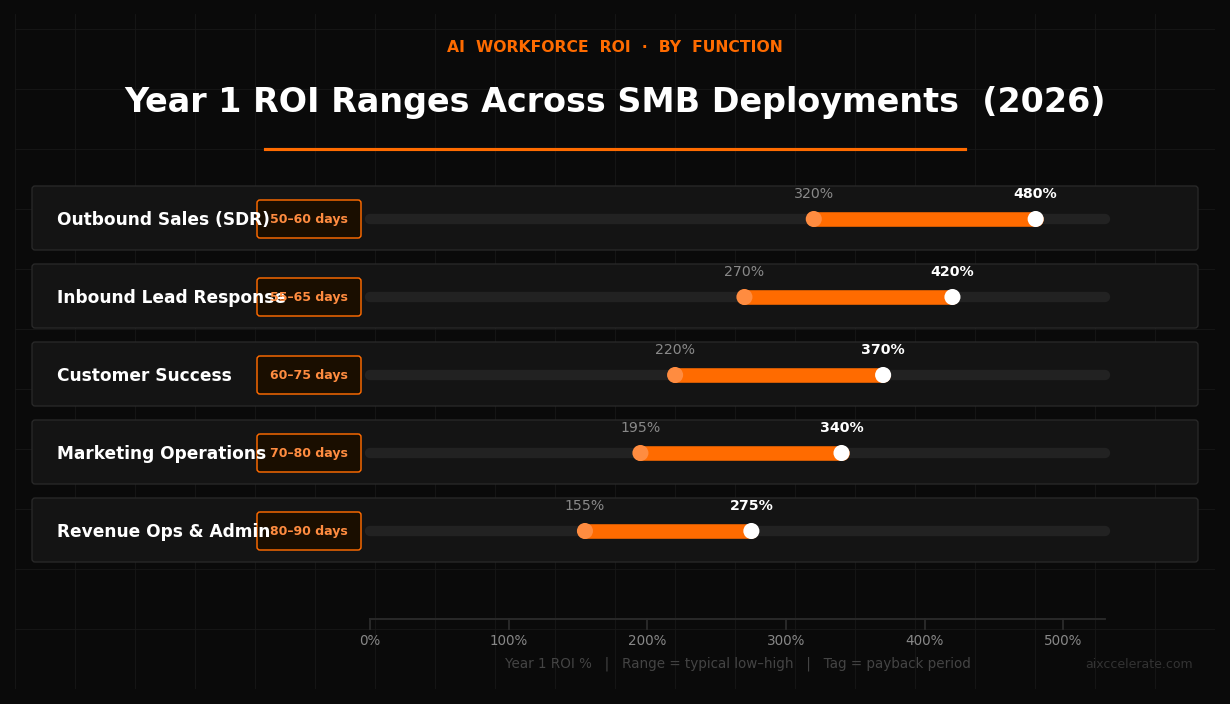
Based on AI Xccelerate's deployment data across SMB customers in 2026:
| AI Workforce Role | Year 1 ROI range | Drivers of variance |
|---|---|---|
| AI Outbound (SDR) | 300–500% | ICP precision, sales motion intensity |
| AI Inbound (Lead Handler) | 250–450% | Lead volume, response-time advantage |
| AI Sales Engineer | 200–400% | Deal complexity, technical content density |
| AI CS Manager | 350–600% | Coverage gap in current team, NRR baseline |
| AI Content Marketer | 250–500% | Existing content velocity, brand voice clarity |
| AI Coordination / Ops | 200–350% | Existing process maturity |
How to present the model to a board or CFO
Three slides:
Slide 1: The summary number. Year 1 ROI percentage, Year 2+ ROI percentage, payback period in months.
Slide 2: The four-variable breakdown. Show each variable, the assumptions, and the dollar value.
Slide 3: The sensitivity analysis. Three scenarios — base case, conservative case, pessimistic case.
FAQ
What is a typical ROI for an AI workforce deployment in 2026?
For an SMB deploying an AI Revenue Employee into a function with a comparable human cost, Year 1 ROI is typically 250–500%.
How long does it take to recover the cost of an AI agent?
Payback periods for Tier 3 AI Revenue Employees deployed at SMBs in 2026 are typically 45–90 days.
What is the biggest hidden cost SMBs miss when calculating AI workforce ROI?
Internal time in the first 30 days. The ICP definition, knowledge base contribution, lead magnet curation, and configuration require 20–40 hours of senior team time.
Should I include revenue lift in my ROI model?
Yes, but conservatively. Model it at 15–25% of labor offset for revenue-generating functions, and run a sensitivity test with revenue lift at zero.
How does AI workforce ROI compare to other software ROI?
AI workforce ROI is structurally different from software ROI because the value is in labor cost offset, not productivity. A 4x AI workforce ROI is roughly equivalent to a 1.4x software ROI if you index against the budget categories.
Ready to run this model on your actual numbers?
Book a free 30-minute AI Workforce Assessment. We'll apply the four-variable framework to your specific revenue functions, build your ROI model live on the call, and send you the full breakdown to take to your CFO or board. No deck. No sales pitch. Just the math.