Assist, Augment, or Replace: How SMBs Should Deploy AI Workforce in 2026
Most SMBs buy Replace-tier AI and deploy it like Assist — then blame the product. The Assist-Augment-Replace framework maps every function to its correct mode, so your AI spend finally delivers.
Every conversation about AI strategy at an SMB eventually arrives at the same fork: how aggressive should we be? Do we want AI to help our team work faster, or do we want AI to do the work?
That question feels binary, but it is not. There are three legitimate deployment modes, and the right answer is almost always "all three, applied to different functions." The strategic mistake we see most often at AI Xccelerate is not choosing the wrong mode in isolation — it is failing to map each business function to its correct mode and ending up with an inconsistent, expensive AI stack.
This is the framework we use with every SMB we work with. It is called Assist-Augment-Replace, and once you understand it, you can audit your existing AI spend and your planned investments through a single lens.
What does Assist, Augment, and Replace actually mean?
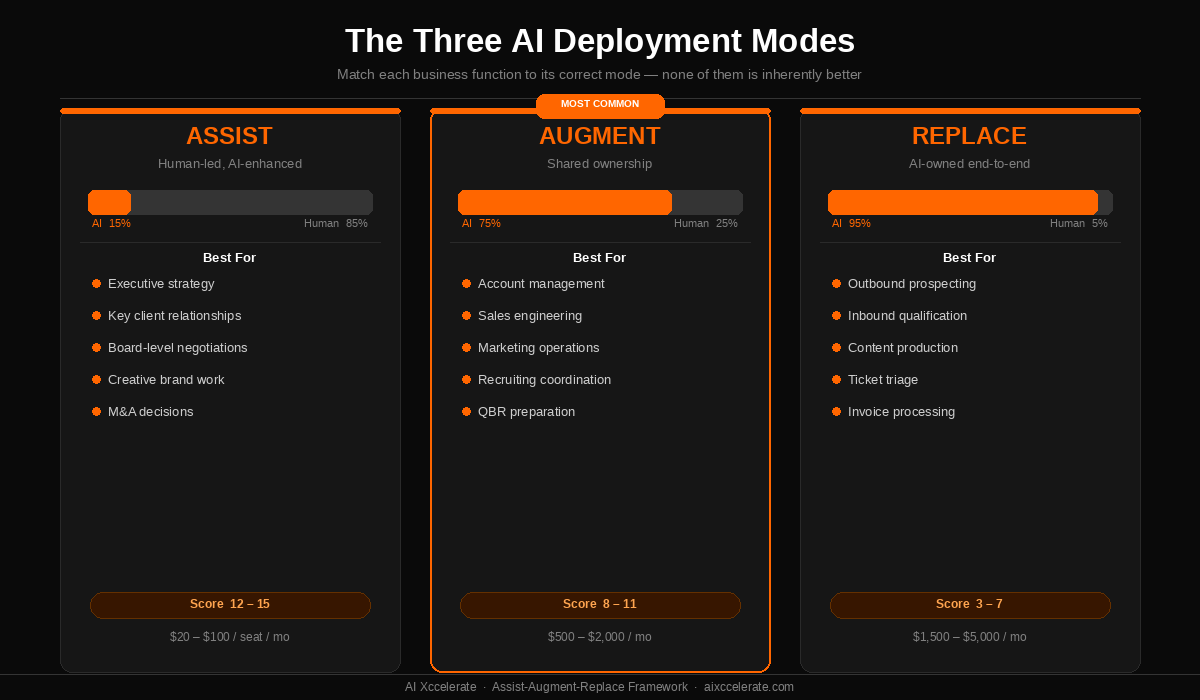
Assist is the mode most SMBs are already familiar with. The human owns the workflow. The AI makes the human faster, sharper, or better-equipped. Examples: a sales rep using ChatGPT to draft a follow-up email, a marketer using Claude to outline a blog, a CSM using an AI summarizer to recap calls. The human still does the job. The AI shaves time and improves quality.
Augment is the middle mode. The AI owns parts of the workflow autonomously, but the human still owns critical steps — usually the high-judgment, high-stakes, or relationship-driven moments. Examples: an AI agent that researches prospects, drafts outbound sequences, and books meetings, with a human SDR taking over once the prospect replies. An AI agent that triages support tickets and resolves Tier 1 cases, escalating Tier 2 to a human. An AI agent that builds the QBR deck, with the CSM doing the executive read.
Replace is full autonomy. The AI owns the function end-to-end. A human reviews performance the way a manager reviews a team member — by output, not by step. Examples: Jules running the entire outbound motion, including replies and follow-up. Pepper handling inbound qualification, scheduling, and CRM updates without a human in the loop until a deal is qualified. George managing the full CSM portfolio, with humans engaged only for executive escalation and strategic accounts.
The labels are not aspirational. They describe how the work actually flows. If your "AI replacement" still requires a human to send every email, you are in Augment mode, not Replace mode. Vendors love to call their products Replace-tier; buyers should be skeptical.
Why the three modes exist (and why none of them is "better")
A common misconception is that Replace is the goal and Assist is the entry point — that companies progress from one to the other as they mature. This is wrong, and following it produces bad outcomes.
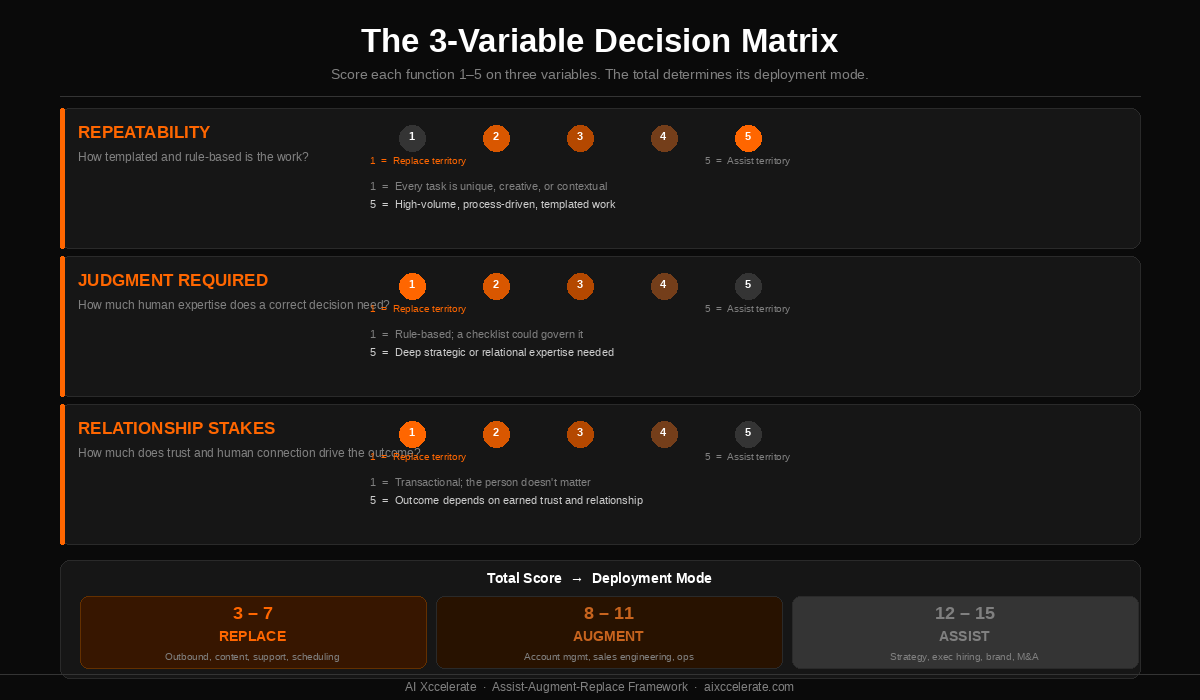
The three modes exist because different functions warrant different modes. The right mode is a function of three variables: how repeatable the work is, how high the stakes are if the AI gets it wrong, and how much human judgment or relationship the work requires.
Functions that are high-volume, repeatable, and low-judgment (outbound prospecting, lead qualification, content production at scale, ticket triage) are good candidates for Replace. The economic case is strongest, the AI error rate is acceptable, and the ROI signature is clean.
Functions that involve high stakes or critical judgment moments but also include large repeatable components (account management, sales engineering, executive support) are good candidates for Augment. The AI handles 70–80% of the volume; the human owns the 20–30% that requires nuance.
Functions that require continuous human judgment, high relational trust, or creative leadership (strategy, executive hiring, board-level negotiations, brand-defining marketing) belong in Assist mode. AI makes the human better. It does not own the work.
There is no progression from Assist to Replace. There is a mapping — a deliberate decision, function by function, about which mode fits.
The 3-variable decision matrix
When we work with SMB leaders to map their functions, we use a simple three-variable scoring system. Each variable is scored 1–5.
| Variable | Low (1) | High (5) |
|---|---|---|
| Repeatability | Every instance is unique | Same pattern repeated thousands of times |
| Judgment required | Pure execution, clear rules | High judgment, no clear rules |
| Relationship stakes | No human relationship at risk | Critical relationship that defines outcome |
Score each function on the three. The total tells you the mode:
- Score 3–7: Replace. High repeatability, low judgment, low relationship stakes. Outbound prospecting, content production, ticket triage, invoice processing.
- Score 8–11: Augment. Mixed profile. Account management, sales engineering, marketing operations, recruiting coordination.
- Score 12–15: Assist. High judgment, high stakes, or both. Strategy, executive hiring, M&A, key customer escalations, brand decisions.
The matrix is deliberately simple because the decision needs to be made dozens of times across an SMB, and complexity kills adoption. The strategic value is in forcing the conversation, not in the precision of the score.
What the three modes look like in a real SMB
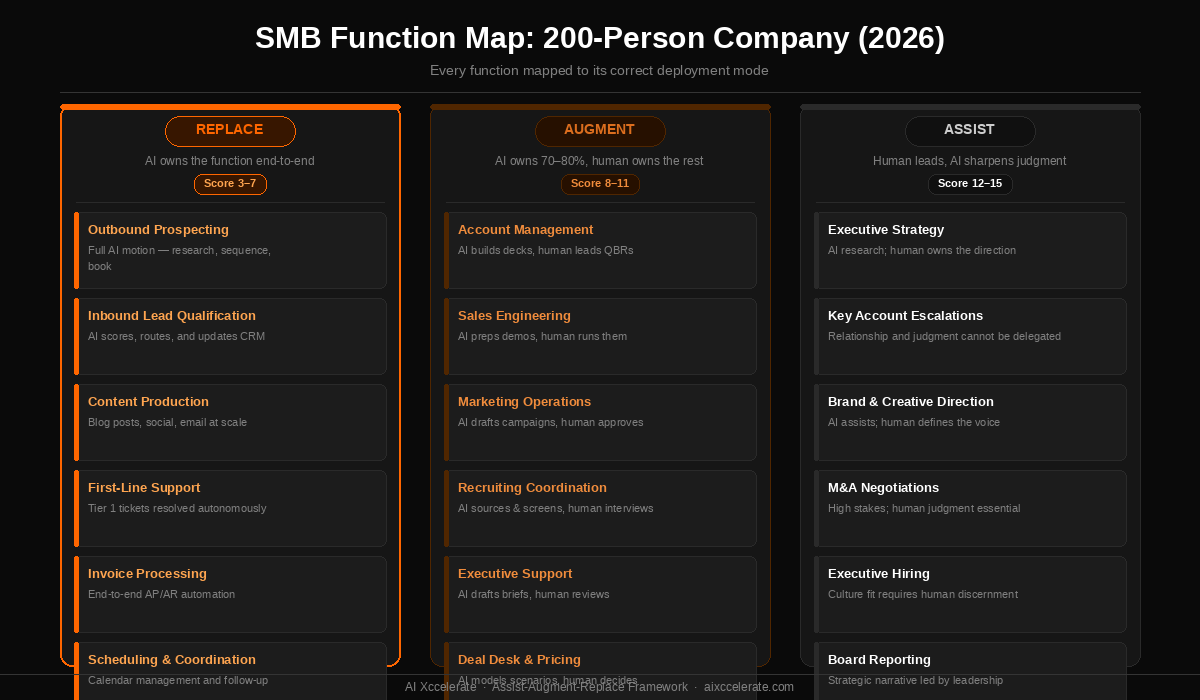
Here is how a 200-person SMB might map their revenue and operations functions across the three modes in 2026.
| Function | Mode | Why |
|---|---|---|
| Outbound prospecting | Replace | High volume, repeatable, low judgment. AI Outbound (Jules) owns it. |
| Inbound lead qualification | Replace | First-touch qualification follows a script. AI Inbound (Pepper) owns it. |
| Demo / SE work | Augment | Discovery is repeatable; deep technical Q&A is judgment-heavy. AI SE (Tony) handles the first 70%, human SE handles complex deals. |
| Account management | Augment | Renewals and check-ins are repeatable; strategic conversations are judgment-heavy. AI CS (George) handles routine; human CSM handles strategic. |
| Content production | Replace | Volume + repeatable formats. AI Content (Nick) owns blog, social, newsletter. Humans write thought-leadership. |
| Marketing strategy | Assist | Judgment + brand. Humans own the strategy; AI accelerates research and drafting. |
| Sales coordination | Replace | High-volume scheduling, CRM hygiene, follow-up tracking. AI Coordination (Joy) owns it. |
| Recruiting | Augment | AI does sourcing, screening, scheduling; humans own final interviews and offers. |
| Executive hiring | Assist | High judgment, brand-level decision. Humans own it; AI helps with research. |
| Customer escalations | Augment | Standard escalations are templatable; CEO-level escalations require human judgment. |
| Finance ops | Replace | Invoicing, reconciliation, basic reporting. AI handles. |
| Strategic finance | Assist | Capital planning, fundraising. Humans own; AI accelerates modeling. |
A company structured this way runs with a smaller, sharper human team than a traditional SMB of the same revenue — and a meaningfully larger AI workforce. The total cost is lower, and the output is higher, because every function is in the right mode.
The most common mistake: buying Replace, deploying Assist
The single most common deployment failure we see is what we call the "mode mismatch." An SMB buys a Replace-tier AI product — an AI SDR, an AI customer success agent — and then deploys it as if it were an Assist tool. The team reviews every output. They edit every email. They override the AI's decisions. They treat it as a junior employee who needs constant supervision rather than as the autonomous worker it was built to be.
Six months later, the company concludes that "AI doesn't work for our business." But what actually didn't work was the deployment. The product was designed for Replace mode. The team operated it in Assist mode. The cost was a Replace-tier subscription. The output was an Assist-tier productivity bump.
The fix is uncomfortable but simple: when you buy a Replace-tier AI, you have to actually let it run. That means defining clear performance metrics (meetings booked, tickets resolved, accounts retained), reviewing them at a managerial cadence (weekly, not transactionally), and giving the AI the same trust runway you would give a new human hire — typically 60–90 days to ramp.
If your team cannot make that mental shift, you bought the wrong mode. Step down to Augment, where human approval gates are designed in, and your team will be happier and the ROI will be cleaner.
The pricing signature of each mode
Each mode has a different cost-and-value profile, and SMB leaders should price accordingly.
Assist mode is the cheapest per seat. You are paying for productivity gains, not labor replacement. Typical pricing: $20–$100 per seat per month for tools like ChatGPT Team, Claude for Work, GitHub Copilot. The ROI is real but bounded — a 10–20% productivity improvement on the time the human spends on assisted work.
Augment mode is mid-tier. You are paying for the AI to own a substantial part of the function, with humans owning the rest. Typical pricing: $500–$2,000 per month per workflow or per agent. The ROI is meaningful — typically a 30–50% reduction in headcount need for that function, plus quality and consistency improvements.
Replace mode is the highest absolute cost but the lowest cost per unit of work. You are paying for a role to be owned end-to-end. Typical pricing: $1,500–$5,000 per month per AI employee, mapped to specific functions. The ROI is the largest because you are offsetting a fully-loaded salary (1.25–1.4x base) with a subscription that costs 20–30% of that salary.
The total spend across all three modes for a well-deployed SMB in 2026 is typically 5–8% of revenue — a significant line item, but cheap relative to the labor cost it replaces.
Sequencing: where to start
For an SMB starting from zero, the highest-ROI sequence is usually counterintuitive: start with Replace in one function, not with Assist everywhere.
The reasoning is simple. Assist mode is comfortable, but the ROI is diffuse. A 15% productivity improvement spread across a team is hard to measure, hard to attribute, and hard to defend at budget time. By contrast, a single Replace deployment — an AI SDR, an AI CS agent, an AI content marketer — produces a measurable, defensible cost reduction. One function. One number. One ROI story.
Pick the function where:
- The work is most repeatable
- The headcount cost is highest
- The current process is most strained (open roles, slow ramp, inconsistent output)
For most SMBs, that is outbound prospecting — high volume, well-defined, expensive to staff. Start there. Run it for 90 days. Measure the result. Use that as the foundation to layer in Augment mode for the next function and Assist mode across the team.
This sequence — Replace one function, then Augment a few, then layer Assist broadly — produces a defensible ROI story for the board, a comfortable cultural ramp for the team, and a deployment pattern that compounds.
How to audit your existing AI spend through this lens
If you are already running several AI subscriptions, do this audit before your next purchase. Take your last 12 months of AI spending. For each line item, ask:
- What mode was this bought as? (Read the marketing page.)
- What mode is it actually deployed in? (Watch your team use it for a day.)
- What is the measurable ROI?
The mismatch between mode-bought and mode-deployed is where money is being wasted. Either re-deploy the product to its intended mode (with the cultural and process changes required), or step it down to the mode you are actually using and switch to a cheaper product designed for that mode.
The companies that do this audit honestly typically find they can cut 20–30% of their AI spend with no loss of capability, freeing the budget for a single Replace-tier deployment that actually shifts the cost curve.
FAQ
What is the difference between AI augmentation and AI replacement?
Augmentation means the AI owns part of a workflow autonomously and a human owns the rest. Replacement means the AI owns the workflow end-to-end. The line is whether a human is in the loop on every decision. In Augment, yes for critical decisions only. In Replace, no — the AI runs and a human reviews outcomes the way a manager reviews a team.
Should an SMB start with AI assist or AI replace?
Counterintuitively, start with one Replace-mode deployment in your highest-cost, most repeatable function. The ROI is measurable, the deployment is contained, and the success story funds the rest of your AI strategy. Assist mode is good but the ROI is diffuse and hard to defend.
Which functions are best suited for AI replacement in 2026?
Outbound prospecting, inbound lead qualification, content production, first-line customer support, scheduling and sales coordination, invoice processing, and basic financial reporting. These functions are high-volume, repeatable, and low in relationship stakes — the three conditions that favor Replace mode.
How do I know if my AI deployment is in the wrong mode?
The cleanest signal is the gap between what the product can do and what your team lets it do. If your team is reviewing every output of a "fully autonomous" AI, you are paying for Replace and deploying in Augment or Assist. The fix is either to trust the system more, or to step down to a cheaper product designed for the mode you actually use.
Does the Assist-Augment-Replace framework apply outside revenue functions?
Yes. It applies equally to operations, finance, HR, and engineering. The variables are the same: repeatability, judgment required, relationship stakes. The mode mapping holds regardless of department. The names of the AI products change, but the framework does not.
If you want to map your business functions to the right deployment mode, AI Xccelerate runs a 60-minute Assist-Augment-Replace workshop with SMB leadership teams.