AI Sales Agents vs CRM Automation: A 2026 Buyer's Comparison
CRM automation moves data. AI sales agents do the work. In 2026, SMBs are confusing the two — and it's costing them. Here's how to tell them apart and buy the right layer.
TL;DR — Key Takeaways
- CRM automation moves data between systems based on rules you define. It does not produce work — it eliminates manual data entry.
- AI sales agents are autonomous workers that produce the work — prospecting, writing, replying, booking — using your CRM as one of several tools they operate.
- A common SMB mistake: paying $40K/year for "CRM AI features" and concluding "AI doesn't work for sales." It does. You bought the wrong category.
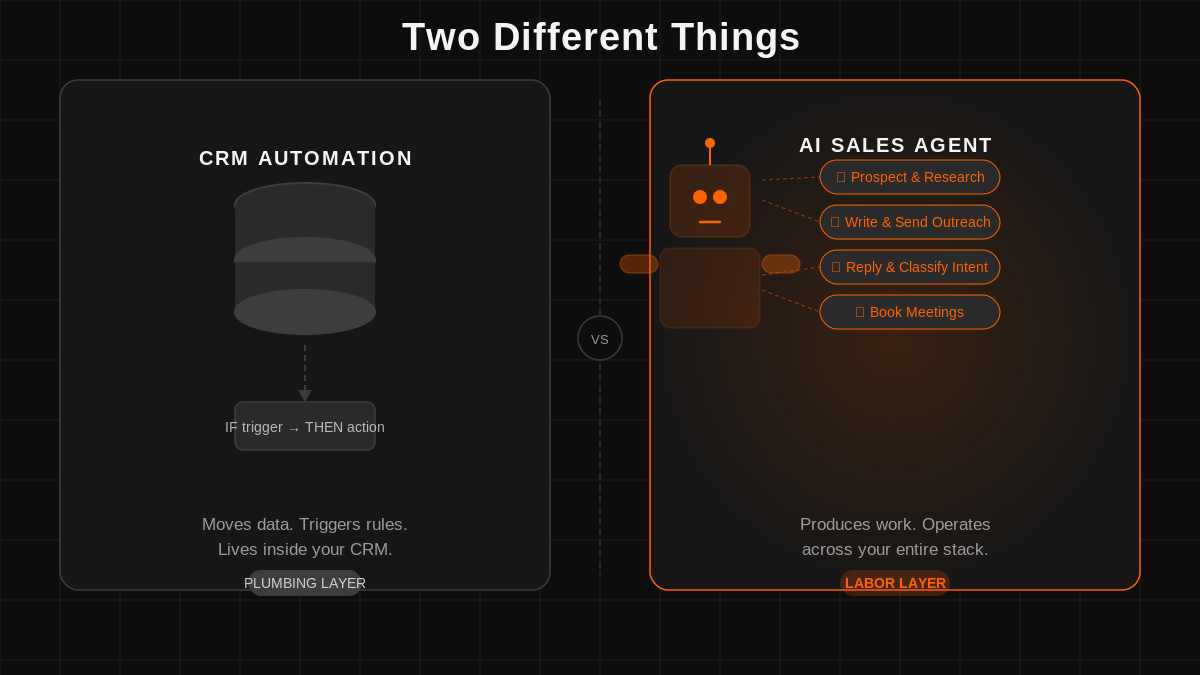
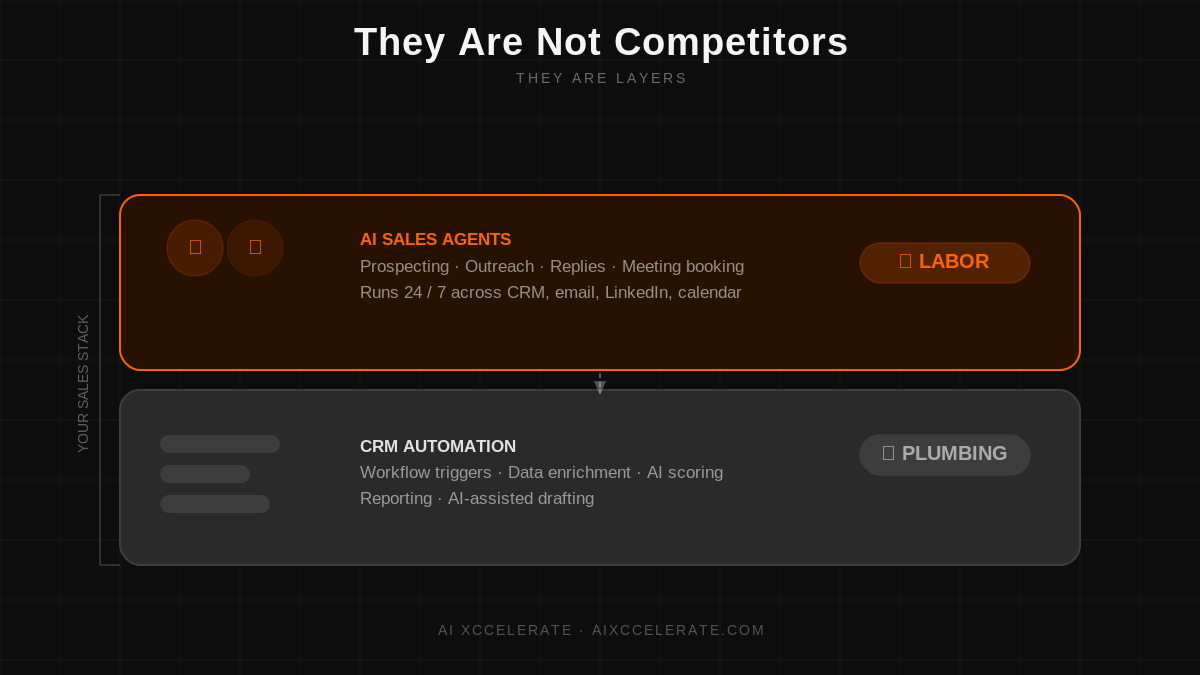
- The two are not competitors — they are layers. CRM automation is plumbing. AI sales agents are labor. You need both.
- The buying signal: if it lives inside your CRM, it is automation. If it lives across your CRM, email, calendar, and LinkedIn, it is an agent.
There is a category confusion happening in the SMB sales tech market in 2026, and it is costing buyers real money. The confusion is between CRM automation features (Salesforce Einstein, HubSpot Breeze, Zoho Zia, etc.) and AI sales agents (Jules, Pepper, Tony, and similar autonomous systems).
Vendors on both sides use the same words: AI, agent, autonomous, intelligent. The capabilities are described in similar marketing language. The pricing pages look superficially similar. But the products are doing fundamentally different things.
What is CRM automation in 2026?
CRM automation refers to the workflows, triggers, and AI features built inside a CRM platform that move data, trigger notifications, and surface insights based on rules you configure. It includes:
- Workflow automation: When a lead reaches stage X, send email Y. When a deal hasn't moved in 14 days, alert the rep.
- AI scoring and prediction: Lead scores, deal-win probabilities, churn-risk scores, sentiment analysis on call transcripts.
- AI-assisted drafting: Suggested follow-up emails, suggested meeting summaries, suggested deal updates. The human reviews and sends.
- Data enrichment: Auto-populating contact and company fields from the CRM's data layer.
- Reporting and dashboards: Surfacing pipeline insights, rep activity, conversion rates.
The keyword is inside. CRM automation lives in your CRM. It operates on records that already exist. It executes rules a human configured. It surfaces insights a human acts on.
The 2026 versions of these features are meaningfully better than they were in 2023, but the structural model has not changed. CRM automation is infrastructure for humans doing the work.
What is an AI sales agent in 2026?
An AI sales agent is an autonomous system that owns a sales function end-to-end. It does not live inside any single tool. It operates across the tools required to do the job — your CRM is one of them, but so are your email, calendar, LinkedIn, prospecting database, and lead-magnet library.
A Tier 3 AI sales agent in 2026 does work, not data movement. It:
- Sources prospects from your data providers based on ICP criteria
- Researches each prospect in parallel across four data dimensions
- Writes personalized outreach grounded in your knowledge base
- Sends and sequences across email and LinkedIn with intelligent timing
- Replies to prospects when they engage — classifying intent, deploying relevant lead magnets, booking meetings
- Updates the CRM with every action, every reply, every meeting booked
- Learns which campaigns, hooks, and lead magnets work best per ICP segment
The keyword is across. An AI sales agent operates across your stack. It does not need you to configure each rule — you brief it on the function, the ICP, the brand voice, and the goal, and it executes.
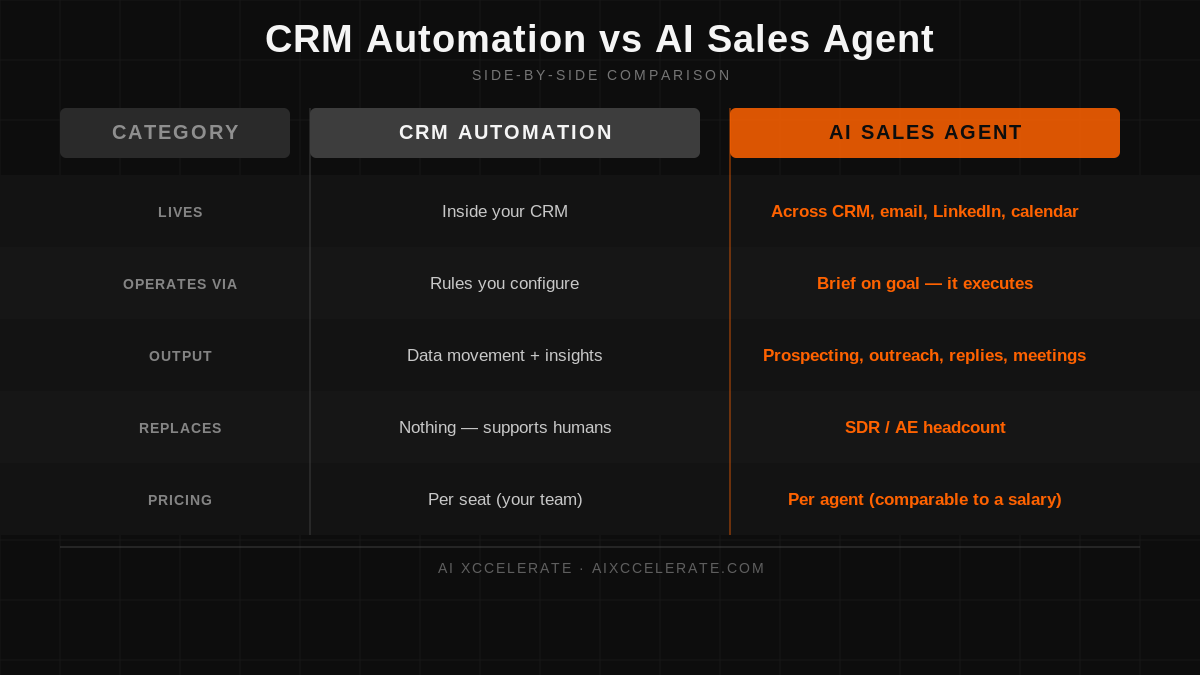
A side-by-side comparison
| Dimension | CRM Automation | AI Sales Agent |
|---|---|---|
| Primary purpose | Move data, trigger notifications, surface insights | Produce sales work (prospecting, outreach, replies, bookings) |
| Where it lives | Inside the CRM | Across CRM, email, calendar, LinkedIn, data sources |
| What you configure | Rules, triggers, workflows | A brief — ICP, value props, knowledge base, goal |
| What it produces | Data movement, alerts, summaries | Sequences, replies, meetings, qualified pipeline |
| Who does the work? | The human, faster | The AI, autonomously |
| Pricing model | Per CRM seat (often included or +$50–$150/seat for AI tier) | Per agent / per role ($1,500–$3,000/month) |
| Success metric | Time saved, data hygiene, dashboard adoption | Meetings booked, pipeline created, deals influenced |
| Best for | Making an existing sales team more efficient | Replacing or scaling sales headcount |
| Setup time | Days to weeks (workflow configuration) | 2–4 weeks (ICP, knowledge base, integrations) |
| ROI shape | 10–25% productivity gain on existing team | 50–70% cost reduction on a function |
Why the two are not competitors
CRM automation and AI sales agents are layers, not alternatives. You need both, and they do not overlap.
CRM automation handles the data layer — the underlying record-keeping that everything else depends on. Without it, an AI sales agent has no clean substrate to operate on.
AI sales agents handle the labor layer — the work that previously required human sales reps. They are not competing with CRM automation. They are using it.
A good mental model: CRM automation is your sales operations team. AI sales agents are your sales team. You would not fire ops and replace them with reps. You also would not fire reps and replace them with ops.
The pricing confusion that costs SMBs money
CRM platforms have become aggressive in 2026 about charging for AI features. Salesforce, HubSpot, Microsoft Dynamics, Zoho, and Pipedrive all offer "AI add-ons" that add $50–$200 per seat per month to existing licensing. For a 20-rep team, that is $24,000–$48,000 per year in additional CRM spend.
This is not bad value if the features are useful. But none of these features replace headcount. They make existing reps faster.
The pricing confusion is that an SMB will spend $40,000/year on the CRM AI tier and then balk at $30,000/year for an AI sales agent that would replace an SDR salary. The math is backwards.
When to buy which (and in what order)
Buy CRM automation first if:
- Your CRM is a graveyard of unmaintained records
- Your reps are spending 30%+ of their week on CRM updates
- Your sales leadership has no real-time pipeline visibility
- Your basic processes are inconsistent rep-to-rep
Buy an AI sales agent first if:
- You have open SDR or AE seats you cannot fill or afford
- Your outbound volume is below what your TAM supports because of capacity constraints
- Your inbound leads aren't being followed up quickly enough
- You are debating whether to hire the next sales rep
For most SMBs, the right answer is: do both, in that order, over 6 months.
What "AI" actually means in CRM marketing copy
AI suggestions (Einstein Email Insights, HubSpot Content Assistant): The AI proposes; a human disposes.
AI scoring (lead scoring, deal scoring): The AI produces a number; a human acts on it.
AI summarization (Gong's call summaries): The AI compresses information; a human consumes it.
AI drafting (suggested follow-ups): The AI writes a starting point; a human edits and sends.
All of these are valuable. None of them are AI sales agents. They are AI features inside CRM automation.
How to audit your current sales tech stack
Pull your sales tech subscriptions. For each, ask:
- Does this tool produce work, or does it support a human producing work?
- If it stopped working tomorrow, would my pipeline drop, or would my reps just be slower?
- Is this tool replacing a salary, or making a team more efficient?
The answers will sort your stack into two buckets: efficiency tools and labor. Most SMBs in 2026 are over-invested in the first bucket and under-invested in the second.
Still running your AI evaluation as a software procurement exercise? Book a free 30-minute AI Workforce Assessment — we'll show you exactly where AI sales agents fit in your current stack and what the ROI looks like vs your next SDR hire.
→ Book your assessment
How AI Xccelerate fits in
We sell AI sales agents — autonomous AI Revenue Employees that own specific sales functions end-to-end. Jules owns outbound. Pepper owns inbound. Tony owns sales engineering. Joy owns coordination. We work inside whatever CRM you run, and we do not compete with CRM automation features.
FAQ
Is an AI sales agent the same as CRM automation?
No. CRM automation moves data and triggers rules inside your CRM. An AI sales agent autonomously produces sales work — prospecting, outreach, replies, meetings — across multiple tools. CRM automation makes existing reps faster. AI sales agents replace or scale rep work.
Do I need to upgrade my CRM before deploying an AI sales agent?
Usually yes, at least to a baseline of hygiene and basic workflow automation. An AI sales agent operates against your CRM data — if that data is dirty or the workflows are inconsistent, the agent's output suffers.
Can my CRM's AI features replace an SDR?
No. CRM AI features (Einstein, Breeze, Zia) are designed to make existing sales reps more productive. They do not autonomously run sequences, handle replies, or book meetings.
How much should an SMB spend on each layer?
Rough rule of thumb for an SMB in 2026: CRM AI tier at 5–10% of revenue line for sales tech, AI sales agents at 1–2 agents per 50 mid-market accounts in your TAM.
What is the easiest way to know which product I am looking at?
Read the pricing page. If pricing is per seat for your sales team, you are looking at a CRM or productivity tool. If pricing is per agent or per role and is comparable to a salary, you are looking at an AI sales agent.
Ready to add the labor layer to your sales stack?
Book a free 30-minute AI Workforce Assessment. We'll map which sales functions in your business are best suited for AI employees, show you what the deployment looks like on top of your current CRM, and give you the cost comparison before you leave the call.