Frontier vs Open Models: How SMBs Can Win With AI Sovereignty (Without Adding Headcount)
Turn frontier and open AI models into a single AI workforce that scales your revenue, protects sovereignty, and freezes headcount—by deploying fully managed AI employees across marketing, sales, and customer success.
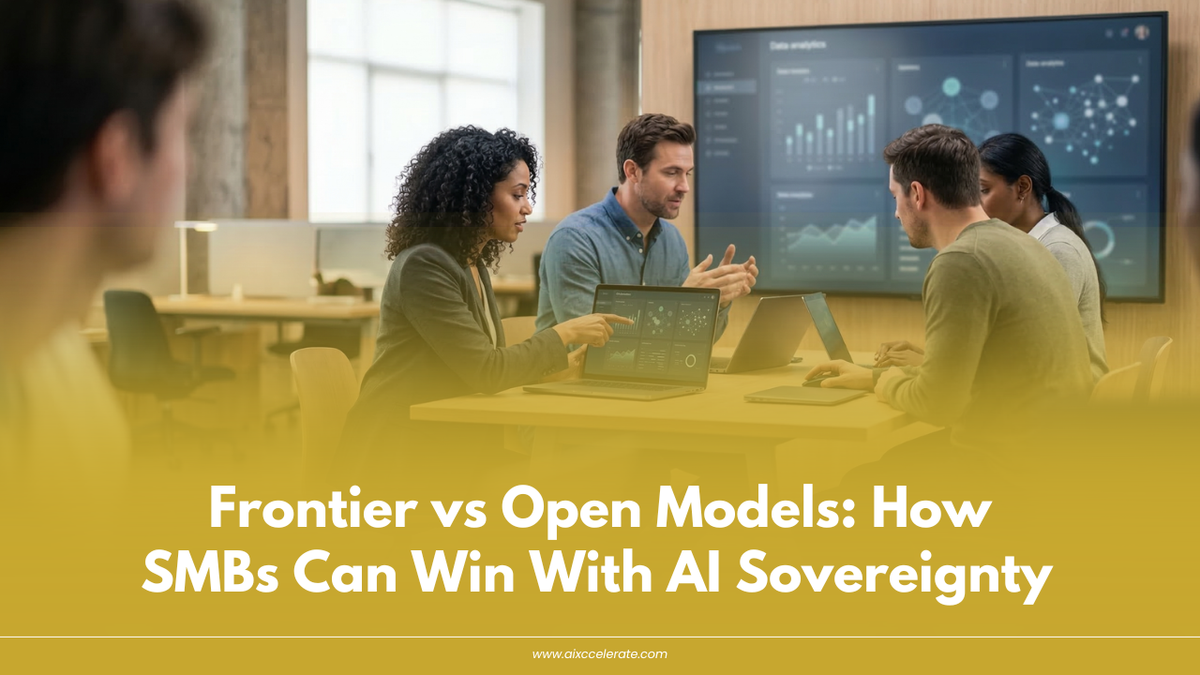
Frontier AI models and open models are giving small and medium-sized businesses unprecedented leverage—but the real question isn’t “which model is better?” It’s how you turn them into an AI workforce that drives revenue while keeping control of your data, processes, and margins. AI Xccelerate exists exactly at that intersection: we are the AI execution layer for the SMB economy, deploying fully managed AI employees across marketing, sales, and customer success so you can scale revenue while freezing headcount.
Frontier AI Models: Maximum Power, Minimal Control
Frontier AI models—built by players like OpenAI, Anthropic, and Google—sit at the cutting edge of large language models (LLMs), multimodal reasoning, and enterprise-grade capabilities. For SMBs, they’re attractive because they can:
- Handle complex, multi-step reasoning and decision support.
- Generate high-quality content, outbound email, and sales scripts.
- Integrate quickly into CRMs and tools via APIs for fast prototyping.
But you “rent” this power:
- The provider controls the model, roadmap, and pricing.
- You depend on external infrastructure and uptime.
- Your AI capacity is tied to someone else’s platform economics, not your own.
Used alone, frontier models can give you strong AI assistants, but not a sovereign, scalable AI workforce.
Open Models: Control, Customization, and AI Sovereignty
Open-weight or open-source LLMs like Llama, Mistral, and Qwen give you access to model weights that can be fine-tuned and, in many cases, self-hosted. For SMBs, this unlocks practical AI sovereignty:
- Run AI where your data and compliance rules live.
- Fine-tune models on your playbooks, CRM history, and domain-specific content.
- Bring down unit costs as usage grows, especially at higher volumes.
This is critical if you operate in regulated or trust-sensitive categories, where data residency and process control are non‑negotiable. However, models—frontier or open—are only raw capability. You still need a way to turn that capability into AI employees embedded in real workflows. That is the layer AI Xccelerate owns for you.
Frontier vs Open Models: What Actually Matters for SMBs
Instead of treating this as a purely technical decision, SMB leaders should look at “frontier vs open” through a revenue and sovereignty lens.
Question for SMB Leaders | Frontier Models | Open Models |
Who controls the stack? | ||
Cost predictability at scale? | ||
Speed to prototype? | Very fast via APIs nvidia+1 | |
Depth of customization? | Deep customization with access to weights datacamp+1 | |
AI sovereignty & compliance? | Much stronger control and alignment mckinsey+1 |
For most SMBs, the winning move is not picking one side, but orchestrating both behind an AI workforce that’s aligned to your P&L. That’s exactly what AI Xccelerate’s multi‑agent AI employees are built to do.
PATTERN BREAKER: What This Does to Your P&L
Here’s how the economics change when you move from human‑only teams or scattered tools to AI employees. From AI Xccelerate’s benchmark data:
- A typical SDR hire costs around $75,000 per year.
- An AI revenue employee from AI Xccelerate is about $20,000 per year.
- That’s roughly $110,000 in net annual savings per deployment, with payback in ~4.3 months.
This isn’t about saving a few hours with AI tools. It’s about reshaping your cost structure so that:
- Revenue scales.
- Headcount stays flat.
- And your AI capacity remains under your strategic control.
You can run your own numbers using AI Xccelerate’s ROI calculator to see exactly how this plays out for your pipeline and team: https://www.aixccelerate.com/calculate-roiFrom Tools to Employees: Where AI Xccelerate FitsMost SMBs today have a scattered AI stack: a chatbot on the website, some generative AI in their CRM, maybe a few internal scripts. Helpful—but still tool‑centric. AI Xccelerate starts from a different premise: give SMBs AI employees, not just tools. Our platform is the AI workforce infrastructure that deploys fully managed, role-based AI agents into your existing systems.
- Jules – AI Marketing Agent: Runs outbound and content programs, connects into your channels, and executes campaigns end‑to‑end.
- Joy – AI Sales Agent: Qualifies leads, manages pipeline tasks, and supports presales motions.
- George – AI Customer Success Agent: Onboards, supports, and retains customers with 24/7 coverage.
All of this sits on top of a hybrid model approach—frontier where raw performance is needed, open where sovereignty and cost control matter more—so you never have to pick or manage models directly. You can explore the full AI Revenue Team here: https://www.aixccelerate.com/our-agents
A Concrete SMB Vignette: From “Too Many Tools” to AI Employees
Imagine AcmeFlow, a 25‑person B2B SaaS company selling into North America.Before (Tools):
- 2 SDRs and a founder doing late‑night outbound.
- A marketing automation tool, a chatbot, and a few AI content tools none of the team fully trusts.
- Follow‑ups slip, onboarding emails are inconsistent, and the CS team is reactive, not proactive.
The result: revenue is growing, but so are salaries, tools, and chaos. The founder can’t justify another hire, but can’t push the team harder either.After (AI Employees with AI Xccelerate):
- AcmeFlow deploys Jules (marketing), Joy (sales), and George (customer success) as AI revenue employees, embedded into their CRM, email, and support channels.
- Behind the scenes, AI Xccelerate orchestrates frontier models for complex language and reasoning, and open models for cost‑efficient, repeatable workflows—fully managed as a service.
- Within weeks, outbound volume increases 3–5x, lead response time drops, and every new customer receives a consistent, automated onboarding journey.
The team still uses their CRM and tools every day, but now they’re directing an AI workforce instead of trying to manually hold every workflow together. The founder hasn’t added headcount—but they have added capacity.
How AI Xccelerate Operationalizes AI Sovereignty for SMBs
Instead of asking SMBs to become AI infrastructure experts, AI Xccelerate abstracts model selection, hosting, and orchestration into a single execution layer. We help you:
- Deploy AI revenue employees directly into your CRM, email, phone, and chat with no heavy lift from your team.
- Execute real work—campaigns, follow‑ups, onboarding, renewals—using the best‑fit mix of frontier and open models for each workflow.
- Scale by adding new AI roles across marketing, sales, and CS as your revenue grows, while your human team focuses on strategy and relationship‑driven work.
The sovereignty piece is built‑in: your data, processes, and AI roles are defined at your business layer, not at the whims of a single model provider.
PATTERN BREAKER: What to Do in the Next 30 Days
If you’re an SMB founder or revenue leader, here’s a concrete 30‑day path:
- Map 2–3 high‑leverage workflows. For example: outbound email, inbound lead qualification, or new‑customer onboarding.
- Decide your sovereignty boundaries. Clarify what data must remain under strict control and where cost sensitivity is highest.
- Meet your AI Revenue Team. Use AI Xccelerate’s Agents page (https://www.aixccelerate.com/our-agents) to align Jules, Joy, and George to the workflows you’ve mapped.
- Run your numbers. Use the ROI calculator (https://www.aixccelerate.com/calculate-roi) to model the impact of replacing or augmenting specific roles with AI employees.
- Pilot with one function. Start with the function where you feel the most pressure—often outbound or CS—and deploy your first AI employee to prove the model before scaling.
In 30 days, you won’t just “be using AI.” You’ll have the beginning of an AI workforce you can measure, manage, and scale.
Hire Your First AI Revenue Employee
You don’t have to choose between frontier and open models, or build an internal AI team, to get the benefits of generative AI and AI sovereignty. You need an AI workforce infrastructure that turns both into fully managed AI employees aligned to your P&L. AI Xccelerate does this for SMBs every day:
- We embed AI revenue employees—Jules, Joy, George, and others—directly into your existing GTM stack.
- We orchestrate the right combination of frontier and open models in the background for performance, cost, and compliance.
- We deliver ROI‑backed deployments, with typical savings of $110,000+ per AI employee and payback in a matter of months.
If you’re ready to see what an AI workforce could look like inside your business:
- Explore your AI Revenue Team: https://www.aixccelerate.com/our-agents
- Quantify your AI leverage: https://www.aixccelerate.com/calculate-roi
- Design your first AI employees with us: book time at https://book.aixccelerate.com and we’ll map your first deployment together.
You’ve experimented with AI tools. Now it’s time to hire your first AI employees.
References
- https://www.aixccelerate.com/
- https://www.nvidia.com/en-us/glossary/frontier-models/
- https://www.datacamp.com/blog/top-open-source-llms
- https://www.datacamp.com/blog/frontier-models
- https://www.mckinsey.com/featured-insights/mckinsey-explainers/what-is-sovereign-ai
- https://www.technaureus.com/blog-detail/best-open-source-llm-in-2026
- https://www.aixccelerate.com/our-agents
- https://www.aixccelerate.com/calculate-roi
- https://book.aixccelerate.com/