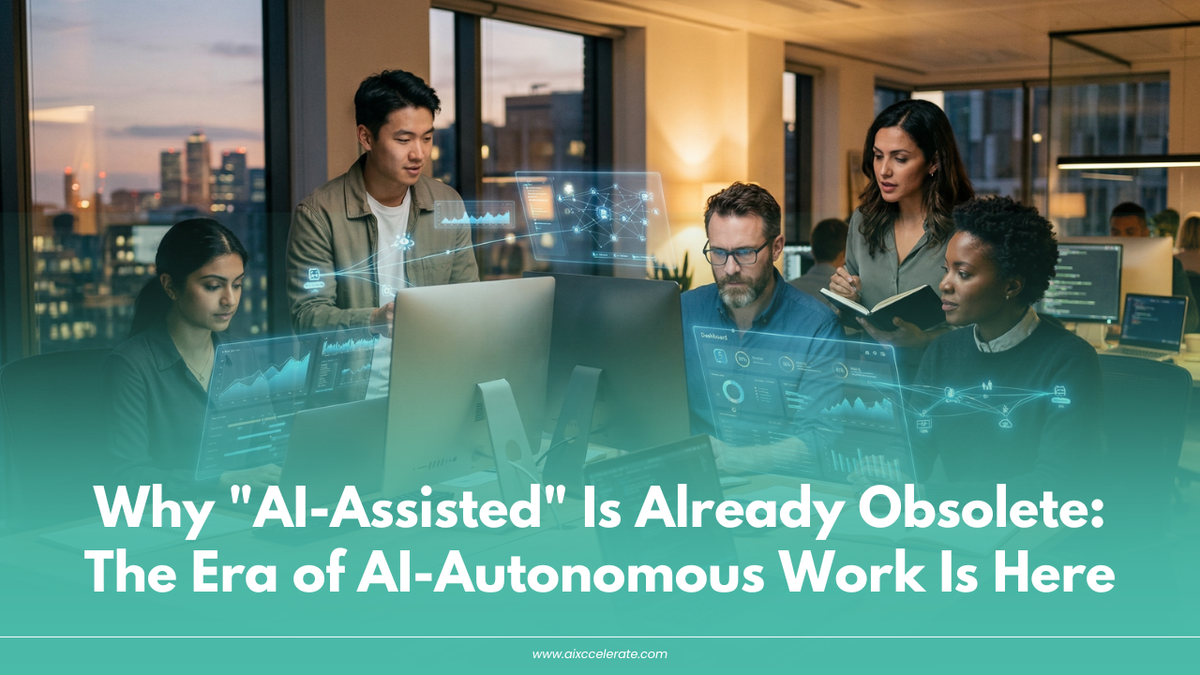
Why "AI-Assisted" Is Already Obsolete — The Era of AI-Autonomous Work Is Here
AI-assisted work is now table stakes. The real advantage comes from AI-autonomous operations, where agents run revenue workflows end-to-end while humans focus on high-judgment work.
The Moment "AI-Assisted" Became Table Stakes
Cast your mind back to 2020. If you told a prospective customer that your team used AI to help write proposals, score leads, or summarize meeting notes, it felt like a differentiator. It suggested you were forward-thinking, tech-savvy, ahead of the curve.
Now it's 2025. Your accountant uses AI. Your intern uses AI. The freelancer you hired last week for a one-off project uses AI. The competitor you barely worry about uses AI. Telling someone your business is "AI-assisted" today is roughly equivalent to saying you use email. It is not a strategy. It is not a moat. It is simply what working in the modern economy looks like.
The businesses that are genuinely pulling ahead — the ones quietly compressing their cost structures, scaling their output, and outpacing their markets — are not "AI-assisted." They are AI-autonomous. And the gap between those two states is far wider, and far more consequential, than most business leaders realize.
If your AI strategy is still built around helping your humans do their jobs a little faster, you are not behind the curve. You are on the wrong curve entirely.
Understanding the Spectrum: Assisted, Augmented, Autonomous
To understand why the shift matters, it helps to be precise about what these terms actually mean in practice.
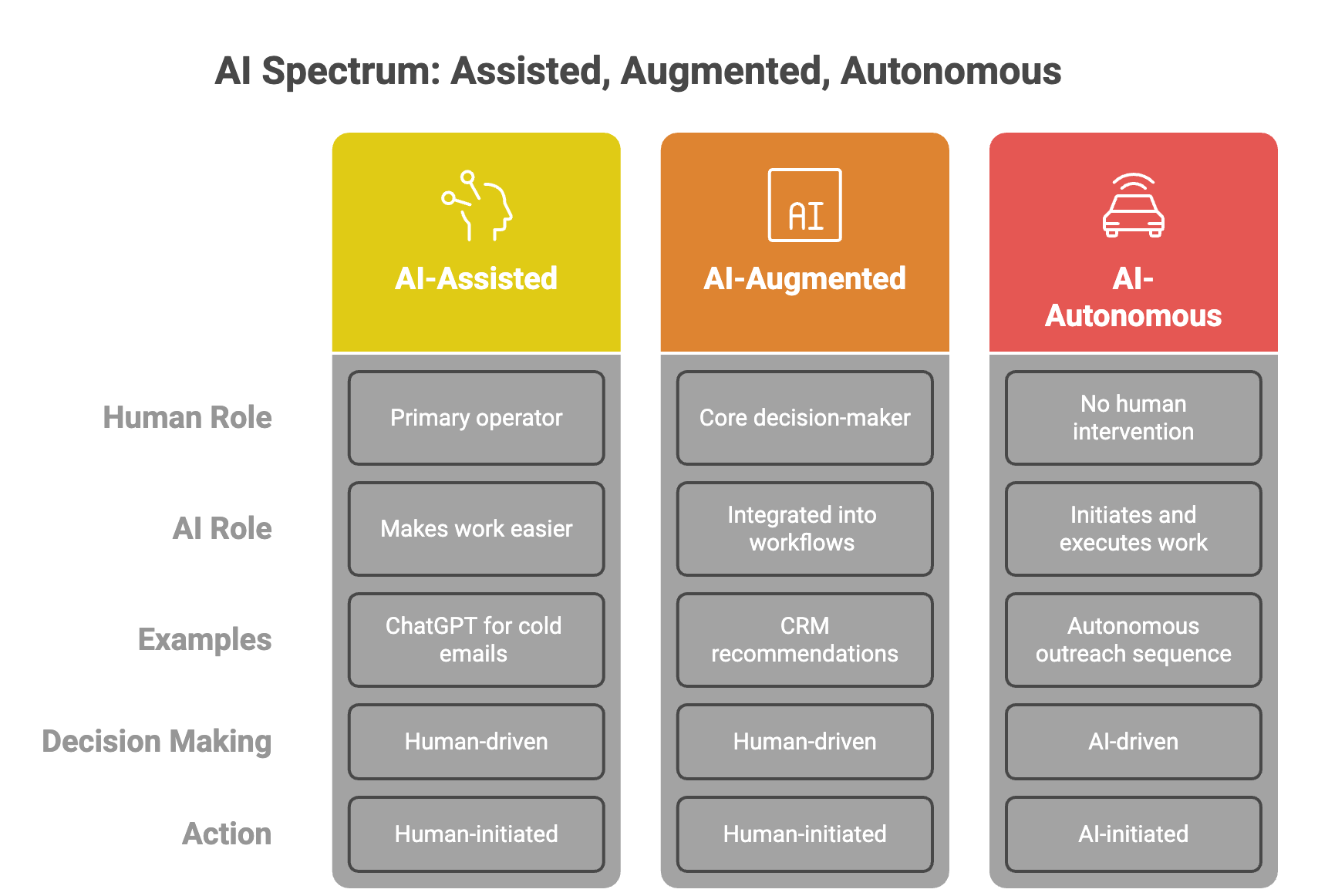
AI-Assisted means a human does the work, and AI makes parts of it easier. A rep writes a cold email with the help of ChatGPT. A manager summarizes a meeting with an AI transcription tool. A marketer uses AI to generate a first draft. The human is still the primary operator. AI is a tool in their hands — a very useful one, but fundamentally reactive and dependent.
AI-Augmented means AI is integrated more deeply into workflows — but humans still make the core decisions and take the primary actions. AI-powered CRM recommendations, lead scoring, conversation intelligence coaching. The system is smarter, but humans are still driving.
AI-Autonomous means AI agents initiate, execute, and complete work independently — without requiring a human to prompt every action. An autonomous AI agent researches a target account, drafts and sends a personalized outreach sequence, monitors response signals, updates the CRM, and escalates to a human rep only when a genuine conversation opportunity is confirmed. No human kickstarted any of that. The agent did it, beginning to end.
This is not a marginal difference. It is a fundamentally different operating model — one that changes what a team of ten people can accomplish, what your cost structure looks like, and what your competitive position is in the market.
The era of AI-autonomous work is not coming. For the businesses paying attention, it is already here.
Why "AI-Assisted" No Longer Builds Moats
There is a simple reason AI-assistance has lost its competitive value: the tools are ubiquitous, cheap, and easy to use.
GPT-4, Claude, Gemini. Notion AI, HubSpot's AI features, Apollo's AI sequences. Grammarly, Jasper, Copy.ai. The entire consumer and business software stack has been retrofitted with AI assistance features over the last two years. Every one of your competitors has access to the same tools, at the same price point, with the same ease of use.
When a competitive advantage becomes universally accessible, it stops being an advantage. It becomes the cost of entry.
Think of it this way: in 1995, having a business website was a genuine differentiator. By 2005, not having one was a liability. AI assistance has undergone the same compression — just in 24 months instead of a decade. The window in which "we use AI to help our team" was meaningful has closed.
The new question is not whether you use AI. It is how much of your business AI can run — autonomously, intelligently, and at scale — while your human team focuses on the work that genuinely requires them.
What AI-Autonomous Work Actually Looks Like
The concept of AI-autonomous work sounds abstract until you see it operating in practice. Here is what it looks like inside a revenue function that has made the leap.
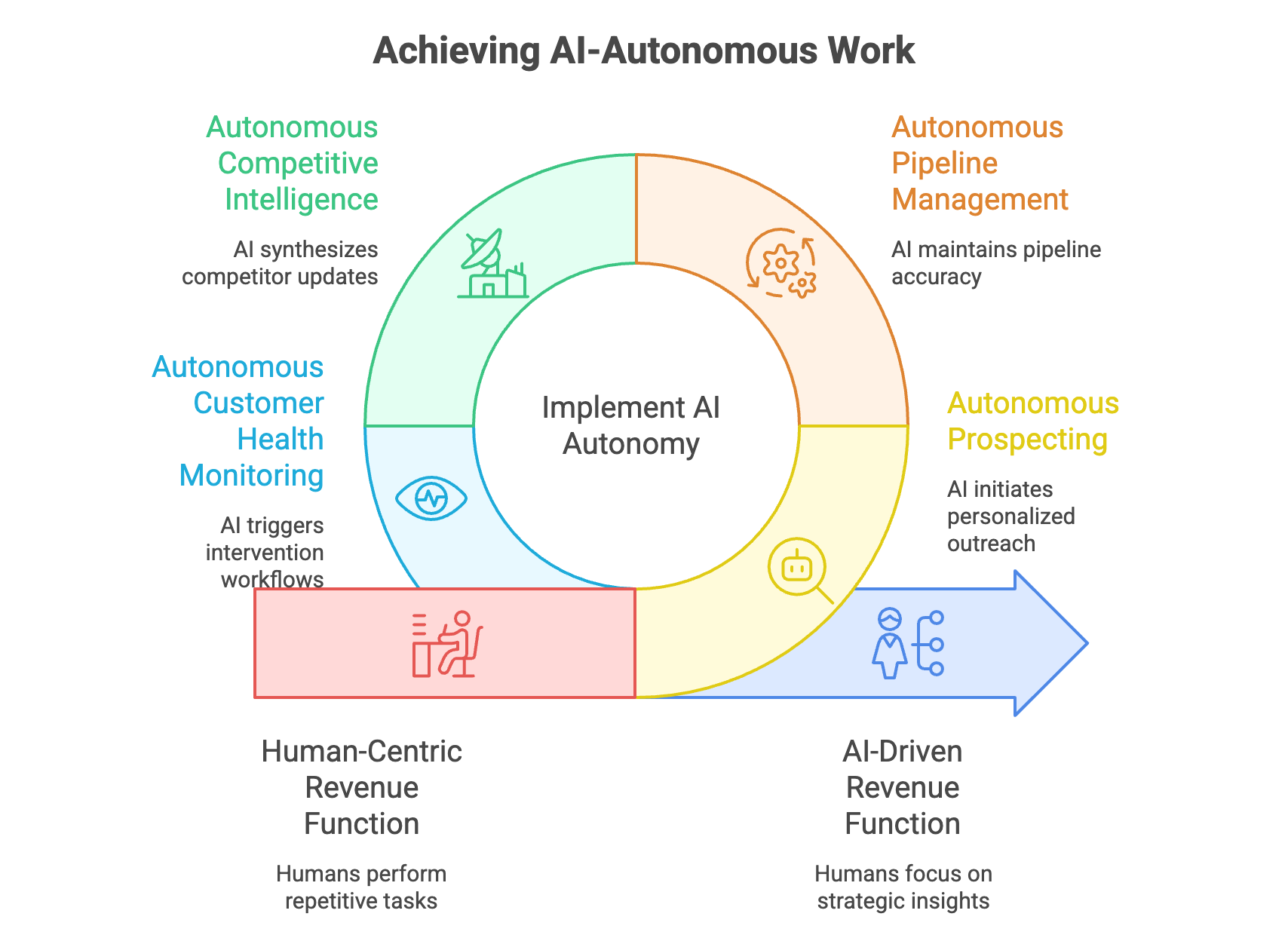
Autonomous prospecting: An AI agent monitors a curated universe of target accounts — tracking hiring signals, funding announcements, technology changes, content engagement, and intent data. When a trigger fires that matches your ideal customer profile, the agent autonomously initiates a research-backed, personalized outreach sequence. No human queued it. No human wrote it. No human scheduled it. The human rep gets a notification when a prospect responds and is ready for a conversation.
Autonomous pipeline management: Rather than relying on reps to manually update deal stages, log activities, and flag risks, an AI system continuously analyzes CRM data, call recordings, email threads, and calendar activity to maintain pipeline accuracy automatically. It surfaces deals at risk, recommends next actions, and alerts managers to anomalies — without anyone pulling a report.
Autonomous competitive intelligence: AI agents monitor competitor websites, review platforms, social channels, and news sources continuously, synthesizing updates into briefings that sales and marketing teams receive on a defined cadence. Nobody has to ask. The intelligence arrives because the system is always watching.
Autonomous customer health monitoring: Post-sale AI systems track product usage, support interactions, and engagement patterns across every account simultaneously. When a health score drops below a defined threshold, the system automatically triggers an intervention workflow — a check-in sequence, a CS rep notification, or an executive escalation — before a human would have noticed the problem.
In each of these cases, AI is not helping a human do work. AI is doing the work — and humans are deployed where their judgment, empathy, and strategic insight genuinely move the needle.
The Organizational Implications Are Profound
The shift from AI-assisted to AI-autonomous is not just a technology upgrade. It is an organizational redesign.
In an AI-assisted model, your headcount needs scale with your growth. More pipeline means more SDRs. More customers means more CS reps. More data means more analysts. The relationship between growth and headcount is largely linear — and largely expensive.
In an AI-autonomous model, that relationship breaks. AI agents absorb the volume increase. Human headcount scales much more selectively — focused on the highest-judgment, highest-relationship, highest-complexity work. A company that previously needed 20 people to run a revenue function may find that AI-autonomous operations allow a team of 8 to operate with greater output, higher quality, and better customer experience.
This has radical implications for unit economics, hiring strategy, and the kinds of people you bring into your organization. The AI-autonomous business is not looking for high-volume task executors. It is looking for people who can think in systems, exercise nuanced judgment, build genuine relationships, and direct the AI workforce beneath them toward the right outcomes.
The job of the human in an AI-autonomous organization is not to do the work. It is to define what great looks like, audit what AI produces, intervene when judgment is required, and continuously improve the systems underneath.
That is a fundamentally different talent brief — and the businesses that start hiring for it now will have a structural advantage over those still building teams designed for an AI-assisted world.
The Objection: "Isn't This Risky? What About Quality Control?"
This is the right question to ask — and it deserves a direct answer.
Yes, AI-autonomous systems require governance. Autonomous agents need guardrails, defined escalation paths, and regular review cycles to ensure output quality. AI can make errors, operate on bad data, or generate outputs that miss the mark without appropriate oversight mechanisms in place.
But here is the critical reframe: the question is not whether AI-autonomous systems are perfect. The question is whether they are better than the imperfect, inconsistent, capacity-constrained human-only systems they replace.
When you consider the dropped follow-ups, the inconsistent messaging, the manual errors, the burnout-driven performance variability, and the constant attrition that plague traditional revenue and ops teams, AI-autonomous systems — properly designed and governed — are almost universally more consistent, more reliable, and more scalable.
The solution to governance risk is not to avoid AI autonomy. It is to build smart governance into your AI-autonomous systems from day one — with clear quality thresholds, human review triggers, continuous monitoring, and improvement loops. That is exactly what well-designed AI-native operations look like.
The Window Is Narrow and Closing
There is a brief window — measured in months, not years — in which the shift to AI-autonomous operations represents a genuine first-mover advantage.
That window exists because most businesses are still in the AI-assisted phase, treating AI as a tool rather than an operator. They are using AI to help their humans — not to redesign what their humans need to do in the first place.
The businesses that make the architectural leap to AI-autonomous operations right now will build a compounding advantage rooted in lower costs, faster execution, and continuous learning that late movers will find extremely difficult to replicate. By the time the majority of your competitors realize that AI-assisted is no longer enough, the AI-autonomous pioneers will have 18 to 24 months of operational refinement, system learning, and market momentum that cannot be bought overnight.
The era of AI-autonomous work is not on the horizon. It is happening right now, inside the most forward-thinking businesses in every industry and market category.
The only question is whether you are building inside it — or watching from outside it.
Make the Leap from AI-Assisted to AI-Autonomous
At AIxccelerate, we help SMBs and growth-stage businesses make the transition from AI-assisted to AI-autonomous — designing revenue operations, customer workflows, and business processes where AI agents do the heavy lifting and your human team operates at its highest and best use.
If your AI strategy still looks like helping your team work a little faster, it's time to redesign it from the ground up.
👉 Book a free AI Autonomy Assessment — in 30 minutes, we'll map your current AI maturity, identify the highest-impact autonomy opportunities in your business, and show you what an AI-autonomous operation could look like for your specific context.
The assisted era is over. The autonomous era is here. Let's build yours.
Published by AIxccelerate | AI Strategy for Growing Businesses
Tags: AI-Autonomous Work, Agentic AI, AI Business Strategy, AI Revenue Operations, Future of Work AI, AI Agents for SMB, AI-First Operations, AI Workforce 2025