$2 Trillion Is Moving From Payroll to AI. The 2026 Reports Explain Why.
$2T is shifting from payroll to AI agents. 2026 data shows SMBs winning by treating AI as headcount, not software—deploying autonomous revenue employees with clear ROI.
Every year, the research houses weigh in. This year, NVIDIA, Deloitte, Google, Hugging Face, MIT Sloan, and TechCrunch all released comprehensive State of AI analyses within weeks of each other. The collective reading is unambiguous: AI has crossed the threshold from experiment to infrastructure.
But there is a gap between what the reports say and what small and mid-sized businesses are supposed to do with that information. Most of the analysis is written for enterprise leaders with innovation labs, AI transformation budgets, and multi-year roadmaps. It does not speak to the founder running a $15M B2B company who needs revenue to grow but cannot keep pace with the cost of the headcount that growth has always required.
AI Xccelerate was built for precisely that company. And the 2026 reports — read carefully — confirm the thesis the company was founded on.
Here are five findings from this year's research, and what they actually mean for SMB revenue teams.
1. Agentic AI Is the Defining Technology of 2026 — But Most Companies Are Still Getting the Architecture Wrong
Every major 2026 report names agentic AI as the breakout category of the year. Not AI assistants. Not copilots. AI systems that plan, act, and execute tasks autonomously — without waiting for a human to prompt each step.
Deloitte's State of AI in the Enterprise reports that worker access to AI tools rose 50% in 2025, and the number of companies with more than 40% of AI projects in active production is set to double within six months. The adoption curve is steep and accelerating.
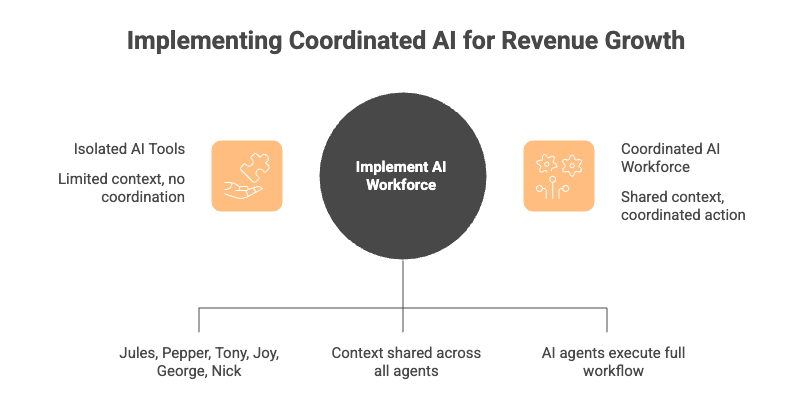
But the architecture most companies are adopting is fundamentally limited. They are deploying AI as a collection of point tools — one AI for email, one for support, one for content — functioning in isolation from each other, unable to share context, unable to coordinate action across a full business workflow.
MIT Sloan's Five Trends in AI for 2026 identifies coordinated, multi-agent systems as the coming competitive advantage. Not one AI doing one thing well. A team of AI agents executing an entire workflow end-to-end, with shared intelligence and shared context across every step.
This is the architecture AI Xccelerate built from day one.
The Revenue Acceleration Engine (RAE) deploys six AI revenue employees — Jules, Pepper, Tony, Joy, George, and Nick — as a coordinated revenue and brand team. Jules fills the pipeline with qualified outbound conversations. Pepper captures every inbound lead and converts interest into booked meetings. Tony brings prospects to technical confidence and commercial conviction. Joy keeps every deal moving with precision follow-up and deal operations. George owns post-sale success, health monitoring, and retention. Nick runs in parallel across every stage, building the content infrastructure that makes the entire revenue motion more effective.
When Jules learns something about a prospect, Pepper knows it when they call in. When Tony builds an ROI model, Joy has it ready for the follow-up. When George detects a retention risk, the entire team is informed. That is not a collection of AI tools. That is AI workforce infrastructure — and it is exactly what the 2026 research is pointing to.
2. The Hype-to-Pragmatism Shift Validates a Workforce-First Approach
TechCrunch opened 2026 with a declaration that cut through the noise: "In 2026, AI will move from hype to pragmatism." IBM's parallel research reached the same conclusion. Boards are no longer celebrating AI pilots. They are asking for proof of return.
This is the right question. And SMBs are actually better positioned to answer it than large enterprises — not despite their constraints, but because of them.
Enterprise AI transformation involves internal training programs, change management processes, AI Centers of Excellence, and multi-year deployment timelines. SMBs have none of those resources, which means they cannot afford to run experiments. They need AI that produces measurable output in the first billing cycle.
AI Xccelerate's deployment model was designed around this reality. Customers do not learn AI. They do not manage prompts, configure models, or hire internal AI talent. They hire AI employees the same way they hire human ones — against a job description, with defined responsibilities, and with performance expectations from day one. AI Xccelerate manages the agents. Customers manage the outcomes.
Eight weeks from contract to live deployment. First measurable outputs — pipeline generated, inbound leads handled, content published — appear within the first four weeks of operation. That is what pragmatism looks like in practice.
3. AI Is Capturing Headcount Budget, Not Software Budget — And the Numbers Are Shifting Fast
Gartner's data, cited in Vention's State of AI 2026 report, projects global AI spending reaching $2 trillion this year and rising to $3.3 trillion by 2029 — a 22% compound annual growth rate. The instinct is to read this as a software market expanding.
The reality is more structural. NVIDIA's State of AI 2026 report, drawing on over 3,200 respondents across financial services, healthcare, manufacturing, retail, and telecommunications, identifies the highest-ROI AI applications not as productivity tools but as revenue-generating and revenue-protecting deployments — outbound prospecting, inbound conversion, customer retention, and pre-sales support.
These are not software functions. They are workforce functions. And the budget flowing into them is not coming from IT procurement — it is coming from payroll.
This is the repositioning that most SMB leaders have not yet made, and it is central to everything AI Xccelerate does. The company does not sell into the software budget. Agent Jules — AI Xccelerate's AI Outbound Marketing and SDR Employee — runs at approximately $20,000 per year, all-in. A fully loaded human SDR costs $65,000–$80,000 in base salary alone, before benefits, management overhead, ramp time, and turnover. Jules operates every day of the year including weekends and holidays, handles multilingual outreach, and does not have a ramp quarter.
The CFO question in 2026 is not "what is our AI tool spend?" It is "what is our AI workforce allocation?" The companies that make that mental shift first will structurally outcompete those that treat AI as a line item in the software budget.
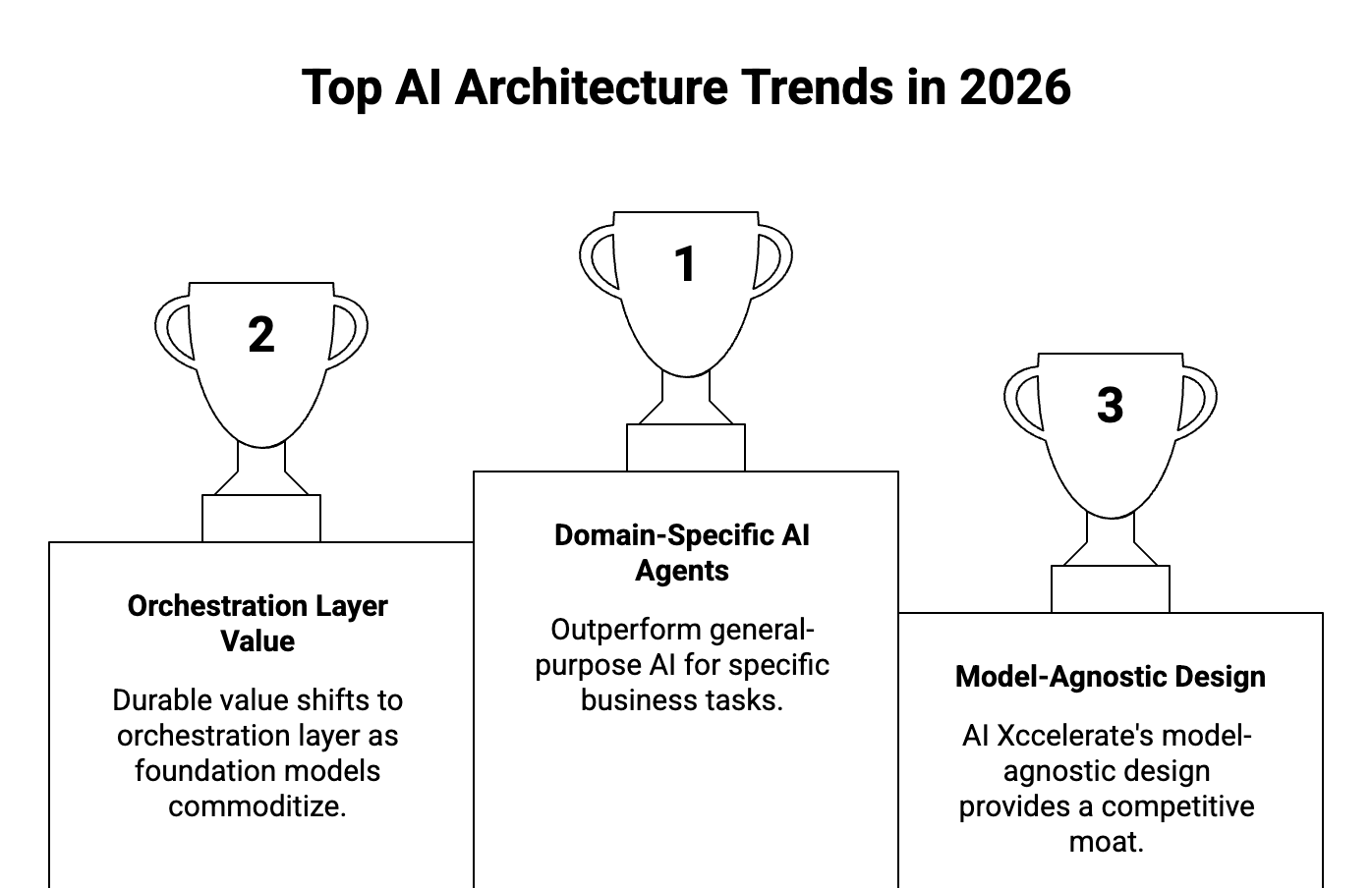
4. Smaller, Domain-Specific AI Models Are Outperforming General-Purpose AI for Business Execution
Hugging Face's State of Open Source: Spring 2026 report, released in mid-March, presents compelling evidence for a trend reshaping enterprise AI architecture: domain-specific, purpose-trained agents are consistently outperforming massive general-purpose models on specific business tasks.
General-purpose AI assistants are genuinely impressive at breadth. They can draft a legal memo, debug code, and write a poem in the same session. But when a business needs an AI employee who handles inbound leads with sales-qualified precision — who understands the product deeply enough to answer technical objections under pressure, who adapts tone for a B2B SaaS founder versus a manufacturing procurement director — general-purpose breadth is not the right architecture.
Every AI revenue employee in the Revenue Acceleration Engine is trained on the specific context, playbooks, tone, and decision logic of the role it fills. Agent Tony, AI Xccelerate's AI Product Expert and Sales Engineer, does not recite product documentation when a prospect raises an objection. He handles objections, qualifies technical requirements, builds ROI models, and moves deals forward — because he is trained on the work of a sales engineer, not on the general knowledge of a language model.
There is a second dimension to this that the Hugging Face report surfaces: as foundation models commoditize — and they are commoditizing rapidly — the durable value shifts upward to the orchestration layer. The company that owns the execution layer, the multi-agent coordination logic, and the deep business context wins regardless of which underlying model dominates next year. AI Xccelerate is model-agnostic by design. That is not an accident. It is the moat.
5. ROI Accountability Has Arrived — And the Right Response Is Treating AI Like Headcount
Deloitte's 2026 enterprise report surfaces a tension that every business leader will recognize: 86% of organizations are increasing AI investment this year, yet the same respondents report growing pressure to demonstrate concrete business outcomes within 12 months.
For SMBs, this creates both a warning and a structural opportunity.
The warning: AI projects deployed without clear ownership, clear output metrics, and clear accountability will not survive the next budget cycle. The graveyard of 2025 AI pilots is full of well-intentioned tools that no one measured, no one owned, and no one could justify renewing.
The opportunity: companies that deploy AI with role-level accountability — the same performance framework applied to any new hire — will see the return that justifies expansion. Not AI as a project. AI as a team member with deliverables.
AI Xccelerate's customers measure their AI revenue employees the same way they measure human ones: pipeline generated per week for Jules, inbound response time and conversion rate for Pepper, sales cycle compression and demo-to-close rate for Tony, CRM data quality and follow-up completion for Joy, customer retention and health scores for George, content output and engagement for Nick. Same accountability frame. Same performance expectations. Same consequence if the numbers are not there.
This is what it means to operate AI as workforce infrastructure rather than as a software tool. Software gets evaluated annually at renewal. Employees get evaluated continuously against the work they were hired to do.
What the 2026 Reports Confirm — and What They Still Leave Unanswered
The 2026 research tells the macro story clearly. Agentic AI is real and accelerating. ROI scrutiny has arrived. Domain-specific execution outperforms general-purpose AI on business tasks. AI spending is shifting from software budgets to workforce budgets. The window for early-mover advantage is open, but it is not open indefinitely.
What the reports do not address is the practical question facing the founder of a 50-person B2B company: how does a business with no Head of AI, no ML engineering team, and no $500K transformation budget actually execute on any of this?
That gap is the market AI Xccelerate was built to serve. AI-native companies — the ones that will structurally outcompete in the next three years — are not the ones with the most sophisticated AI strategy documents. They are the ones that quietly replaced two SDR headcount plans with AI agents in Q1, deployed an inbound handler that responds in under 90 seconds at 2am on a Sunday, and are running content operations at five times the volume with the same team.
The next hire for the revenue team should be an AI agent. Not because it is the trend of the moment. Because the math is undeniable, the technology is production-ready, and the structural advantage of moving early compounds every quarter it is sustained.
Revenue growth without headcount growth is not a prediction for 2028. It is the operating model of AI-native SMBs right now.
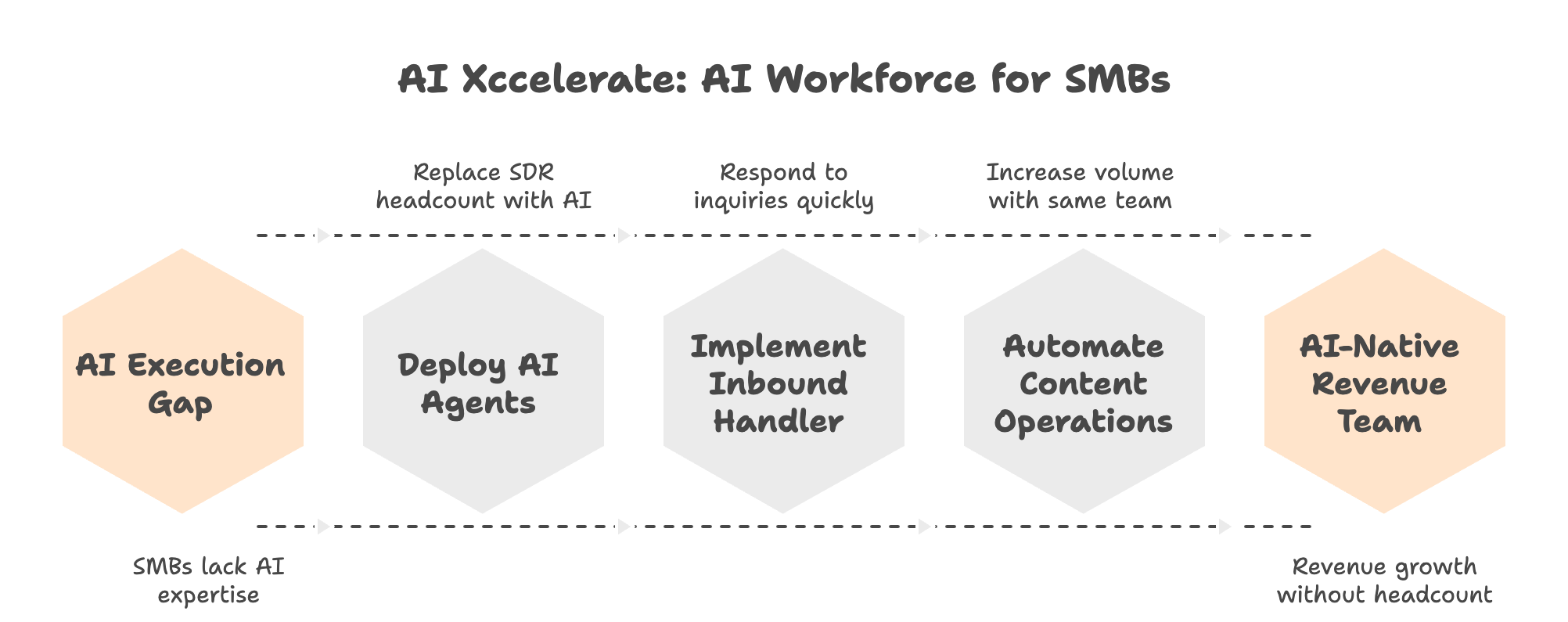
AI Xccelerate builds AI workforce infrastructure for SMBs. The Revenue Acceleration Engine deploys six coordinated AI revenue employees — Jules, Pepper, Tony, Joy, George, and Nick — across the full revenue motion, from pipeline generation to customer retention. The company captures headcount budget, not software budget.
Learn what an AI-native revenue team looks like for your business: book.aixccelerate.com
Sources & Credits
The analysis and findings cited throughout this article are drawn from the following primary research reports, all published in early 2026. Each source is linked directly for independent verification. AI Xccelerate's editorial interpretations and business applications are its own.
1. NVIDIA — State of AI 2026: How AI Is Driving Revenue, Cutting Costs and Boosting Productivity Publisher: NVIDIA Corporation Published: Q1 2026 Survey base: 3,200+ respondents across financial services, healthcare, retail, manufacturing, and telecommunications Read the full report →
2. Deloitte — State of AI in the Enterprise 2026 Publisher: Deloitte United States Published: Q1 2026 Key findings cited: 50% rise in worker AI access (2025); doubling of companies with 40%+ AI projects in active production; 86% of organizations increasing AI investment Read the full report →
3. Vention Teams — State of AI 2026: AI Market Size, Investment, and Industry Data Publisher: Vention Teams Published: 2026 Key data cited: Gartner projections — global AI spending $2T in 2026, rising to $3.3T by 2029 at 22% CAGR Read the full report →
4. Hugging Face — State of Open Source on Hugging Face: Spring 2026 Publisher: Hugging Face Published: March 17, 2026 Key findings cited: Domain-specific, fine-tuned models outperforming general-purpose models on specific business tasks; open-source AI landscape analysis Read the full report →
5. MIT Sloan Management Review — Five Trends in AI and Data Science for 2026 Publisher: MIT Sloan Management Review Published: 2026 Key findings cited: Coordinated multi-agent systems as the coming competitive advantage over isolated point-tool AI deployments Read the full report →
6. TechCrunch — In 2026, AI Will Move from Hype to Pragmatism Publisher: TechCrunch Published: January 2, 2026 Key findings cited: Industry-wide shift from AI experimentation to ROI-accountable AI deployment; "hype to pragmatism" transition Read the full article →
7. Google — 2026 Responsible AI Progress Report Publisher: Google Published: Q1 2026 Key findings cited: Responsible AI now fully embedded in product development and research lifecycles; shift in organizational AI maturity Read the full report →
8. TechInsights — AI Outlook Report 2026 Publisher: TechInsights Published: 2026 Key findings cited: Datacenter compute market projected to surpass $600B by 2030; AI hardware and infrastructure investment trends Read the full report →