What Is an AI Revenue Employee And How Is It Different From Sales Automation?
AI revenue employees go beyond sales automation by actually doing the work — prospecting, follow-up, onboarding, and demos — so SMBs can scale revenue like a full team, without scaling headcount.
If you've been keeping up with how small and mid-sized businesses are growing their revenue in 2026, you've probably noticed two terms being thrown around a lot — sales automation and AI revenue employees. They sound like they might mean the same thing. They don't.
This distinction matters more than most people realise, especially if you're a founder or sales leader trying to figure out where to invest your time, money, and energy to actually grow.
Let's break it down simply, clearly, and honestly.
The Promise That Sales Automation Made
Sales automation has been around for over a decade. Platforms like HubSpot, Outreach, and Salesloft built entire categories around it. The idea was straightforward: automate the repetitive parts of selling — email sequences, follow-up reminders, task creation, pipeline updates — so your reps could focus on the parts that actually require a human.
And it worked. Sort of.
For businesses with established sales teams, dedicated RevOps staff, and the bandwidth to configure and manage these platforms, sales automation delivered real value. Sequences went out on time. Reps got nudged to follow up. CRMs stayed cleaner.
But for the average small or mid-sized business — where the founder is also the closer, the marketer is also the SDR, and no one has time to become a HubSpot admin — sales automation created a different kind of problem. It added more tools to manage, more workflows to build, and more notifications to respond to. It made humans more organised, but it didn't remove humans from the equation.
That's a critical limitation. Because what most growing businesses actually need isn't a smarter to-do list. They need someone — or something — to do the work.
So, What Is an AI Revenue Employee?
An AI revenue employee is an autonomous AI agent designed to execute revenue-generating work independently — without needing a human to trigger, review, or approve every action.
Think of it this way. Sales automation is a tool that reminds your rep to send a follow-up email. An AI revenue employee is the rep. It researches the prospect, writes the email, sends it, tracks the reply, and decides what to do next — all on its own.
The distinction isn't just technical. It's philosophical. Sales automation is built around the assumption that there will always be a human in the loop. AI revenue employees are built around the assumption that, for many tasks in the revenue cycle, the human doesn't need to be there at all.
This is what makes the category genuinely new — and genuinely useful, particularly for smaller teams that can't afford to hire a full revenue department but can't afford to grow slowly either.
What Does an AI Revenue Employee Actually Do?
This is where it gets practical. The scope of what an AI revenue employee handles varies by platform, but the most capable systems today cover the full revenue cycle — not just one part of it.
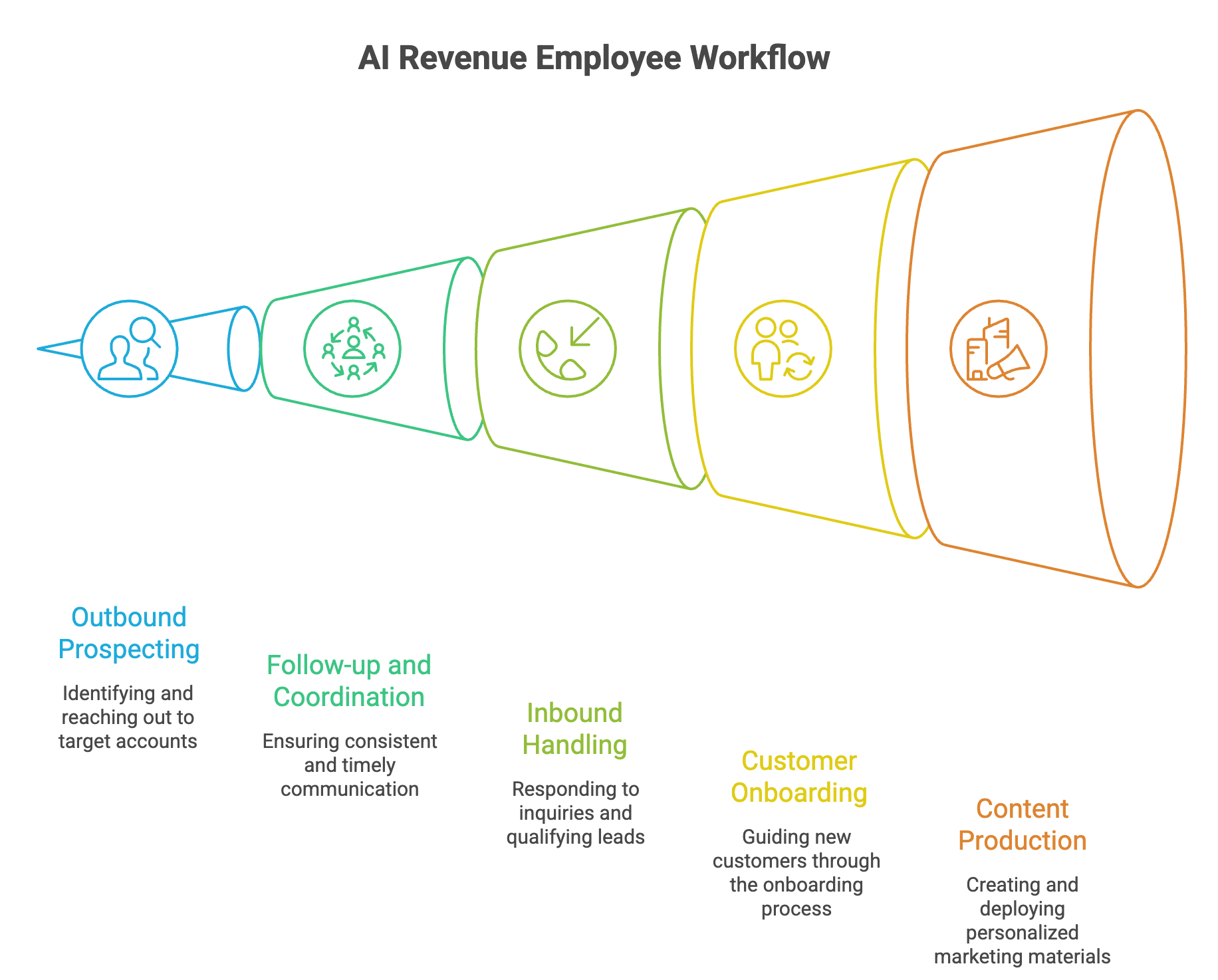
That typically includes:
Outbound prospecting. Identifying target accounts, researching individual prospects, crafting personalised outreach, and managing multi-channel sequences across email and phone — all without a human writing a single line.
Follow-up and coordination. One of the biggest revenue leaks for any business is poor follow-up. Leads go cold because no one got around to sending the third email. An AI revenue employee handles this consistently, at scale, and without being asked twice.
Inbound handling. When a prospect fills out a form, calls in, or replies to an email, they expect a fast, relevant response. An AI agent can handle that initial conversation — qualifying the lead, answering common questions, and routing or booking appropriately.
Customer onboarding. The period between a signed deal and a successful customer is often chaotic and manual. AI revenue employees can manage onboarding check-ins, send the right resources at the right time, and flag friction early.
Content and outreach production. Writing personalised emails, follow-up sequences, and prospect-specific messaging at scale is time-consuming. An AI agent built for this can produce and deploy content continuously without a content team behind it.
Discovery and demo calls. Some AI agents are now capable of running structured discovery conversations and product demos — handling questions, qualifying deeper, and surfacing insights for the human team.
When these functions are handled by a single platform where all the agents share context and intelligence, you get something that looks much less like software and much more like an actual revenue team.
The 5 Key Differences Between Sales Automation and AI Revenue Employees
To make this concrete, here's how the two approaches compare on the dimensions that actually matter for a growing business.
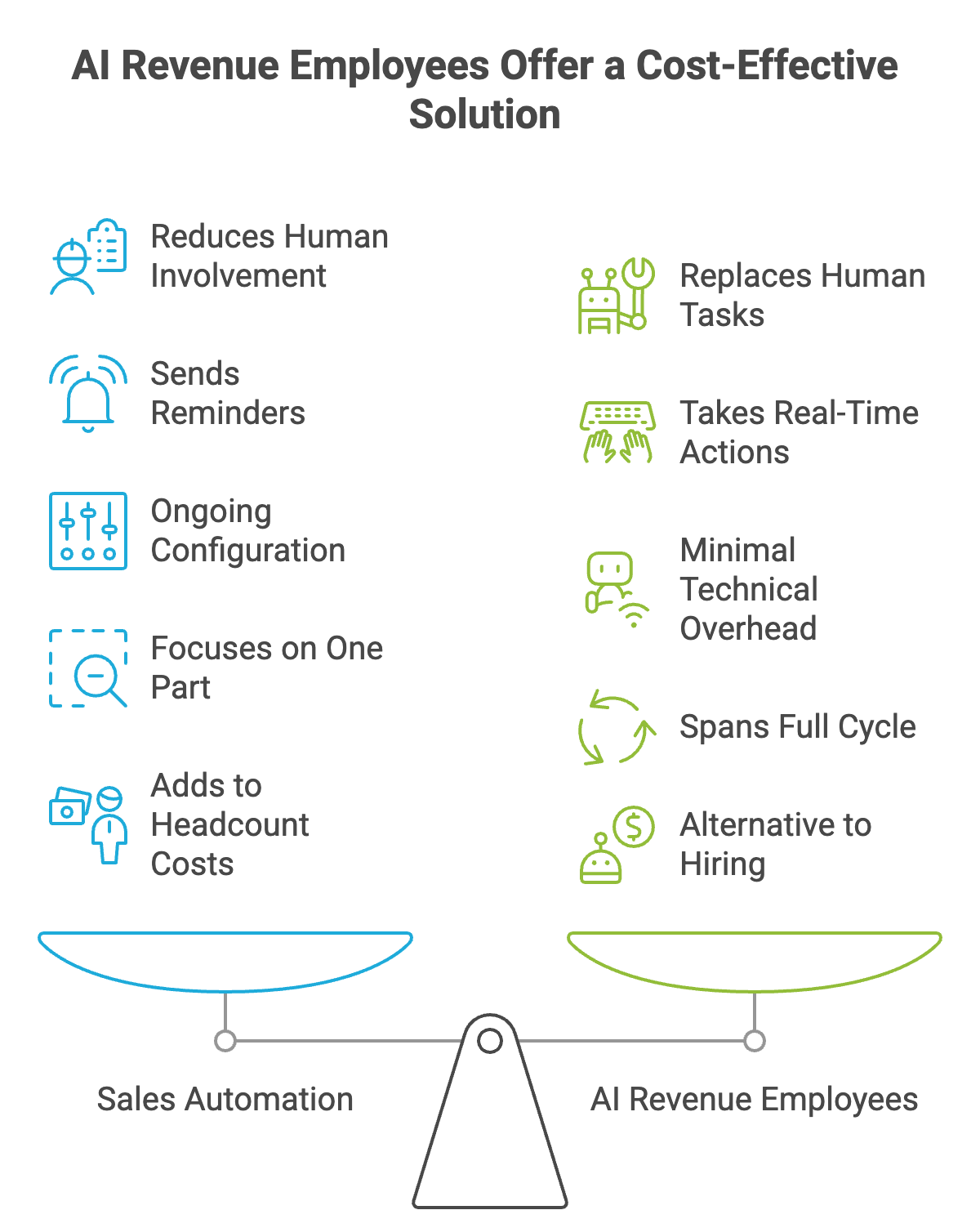
1. Human involvement. Sales automation reduces how much humans do. AI revenue employees replace what humans do in specific, well-defined tasks. One assists; the other executes.
2. Trigger vs. action. Automation platforms send reminders and create tasks. AI revenue employees take actions — writing, sending, calling, responding — based on real-time context.
3. Setup and maintenance. Traditional automation requires ongoing configuration, workflow management, and regular tuning. The best AI revenue employee platforms are designed to embed into existing tools and start working quickly, with minimal technical overhead.
4. Scope. Most sales automation tools focus on one part of the funnel — outbound, or follow-up, or CRM hygiene. AI revenue employees, at their best, span the full cycle from first touch to successful onboarding.
5. Cost model. Hiring a 5-person revenue team costs $300,000–$500,000 per year in salaries alone. Sales automation tools add to headcount costs rather than replace them. AI revenue employees are positioned as a genuine alternative to hiring — delivering comparable output at a fraction of the cost.
Why This Matters Specifically for SMBs
Large enterprises have the resources to field a full sales team and layer automation on top. For a 10- or 20-person business, that's not a realistic option.
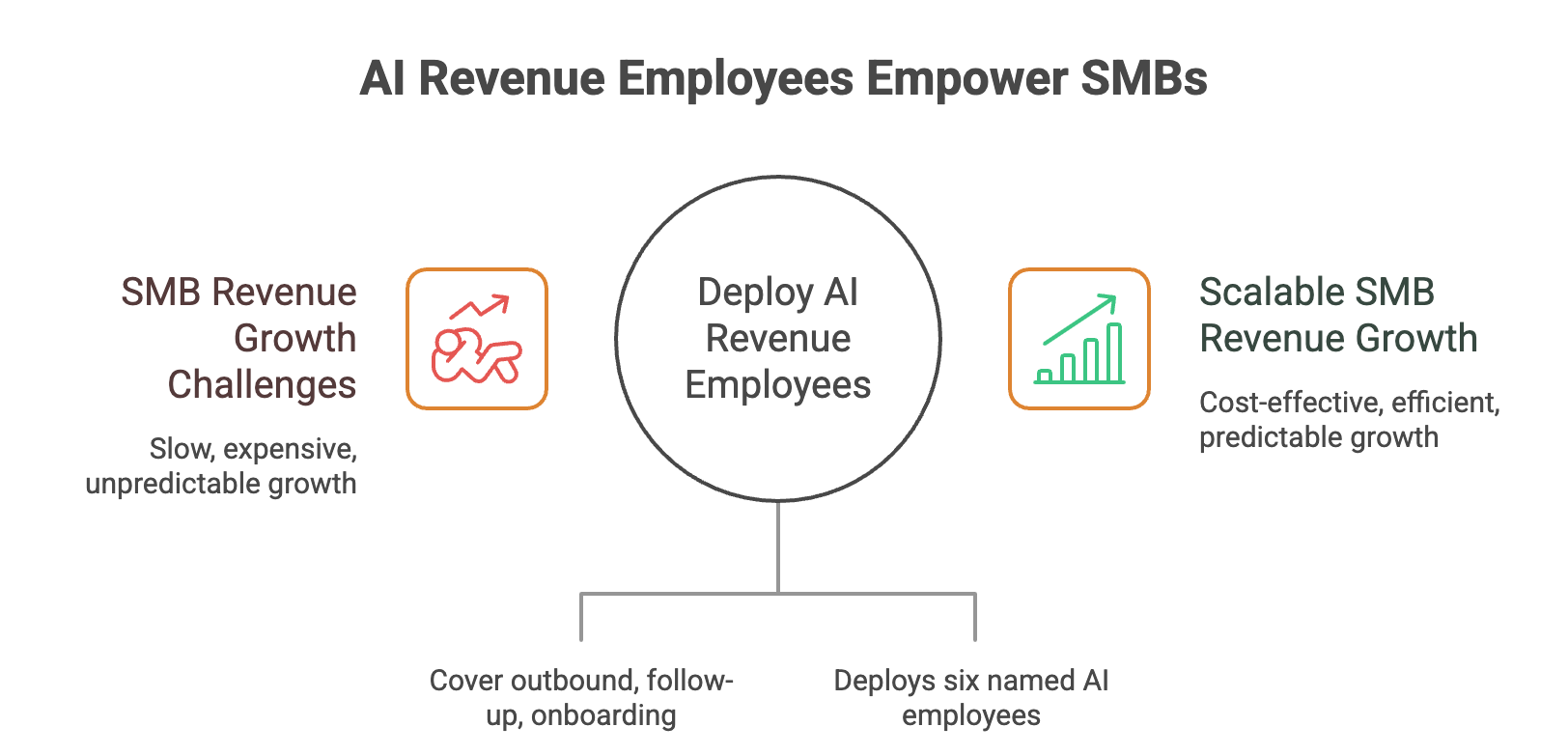
The traditional path for SMB revenue growth looked like this: founder sells until they're stretched too thin → first sales hire → slow onboarding → inconsistent results → hire again. It's expensive, slow, and unpredictable.
AI revenue employees change that equation. A small team can now deploy multiple AI agents across different revenue functions simultaneously — effectively operating with the output of a much larger team, without the cost, management overhead, or HR complexity.
This is why platforms designed specifically for this use case — like AIXccelerate, which deploys six named AI revenue employees covering outbound, follow-up, onboarding, content, demos, and inbound handling — are gaining traction quickly. The appeal isn't just the technology. It's the business model it enables.
What to Look For When Evaluating AI Revenue Employee Platforms
Not all AI agents are created equal. If you're exploring this space, here are the questions worth asking.
Does it cover more than one function? Point solutions that handle only outbound, or only follow-up, still require you to stitch together a workflow. Platforms that cover the full cycle create compounding value.
Does it integrate with your existing tools? The last thing a small business needs is another platform to learn. The best implementations embed into your existing CRM, email, phone, and calendar without replacing them.
Does it share context across agents? Individual AI tools are useful. AI agents that share a unified knowledge base — understanding your company, your prospects, and your customers collectively — are significantly more powerful.
What does autonomous actually mean? Ask vendors specifically: which actions require human approval, and which happen automatically? The answer tells you a lot about how much time you'll actually save.
Can you see what it's doing? Transparency and reporting are non-negotiable. A good AI revenue platform should give you a clear view of activities, outcomes, and pipeline impact in real time.
The Bottom Line
Sales automation improved the efficiency of human sales teams. AI revenue employees are beginning to replace parts of those teams entirely — handling specific, defined jobs with consistency, speed, and scale that human teams can't match at SMB budgets.
This doesn't mean sales automation is obsolete. For certain use cases and certain team sizes, it still makes sense. But if you're a growing business trying to build a revenue engine without building a large revenue team, the question worth asking isn't which automation platform should we use — it's which AI revenue employees should we hire.
The category is early, the technology is moving fast, and the businesses that figure this out first will have a meaningful structural advantage over those that don't.
Exploring how AI revenue employees could work for your business? AIXccelerate deploys six purpose-built AI agents covering the full revenue cycle — designed specifically for small and mid-sized businesses.