AI SDR or Revenue Agent: What's Right for Your Business?
Not all AI sales tools are the same. AI SDRs fill your pipeline fast. Full revenue agents run the whole cycle. Here's how to pick the right one for your business model and growth stage.
The AI sales revolution is no longer hypothetical. Across B2B pipelines worldwide, companies are replacing (or augmenting) human sales roles with AI-powered systems that prospect, qualify, nurture, and close — at scale, around the clock, without a commission structure.
TL;DR: If your main problem is "not enough meetings," you likely need an AI SDR. If your problem is "sales costs too much for our ACV," you likely need a full revenue agent. Most scaling teams eventually need both.
But not all AI sales tools are built the same. AI SDRs and full revenue agents are fundamentally different in scope, capability, and strategic fit — and choosing the wrong one doesn't just waste budget, it can stall your go-to-market motion at exactly the moment you need momentum.
What Is an AI SDR?
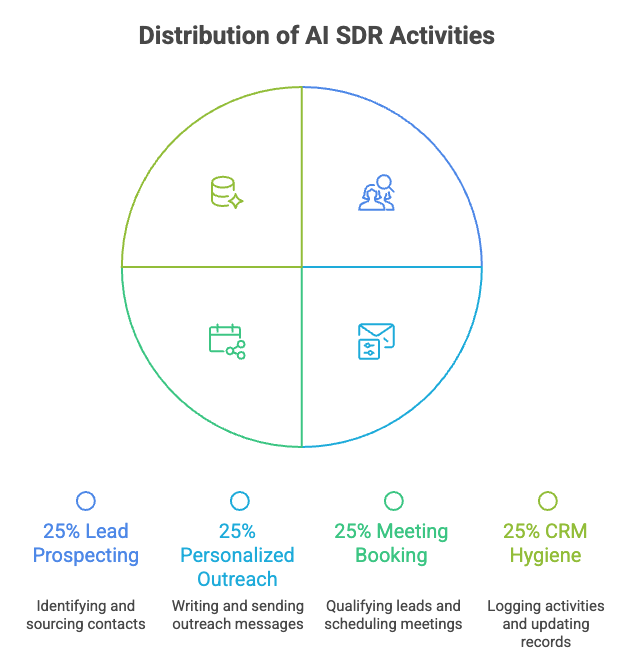
An AI SDR (Sales Development Representative) is an AI system designed to replicate — and scale — the top-of-funnel activities traditionally handled by a human SDR. These include:
- Lead prospecting: Identifying and sourcing contacts from databases, LinkedIn, web signals, and intent data
- Personalized outreach: Writing and sending cold emails, LinkedIn messages, and follow-up sequences
- Meeting booking: Qualifying inbound and outbound leads and scheduling demos with account executives
- CRM hygiene: Logging activities, updating contact records, and flagging high-intent accounts
Popular AI SDR tools like Artisan's Ava, 11x's Alice, and Relevance AI's SDR agents operate within a defined lane. They are purpose-built for outbound pipeline generation. Give them a target persona and ICP, and they will work the top of the funnel indefinitely — without burnout, sick days, or Monday morning pipeline anxiety.
The core value proposition of an AI SDR: volume and consistency at the top of the funnel, at a fraction of the cost of human reps.
What Is a Full Revenue Agent?
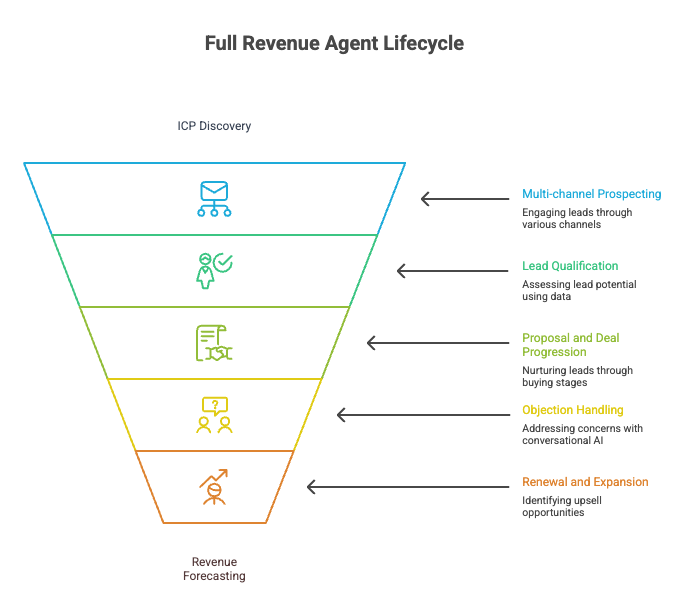
A full revenue agent (also called an AI revenue agent, autonomous sales agent, or full-cycle AI agent) operates across the entire revenue lifecycle — not just prospecting, but everything from first contact to closed-won.
A mature full revenue agent can handle:
- ICP discovery and market segmentation
- Multi-channel outbound prospecting (email, LinkedIn, phone scripts, SMS)
- Lead qualification and scoring against live CRM and intent data
- Proposal and deal progression — nurturing leads through multiple buying stages
- Objection handling via conversational AI interfaces
- Renewal and expansion signals — identifying upsell and cross-sell opportunities in existing accounts
- Revenue forecasting based on pipeline health and engagement data
Where an AI SDR is a specialist, a full revenue agent is closer to an autonomous GTM (go-to-market) system. It doesn't hand off — it runs the play end-to-end, escalating to a human only when strategic judgment is required (or when the deal is ready to close).
Companies like Salesforce (with its Agentforce platform), HubSpot (with Breeze Agents), and emerging startups like Keyplay and Pocus are racing to build out this category. As of 2026, full revenue agents are still maturing, but early adopters are reporting material reductions in time-to-pipeline and cost-per-acquisition.
AI SDR vs Full Revenue Agent: The Core Differences
| Dimension | AI SDR | Full Revenue Agent |
|---|---|---|
| Scope | Top-of-funnel only | Full sales cycle |
| Autonomy | Executes defined sequences | Makes multi-step decisions across pipeline stages |
| Handoff required | Yes — to human AE | Optional — can run end-to-end |
| Best for | High-volume outbound | Complex or long-cycle B2B sales |
| Integration depth | CRM, email, LinkedIn | CRM, ERP, CS platforms, revenue intelligence |
| Time-to-value | Weeks | Months (higher setup complexity) |
| Cost | Lower upfront | Higher, but broader ROI potential |
| Risk surface | Lower | Higher — errors compound across the cycle |
When an AI SDR Is the Right Choice
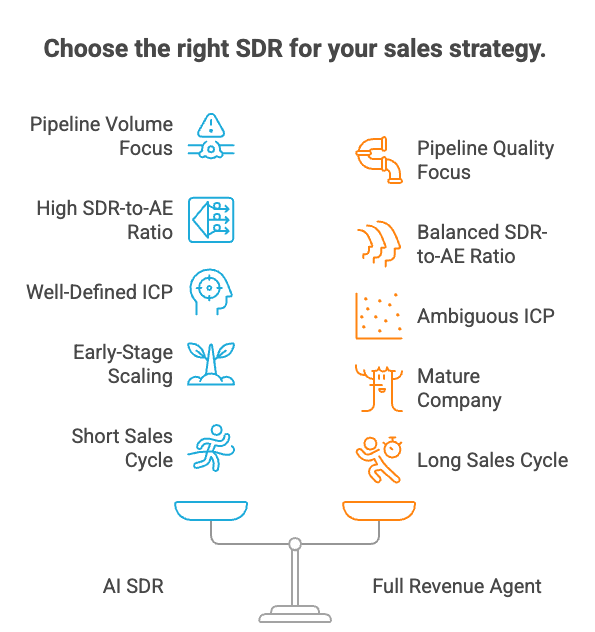
AI SDRs are the right investment when your primary constraint is pipeline volume — not pipeline quality or conversion rate.
Consider an AI SDR if:
Your SDR-to-AE ratio is too high. If your account executives are waiting for meetings, an AI SDR can flood the top of the funnel faster than any human team can. Many sales-led companies are running 3–5x the outreach volume with AI SDRs at the same or lower cost than a single human rep.
Your ICP is well-defined. AI SDRs thrive with clarity. If you know exactly who you're targeting — by industry, company size, tech stack, buying signals — the AI can execute with precision. Ambiguous ICPs produce noisy outreach and burned domains.
You're an early-stage or mid-market company scaling outbound. Hiring a full SDR team requires time, training, and management overhead. An AI SDR gives you ramp speed without the ramp.
Your product sells in a short cycle. If deals typically move from first touch to close in under 60 days, an AI SDR feeding a human AE is an efficient, proven model. You don't need full-cycle automation for a transactional sale.
When a Full Revenue Agent Is the Right Choice
Full revenue agents make sense when the entire revenue motion needs to be accelerated — not just the front door.
Consider a full revenue agent if:
You're running a high-velocity, low-ACV (average contract value) motion. When deal sizes are small (sub-$5K ARR), having a human AE in every deal is economically irrational. A full revenue agent can run those cycles end-to-end at near-zero marginal cost.
You have a large install base you're under-monetizing. Full revenue agents shine in expansion and renewal motions. They can monitor product usage signals, identify at-risk accounts, trigger proactive outreach, and move upsell conversations forward — all without a CSM touching every account.
Your sales cycle is complex but repeatable. Enterprise deals with defined stages, standard objections, and predictable stakeholders are good candidates for agent automation — especially for the middle of the funnel, where deals often stall due to rep inaction.
You're building a product-led growth (PLG) layer. Many PLG companies use full revenue agents to convert self-serve users into enterprise contracts — monitoring activation events, triggering personalized sales touches, and routing high-intent users to human closers at the right moment.
The Hybrid Model: What Most Mature Teams Are Building
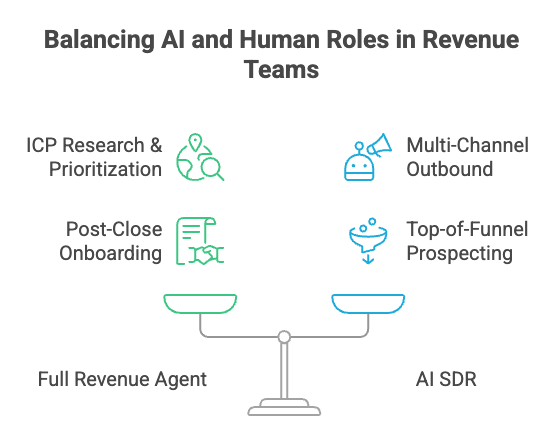
Here's the honest reality: most high-performing revenue teams in 2026 aren't choosing between AI SDRs and full revenue agents. They're building hybrid systems where both work in concert with a lean human team.
A common architecture looks like this:
- Full revenue agent handles ICP research, account prioritization, and initial personalization at scale
- AI SDR executes multi-channel outbound sequences for top-of-funnel prospecting
- Human AE receives warm, qualified meetings and handles negotiation and close
- Full revenue agent picks back up post-close for onboarding signals, renewal monitoring, and expansion plays
This model compresses the cost-per-meeting by 60–80% in early benchmarks while preserving human judgment where it has the highest leverage — in rooms (virtual or otherwise) where trust and nuance close the deal.
The Risks Nobody Is Talking About
Neither AI SDRs nor full revenue agents are plug-and-play. The two most common failure modes are:
Garbage in, garbage out. AI agents are only as good as the data and instructions they operate on. Poorly defined ICPs, stale contact data, and vague value propositions produce outreach that damages your brand faster than no outreach at all. Before deploying either type of agent, audit your foundational GTM inputs.
Automation without accountability. Full revenue agents in particular introduce accountability gaps. When a deal stalls, who owns it? When an AI sends an off-brand message, who catches it? Companies that succeed with revenue agents build explicit human review loops into every stage — not to slow the AI down, but to catch errors before they compound.
The Bottom Line: Which Does Your Business Actually Need?
If you need more pipeline, faster, with a defined ICP: Start with an AI SDR. It's lower risk, faster to deploy, and will generate measurable ROI within 60–90 days.
If you need to compress your entire cost of revenue: Invest in a full revenue agent — but plan for a longer implementation runway and deeper systems integration.
If you're already running an SDR function: Evaluate where your human reps spend the most time on low-judgment tasks. That's your automation opportunity, and the answer will tell you whether you need to augment the top of the funnel or rethink the entire revenue motion.
The companies that will win in this AI-native era aren't the ones who deploy the most agents. They're the ones who deploy the right agents — with clear ownership, clean data, and humans in the loop where judgment matters most.
Frequently Asked Questions
What is the difference between an AI SDR and an AI revenue agent? An AI SDR focuses exclusively on top-of-funnel tasks like prospecting and meeting booking. A full revenue agent handles the entire sales cycle — from lead generation through to renewal and expansion — with minimal human handoff required.
Can an AI SDR replace a human sales development representative? AI SDRs can fully automate the execution of outbound sequences, but they lack the contextual judgment and relationship-building nuance of skilled human SDRs. Most businesses use AI SDRs to augment or multiply human SDR capacity, not replace it entirely.
What types of businesses benefit most from full revenue agents? High-velocity, low-ACV SaaS companies, PLG businesses converting self-serve users, and companies with large install bases to mine for expansion are the clearest beneficiaries of full revenue agents as of 2026.
How much do AI SDRs and revenue agents cost? AI SDR platforms typically range from $1,500–$5,000/month depending on volume and features. Full revenue agent platforms vary widely — from $2,000/month for focused tools to custom enterprise pricing for full GTM orchestration platforms.
Is it possible to use both an AI SDR and a full revenue agent? Yes. Many mature GTM teams use a hybrid model where a full revenue agent handles account intelligence and post-sale motions while an AI SDR drives top-of-funnel outreach — with human AEs focused exclusively on negotiation and close.
Looking to implement AI agents in your revenue stack? The right architecture depends on your ICP, deal complexity, and current bottlenecks. Start with an audit of where human effort is highest and return is lowest — and build from there.