5 Signs Your SMB Is Ready to Hire an AI Sales Agent
AI sales agents are already helping SMBs book meetings, rescue inbound leads, and scale outreach without new headcount. This blog shows five clear signs your business is ready to hire one.
The conversation around AI in sales has shifted dramatically in the past 12 months. It is no longer a question of whether AI sales agents work. There are real SMBs running them right now, generating pipeline, booking meetings, and handling inbound leads around the clock without adding a single person to payroll.
The question most business owners are asking now is more specific: is my business actually ready for one?
The honest answer is that not every SMB is at the right stage. Deploying an AI sales agent when the fundamentals are not in place is a fast way to burn budget and conclude that the technology does not work, when the real issue was timing and fit.
This article gives you five concrete signs that your SMB is ready and what the right first move looks like when you are.
Sign 1: You Have a Defined ICP but Not Enough Outreach Volume
The most common sales problem in SMBs is not that the company does not know who to sell to. It is that there are not enough hours in the day to reach all of them consistently.
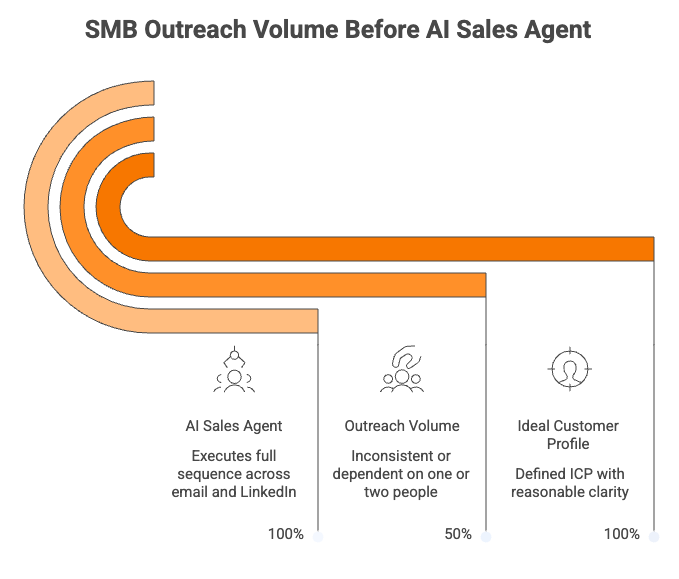
If you can describe your ideal customer profile with reasonable clarity (industry, company size, job title, pain point) but your outreach volume is inconsistent or dependent on one or two people having a good week, that is a signal that an AI sales agent would have an immediate impact.
An AI outbound agent like Jules researches prospects against your ICP, writes personalised messages based on that research, and executes the full sequence across email and LinkedIn without any drop in consistency. Your ICP definition is the input. The AI handles the execution volume.
Gartner research shows that the biggest barrier to outbound performance in SMBs is not message quality. It is throughput. Human SDRs simply cannot maintain high-quality, personalised outreach at the volume required to generate consistent pipeline. An AI sales agent removes that constraint entirely.
If you have the ICP but not the volume, you are ready.
Sign 2: Your Team Is Spending More Time on Admin Than on Selling
Take an honest look at where your salespeople spend their time. If a significant portion of the day goes to CRM updates, follow-up scheduling, proposal chasing, meeting coordination, and other administrative tasks rather than actual selling conversations, you have a capacity problem that hiring more salespeople will not solve.
Salesforce's State of Sales report consistently finds that sales reps spend less than 30 percent of their working hours on direct selling activity. The rest is coordination, documentation, and follow-up that could be executed by an AI agent at zero marginal cost.
An AI sales coordinator handles all of that: automated follow-up sequences, CRM data hygiene, meeting prep reminders, post-call summaries, and proposal assembly. Your human team gets their time back and redirects it toward conversations and closes.
If your salespeople are doing admin work that could be automated, you are ready.
Sign 3: You Are Losing Inbound Leads Because of Response Time
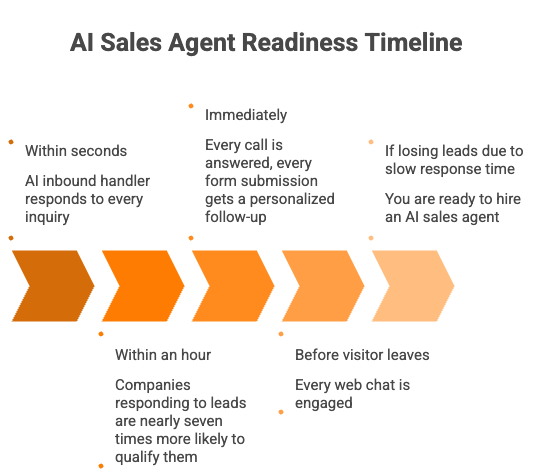
There is strong research showing that response time to inbound leads is one of the most significant factors in conversion rates. A study published by Harvard Business Review found that companies that respond to leads within an hour are nearly seven times more likely to qualify that lead than those who wait even 60 minutes longer. For most SMBs, responding within an hour to every inbound inquiry is simply not possible with a human team.
If you have leads coming in through your website, contact forms, or phone and some of them are going cold because nobody responded quickly enough, you are leaking revenue that is already paid for. You have already spent the marketing budget to generate that interest. The failure is happening at the response layer.
An AI inbound handler responds to every inquiry within seconds. Every call is answered. Every form submission gets a personalised follow-up immediately. Every web chat is engaged before the visitor leaves. No lead goes cold because of slow response time.
If you are losing leads you already generated because your response time is inconsistent, you are ready.
Sign 4: You Are Planning to Hire a Sales Role in the Next 90 Days
This is arguably the clearest signal of all. If you have a headcount request in progress for an SDR, a sales coordinator, a receptionist, an inbound handler, or a junior customer success manager, you are already acknowledging that a gap exists in your revenue operation.
Before you hire a human into that role, run the comparison:
| Human Hire | AI Sales Agent | |
|---|---|---|
| Fully loaded annual cost | $65,000 – $120,000 | $17,000 – $32,000 (year 1) |
| Time to productivity | 60 – 90 days | 2 – 4 weeks |
| Availability | Business hours | 24/7, 365 days |
| Turnover risk | High | Zero |
| Scaling cost | Linear | Near-zero marginal cost |
The human hire is not inherently wrong. Senior relationship-driven roles, complex enterprise sales, and strategic account management still benefit significantly from human judgment. But for the operational, high-volume functions (outbound prospecting, inbound response, follow-up, coordination), an AI agent delivers more output at a fraction of the cost.
McKinsey's AI in Business research shows that companies deploying AI in sales functions are seeing measurable gains in pipeline velocity and sales productivity within the first quarter of deployment, without proportional headcount increases.
If you are about to hire a sales role, consider whether an AI agent is the better first move.
Sign 5: Your Revenue Growth Has Plateaued but Payroll Has Not
This is the strategic sign rather than the operational one. If your business is generating revenue but growth has flattened while your people costs keep rising, the model is compressing your margins without producing proportional output gains. Adding more humans to the same model produces the same result at higher cost.
This is the scenario AI workforce infrastructure is specifically designed to address. The core thesis is simple: revenue growth has historically required headcount growth. AI breaks that relationship. You can increase outbound volume, improve inbound response, reduce churn, and expand into new verticals without the corresponding payroll increase.
Forrester's research on AI-native sales operations projects that businesses deploying AI in their sales development function will structurally outcompete those that do not within the next two to three years, specifically because of the cost-per-opportunity advantage that compounds over time.
If your growth has stalled and your cost base has not, an AI sales agent is a structural fix, not a temporary productivity hack.
What the Right First Move Looks Like
If two or more of the above signs apply to your business, the best starting point is to identify the single biggest gap in your revenue motion right now and deploy one AI agent into that function.
For most SMBs, that is one of two places:
Outbound: If your pipeline is inconsistent because outreach volume is too low or too dependent on individual effort, start with an AI outbound agent. It will research your ICP, run personalised sequences, and fill the calendar with qualified meetings within the first few weeks.
Inbound: If you are generating website or referral traffic but losing leads because of slow response time or after-hours gaps, start with an AI inbound handler. Every call answered, every form followed up instantly, every visitor engaged before they leave.
Either way, the model is a land-and-expand approach. You start with one function, prove the ROI, and add agents as the business grows. The payback period on a single AI sales agent is typically under six months. After that, every month is margin improvement.
A Note on Readiness: What You Need Before You Deploy
An AI sales agent is not a plug-and-play button. The businesses that get the best results share a few things in common before they deploy:
A clear ICP document. The agent's outreach quality is directly tied to how well-defined your target audience is. If your answer to "who do you sell to" is vague, tighten that first.
Basic CRM hygiene. The agent logs all activity to your CRM. If your CRM is a mess, you will not be able to measure what is working. Clean it up before deployment.
A designated point of contact for the first 30 days. AI agents need onboarding just like human employees do. Having someone who can review early sequences, give feedback on messaging, and confirm lead quality in the first few weeks accelerates time to value significantly.
With those three things in place, deployment typically takes two to four weeks and the pipeline impact is visible within the first month.
The Bottom Line
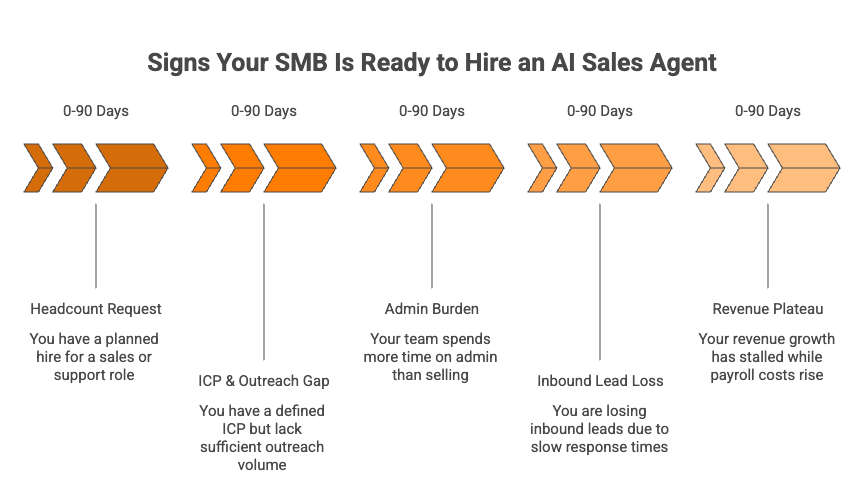
The five signs are straightforward: defined ICP without sufficient outreach volume, sales team buried in admin, inbound leads going cold, an open headcount request, or revenue growth flattening while payroll grows. If any of these describe your business today, you are not waiting for AI sales agents to mature. The technology is live, the deployments are real, and the economics are clear.
The question is not whether your SMB will eventually adopt AI workforce infrastructure. The question is whether you will be among the early adopters who build a structural advantage now, or the ones who catch up in two years at a higher cost.
Ready to find out which AI sales agent fits your business first? Book a 30-minute demo with AI Xccelerate and we will map your current gaps to the right starting agent.