AI Employees Don't Call in Sick: The Case for an AI-First Revenue Team
AI employees don’t call in sick, burn out, or miss follow-ups. Discover how an AI-first revenue team helps SMBs automate sales, protect pipeline, and scale revenue without adding headcount.
Your Best Rep Just Called in Sick. Again.
It's 8:47 AM on a Tuesday. Your top SDR is out with the flu. Your AE has a family emergency. Your RevOps manager is at a conference. And somewhere in your CRM, 47 warm leads are sitting untouched, a follow-up sequence has stalled, and a deal that was supposed to close this week is drifting toward silence.
This is not a hypothetical. This is Tuesday for most SMB revenue teams.
Human-dependent revenue systems are, by design, fragile. They are built on the assumption that your people will be present, healthy, motivated, and operating at peak capacity — simultaneously, consistently, indefinitely. That assumption is almost never fully true.
Now consider a different scenario. What if a core part of your revenue team never called in sick? Never had a bad Monday. Never forgot to follow up. Never needed onboarding, ramp time, or a performance improvement plan. What if they worked every hour of every day, at full capacity, for a fraction of the cost of a single full-time hire?
That team exists. It's called an AI-first revenue team. And the SMBs that build one are rewriting the rules of what's possible in go-to-market execution.
The Hidden Fragility of Human-Only Revenue Teams
Let's be honest about something most revenue leaders don't say out loud: a traditional sales team is an extraordinarily unreliable machine.
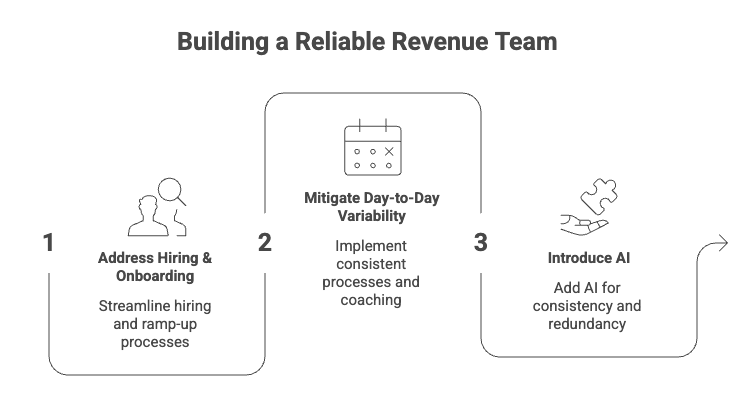
Consider the average SMB revenue operation. Hiring a solid SDR takes two to three months. Ramping them to full productivity takes another three to six. The average SDR tenure in B2B is under 18 months — meaning you're often losing people just as they become genuinely valuable. Multiply that across your AE bench, your RevOps function, and your customer success team, and you have a system that is perpetually in some stage of hiring, onboarding, ramping, or losing people.
Then layer in the day-to-day variability. Sick days. Vacations. Personal crises. Motivation cycles. Quota pressure that leads to cherry-picking the easy deals. Inconsistent follow-up. Reps who go off-script. Managers who coach inconsistently because they're too busy fighting fires to develop their team.
None of this is a criticism of the individuals. It is simply the nature of building a business on human capacity without any structural redundancy or consistency layer beneath it.
This is precisely where AI changes everything.
What AI Employees Actually Bring to a Revenue Team
The phrase "AI employee" might sound like science fiction or marketing hyperbole. It isn't. Across the modern go-to-market stack, AI is already performing discrete, high-value revenue functions with a level of consistency, speed, and scalability that no human team can match.
Here is what your AI revenue team members bring to the table.
They are always on. An AI-powered prospecting agent does not stop researching at 5 PM. It does not take a long lunch. It does not have an off week after a tough quarter. It processes intent signals, enriches contact data, scores leads, and triggers outreach around the clock — generating pipeline while your human team sleeps.
They never forget. One of the most costly failures in any sales process is the dropped follow-up. A prospect expresses interest, a rep means to circle back, and three days later the moment has passed. AI-driven sequence tools and CRM automation eliminate this entirely. Every follow-up happens. Every touchpoint fires. Every re-engagement trigger activates. Not most of the time — every time.
They scale instantly. When a human revenue team needs to handle double the pipeline volume, you hire more people. That takes months and costs tens of thousands in recruitment, salary, and benefits. When an AI revenue system needs to handle double the volume, you adjust a setting. The marginal cost of AI scaling approaches zero in ways that human scaling never can.
They are radically consistent. Your AI SDR sends the same quality of personalized outreach on day 300 as it did on day one. It never burns out, never gets jaded, never starts cutting corners because it's had a rough week. Your best human performers are inconsistent — because they're human. AI is consistent by design.
They get smarter over time. Unlike a human hire who plateaus unless actively developed, AI systems improve continuously as they process more data. The more your AI revenue agents engage with prospects, analyze outcomes, and refine messaging, the more effective they become. The system compounds its own performance.
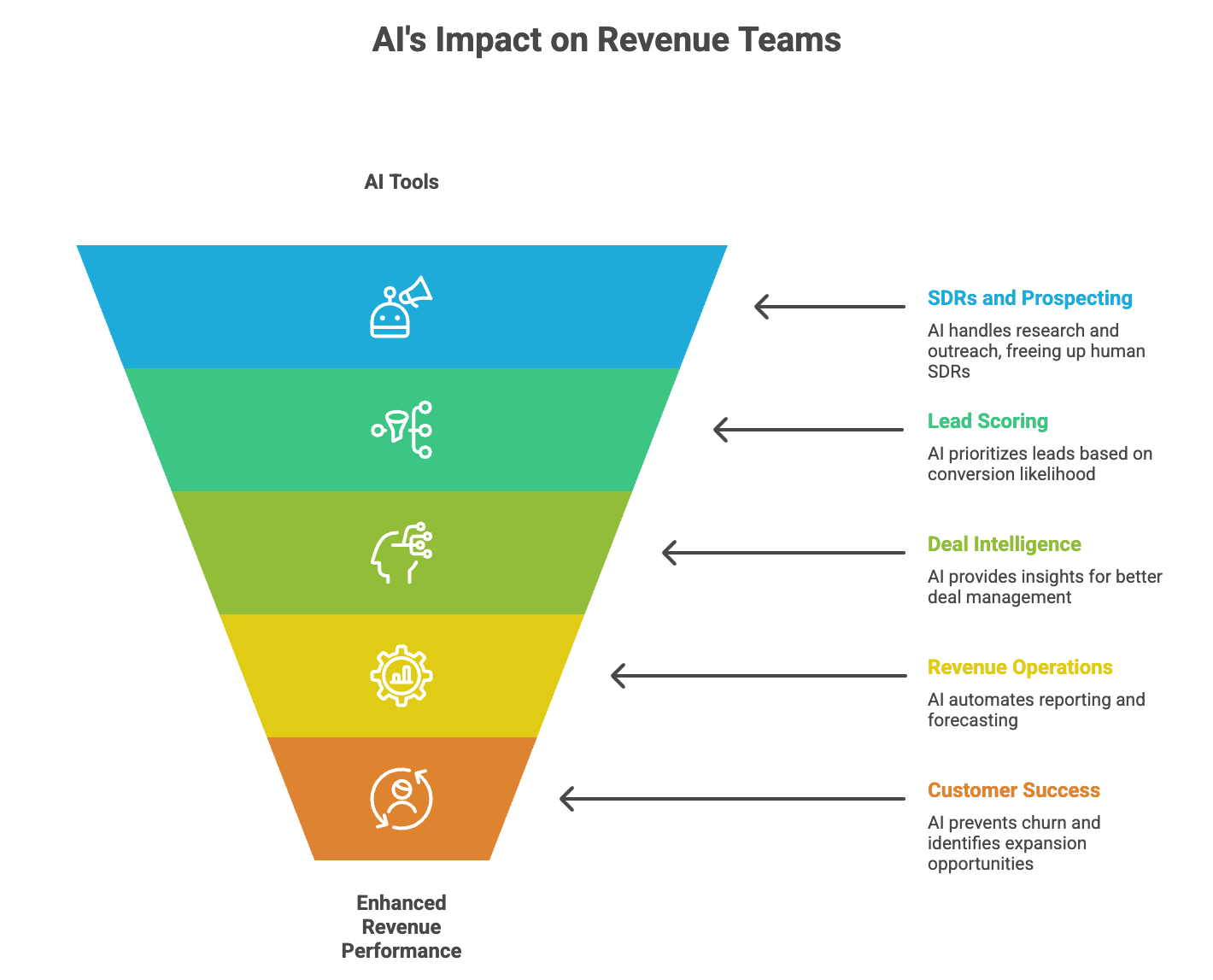
The Five Roles AI Is Already Playing on Revenue Teams
This is not theoretical future-gazing. Right now, across thousands of SMBs and growth-stage companies, AI is performing real revenue functions. Here are the five areas where the impact is most immediate.
1. AI SDRs and Prospecting Agents AI tools can now research target accounts, identify buying signals, craft personalized outreach at scale, and manage multi-touch sequences entirely autonomously. Human SDRs in AI-first teams focus exclusively on the conversations that AI surfaces — not the research and admin that used to consume 60–70% of their day.
2. AI-Powered Lead Scoring and Prioritization Not all leads are equal, but traditional SMB teams treat them that way because they lack the bandwidth to do otherwise. AI scoring models analyze dozens of behavioral and firmographic signals to rank leads by conversion likelihood in real time — ensuring your human reps always work the highest-value opportunities first.
3. AI Deal Intelligence and Coaching Conversation intelligence platforms powered by AI listen to every call, analyze every email thread, and surface insights that would take a skilled sales manager weeks to identify manually. Win/loss patterns, objection frequency, competitor mentions, deal risk indicators — all served to reps and managers in real time, making every human more effective on every deal.
4. AI Revenue Operations and Forecasting Manual RevOps is a data bottleneck. AI-native RevOps tools automate pipeline reporting, flag anomalies, generate accurate forecasts, and keep your CRM clean without requiring hours of manual maintenance. Leadership gets the visibility they need to make good decisions. The team spends less time on hygiene and more time selling.
5. AI Customer Success and Churn Prevention Post-sale revenue protection is where AI earns its keep quietly but powerfully. Health score models monitor product usage, engagement patterns, and support ticket trends to flag at-risk accounts before a human would notice the warning signs. AI-assisted QBR prep, automated check-in sequences, and expansion opportunity identification turn your CS team into a precision retention engine.
Objection: "But AI Can't Replace Human Relationships"
This is the most common pushback — and it contains a kernel of truth wrapped in a significant misconception.
No, AI cannot fully replicate the nuanced empathy, trust-building, and strategic judgment that characterize the best human sales relationships. Nobody credible is arguing that it should.
What AI can do is remove the 70% of revenue team activity that is not relationship-building — the research, the admin, the data entry, the follow-up sequences, the reporting, the forecasting — so that your human team can spend more time doing the thing that only humans can do well: connecting with people, navigating complexity, and closing deals.
An AI-first revenue team doesn't replace human judgment. It liberates human judgment from being buried under tasks that a machine can handle better, faster, and cheaper.
The SMBs that understand this distinction are building revenue teams where their human talent operates at its highest and best use, supported by AI doing everything else. The SMBs that don't are wasting the majority of their human talent on tasks that should have been automated years ago.
The Numbers Make the Case
The ROI of an AI-first revenue approach is no longer theoretical. The data is in.
Companies deploying AI across their revenue functions report an average 40–60% reduction in time spent on non-selling activities. Sales teams using AI-assisted outreach report 2x to 4x increases in qualified meetings booked. Organizations using AI forecasting report forecast accuracy improvements of 25–35%. And companies with AI-driven customer health monitoring report churn reductions of 15–30% within the first year of deployment.
These are not edge-case outcomes. They are the baseline results of a deliberate, well-executed shift to AI-native revenue operations.
For an SMB generating $5M to $25M in annual revenue, these numbers translate to millions in incremental pipeline, faster deal cycles, stronger retention, and a revenue operation that scales without proportional headcount growth. That is a structural competitive advantage — and it is available to any SMB willing to build it.
Building Your AI-First Revenue Team: Where to Start
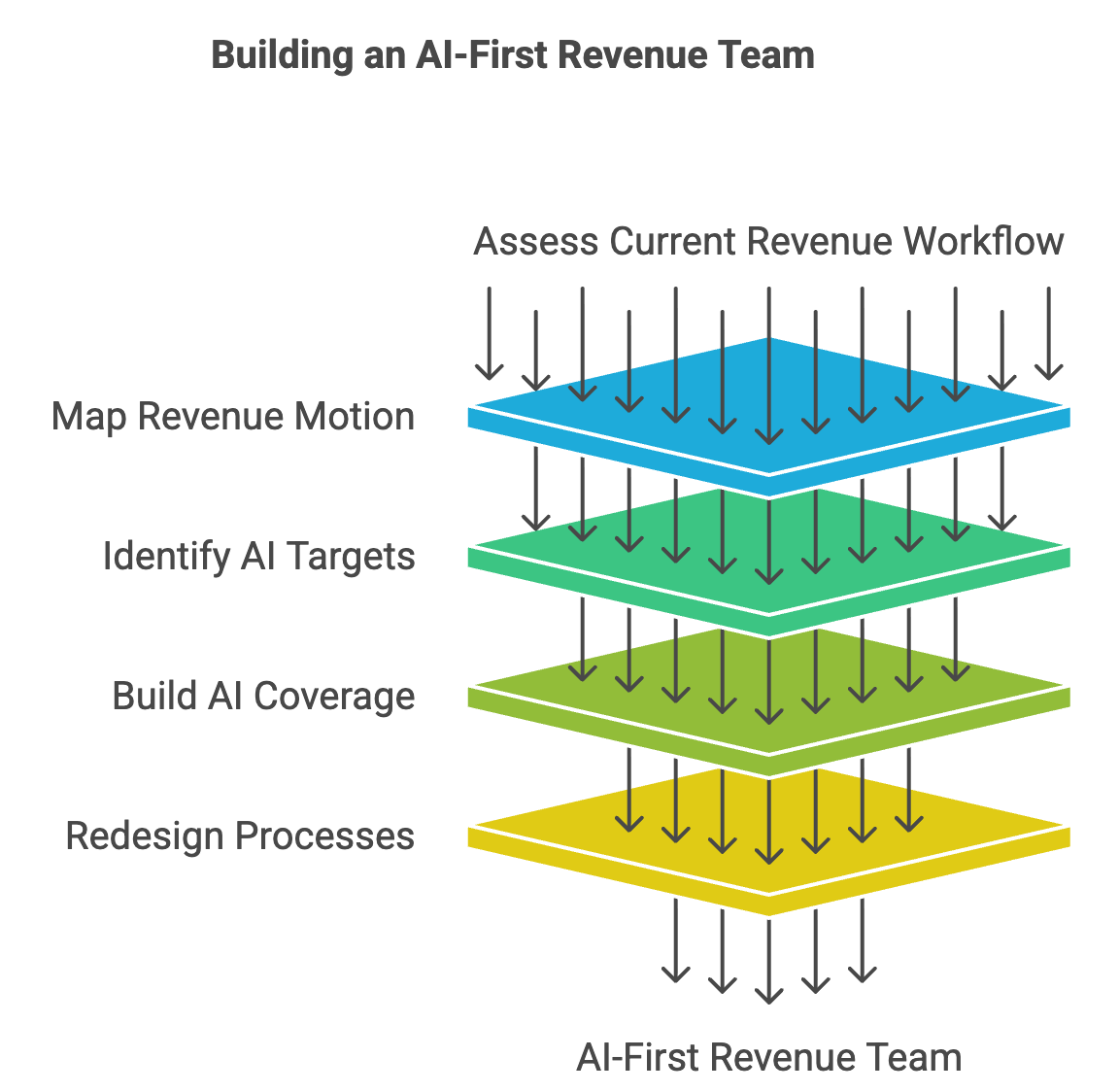
The path to an AI-first revenue team doesn't require a complete overnight transformation. It requires a clear-eyed assessment of your current revenue workflow and a commitment to systematic redesign.
Start by mapping your existing revenue motion and identifying the activities that are high-volume, highly repeatable, and currently consuming your best people's time. Those are your first AI deployment targets. Then build from there — expanding AI coverage across prospecting, pipeline management, deal execution, and customer success over a structured 90 to 180 day roadmap.
The key principle is this: don't add AI on top of a broken process. Redesign the process with AI as the primary operator, and deploy your human team where judgment, empathy, and creativity are genuinely irreplaceable.
That redesign is the work. And it is work that is worth doing urgently — because your competitors are either doing it now, or they are falling further behind with every week that passes.
Your Revenue Team Is About to Get a Lot More Reliable
AI employees don't call in sick. They don't have bad quarters. They don't leave for a competitor. They don't ghost warm leads or forget to update the CRM. They work every day, at full capacity, without complaint — and they get better over time.
Building an AI-first revenue team is not about eliminating the humans who make your business great. It is about making those humans more powerful, more focused, and more effective than they have ever been — by giving them an AI-powered foundation that handles everything they shouldn't have to.
The reliability, consistency, and scalability of an AI-first revenue team is not just a competitive advantage. In the market environment ahead, it may be the price of staying competitive at all.
Let's Build Your AI-First Revenue Team Together
At AIxccelerate, we specialize in helping SMBs design and deploy AI-first revenue systems that drive real results — more pipeline, faster cycles, stronger retention, and a team that performs at its best every single day.
Stop losing revenue to sick days, dropped follow-ups, and an over-stretched team. Start building the revenue operation that runs at full capacity, always.
👉 Book your free Revenue AI Strategy Call — in 30 minutes, we'll show you exactly where AI can replace friction in your revenue workflow and give you a practical roadmap to get started.
Because the best revenue team you'll ever build doesn't call in sick.
Published by AIxccelerate | AI Strategy for Growing Businesses
Tags: AI Revenue Team, AI Employees, Sales Automation, AI for SMBs, Revenue Operations AI, AI SDR, Artificial Intelligence Sales, SMB Growth Strategy