AI SDR Mistakes That Cost SMBs Dearly
Thousands of vendors. One big decision. This guide breaks down AI SDR total costs, 90-day ROI benchmarks, and the five integration mistakes killing SMB adoption before pipeline ever starts.
The AI SDR market has exploded. Thousands of vendors now offer some form of AI-powered sales development capability — spanning autonomous outbound agents, AI-assisted email sequencers, enrichment platforms, and conversational qualification tools. For SMB leaders, separating genuine value from vendor noise has become a full-time job.
This guide does not cover why AI SDRs matter. What it covers is what comes next: the real cost structure, the ROI benchmarks you should be demanding, and the integration mistakes that kill adoption before pipeline ever materialises.
What Exactly Is an AI SDR?
An AI Sales Development Representative (AI SDR) is an autonomous or semi-autonomous software agent that uses large language models (LLMs), natural language processing (NLP), and intent data to perform top-of-funnel sales tasks traditionally handled by human SDRs — including prospect research, personalised outreach, inbox management, objection handling, and meeting booking.
The critical distinction every SMB leader must internalise: an AI SDR is not a mail merge tool with a chatbot attached. Modern AI SDR platforms are built on generative AI foundations and are capable of dynamic, context-aware, multi-turn prospect conversations without a human in the loop at each step.
KEY INSIGHT: The defining capability of a true AI SDR is contextual persistence — the ability to remember prior interactions, adapt tone based on behavioural signals, and escalate to a human rep at precisely the right moment. If the platform you're evaluating cannot do this, it is not an AI SDR. It is automation.
This distinction matters because pricing, integration requirements, and ROI expectations differ dramatically between the two categories — and vendors are not always transparent about which one they actually are.
The True Cost of an AI SDR: Beyond the Subscription Price
The number most SMBs see first is the monthly subscription. The number they should focus on is the total cost of ownership (TCO) over 12 months — which routinely runs 2.5x to 4x the advertised platform fee.
- $500–$3,000/month — Typical platform fee for SMB-tier AI SDR tools
- $8,000–$15,000 — Realistic Year 1 TCO for most SMBs (complex or multi-platform setups can run higher)
- 60–90 days — Time to reach consistent pipeline output (not 2 weeks)
- 3–5x ROI — What SMBs with clean CRM data report after proper deployment
The costs vendors understate: CRM data cleaning before onboarding ($1,500–$4,000 for SMBs with legacy databases), email deliverability infrastructure setup, ICP definition workshops, and ongoing prompt engineering — a task that never truly ends.
KEY INSIGHT: TCO is not a reason to avoid AI SDRs — it is the frame that separates realistic adopters from disappointed ones. Know the full number before you budget.
The Data Debt Problem
AI SDRs are only as intelligent as the data they operate on. If your CRM contains duplicate records, outdated job titles, or contacts without verified emails, the AI does not compensate — it scales the problem. Every email sent to an inaccurate contact damages your sender reputation for the entire domain.
Before any AI SDR deployment, budget for a data audit. This is not optional — it is the single highest-ROI investment you can make before go-live.
What It Looks Like in Practice
A B2B software SMB (12-person team, SaaS vertical) invested $9,200 in Year 1 AI SDR costs — covering platform fees, a CRM data clean, domain warm-up, and four weeks of sequence optimisation. By day 90, the AI SDR had generated $118,000 in qualified pipeline across 23 booked meetings, at a cost-per-meeting 54% lower than their previous human SDR model. The turning point was week six — when they stopped tweaking the tool and started trusting the data it was already producing.
AI SDR vs. Traditional Sales Automation
Much of the market confusion stems from vendors positioning traditional automation tools as AI SDRs. Here is what actually separates them:
| Capability | Traditional Automation | Genuine AI SDR |
|---|---|---|
| Outreach personalisation | Template merge fields | LLM-generated, context-aware copy per prospect |
| Reply handling | Manual or rule-based | AI reads, classifies & responds autonomously |
| Lead qualification | Score-based, static rules | Conversational AI via multi-turn dialogue |
| CRM updates | Manual sync required | Autonomous logging, tagging & stage updates |
| Intent signal usage | ✗ Not typically | ✓ Real-time intent data integration |
| Learns over time | ✗ | ✓ Improves with feedback loops & A/B data |
| Human handoff | ✗ Time-based only | ✓ Signal-based, context-aware escalation |
If a vendor cannot demonstrate autonomous reply handling and signal-based human handoff in a live demo, you are looking at automation with AI branding — not a genuine AI SDR.
"The AI SDR does not replace your best sales rep. It gives every prospect the attention your best rep never had time to give them."
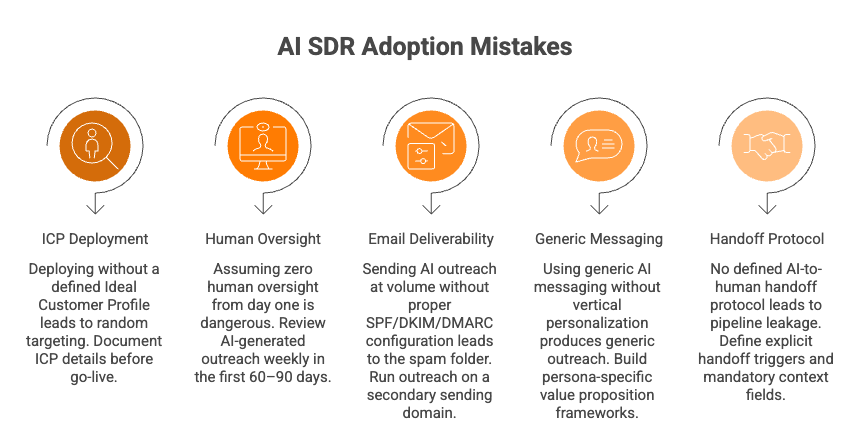
The 5 Integration Mistakes That Kill AI SDR Adoption
Adoption failure is rarely a technology problem. It is almost always a process and infrastructure problem that the technology exposes. These five mistakes account for the majority of failed SMB deployments.
01. Deploying without a defined Ideal Customer Profile (ICP) An AI SDR without a precise ICP is a precision instrument firing at random. Document your ICP down to company size, industry vertical, technology stack, growth signals, and buying committee roles before go-live. Vague targeting produces volume with no conversion.
02. Assuming zero human oversight from day one The "set it and forget it" promise is the most dangerous message in this category. In the first 60–90 days, a human reviewer should inspect AI-generated outreach weekly — catching tone drift, personalisation errors, and refining handoff triggers. Autonomy is earned, not assumed.
03. Neglecting email deliverability infrastructure Sending AI-generated outreach at volume from your primary domain without proper SPF/DKIM/DMARC configuration and a domain warming period is a reliable path to the spam folder. Run AI SDR outreach on a secondary sending domain with a minimum 4-week warm-up before full volume.
04. Using generic AI messaging without vertical personalisation The AI writes what you instruct it to write. Generic system prompts produce generic outreach. Build persona-specific value proposition frameworks, objection-handling libraries, and industry-specific pain point vocabulary before asking the AI to generate sequences.
05. No defined AI-to-human handoff protocol The most common pipeline leakage point is the handoff moment. If a human rep receives a warm lead with no context on what was discussed or promised, conversion rates collapse. Define explicit handoff triggers, mandatory context fields, and response SLAs before launch.
How to Evaluate AI SDR Vendors: SMB Checklist
☐ Request a live demo with a real scenario from your industry — not a scripted walkthrough ☐ Ask for case studies from SMBs with under 50 employees in your vertical ☐ Confirm native CRM integration (not Zapier-bridged) with your specific CRM ☐ Ask: "How does your platform handle an angry or opt-out reply?" ☐ Request average time-to-first-booked-meeting for SMB clients in Year 1 ☐ Clarify data ownership: if you leave, do you retain all conversation history? ☐ Ask for a deliverability audit of your domain before committing ☐ Confirm whether prompt engineering is included or billed separately ☐ Ask which LLM underpins the outreach generation and when it was last updated ☐ Request references from two clients who churned — and ask why they left
The most revealing question: "What does your onboarding look like for a company with a messy CRM?" Vendors with real SMB experience give honest, detailed answers. Everyone else pivots to a demo.
The 90-Day AI SDR Infrastructure Window: What Good Actually Looks Like
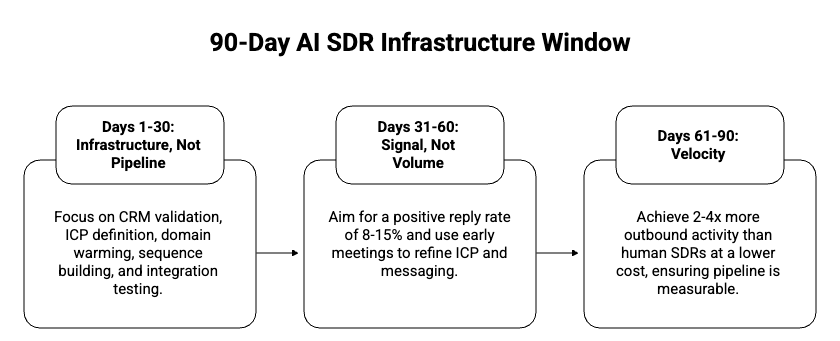
This is the ownable framework every SMB leader needs before deploying: the first 90 days are not a sales exercise — they are an infrastructure exercise. Leaders who understand this go on to build durable pipeline engines. Leaders who don't spend month four wondering why the tool "isn't working."
Days 1–30: Infrastructure, Not Pipeline Realistic expectation: zero closed pipeline. This period covers CRM validation, ICP definition, domain warming, sequence build, and integration testing. Treat it as foundational investment — the compounding starts in month two.
KEY INSIGHT: Teams that try to shortcut the 90-Day AI SDR Infrastructure Window by skipping data cleaning or ICP definition consistently underperform teams that invest in it fully — regardless of which platform they use.
Days 31–60: Signal, Not Volume By day 45–60, a well-configured AI SDR should generate a positive reply rate of 8–15% on cold outreach depending on vertical. The first meetings booked here are validation moments — use them to refine ICP and messaging before scaling volume.
Days 61–90: Velocity At 90 days with a clean deployment, SMBs typically see 2–4x more outbound activity than previous human SDR capacity at 30–60% lower cost-per-meeting. Pipeline from AI SDR activity must be attributable in CRM as a distinct source. If it is not measurable, it is not optimisable.
Frequently Asked Questions
How much does an AI SDR cost for a small business? Platform fees range from $500–$3,000/month. Total Year 1 TCO typically reaches $8,000–$15,000 for most SMBs, and higher for complex multi-tool setups. Budget for TCO, not just the subscription.
What is the ROI of an AI SDR for SMBs? SMBs with clean data and a defined ICP report 30–60% reduction in cost-per-meeting and 2–4x increase in outreach volume within 90 days. ROI is highest when AI owns qualification and human reps focus exclusively on closing.
Can an AI SDR replace my human sales team? No. AI SDRs excel at scale, consistency, and 24/7 top-of-funnel availability. Human reps remain essential for complex negotiations and closing. The optimal model is AI-human collaboration, not replacement. The AI SDR does not replace your best sales rep — it gives every prospect the attention your best rep never had time to give them.
Will AI outreach hurt our brand or relationships? Only if deployed carelessly. The risks — robotic tone, irrelevant personalisation, spammy volume — are all addressable with proper prompt libraries, vertical-specific messaging frameworks, human oversight in the first 90 days, and clear handoff protocols that ensure prospects feel heard, not processed. Done right, prospects rarely know the first touch was AI-initiated. Done wrong, they always do.
How long does onboarding take? Allow 30–45 days before first outreach goes live, plus 45–60 days of optimisation before consistent pipeline output. Total time to ROI-positive deployment: 60–90 days with proper upfront investment — which is exactly what the 90-Day AI SDR Infrastructure Window is designed to protect.
The Bottom Line: Adopt the AI SDR System Architect Mindset
The AI SDR category is maturing fast, and the tools available in 2025 are genuinely capable of transforming outbound sales economics for SMBs. But the leaders who extract the most value are not the ones who move fastest — they are the ones who prepare most thoroughly.
Clean data, a sharp ICP, deliverability-safe infrastructure, disciplined human oversight, and a well-defined handoff protocol are not nice-to-haves. They are the conditions under which AI SDR technology actually works. Without them, even the most advanced platform becomes an expensive lesson in automating dysfunction at scale.
The shift that matters most is this: stop thinking like a tool buyer and start thinking like a system architect. That is the AI SDR System Architect Mindset — and it is what separates the case studies from the cautionary tales.