How AI SDRs Help SMBs Scale Sales Faster
Learn how AI SDRs help SMBs automate outreach, qualify leads, and scale pipeline without extra headcount. Start your AI sales journey today.
What Is an AI SDR — And Why Is Every SMB Sales Leader Talking About It?
An AI SDR — short for AI Sales Development Representative — is an artificial intelligence-powered system that automates the top of your sales funnel: prospecting, researching leads, writing personalized outreach, handling follow-ups, qualifying intent, and booking meetings, all without a human lifting a finger.
The market is moving fast. The global AI in sales automation sector is projected to surpass $11 billion by 2027, growing at over 35% annually — and the companies adopting early are already pulling ahead. For SMB leaders, the cost math alone makes the case: a single outbound SDR in the US costs $60,000–$90,000 per year before overhead and attrition. An AI SDR runs 1,000 personalized outreach sequences simultaneously, improves in real time using large language models (LLMs), and doesn't quit after 18 months.
For SMBs competing against enterprise giants with massive sales floors, this is not a nice-to-have. It is a competitive survival tool.
How AI-Powered Sales Development Representatives Actually Work
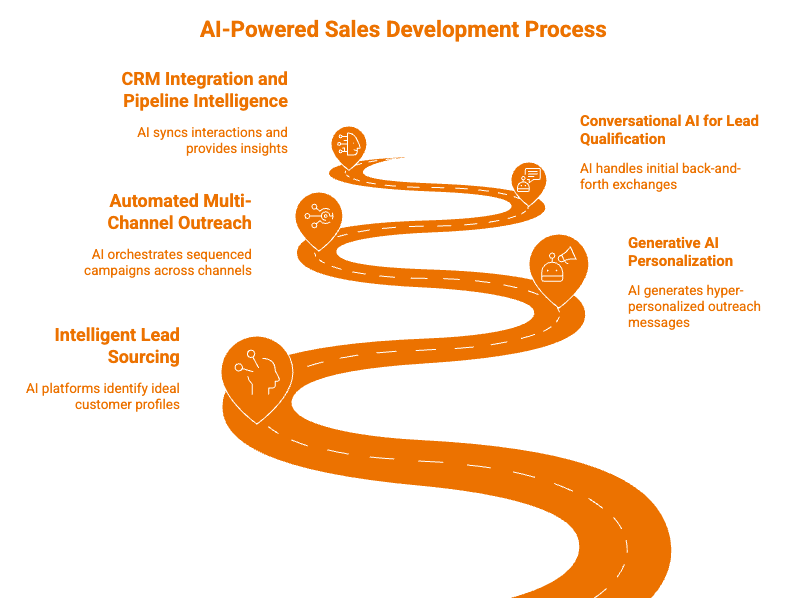
Understanding the mechanics helps SMB leaders make smarter buying decisions and set realistic expectations. A modern AI SDR operates across several interconnected layers:
1. Intelligent Lead Sourcing AI SDR platforms integrate with data providers (like Apollo, ZoomInfo, or LinkedIn Sales Navigator) and use machine learning models to identify your ideal customer profile (ICP) from millions of contacts. Rather than manually building lists, the AI continuously surfaces high-intent prospects based on firmographic, technographic, and behavioral signals.
2. Generative AI Personalization This is where large language models (LLMs) like GPT-4, Claude, or purpose-built sales LLMs enter the picture. The AI reads a prospect's LinkedIn activity, recent company news, job postings, and technology stack — then generates a hyper-personalized first-touch email or LinkedIn message that feels like it was written by a human who did real research. At scale.
3. Automated Multi-Channel Outreach AI SDRs don't just send emails. They orchestrate sequenced, multi-touch campaigns across email, LinkedIn, SMS, and even voice — adapting tone and timing based on engagement data. If a prospect opens an email three times without responding, the AI SDR recognizes intent and escalates accordingly.
4. Conversational AI for Lead Qualification When a prospect responds, AI SDR platforms use natural language processing (NLP) and conversational AI to handle initial back-and-forth exchanges, qualify BANT criteria (Budget, Authority, Need, Timeline), and only hand off to a human rep when a lead is sales-ready. This eliminates the single biggest time-sink in any SDR role.
5. CRM Integration and Pipeline Intelligence All interactions sync automatically to your CRM (Salesforce, HubSpot, Pipedrive). The AI builds deal context, logs activity, and surfaces predictive pipeline insights — giving revenue leaders real-time visibility without manual data entry.
Why AI SDRs Are a Game-Changer Specifically for SMBs
Enterprise companies have 50-person sales development teams. You don't. That asymmetry has historically made outbound sales one of the most resource-constrained growth levers for small and mid-sized businesses. AI SDRs change the math dramatically.
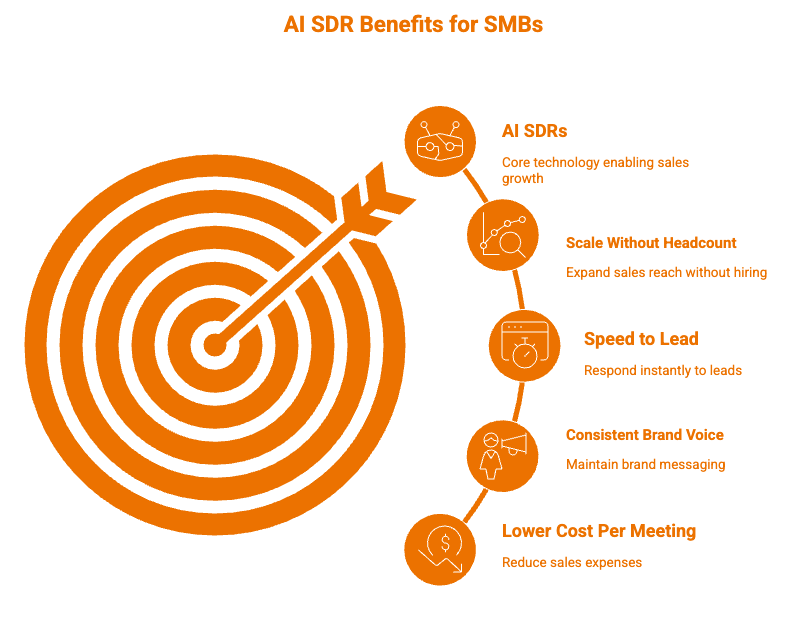
Scale Without Headcount A five-person SMB can now run an outbound motion that rivals a mid-market company's SDR floor. One AI SDR tool can replace the output of three to five human SDRs — running personalized sequences to thousands of prospects per month without the HR overhead.
Speed to Lead Studies show that responding to an inbound lead within five minutes increases conversion rates by 9x. AI SDRs respond instantly, 24/7, in any time zone. For SMBs selling into global markets or handling leads across multiple regions, this is a structural advantage that simply wasn't available three years ago.
Consistent Brand Voice and Messaging Human SDRs go off-script. They improvise (sometimes well, sometimes not). AI SDRs execute your proven messaging framework with perfect consistency — A/B testing subject lines, CTAs, and value propositions across thousands of sequences and reporting back on what converts.
Lower Cost Per Meeting Early adopters of AI SDR technology are reporting cost-per-meeting reductions of 60–80% compared to fully-staffed human SDR teams. For an SMB trying to hit pipeline targets on a lean budget, that ROI calculus is hard to ignore.
The Best AI SDR Tools SMB Leaders Are Evaluating in 2026
The AI SDR software market has matured rapidly. Here's a practical shortlist mapped to what actually matters for SMB buyers:
| Tool | Best For | Autonomy Level | Typical SMB Buyer |
|---|---|---|---|
| Artisan AI (Ava) | LinkedIn-heavy outreach, personalization at scale | Fully autonomous | B2B SaaS, 10–200 employees |
| 11x.ai (Alice) | Multi-channel orchestration with deep CRM sync | Fully autonomous | Tech-forward SMBs, Series A+ |
| Relevance AI | Custom AI SDR workflows, no-code flexibility | Semi-autonomous | Ops-savvy teams wanting control |
| Outreach + AI Agents | AI-assisted outreach on an established platform | AI-assisted | Teams already using Outreach |
| Clay + GPT-4 | Data enrichment + hyper-personalized outreach | Semi-autonomous | Growth marketers, RevOps teams |
If you're not yet ready for a fully autonomous AI SDR, all-in-one platforms like Apollo.io, Amplemarket, and Instantly are worth evaluating. They combine prospecting databases, sequencing, and AI writing assistance in a single tool — a lower-friction entry point for SMBs that want AI-augmented outreach without stitching together multiple platforms.
Regardless of which tool you shortlist, prioritize CRM compatibility, transparent AI activity reporting, and built-in compliance workflows for GDPR and CAN-SPAM before committing.
Where AI SDRs Are a Bad Fit — Be Honest With Yourself
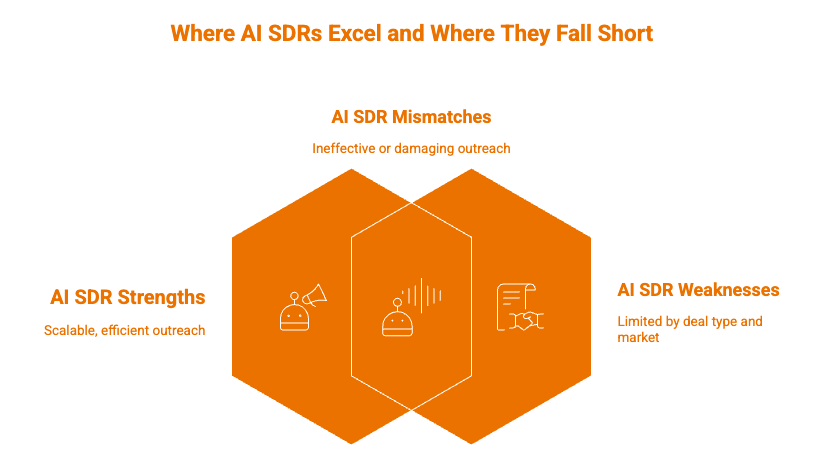
AI SDRs are powerful, but they are not universal. Before committing budget, SMB leaders should recognize the deal patterns where AI-led outreach is likely to underperform:
- Ultra-high-ACV, relationship-driven sales. If your average deal is $500K+ and closes over 18 months through executive relationships or board referrals, AI SDRs won't move the needle. These deals require human trust-building from the very first touchpoint — not automated sequences.
- Extremely low-volume, niche markets. If your total addressable market is 200 companies, AI-generated outreach blasted repeatedly to the same buyers will damage your reputation faster than it fills pipeline. Quality and personal touch win here.
- Heavy procurement and RFP-driven cycles. In industries like government contracting, regulated healthcare, or enterprise financial services, deals are initiated through formal procurement channels, vendor panels, or approved supplier lists — not cold outreach. AI SDRs add little value when the buying process bypasses the inbox entirely.
Knowing where AI SDRs don't fit is just as valuable as knowing where they do. A tool mismatched to your sales motion — however sophisticated — is just expensive noise.
Common Objections SMB Leaders Have About AI SDRs — Answered
"Will prospects know they're talking to an AI?" This is the most common concern — and the most nuanced. The best AI SDR implementations are transparent in spirit: they generate authentic, research-based outreach that adds genuine value to the prospect. The ethical standard emerging in the industry is human-in-the-loop oversight: AI drafts and sends, a human reviews flagged responses. As conversational AI improves, the line will blur further, which is why leading teams build trust through relevance and value, not deception.
"Our sales process is too complex for AI." AI SDRs are not designed to close complex enterprise deals. They are designed to fill your pipeline with qualified, warmed-up meetings so your closers can do what they're best at. Think of an AI SDR as the world's most tireless top-of-funnel machine — not a replacement for human relationship-building in later sales stages.
"We don't have the technical resources to implement this." Modern AI SDR platforms are built for non-technical buyers. Most offer plug-and-play CRM integrations, onboarding support, and pre-built outreach templates. If your team can use HubSpot, they can use an AI SDR tool.
How to Prepare Your SMB for AI SDR Adoption
Deploying an AI SDR without the right foundation is a fast track to wasted spend and damaged sender reputation. Here's how to set yourself up for success:
Define your ICP with precision. AI is only as good as the inputs you give it. Before turning on any automation, document your ideal customer profile in detail — industry, company size, tech stack, pain points, buying triggers. The AI will use this to source and personalize at scale.
Audit your email infrastructure. AI SDRs send high volumes of email. Ensure you have properly warmed sending domains, SPF/DKIM/DMARC authentication, and a dedicated outbound domain separate from your primary business domain.
Align AI outreach with your human team. AI SDRs hand off meetings. Your human AEs need to be prepped on AI-generated context, trained on how to receive warm handoffs, and aligned on the qualification criteria the AI is using.
Start with one channel. Don't try to automate email, LinkedIn, SMS, and voice simultaneously on day one. Pick your highest-converting channel, run the AI SDR there for 60–90 days, measure results, then expand.
The Future of AI-Powered Sales: What SMB Leaders Should Expect Next
The trajectory of AI in sales is not slowing down. Within the next 18–24 months, expect AI SDRs to evolve from outreach automation tools into fully agentic revenue systems — capable of conducting multi-turn sales conversations, integrating real-time intent data from across the web, and autonomously adjusting strategy based on competitive intelligence.
Voice AI SDRs — capable of making and handling phone calls with near-human conversational fluency — are already in early deployment at forward-thinking companies. Multimodal AI agents that can engage prospects across video, chat, email, and voice within a single coherent conversation thread are on the near-term horizon.
For SMB leaders, the window to gain a competitive advantage by adopting AI sales automation early is still open — but it's closing. The businesses that build AI-native sales motions today will have 12 to 24 months of data, learning, and process optimization over competitors who wait.
Curious what this could look like in your business? Book a tailored demo with our team at book.aixccelerate.com.
The Bottom Line: AI SDRs Are the Great Equalizer for SMBs
You don't need a 20-person SDR floor to compete. You need the right AI.
An AI SDR won't replace the humanity of your best salespeople. It will free them to do the work that actually requires human judgment, empathy, and relationship-building — while the AI handles the volume, the follow-ups, the research, and the qualification that used to consume 70% of their week.
For SMB leaders serious about scaling revenue efficiently in 2026, the question is no longer whether to adopt AI SDR technology. It's which platform, how to integrate it into your existing motion, and how fast you can get it running.
The pipeline isn't going to fill itself. But with the right AI SDR in place, it doesn't have to.
Ready to explore how AI SDRs can transform your SMB sales pipeline? The conversation starts with understanding your ICP, your current outreach performance, and where AI can close the gap. Start there — and the technology will meet you.