Inside Pepper: How AI Inbound Handlers Are Replacing First-Touch Sales Teams in 2026
An excerpt for this blog which should be of two hundred characters, a meta title of forty characters, and a meta description of one forty characters, and a few keywords to tag.
TL;DR — Key Takeaways
- First-touch on inbound leads is the highest-ROI function to deploy AI in an SMB sales motion. Speed-to-lead correlates more strongly with conversion than almost any other factor.
- Pepper, AI Xccelerate's AI Inbound Handler, picks up inbound leads in under 60 seconds, qualifies them against your ICP, books meetings autonomously, and routes complex cases to humans.
- A typical SMB deploying Pepper sees 3–5x faster first-touch response, 30–50% higher inbound-to-meeting conversion, and headcount cost savings of $80K–$120K per year.
- The pattern works because inbound qualification is mostly pattern matching against an ICP — exactly the kind of work AI is now demonstrably good at.
- The honest limit: complex enterprise leads with multi-stakeholder buying committees still benefit from human first-touch. Pepper escalates these proactively.
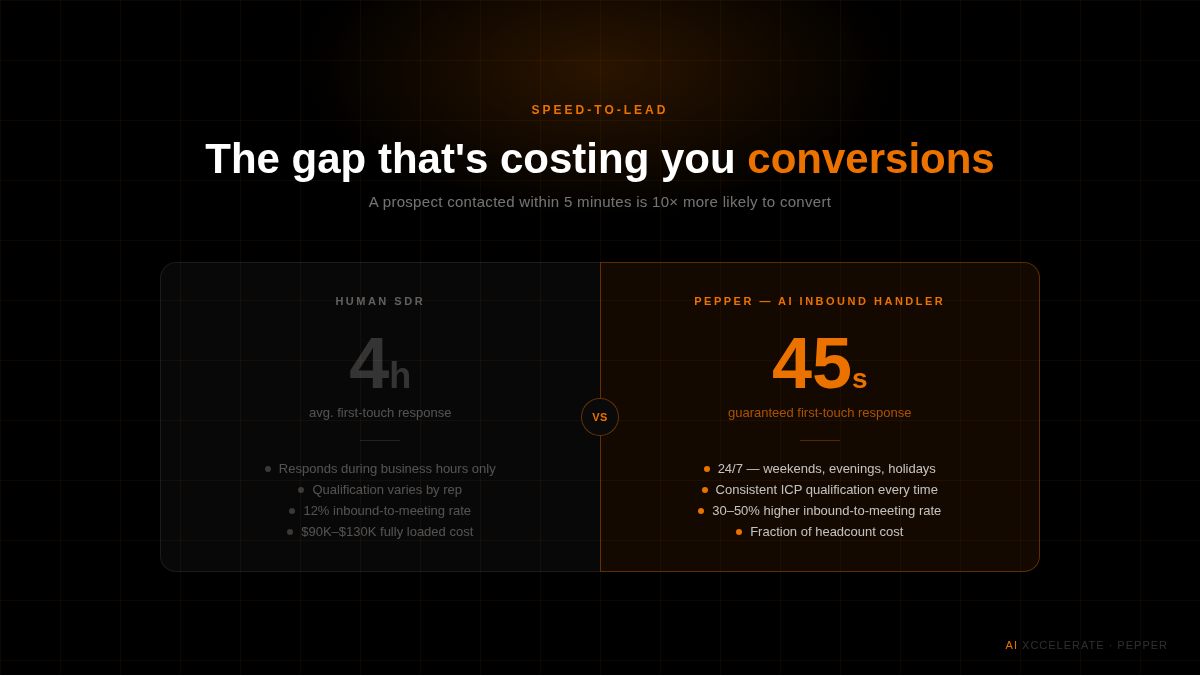
If you have ever measured the conversion impact of speed-to-lead in a B2B SMB, you know the math is brutal. A prospect contacted within 5 minutes of submitting a form is roughly 10x more likely to convert than the same prospect contacted within an hour. Yet most SMBs measure their inbound response time in hours, not minutes.
This is the structural problem that AI inbound handlers were built to solve.
What does an AI inbound handler actually do?
An AI inbound handler in 2026 owns the first-touch interaction with every inbound lead — form fills, demo requests, chat conversations, inbound emails to sales addresses — autonomously. It does not augment a human SDR. It is the SDR for first-touch.
Specifically, Pepper handles:
1. Sub-60-second response. When a prospect submits a form or chats in, Pepper picks up within seconds. The first message is personalized, on-brand, and tailored to the request type.
2. ICP qualification in conversation. Pepper asks the qualification questions a human SDR would ask — conversationally over chat, email, or phone.
3. Dynamic value response. Based on what Pepper learns, it surfaces the most relevant content — case studies, product positioning, ROI calculators.
4. Meeting booking. When the prospect is qualified and interested, Pepper books the meeting directly into the relevant AE's calendar.
5. Routing edge cases. When the prospect is high-stakes or the conversation gets complex, Pepper routes to a human AE with full context.
6. CRM and downstream updates. Every interaction is logged.
Why first-touch is the highest-ROI AI function
Reason 1: Speed matters more than skill. A great human SDR responding in 4 hours converts worse than a mediocre AI responding in 4 minutes.
Reason 2: The work is pattern-recognition heavy. Qualifying an inbound lead against your ICP is mostly pattern matching.
Reason 3: The conversation is bounded. First-touch qualification follows a predictable arc.
Reason 4: The cost-to-staff is high relative to the value of the conversation. Inbound SDRs cost $90K–$130K fully loaded.
The technical architecture: what makes Pepper different from a chatbot
A chatbot answers questions from a knowledge base. Pepper does that, but also:
Multi-source enrichment in real time. When a prospect submits a form, Pepper kicks off parallel enrichment on the contact and the company.
Conversational qualification, not form-based. Pepper qualifies through conversation, just faster and more consistently.
Agentic decision-making. When Pepper hits a decision point, it reasons about the context using the full knowledge base.
Multi-turn, multi-channel continuity. A prospect who chats once, then emails three days later, gets a continuous conversation.
Cross-channel coordination with other AI employees. When Pepper books a meeting that later becomes a customer, George (the CS AI) picks up with full upstream context.
The economic case for an SMB
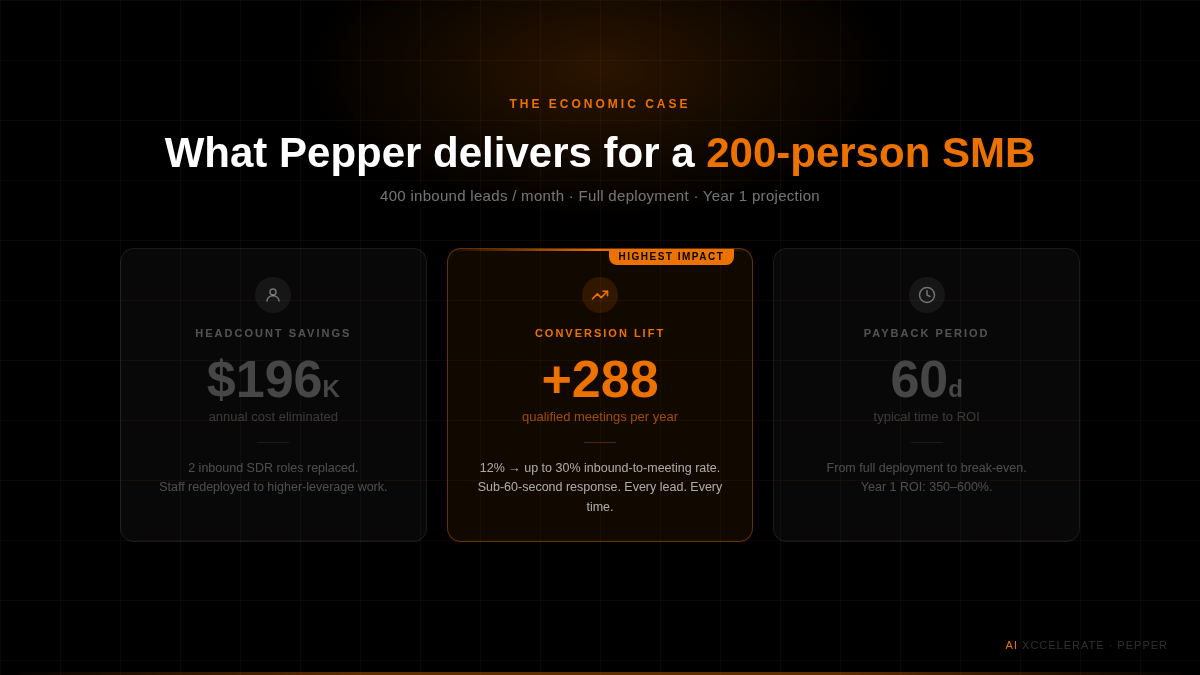
Scenario: A 200-person B2B SMB generates 400 inbound leads per month. Current setup: 2 inbound SDRs, ~12% conversion to meeting.
Current state:
| Metric | Value |
|---|---|
| Inbound SDRs | 2 |
| Fully loaded cost per SDR | $110,000/year |
| Total inbound SDR cost | $220,000/year |
| Average first-touch response time | 2.5 hours |
| Inbound-to-meeting conversion | 12% |
| Monthly qualified meetings | 48 |
| Cost per qualified meeting | $382 |
With Pepper deployed:
| Metric | Value |
|---|---|
| Inbound SDRs | 0 (or 1 redeployed to enterprise leads) |
| Pepper fully loaded cost | $24,000/year |
| Average first-touch response time | 45 seconds |
| Inbound-to-meeting conversion | 18% (50% lift from speed-to-lead) |
| Monthly qualified meetings | 72 |
| Cost per qualified meeting | $28 |
Annual savings + lift:
- Direct headcount savings: ~$196,000
- Additional qualified meetings per year: 288
- Cost per qualified meeting: 92% lower
Is your inbound response time longer than 30 minutes? That gap is costing you conversions every day. Book a free 30-minute AI Workforce Assessment and we'll show you what Pepper does with your inbound volume — and what the conversion lift looks like in the first 30 days.
→ Book your assessment
Where Pepper fails (and what we do about it)
Case 1: Complex enterprise leads with multi-stakeholder buying committees. Pepper escalates enterprise leads above a defined threshold to a human AE on first message.
Case 2: Highly technical products requiring sales engineering on first touch. Cross-deployment with Tony, AI Xccelerate's AI Sales Engineer.
Case 3: Brand-defining customer interactions. A "VIP list" routed directly to a human.
How a Pepper deployment actually works
Weeks 1–2: Scoping and ICP definition.
Weeks 3–4: Knowledge base contribution.
Weeks 5–6: Integration and pilot. Run on 25% of inbound volume.
Weeks 7–8: Full deployment.
Ongoing: Quarterly tuning.
The total deployment timeline is typically 6–8 weeks. Payback is typically 60–90 days from full rollout.
The signal you should deploy AI inbound
Five questions. If you answer yes to three or more, deploy:
- Is your average first-touch response time longer than 30 minutes during business hours?
- Are you missing inbound leads on weekends, evenings, or holidays?
- Are you considering hiring an inbound SDR primarily to handle volume?
- Is your inbound-to-meeting conversion rate below 15%?
- Do you have a clearly defined ICP?
How Pepper fits into the larger AI workforce stack
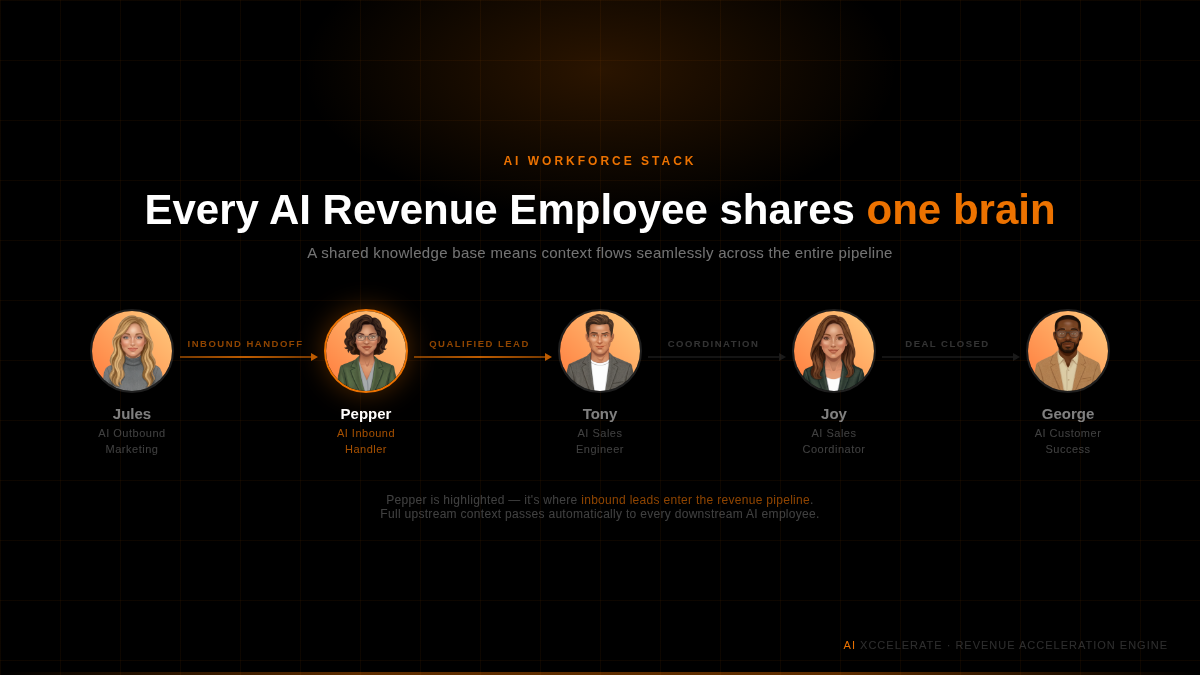
Pepper does not operate alone. In a fully deployed AI Xccelerate stack, Pepper is the inbound counterpart to Jules (outbound), works alongside Tony (sales engineering), hands qualified meetings to either human AEs or Joy (AI sales coordination), and contributes context to George (customer success) once the deal closes.
The shared knowledge base means Pepper writes from the same source-of-truth as every other AI Revenue Employee.
FAQ
What is an AI inbound handler?
An autonomous AI agent that owns first-touch interactions with inbound leads — form fills, demo requests, chat conversations, sales-address emails. It qualifies leads against your ICP, books meetings autonomously, and routes complex cases to humans.
How is Pepper different from a chatbot?
A chatbot answers questions from a knowledge base. Pepper handles real-time multi-source enrichment, conversational ICP qualification, agentic decision-making, multi-turn multi-channel continuity, and cross-coordination with other AI employees.
Can AI replace my inbound SDR team?
For most SMBs running standard inbound motions, yes. The typical pattern is to reduce inbound SDR headcount by 70–90% and redeploy remaining staff to higher-leverage work.
How fast does an AI inbound handler respond to leads?
A well-deployed AI inbound handler responds in under 60 seconds, typically 15–45 seconds.
What is the ROI of deploying an AI inbound handler?
For a typical SMB with 300–500 monthly inbound leads, deploying produces $150K–$250K of annual labor cost savings plus a 25–80% increase in inbound-to-meeting conversion. Payback is typically 60–90 days. Year 1 ROI: 350–600%.
Ready to stop losing inbound leads to slow first-touch?
Book a free 30-minute AI Workforce Assessment. We'll review your current inbound motion, model the conversion lift from sub-60-second response, and show you exactly what a Pepper deployment looks like for your lead volume. Typical payback: 60–90 days.