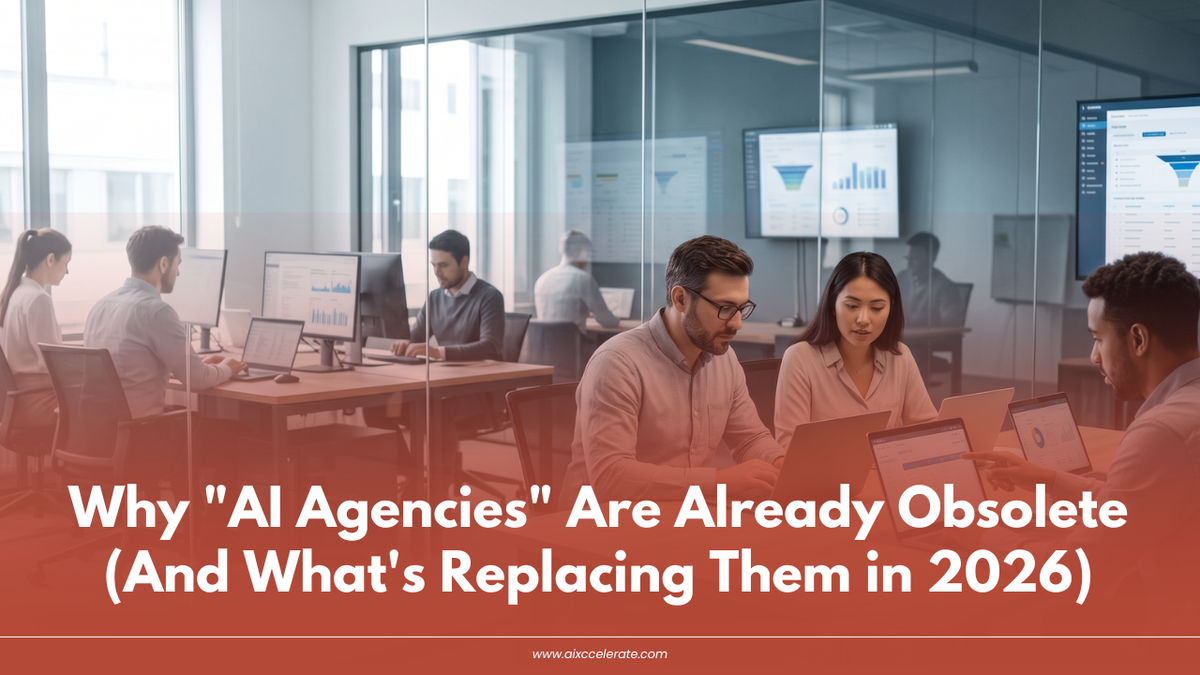
Why "AI Agencies" Are Already Obsolete (And What's Replacing Them in 2026)
The AI agency model that dominated 2024 is breaking down. Productized AI workforce vendors now deliver more capability at half the cost — on subscription, with continuous upgrades.
TL;DR — Key Takeaways
- The "AI agency" business model — selling AI implementation as a project — is structurally broken. It cannot scale, cannot retain expertise, and cannot price competitively against AI workforce products.
- SMBs that hired AI agencies in 2024–2025 are increasingly leaving them for AI workforce infrastructure vendors who sell the labor, not the project.
- The economics: AI agencies bill $10K–$50K per project on a one-time basis. AI workforce vendors bill $1.5K–$3K per month on an ongoing basis with continuous capability upgrades.
- Agencies built around "implementing AI for you" are competing with vendors who are the AI. The structural advantage is permanent.
- The agencies that will survive 2026 are the ones that abandon the implementation model and become deployment partners for AI workforce products.
In 2024, the smartest move for an SMB that wanted to use AI was to hire an AI agency. The technology was fragmented, the deployment was complex, and the buyer needed expertise more than they needed product. Agencies charged $20K–$50K to build a custom chatbot, a workflow automation, or a "GPT-powered" sales assistant.
By 2026, the agency model is breaking down. Not because agencies became bad at what they do, but because the structural conditions that made the agency model viable have changed.
The original case for AI agencies in 2024
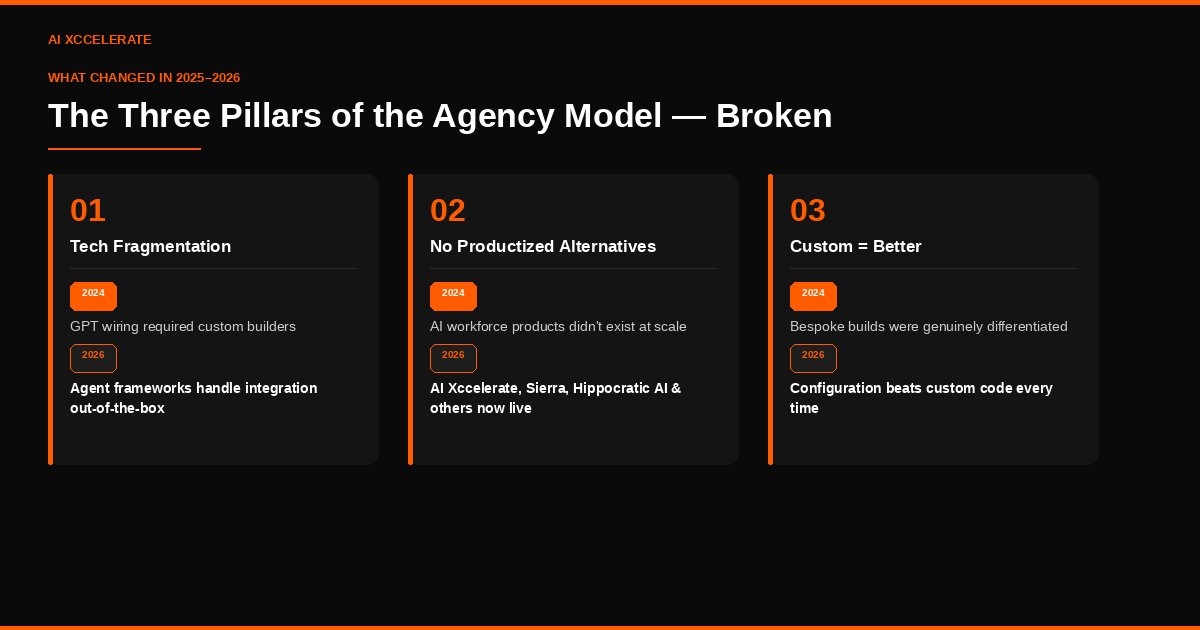
The AI agency model made sense in a specific moment. Three conditions had to be true:
Condition 1: The tech was too fragmented for an SMB to deploy alone. An SMB CEO could not realistically wire up GPT-4 to their CRM and Slack and email and expect it to work. They needed a builder.
Condition 2: There were no productized alternatives. The AI workforce product category did not yet exist at scale.
Condition 3: Custom implementations were defensible. Every business had unique processes, and the agency's pitch was that those processes deserved custom AI.
In 2024, all three conditions held. Agencies booked record revenue. The model worked because the alternative was for SMBs to do nothing.
What changed in 2025–2026
All three conditions have broken in the last 18 months.
Condition 1 broke when agent frameworks matured. The integration work that previously required a custom build is now table stakes for any serious AI workforce vendor.
Condition 2 broke when AI workforce vendors productized the category. AI Xccelerate, Eleven Labs, Sierra, Hippocratic AI, and several others have now productized the AI employee model.
Condition 3 broke when "custom" stopped meaning "better." Productized AI workforce products are now configurable enough that the customization happens through configuration rather than through code.
The three pillars of the agency model are gone.
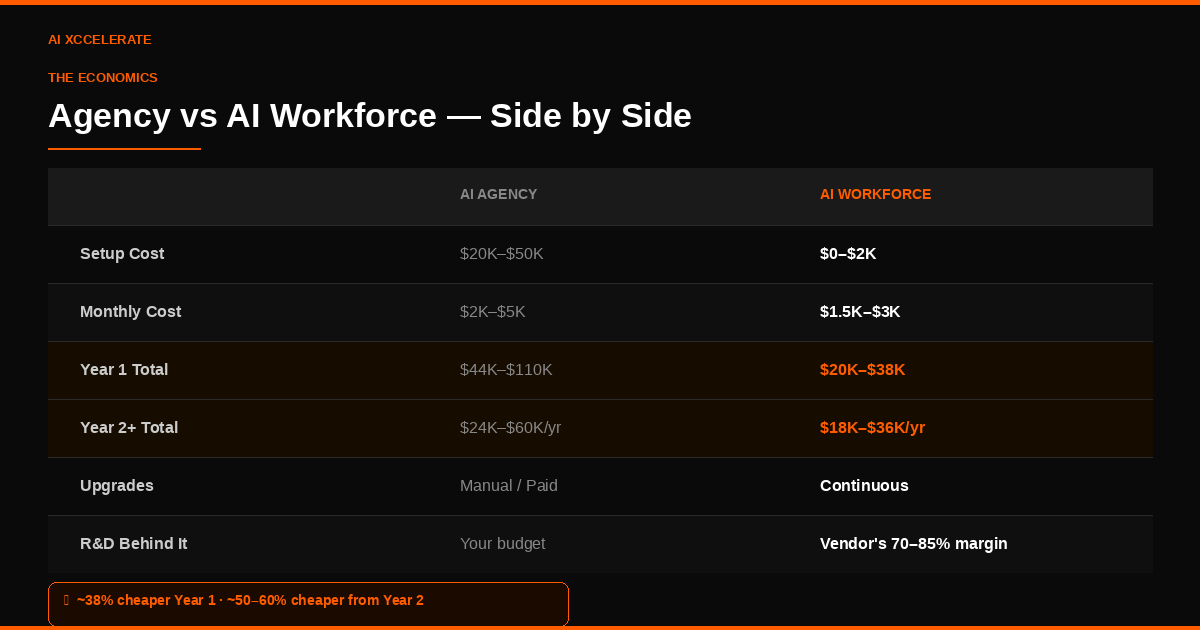
The economics: agency vs AI workforce, side by side
A typical SMB engagement with an AI agency in 2024–2025:
| Line item | Cost |
|---|---|
| Discovery and scoping | $5,000 |
| Custom build (e.g., AI SDR) | $25,000 |
| Integration with CRM, email, LinkedIn | $8,000 |
| Training and handoff | $3,000 |
| Maintenance retainer (Year 1) | $12,000 |
| Year 1 total | $53,000 |
| Year 2 (retainer + changes) | $15,000–$25,000 |
A typical AI workforce subscription in 2026:
| Line item | Cost |
|---|---|
| AI workforce subscription | $24,000/year |
| Setup and onboarding | $3,000 |
| Internal time (ICP, KB, config) | $6,000 (one-time) |
| Year 1 total | $33,000 |
| Year 2+ | $24,000 |
The headline: AI workforce is ~38% cheaper in Year 1 and ~50–60% cheaper from Year 2 onwards.
But the cost story is the smaller story. The bigger story is capability. The agency-built AI SDR is locked at whatever the agency built it to be on the day of delivery. The productized AI SDR is upgraded continuously by the vendor's R&D team. After 18 months, the productized version is meaningfully more capable than the agency build — at half the cost.
Why the agency model cannot scale to fix this
Constraint 1: Talent. Senior AI engineers are expensive ($200K–$400K fully loaded) and scarce. Agencies cannot match the comp packages or the equity upside of AI workforce product companies.
Constraint 2: Continuous improvement requires installed base. A product vendor with 200 customers running the same product has 200 datasets to learn from. An agency with 200 customer engagements has 200 separate, bespoke implementations with no shared learning.
Constraint 3: Margin structure. AI agency margins are services margins (20–35% gross). AI workforce product margins are SaaS margins (70–85% gross). The product company has 2–3x more capital per dollar of revenue to invest in R&D.
Constraint 4: The customer narrative is different. The customer story for an agency is "we built this for you." The customer story for a workforce vendor is "we are continuously upgrading this on your behalf." The second story is durable.
What is replacing AI agencies in 2026
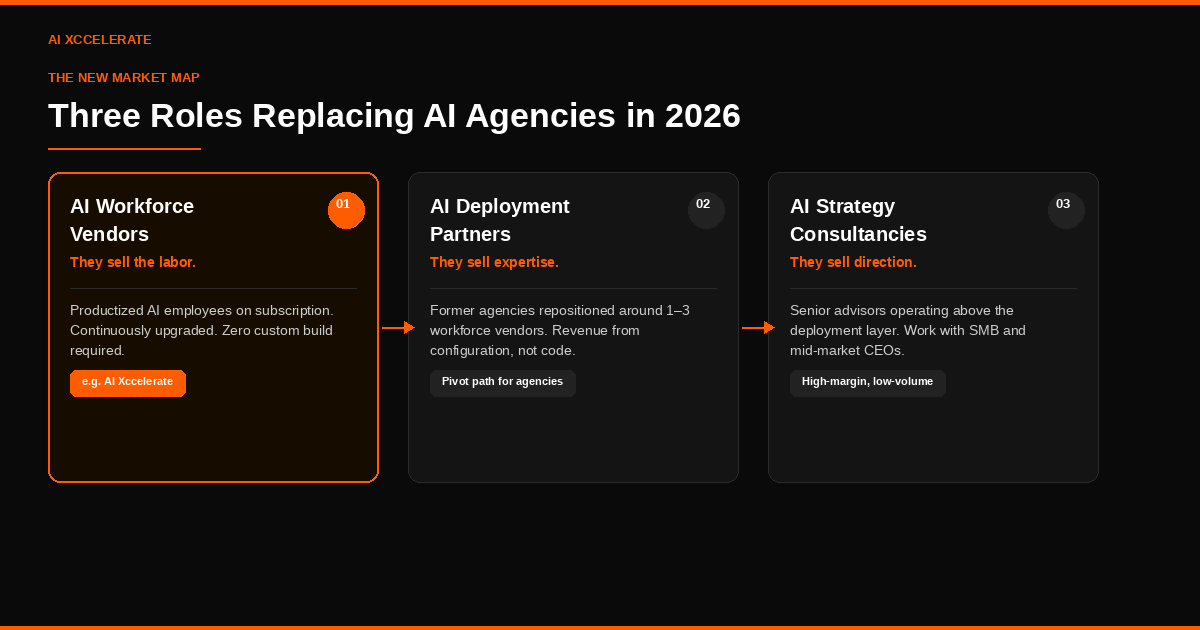
The market is rationalizing into three roles, none of which is the traditional agency:
Role 1: AI workforce vendors (companies like AI Xccelerate). They sell the labor.
Role 2: AI deployment partners. These are agencies that have repositioned. Instead of selling custom builds, they sell deployment expertise on top of workforce products.
Role 3: AI consultancies (strategy-level). A small number of firms operate above the deployment layer, advising SMB and mid-market CEOs on AI strategy across functions.
Still paying agency retainers for AI that should be productized by now? Book a free 30-minute AI Workforce Assessment — we'll show you what the same budget looks like deployed as AI Revenue Employees instead.
→ Book your assessment
What this means if you are an SMB still working with an AI agency
Run a simple audit:
Question 1: What is the agency building that you could subscribe to instead?
Question 2: What is the maintenance commitment, and what is the agency's roadmap?
Question 3: What is the agency's installed base on the system they built for you?
Question 4: What would it cost to migrate? In most cases, the answer is "less than six months of the current retainer."
What this means if you are an AI agency in 2026
The path forward is repositioning, not defending. Three options:
Option A: Become a deployment partner. Pick 1–3 AI workforce vendors. Build certified deployment expertise.
Option B: Build a productized vertical. Turn the bespoke builds you have done into a productized offering for that vertical.
Option C: Move up to strategy. A small number of agencies will succeed as AI strategy consultancies.
The hard truth
The AI agency model was right for a moment in time. That moment is closing. The new model is productized AI workforce, sold as labor, on subscription, with continuous improvement.
FAQ
Are AI agencies going away in 2026?
The bespoke-build AI agency model is in structural decline. Agencies that pivot to deployment partnerships, verticalized products, or strategy consulting will survive.
What is the difference between an AI agency and an AI workforce vendor?
An AI agency sells implementation services. An AI workforce vendor sells a productized AI employee. Pricing tells you which is which.
Should an SMB hire an AI agency in 2026?
For most use cases, no. The productized alternatives are cheaper, faster to deploy, and continuously upgraded.
What is replacing AI agencies for SMBs?
AI workforce vendors that sell pre-built AI Revenue Employees on subscription, and deployment partners that help SMBs configure and roll those vendors out.
Why are AI workforce vendors cheaper than AI agencies?
The build cost is amortized across hundreds of customers, the integration work is reusable, and the SaaS-margin business model supports more R&D.
Ready to replace the agency model with something that compounds?
Book a free 30-minute AI Workforce Assessment. We'll map your current AI agency or tool spend to specific AI Revenue Employees, show you the capability and cost comparison, and give you a deployment timeline. No retainer. No custom build. Just productized AI that's live in 2–4 weeks.