How to Actually Use Claude Fable 5 in Your Business (Without a Technical Team)
Your competitor is doing more with fewer people — not because they hired better, but because they stopped doing things manually. Here's how to use Claude Fable 5 in your business today.
Your to-do list isn't getting shorter. Your team isn't getting bigger. And somewhere across town, a competitor is doing more with fewer people — not because they hired better, but because they stopped doing things manually.
You can use Claude models in your business right now without a single engineer on your payroll. The latest release — Claude Fable 5, launched June 9, 2026 by Anthropic — is the first publicly available AI model capable of running autonomous, multi-step work tasks from start to finish. Non-technical founders are already using it to handle research, draft customer communications, analyze documents, and run weekly finance summaries. This post walks you through exactly how.
TL;DR
- Claude Fable 5 (June 2026) is the most capable publicly available AI model in the world — and you don't need a developer to use it
- It handles multi-step, long-running work: research, writing, analysis, customer communication, and document review
- Stripe used an early version to migrate a 50-million-line codebase in one day — work that would have taken a full team two months by hand (Anthropic, June 2026)
- Non-technical teams can access it through Claude.ai, no-code tools like Zapier or Make, or through a setup partner
- The biggest mistake businesses make: treating AI like a search engine instead of an autonomous operator
- AI Xccelerate helps teams identify which tasks to hand to AI first, then builds the workflow — typically live within 2–3 weeks
What changed in June 2026 that actually matters to your business?
New AI models get announced constantly. Most of them matter to developers. This one is different.
Anthropic released Claude Fable 5 on June 9, 2026. It's the first model in their lineup built for what they call "long-horizon" tasks — meaning it doesn't just answer a question, it works through a multi-step problem from start to finish, makes decisions along the way, and checks its own work before it hands anything back.
The model outperforms every previous Claude version on nearly all tested benchmarks. But what matters for your business isn't the benchmark score. It's what that score translates to in practice: an AI that can take a task off your plate and actually complete it — not just start it.
According to Anthropic's own release data, more than 95% of Fable 5 sessions complete without any fallback to a less capable model. That reliability is what makes it usable in a real business context — not just a demo.
What can Claude Fable 5 actually do without a technical team?
Most people use AI the way they use Google — ask a question, get an answer, move on. That's not how the newest models are designed to work.
Claude Fable 5 is built for tasks that have multiple steps, require judgment, and take time. Here's what that looks like for a non-technical business team:
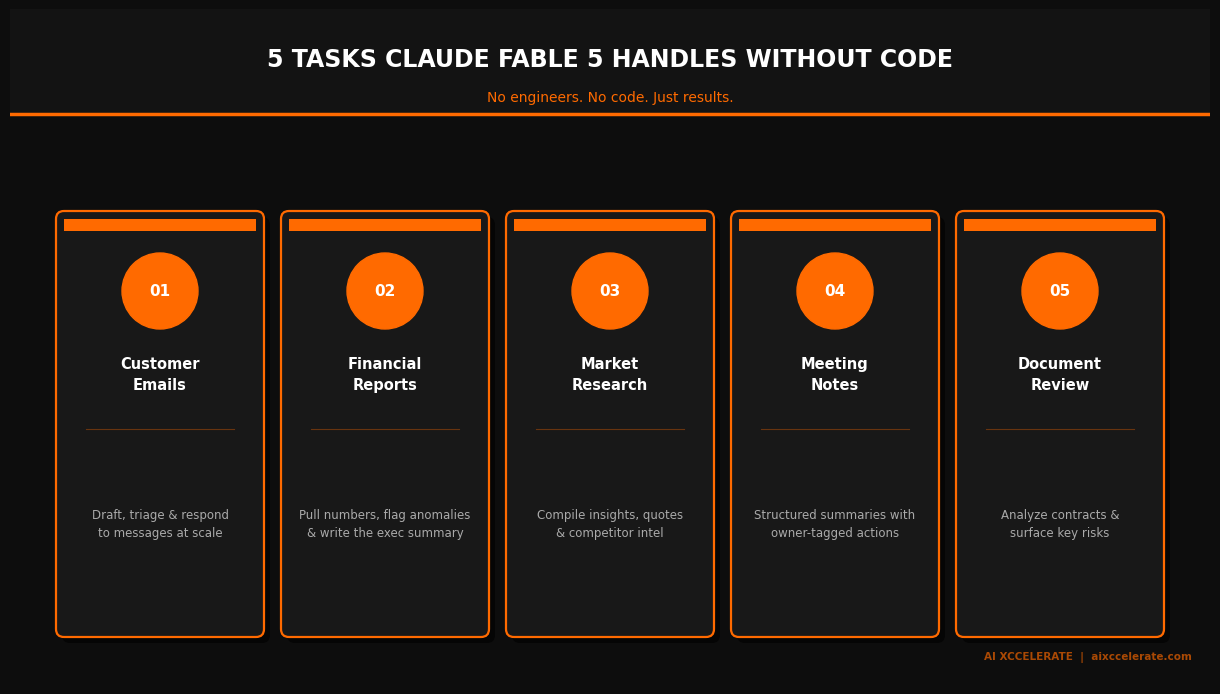
Customer email triage and drafting. Give the model context about your inbox and it will read, categorize, draft responses, and flag the ones that need a human. Not just one email — a full backlog.
Financial document analysis. Upload a contract, a P&L, or a vendor proposal. Fable 5 will extract the key numbers, flag the risks, and summarize what matters. Hebbia, a financial AI firm, found that Fable 5 scored the highest among all models tested on senior-level finance reasoning — including document-based reasoning, chart interpretation, and problem solving (Anthropic, June 2026).
Research and competitive analysis. Brief it on what you need to know. It will find the information, structure the output, and present findings you can act on — not a wall of links.
Meeting notes and action items. Drop in a transcript. Get back a structured summary, owner-tagged action items, and a draft follow-up email — ready in under two minutes.
Spreadsheet and reporting work. According to Peter Wang, Chief Science Officer at Anaconda, Claude Fable 5 outperforms earlier models on spreadsheet tasks, completing runs 25–30% faster (Anthropic, June 2026).
None of these require you to write code. They require you to know what task you want done and give the model enough context to complete it.
What does this look like in a real business scenario?
Here's a scenario that plays out at dozens of companies every week.
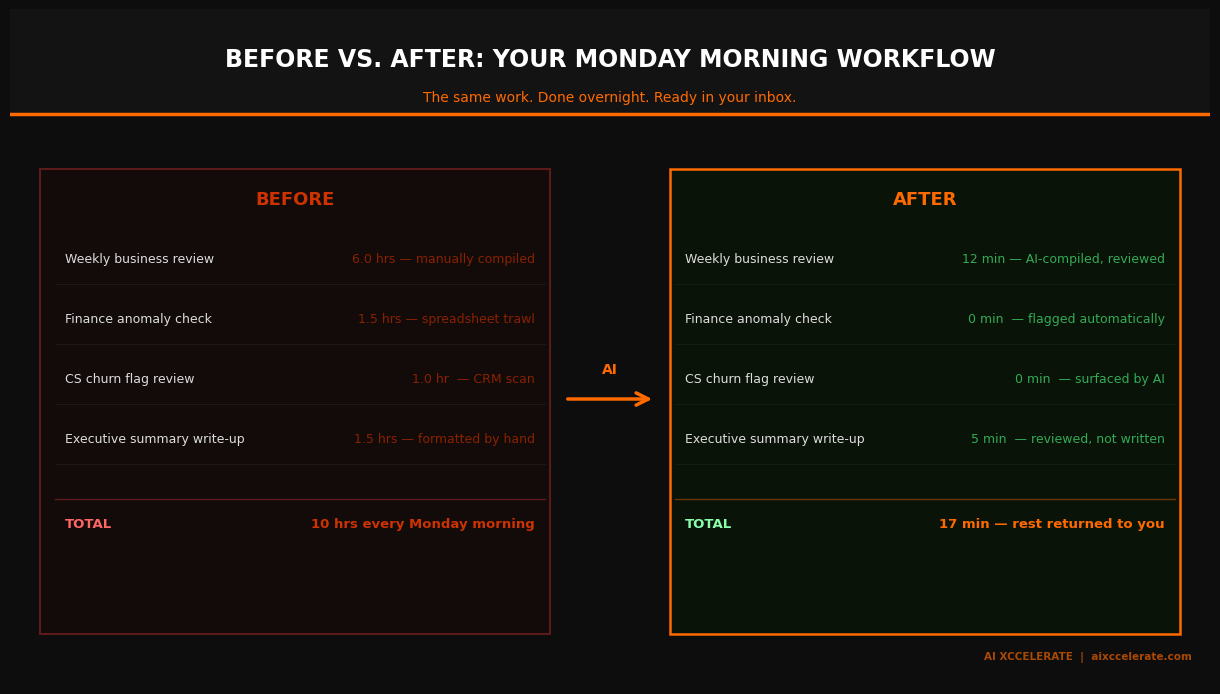
The situation: A 42-person B2B SaaS company. The operations lead — let's call her Maya — spends six hours every Monday morning compiling the weekly business review. She pulls numbers from three different tools, summarizes the sales pipeline, flags churn risks in the CS queue, and writes the executive summary for leadership.
Six hours. Every Monday. Work that matters — but not work that requires a human to do it.
With Claude Fable 5 in the workflow:
Maya sets up a simple automation — no code, using Make connected to Claude's API. The workflow runs every Sunday night. The model pulls data from her CRM, her finance tool, and her support queue. It compiles the numbers, flags anomalies, and writes the executive summary in the company's standard format. By 7am Monday, the report is in her inbox — ready to review, not ready to write.
That's 5.5 hours returned to her every week. Over a year, that's 286 hours — more than seven full work weeks — handed back to a person who should be solving problems, not formatting spreadsheets.
The model doesn't get tired. It doesn't miss a week because someone is on vacation. And it gets more reliable the more context you give it, because Fable 5 has significantly improved memory and long-context handling compared to any previous version.
This isn't hypothetical. Stripe reported that Claude Fable 5 compressed what would have been two months of work for a full engineering team into a single day — in a 50-million-line codebase (Anthropic, June 2026). The same principle applies to operational workflows at your scale.
Want to know which workflow at your company should go first? → Book your assessment
How do you actually set this up if you have no technical team?
This is where most founders get stuck — and it's a simpler problem than it looks.
There are three ways to access Claude Fable 5 without an engineer:
Option 1: Claude.ai directly. Open a browser, go to Claude.ai, and start working. No setup, no installation. You can upload documents, give it complex multi-part instructions, and get results immediately. This works well for one-off tasks or daily manual workflows you run yourself.
Option 2: No-code automation tools. Zapier, Make, and similar platforms let you connect Claude to your existing tools — your CRM, your email inbox, your project management software — without writing a line of code. You build the workflow visually. The AI runs inside it on a schedule you define.
Option 3: Work with an AI implementation partner. For workflows that need to be reliable, repeatable, and connected across multiple systems, an implementation partner builds the agent for you. You define what you want done. They build it, test it, and hand you a running system.
Option 3 costs a fraction of what it would take to hire an in-house AI engineer. Claude Fable 5 is priced at $10 per million input tokens and $50 per million output tokens (Anthropic, June 2026) — meaning the cost of running most business workflows is measured in dollars per month, not salary.
What is the AIX framework for identifying your first AI workflow?
At AI Xccelerate, we use a three-step process with every client before building anything. Here it is so you can run it yourself this week.
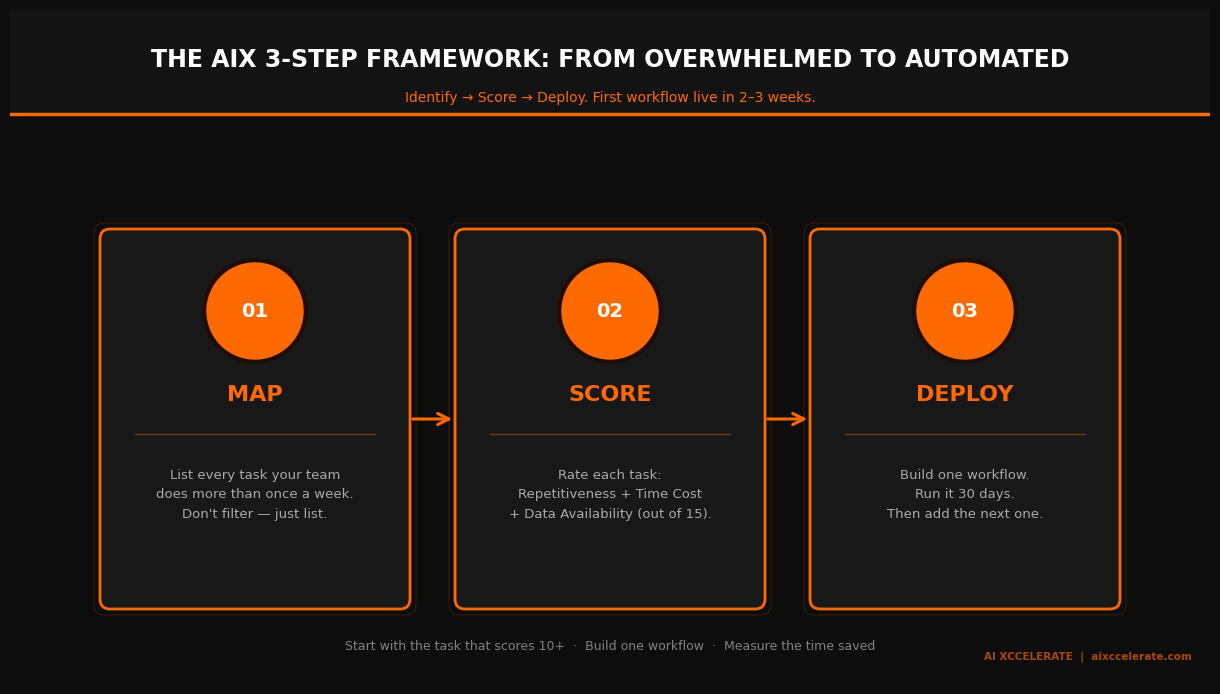
Step 1: Map your repetitive tasks. List every task your team does more than once a week. Don't filter yet — just list. Typical outputs include: weekly reports, customer email responses, meeting summaries, onboarding documents, proposal drafts, invoice reconciliation.
Step 2: Score each task on three dimensions.
| Task | Time/Week (hrs) | Repetitiveness (1–5) | Data Availability (1–5) | AIX Readiness Score |
|---|---|---|---|---|
| Weekly business review | 6 | 5 | 5 | 16/15 |
| Invoice reconciliation | 2 | 5 | 5 | 12/15 |
| Competitor research | 4 | 3 | 4 | 11/15 |
| Customer renewal emails | 3 | 4 | 3 | 10/15 |
| Ad-hoc board updates | 1.5 | 2 | 2 | 5.5/15 |
Tasks that score 10 or above are your first candidates. Start with the highest-scoring task that also has the highest weekly time cost. That's your first workflow.
Step 3: Build one workflow, run it for 30 days. Not three workflows. One. Run it, measure the time saved, tighten the instructions, and confirm the output quality. Once it's reliable, add the next one. Teams that follow this sequence have their first AI workflow live in two to three weeks — without writing a single line of code.
This is the same process we use to deploy agents like Jules (research and analysis) and Pepper (customer-facing communications) for our clients. The framework works because it starts with time cost, not excitement — which means you see a real return within the first month.
Where does AI Xccelerate come in?
If you've gotten to this point thinking "I understand this, but I don't have the time to figure out which tool connects to which" — that's exactly the problem we solve.
AI Xccelerate builds AI workflows for non-technical business teams. We identify which tasks to automate first, connect your existing tools to Claude, and hand you a running system — not a plan, not a prototype, a running system.
We work with founders at 20- to 100-person companies who are past the "should we try AI?" stage and stuck on "how do we actually implement it without breaking what already works?"
Typical engagement: 2–3 weeks to first live workflow. Zero technical staff required on your side.
Ready to find out which task your business should automate first?
We'll map your top three workflows against Claude Fable 5's capabilities, score them using the AIX Readiness framework above, and tell you exactly which one to automate first — and how.
No sales pitch. No commitment. A clear answer to: "Where do I start?"
Frequently Asked Questions
How do I use Claude for my business if I don't know how to code? You can start immediately at Claude.ai — it works like a chat interface and requires no setup. For recurring, automated workflows, no-code tools like Zapier or Make connect Claude to your existing systems without any code. For complex multi-system setups, an implementation partner gets you live faster and more reliably than doing it solo.
Is Claude Fable 5 different from ChatGPT? Yes. Claude Fable 5 is Anthropic's latest model, released June 9, 2026. It's built specifically for long-horizon, multi-step tasks — meaning it can complete a complex workflow from start to finish, not just answer one question at a time. On independent benchmarks for finance reasoning, analytical work, and document analysis, Fable 5 scores above other leading models (Anthropic, June 2026).
How much does it cost to use Claude Fable 5 for business? For API access — which powers automated workflows — Anthropic prices Fable 5 at $10 per million input tokens and $50 per million output tokens (Anthropic, June 2026). For most business workflows, this translates to a few dollars per month, not per task. Consumer access through Claude.ai is available through subscription plans.
What kinds of tasks is Claude Fable 5 not good at? Claude Fable 5 is not designed for tasks requiring live data it doesn't have access to, or decisions that require organizational judgment built over years. It also has safety classifiers that occasionally route sensitive requests to a less capable model — Anthropic data shows this affects fewer than 5% of sessions in typical business use.
Can Claude replace my operations team? No — and anyone who tells you it can is overselling. Claude handles repetitive, structured, information-based tasks extremely well. It does not replace relationship management, strategic judgment, or decisions that depend on organizational context. The right frame: AI handles the work that doesn't need a human; your team focuses on the work that does.
How long does it take to get an AI workflow running? If you use Claude.ai manually, you can start today. For a connected, automated workflow using no-code tools, budget a weekend. For a fully built, multi-system agent with reliable output, typical timelines with an implementation partner like AI Xccelerate are two to three weeks.
Do I need to tell my clients I'm using AI? This depends on your industry and the nature of the task. For internal workflows — reports, research, summaries — there is generally no disclosure requirement. For client-facing outputs, review your contracts and applicable regulations. When in doubt, disclose — most business clients today expect AI to be part of your process.