Stop Buying AI Point Tools: The Case for an AI Workforce Stack in 2026
Most SMBs are burning $60K–$100K/year on disconnected AI tools that don't talk to each other. Here's how to consolidate into a workforce stack that actually compounds value.

TL;DR — Key Takeaways
- The average SMB in 2026 is running 14–22 separate AI tool subscriptions — totaling $30K–$120K/year — with no integration, no shared context, and no compounding value.
- AI point tools each solve a narrow problem in isolation. They do not coordinate, do not learn from each other, and do not own the work end-to-end.
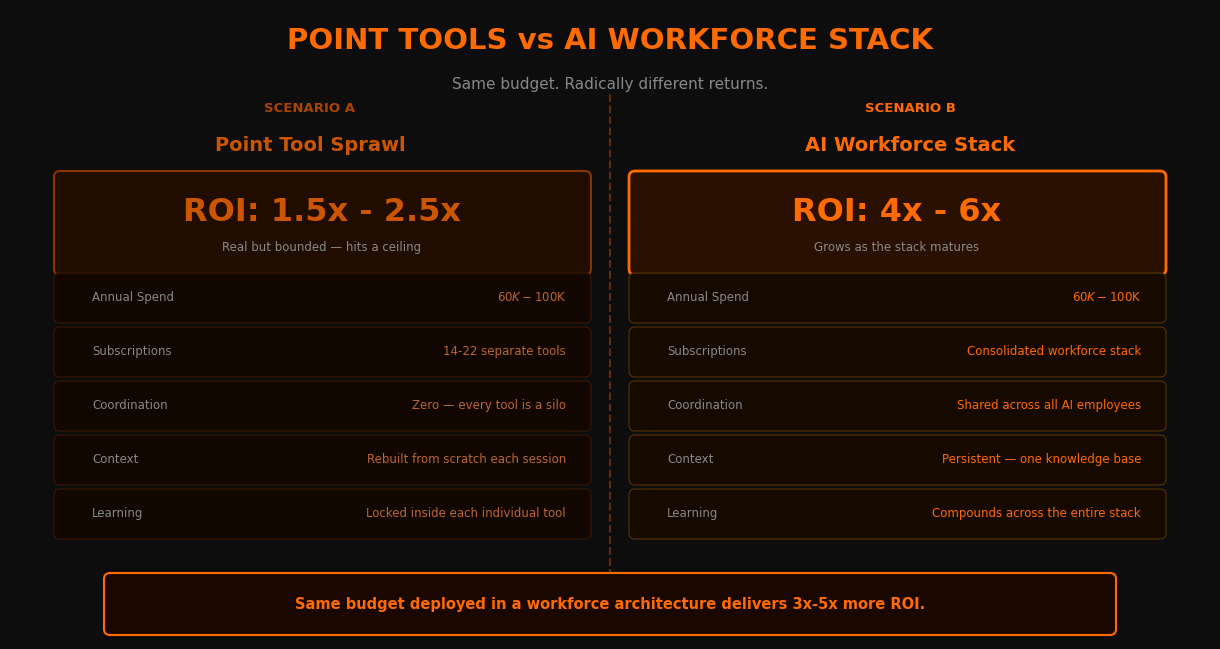
- An AI workforce stack — integrated AI Revenue Employees sharing a common knowledge base — produces 3–5x the ROI of the same spend distributed across point tools.
- The signal you have a sprawl problem: when no one in your company can name all the AI subscriptions, and at least three of them duplicate capabilities.
- The fix is not "buy more AI" — it is to consolidate around a workforce architecture and rationalize the tools that survive.
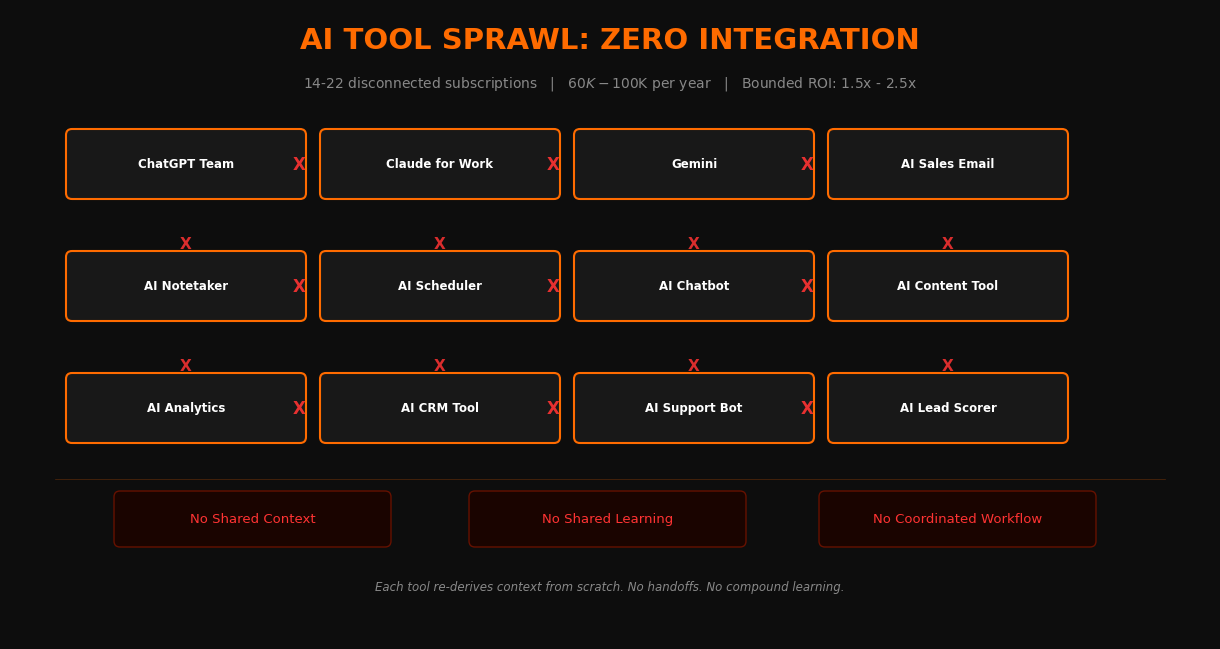
Walk through the AI subscriptions of a typical 200-person SMB in 2026. You will find ChatGPT Team. You will find Claude for Work. You will find Gemini somewhere. You will find a separate AI sales-email tool. A separate AI meeting notetaker. A separate AI calendar scheduler. A separate AI customer service chatbot.
Total AI spend: $60K–$100K a year. Total integration between these tools: roughly zero.
What is AI tool sprawl, and why is it accelerating in 2026?
AI tool sprawl is the proliferation of single-purpose AI subscriptions across teams that operate independently of each other. It happens because:
1. AI tools are cheap and easy to buy. A $30/seat/month AI tool clears most SMB expense approvals without a procurement conversation.
2. Vendors target specific use cases. Every AI vendor builds for a narrow pain point.
3. There is no central AI strategy at most SMBs. AI procurement is rarely owned at the C-level.
4. Marketing language obscures overlap. Three tools that all "write emails with AI" sound different on their marketing pages. They all use the same underlying LLMs.
Most SMBs we audit at AI Xccelerate are spending 1.5–2x what they think they are spending on AI, and getting roughly half the value they could be getting from the same dollars deployed coherently.
Why point tools cannot compound
Three reasons:
Reason 1: No shared context. Each AI tool operates against its own slice of your data. Every tool re-derives context from scratch on every interaction.
Reason 2: No shared learning. When the AI sales tool learns that a particular hook converts well, that learning stays inside the sales tool.
Reason 3: No coordinated workflow. Real revenue work crosses functions. With point tools, each stage is handled by a different tool with no handoff. With an AI workforce stack, the same shared context follows the prospect through every stage.
What an AI workforce stack looks like
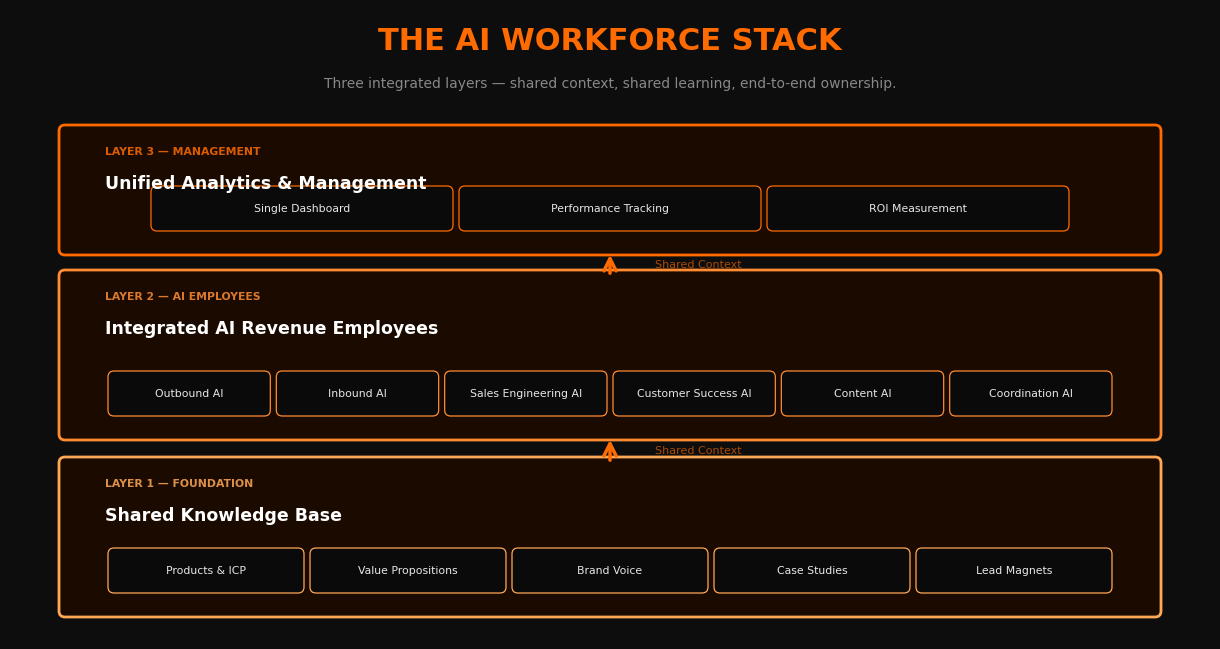
An AI workforce stack has three layers:
Layer 1: Shared knowledge base. A single, structured representation of your business — products, ICP, value propositions, lead magnets, case studies, brand voice. Every AI agent in the stack reads from this knowledge base.
Layer 2: Integrated AI employees. Multiple AI Revenue Employees — outbound, inbound, sales engineering, customer success, content marketing, sales coordination — that share the knowledge base and coordinate workflows across the customer journey.
Layer 3: Unified analytics and management. A single management surface across all AI employees.
The economics: point tools vs workforce stack
Scenario A: Point tool sprawl (current state for most SMBs)
| Category | Annual cost |
|---|---|
| AI writing assistants | $9,000 |
| AI sales email tool | $4,800 |
| AI meeting notetaker | $3,600 |
| AI customer service bot | $12,000 |
| AI CRM intelligence | $18,000 |
| AI marketing analytics | $9,600 |
| AI scheduling | $2,400 |
| AI legal review | $4,800 |
| AI HR screening | $7,200 |
| AI image / design | $1,800 |
| Misc | $4,800 |
| Total | $78,000 |
Honest ROI: probably 1.5–2.5x — real but bounded.
Scenario B: AI workforce stack
| Component | Cost |
|---|---|
| AI Outbound Employee (Jules) | $24,000 |
| AI Inbound Employee (Pepper) | $20,000 |
| AI Customer Success Employee (George) | $22,000 |
| Continued use of AI writing assistants (rationalized) | $4,500 |
| CRM AI tier (kept) | $15,000 |
| Rationalized point tools | $6,000 |
| Total | $91,500 |
Honest ROI: 4–6x — significantly higher because the spend is concentrated where labor cost is being offset.
The audit every SMB should run
Step 1: List every AI subscription. Pull credit card statements.
Step 2: Categorize each subscription. Productivity tools / point tools / AI workforce / infrastructure.
Step 3: Identify overlap.
Step 4: Measure usage. Most SMBs find that 30–40% of their AI subscriptions have fewer than 5 active users.
Step 5: Calculate the gap to a workforce stack.
The audit alone often saves 20–40% of AI spend by killing duplicate or unused subscriptions.
Not sure what's actually worth keeping in your AI stack? Book a free 30-minute AI Workforce Assessment — we'll audit your current AI subscriptions, identify the duplicates and the gaps, and show you what a workforce stack looks like for your business specifically.
→ Book your assessment
Why this argument is unpopular with team-level buyers
The pushback on consolidation usually comes from team-level adopters. The right move is to consolidate the workforce-tier spend (the AI employees doing the work) into an integrated stack, while letting individual teams keep the productivity tools that genuinely improve their daily work.
The strategic question: who owns AI architecture in your company?
The structural reason AI tool sprawl exists is that nobody owns AI architecture at most SMBs. The fix is straightforward: someone in the C-suite needs to own AI architecture as an explicit responsibility.
What the next 12 months look like for SMBs that consolidate
Months 1–2: Audit and rationalize. Kill 20–40% of existing AI subscriptions.
Months 3–5: Deploy the first AI Revenue Employee. Establish the knowledge base.
Months 6–9: Deploy a second AI Revenue Employee.
Months 10–12: Deploy a third AI Revenue Employee. Full workforce stack in operation.
FAQ
What is AI tool sprawl?
The proliferation of single-purpose AI subscriptions across teams that do not coordinate or share context. A typical SMB in 2026 has 14–22 separate AI tool subscriptions totaling $30K–$120K/year.
How do I know if my SMB has an AI sprawl problem?
Three signals: (1) nobody can list all the AI subscriptions, (2) at least three tools solve similar problems, (3) AI spend exceeds 4% of revenue and you cannot trace the ROI clearly.
What is the difference between AI point tools and an AI workforce stack?
Point tools solve narrow problems in isolation. An AI workforce stack is an integrated set of AI employees that own entire functions and share a common knowledge base.
How should an SMB consolidate AI spend in 2026?
Audit the current stack, kill duplicates and unused subscriptions, reallocate budget toward workforce-tier AI employees.
Will an AI workforce stack save my SMB money?
In most cases yes, modestly — typical SMBs save 20–40% on total AI spend by consolidating, plus large additional savings from labor cost offset.
Ready to stop accumulating tools and start building a stack that works?
Book a free 30-minute AI Workforce Assessment. We'll review your current AI spend, identify what to cut, and show you exactly how to reallocate that budget toward AI Revenue Employees that offset real headcount cost. No deck. No sales pitch. Just a clear plan.