Headcount Is a Liability. AI Workforce Is an Asset.
Headcount scales linearly. AI doesn't. Discover why smart SMB leaders are replacing headcount dependency with AI workforce strategies that cut costs and scale faster.
Every payroll run is a decision you made months ago. Every new hire is a fixed cost disguised as a growth move. But AI agents, generative AI tools, and intelligent automation don't sleep, don't resign, and don't require benefits. For SMB leaders willing to look honestly at their cost structures, the shift from headcount-first to AI workforce-first is no longer a future consideration — it is the present competitive divide.
The Hidden Cost Architecture of Human Headcount
When SMB leaders talk about hiring, they typically quote a salary. But the real cost of a single full-time employee runs between 1.25× and 1.4× their base salary when you factor in payroll taxes, health benefits, onboarding time, management overhead, and the productivity lag of every new hire. For a $60,000 employee, your true annual spend is closer to $84,000 — before accounting for attrition, retraining, or underperformance.
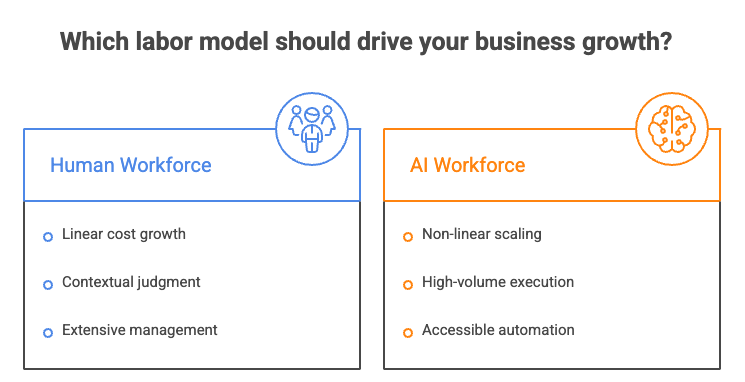
This is the liability equation that most SMB founders refuse to confront openly. Headcount scales linearly: double your output, double your payroll. It is structurally hostile to margin expansion. And in a macroeconomic environment defined by interest rate volatility, shifting consumer demand, and AI-enabled competitors, linear scaling is a strategic vulnerability.
Key Statistics:
- 40% — Average productivity gain from AI automation in SMB operations
- 1.4× — True cost multiplier of every employee's stated salary
- $13T — Estimated global economic impact of generative AI by 2030
- 72% — Of SMBs report AI tools delivered ROI within 6 months
What "AI Workforce" Actually Means in 2025
The term AI workforce is not a metaphor. It refers to a stack of coordinated AI systems — including large language models (LLMs), AI agents, robotic process automation (RPA), and generative AI tools — that perform work previously assigned to human employees. In 2025, this stack has matured to the point where SMBs can deploy it without enterprise budgets or technical teams.
Consider the practical scope of what modern agentic AI can now execute without human supervision:
Core AI Workforce Capabilities for SMBs:
- Draft, review, and send client-facing communications via generative AI writing tools
- Qualify inbound leads, schedule meetings, and update CRM records using AI sales agents
- Generate, test, and deploy code snippets via AI coding assistants like GitHub Copilot or Claude
- Monitor inventory, process purchase orders, and flag anomalies through intelligent automation
- Produce marketing content, SEO articles, and social copy at scale with generative AI platforms
- Analyse customer sentiment, support tickets, and churn signals via AI-powered analytics
- Handle Tier-1 customer support interactions 24/7 with conversational AI chatbots
These are not experimental capabilities. They are deployed today by SMBs that understand the core insight: AI workforce scales non-linearly. Deploying five AI agents does not cost five times one. The marginal cost of scale approaches zero.
"The businesses winning right now are not the ones with the most people. They are the ones who figured out which work requires people — and deployed AI for everything else."
Human Headcount vs. AI Workforce: A Direct Comparison
For SMB leaders evaluating where to invest in growth, the following comparison crystallises the structural difference between traditional headcount and an AI workforce strategy:
| Dimension | Human Headcount | AI Workforce |
|---|---|---|
| Cost structure | Fixed + benefits (1.4× salary) | Subscription / usage-based |
| Scalability | Linear — hire to grow | Non-linear — scales on demand |
| Availability | 8–9 hrs/day, 5 days/week | 24/7/365, no downtime |
| Onboarding time | 30–90 days to full productivity | Hours to days |
| Consistency | Variable (mood, fatigue, tenure) | Deterministic and auditable |
| Attrition risk | High — knowledge loss on exit | None — knowledge persists |
| Deep relational work | High capability | Developing — not yet parity |
| Creative strategy | High capability | Assistive — human-led |
The table reveals the honest truth: human talent remains irreplaceable for strategic thinking, complex negotiation, and high-trust relationship management. The strategic error most SMB leaders make is not recognising that these capabilities constitute perhaps 20–30% of total workflow volume. The remaining 70–80% — repeatable, rule-based, content-generation, or data-processing tasks — is precisely where an AI workforce delivers compounding returns.
The Three AI Adoption Levers Every SMB Should Pull Now
Lever 1 — Generative AI for Content and Communication
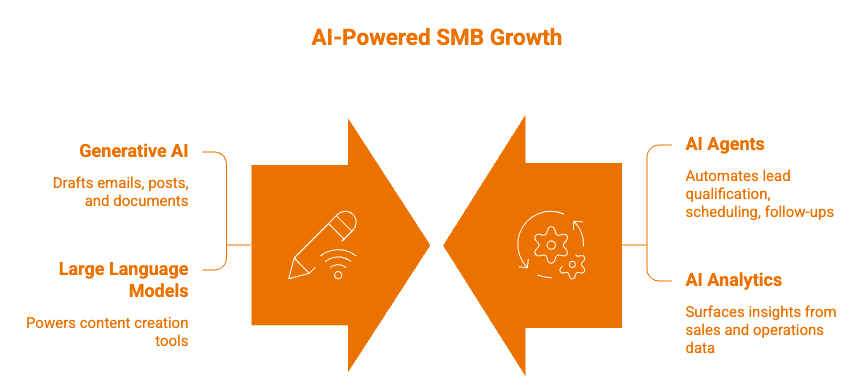
Generative AI tools powered by large language models — including OpenAI's GPT-4o, Anthropic's Claude, and Google Gemini — can now draft customer emails, sales proposals, blog posts, job descriptions, and internal documentation with minimal human editing. SMBs that deploy these tools report reclaiming 8–12 hours of knowledge worker time per week, per employee. Multiply that across your team and the productivity dividend becomes structural, not incidental.
Lever 2 — AI Agents for Process Automation
Agentic AI represents the next frontier: AI systems that don't just respond to prompts but autonomously complete multi-step tasks. Platforms like Make, Zapier with AI, and purpose-built agent frameworks allow SMBs to deploy AI agents that handle lead qualification, appointment scheduling, invoice follow-up, and data entry — all without a human in the loop. The defining characteristic of agentic AI is that it acts, not merely advises.
Lever 3 — AI Analytics for Decision Intelligence
The most underutilised application of AI in SMBs is not content generation — it is decision intelligence. AI-powered analytics tools can now ingest your sales data, customer behaviour patterns, and operational metrics to surface insights that would previously require a dedicated data analyst. Tools like Microsoft Copilot for Business, Google Looker with AI, and Tableau AI democratise data science for businesses without a single data hire on the payroll.
How to Transition Without Disrupting Your Team
The most common fear SMB leaders express when confronted with AI workforce strategies is cultural: will this signal to my team that their jobs are at risk? This is a legitimate concern — and one that deserves a direct answer.
The framing matters enormously. AI adoption is not about replacing your people — it is about upgrading what your people can achieve. The SMBs that navigate this transition most successfully position AI tools as force multipliers for their existing team, not as substitutes. A marketing manager who learns to direct generative AI tools doesn't lose their job — they become a one-person content department. A customer success rep who uses AI to draft responses in seconds doesn't get replaced — they handle three times the client volume at higher quality.
The practical transition framework most SMB leaders follow is augment before automate: introduce AI tools that assist your existing employees first, build familiarity and trust, then gradually identify workflows that can be fully automated. This staged approach reduces internal resistance and builds organisational AI fluency over time — which compounds into competitive advantage.
The Competitive Clock Is Already Running
In sectors from legal services to e-commerce, from financial advisory to logistics, AI-first SMBs are already operating at cost structures that traditionally staffed competitors cannot match. They are not necessarily larger, better funded, or more experienced. They have simply made a decision that their headcount-dependent competitors have not: to treat AI as a workforce strategy rather than a productivity experiment.
The window to make this shift while it still confers differentiation is narrowing. As AI adoption rates among SMBs accelerate — McKinsey projects that 70% of businesses will have adopted at least one AI tool by 2026 — the advantage shifts from first movers to those who adopt most strategically. Deploying a single chatbot does not constitute an AI workforce strategy. Building an integrated stack of generative AI, agentic AI, and intelligent automation — aligned to your specific business workflows — does.
"Your competitors are not waiting to hire the right person. They are deploying the right AI. The question is not whether to act — it is whether you act first, or respond later."
Where to Start: A Practical AI Adoption Roadmap for SMB Leaders
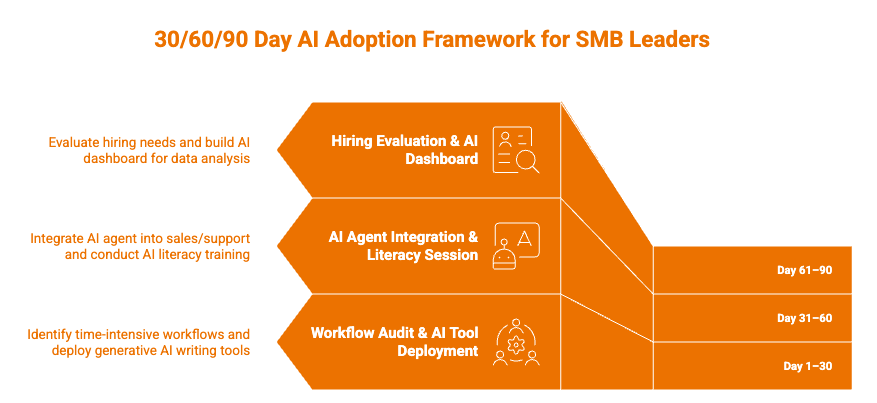
30 / 60 / 90 Day AI Adoption Framework:
Day 1–30:
- Audit your 10 most time-intensive workflows and identify which involve repeatable, rule-based tasks suitable for AI automation
- Deploy a generative AI writing tool (Claude, ChatGPT, or Gemini) for your content, email, and documentation workflows — measure time saved weekly
Day 31–60:
- Integrate one AI agent into your sales or customer support pipeline — use platforms like HubSpot AI, Intercom Fin, or a custom Make/Zapier workflow
- Run an internal AI literacy session — ensure your core team understands how to prompt and direct AI tools effectively
Day 61–90:
- Evaluate your hiring pipeline — determine whether any planned headcount additions can be deferred or replaced by an expanded AI workflow
- Build your first AI dashboard: connect your key business data to an AI analytics tool and establish a weekly decision review cadence
The businesses that will define their categories in the next five years are not waiting for AI to mature further. They are learning, deploying, and iterating now — while the technology is powerful enough to deliver ROI and early enough that fluency is still a differentiator.
The core argument is simple: headcount is a fixed, linear cost structure tied to human capacity limits. An AI workforce is a variable, non-linear asset that scales with demand, compounds in capability over time, and never depreciates through attrition. For SMB leaders building for the next decade, the strategic question is not how many people do we need to grow — it is what does our AI workforce need to look like to get there.
The leaders who answer that question clearly, and act on it decisively, will not just reduce costs. They will build organisations that are structurally faster, more resilient, and more profitable than anything headcount alone could produce.