Jules 1.0 to 2.0: Your AI SDR Grew Up
Jules 1.0 proved AI could replace an SDR. Jules 2.0 is built to outlearn one. Here's what changed architecturally — and why SMB leaders need to understand it before their competitors do.
The conversation around artificial intelligence for small and mid-sized businesses has shifted dramatically. It is no longer about whether to adopt AI — it is about which AI systems are actually doing the work, and how mature they are. Jules, the AI outbound sales employee from AI Xccelerate, is one of the most instructive case studies in that shift.
This article is a structured comparison of Jules 1.0 and the upcoming Jules 2.0 — two generations of the same AI agent, separated by a fundamental rethink of what an agentic AI system should be capable of. If you are an SMB founder, revenue leader, or head of growth, this is the kind of evolution you need to understand before your competitors do.
What Jules 1.0 Got Brilliantly Right
Before discussing where Jules is going, it is worth pausing on what Jules 1.0 achieved — because it was genuinely impressive for what it set out to do.
Jules 1.0 was positioned, from day one, as an AI employee rather than a tool or an automation platform. That framing was deliberate and important. It described Jules using employee verbs — researches, writes, runs, books, manages — not software verbs like automates or streamlines. For SMB leaders tired of being sold software they have to operate themselves, this was a meaningful distinction.
The core 1.0 capability set was built around five functions: prospect research, personalized outreach, multi-touch sequencing, meeting booking, and warm lead handoff. Each addressed a specific failure mode of the traditional human SDR — inconsistent follow-up, templated messages, slow ramp times, and high salary costs. At approximately $20,000 per year versus $65,000–$80,000 for a human sales development representative, the cost equation alone was compelling.
Key Jules 1.0 results:
- 50% LinkedIn response rate on targeted campaigns
- 991 contacts reached in a single campaign cycle
- Pipeline activity comparable to a $75K/yr human hire
- 24/7 always-on operation — no ramp, no sick days
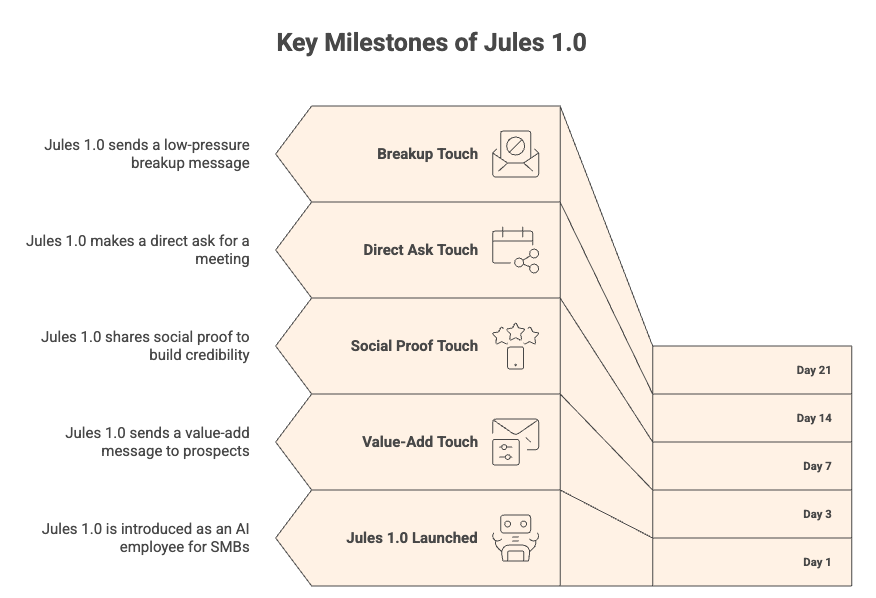
The named 5-Touch Framework was Jules 1.0's most defensible piece of product thinking. A sequenced, logic-driven cadence — cold intro on Day 1, value-add on Day 3, social proof on Day 7, direct ask on Day 14, and a low-pressure breakup on Day 21 — gave small businesses a systematic outbound motion that most of them had never been able to maintain at scale. It ran to completion, every time, which addresses the statistic that 44% of human reps abandon pursuit after a single attempt.
"Jules 1.0 solved the discipline problem. Every sequence runs to completion. Every touch lands on schedule. That alone puts it ahead of most human SDR teams."
The integration stack — HubSpot, Salesforce, Zoho, Google Calendar, Cal.com, Calendly, Apollo, and LinkedIn enrichment — meant Jules 1.0 dropped into a typical SMB's existing infrastructure without a rip-and-replace. The CRM transparency promise ("no black box — team sees Jules's activity exactly as they would a human rep's") built trust with operations and sales leaders who worry about AI accountability.
Jules 1.0 was, in short, a well-executed first generation: a disciplined AI SDR that could operate at human quality and machine scale, at a fraction of the cost. It earned its place in the market.
The Honest Gaps Jules 1.0 Left Open
Every first generation of a product is defined as much by what it does not yet do as by what it does. Jules 1.0 was designed to execute a known playbook well. But for businesses operating in a complex, signal-rich environment, the gaps became apparent.
There was no intelligence layer beneath the surface. Jules 1.0 could execute a sequence, but it could not learn from what was working. There were no A/B testing mechanisms, no feedback loops from meeting outcomes, no intent-signal triggers based on prospect behaviour like funding rounds, job changes, or technology stack shifts. The research function produced context, but it was not exposed to enrichment from four simultaneous data perspectives. Reply handling — the moment that matters most when a prospect actually responds — was not described as a sophisticated capability in the 1.0 architecture.
Channel coverage was also limited. Email and LinkedIn covered the core, but phone, SMS, and voice remained absent. Account-based marketing — targeting multiple stakeholders within a single company rather than individual leads — was not a first-class capability. For SMBs selling into enterprise accounts, this was a ceiling.
These are not criticisms so much as design constraints of a v1. Jules 1.0 knew what it was built to do. Jules 2.0 is built to do far more.
Jules 2.0: A Multi-Agent AI Outbound System, Not Just a Smarter Bot
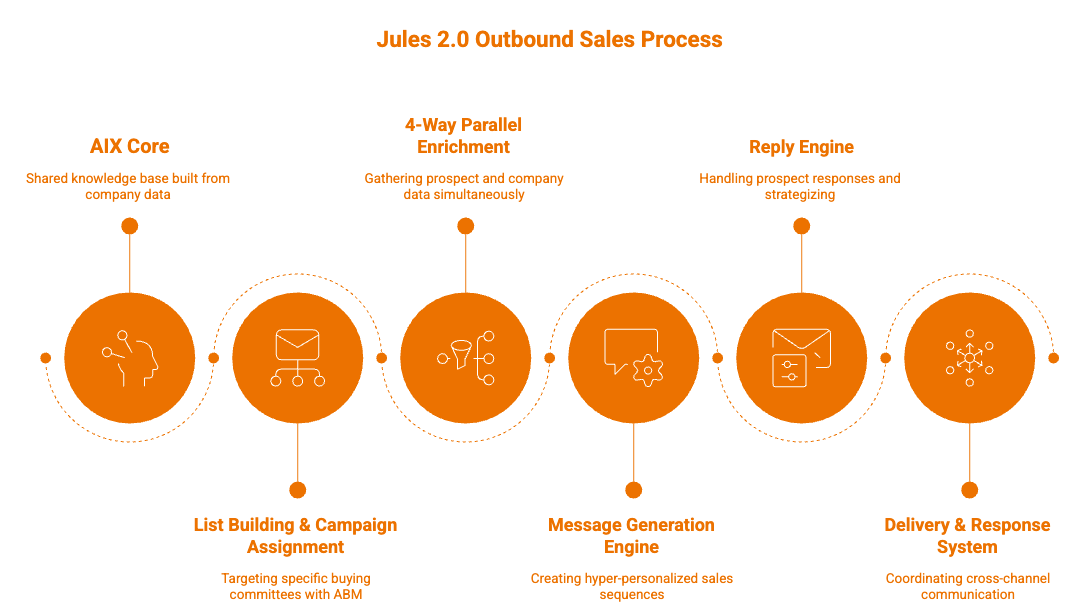
The most important thing to understand about Jules 2.0 is the architectural change. Jules 1.0 was a single agent executing a defined playbook. Jules 2.0 is a multi-agent AI system — a coordinated team of specialized AI workers, reviewers, and engines operating in parallel, each responsible for a specific stage of the outbound pipeline.
This distinction matters enormously for SMB leaders. When you hire a human SDR, you get one person doing research, writing, sending, and replying — sequentially, with variable quality. When you deploy Jules 2.0, you get an orchestrated AI workforce: one agent enriching prospect data from four parallel sources simultaneously, another mapping that intelligence to your company's knowledge base, a writer generating hyper-personalized sequences, a reviewer quality-gating every message before it sends, and a separate Reply Engine that handles every prospect response with full conversational context until the meeting is booked.
The five architectural blocks of Jules 2.0 represent a complete rethink of how AI-powered outbound sales should work:
AIX Core (Foundation): A shared knowledge base built from your company's profile, products, ideal customer profile across five dimensions, and lead magnets — case studies, white papers, ROI calculators — all structured and tagged so Jules always writes from your actual positioning, not generic AI copy.
List Building & Campaign Assignment: Apollo, Exa, CRM imports, CSV uploads, and LinkedIn Sales Navigator — with account-based marketing (ABM) capability built in. Jules 2.0 can target a whole buying committee, not just a single contact.
4-Way Parallel Enrichment: Every prospect receives simultaneous contact-data enrichment, contact research, company-data enrichment, and company research — assembled into a Unified Context Packet. This is more intelligence than a human SDR could gather in an hour, delivered automatically for every single prospect.
The Message Generation Engine + Reply Engine: Two distinct AI engines — one that produces 5–7 touch, hyper-personalized sequences grounded in your ICP and knowledge base, and one that handles every reply, classifying intent, strategizing responses, and deploying lead magnets until the conversation reaches its goal.
Delivery & Response System: Cross-channel coordination across email and LinkedIn with scheduling, rate limiting, timezone awareness, sender warmup, and a critical cross-channel pause rule — when a prospect replies on any channel, all other channels pause and the Reply Engine takes over.
Jules 1.0 vs Jules 2.0: Side-by-Side Comparison
| Dimension | Jules 1.0 | Jules 2.0 |
|---|---|---|
| Architecture | Single AI agent executing a defined sequence | Multi-agent system — workers, reviewers, and engines in parallel |
| Prospect Research | ICP-aligned list building from connected sources | 4-way parallel enrichment → Unified Context Packet per prospect |
| Personalization | Role, company, and pain-point aware messaging | Grounded in company KB (products, ICP, lead magnets) — every message uniquely contextual |
| Sequence Depth | 5-touch framework (Days 1, 3, 7, 14, 21) | 5–7 touch with branching logic by engagement signal and ICP intersection |
| Reply Handling | Not explicitly detailed | Dedicated Reply Engine: classifies intent, strategizes, deploys lead magnets, books meetings |
| Quality Assurance | Sequence runs as designed | Worker + Reviewer architecture — no message ships without passing a quality gate |
| Account-Based Marketing | Lead-by-lead outreach | Full ABM capability — target multiple stakeholders within one account |
| Lead Magnets | Not mentioned | Case studies, white papers, ROI tools — matched by ICP dimension, deployed in sequences and replies |
| Learning & Optimisation | Consistent execution | System learns which angles, hooks, CTAs, and lead magnets perform best over time |
| Analytics | CRM activity logging | Campaign-level dashboards — reply rate, meeting rate, lead magnet engagement, sender health |
| Cross-Channel Logic | Email + LinkedIn coordination | Cross-channel pause on reply, unified conversation thread, intelligent channel routing |
| Data Sources | Apollo, LinkedIn enrichment | Apollo, Exa, LinkedIn Sales Navigator, CRM import, CSV upload |
Why This Matters for SMB Leaders Considering AI Adoption
If you are a founder or revenue leader at a small or mid-sized business, the question is not whether to adopt AI-powered sales tools — your competitors already are. The question is how to adopt intelligently, and what to look for in a system that will actually compound value over time rather than just automate mediocre outreach at scale.
The Jules evolution from 1.0 to 2.0 illustrates exactly the framework you should be applying to every AI vendor you evaluate. Three questions matter above all others:
1. Does the AI learn from your business, or does it operate generically?
Generic AI outreach tools prompt a language model with "write a cold email to a VP of Sales." The output sounds like AI, because the system knows nothing about your company, your ICP, or your specific value propositions. Jules 2.0's Knowledge Base architecture — structured around your company profile, product definitions, ICP across five dimensions, and lead magnets — means every message is grounded in your actual positioning. The AI writes as your best SDR would, not as a generic assistant.
2. Does the system handle the full loop, including replies?
Most outbound tools are built for sending, not for responding. But the reply is where pipeline is actually created. Jules 2.0's dedicated Reply Engine — which classifies prospect intent, selects the right response strategy, deploys relevant lead magnets, and routes conversations toward a booked meeting — is the capability that closes the loop that Jules 1.0 opened. For SMBs with lean teams, this is the difference between a tool that generates activity and an AI employee that generates revenue.
3. Does the system compound, or does it plateau?
Jules 2.0 is designed to learn which subject lines, message angles, calls to action, and lead magnets produce the best outcomes — and to apply that learning across future campaigns. This compounding intelligence is what separates a first-generation AI automation tool from a second-generation agentic AI system. The longer it runs, the better it gets.
"The question for SMB leaders is not whether AI can do outbound. Jules 1.0 proved it can. The question is whether your AI outbound system gets smarter every week. Jules 2.0 is designed to."
The Broader Picture: AI Employees vs AI Tools
One of the most important strategic distinctions in enterprise AI adoption right now is the difference between an AI tool and an AI employee. Tools wait for input. Employees execute work. Jules — from version 1.0 onwards — was deliberately positioned in the employee category, and that positioning becomes even more important in the 2.0 architecture.
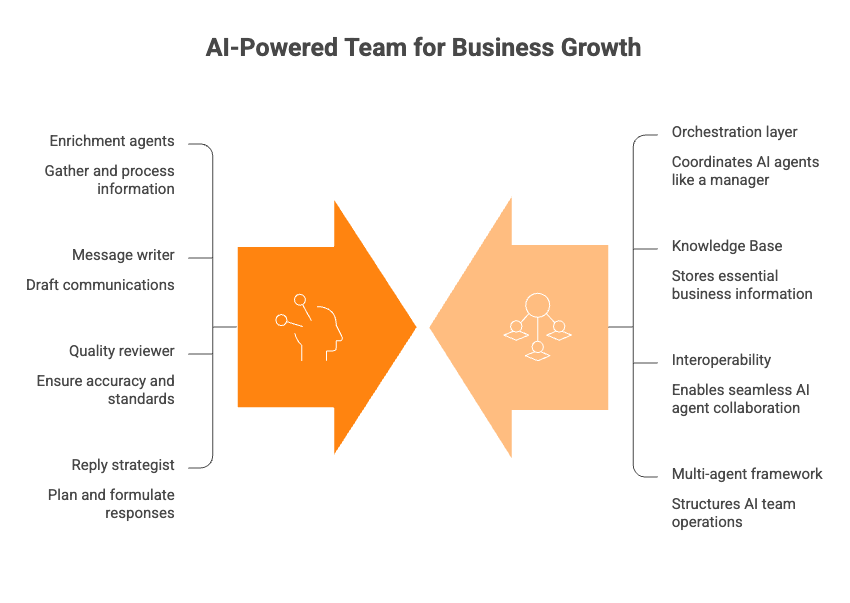
In a multi-agent system like Jules 2.0, the individual AI components — the enrichment agents, the message writer, the quality reviewer, the reply strategist — are each doing the kind of focused, specialist work that you would otherwise hire and manage humans to do. The orchestration layer coordinates them the way a good manager would. The result is not just an AI that sends emails — it is an AI that researches, plans, writes, reviews, sends, responds, and learns as a team.
For SMB leaders, this means the mental model has shifted. Deploying Jules 2.0 is less like buying a SaaS subscription and more like onboarding a specialist team — one that never sleeps, never loses motivation, never has an off-quarter, and costs a fraction of the equivalent human headcount. The setup investment is real: you need to build the Knowledge Base, define your ICP with precision, and configure your campaigns thoughtfully. But the system returns that investment in compounding outbound output that scales without additional hiring.
The AI Xccelerate agent roster — Jules on outbound, Pepper on inbound, Nick on content, Tony on sales engineering, Joy on sales ops, George on customer success — is pointing toward a future where every function in a small business's revenue team has an AI counterpart. Jules 2.0 is the most mature expression of that vision to date, and the architecture it introduces — the multi-agent framework, the knowledge base, the interoperability between AI employees — is the foundation on which that entire system will be built.
What SMB Leaders Should Do Now
The practical takeaway from the Jules 1.0 to 2.0 comparison is a checklist every SMB leader should apply before investing in any AI sales automation system:
- Confirm the AI grounds its output in your specific company knowledge — products, ICP, value propositions — not generic prompts.
- Confirm the system handles replies, not just sends. The reply loop is where meetings are booked.
- Confirm there is a quality gate between generation and delivery. AI that ships every first draft is AI that erodes your brand.
- Confirm there is a learning mechanism — the system should improve with every campaign, not plateau after the first month.
- Confirm the analytics layer is transparent. You need to know what is working, at the campaign and message level, not just whether emails were sent.
- Confirm the system can scale to account-based motions if your deal sizes warrant it.
Jules 2.0 checks every box on that list. More importantly, the evolution from 1.0 to 2.0 demonstrates that the team building Jules is thinking in the right direction — not just adding features, but rethinking the architecture to support a fundamentally more capable, more intelligent, and more autonomous AI outbound employee.
For SMBs that want to compete on pipeline without competing on headcount, that is exactly the kind of system worth understanding — and worth investing in early.
Learn more at aixccelerate.com