The Hire You're About to Make — AI Already Does That Job
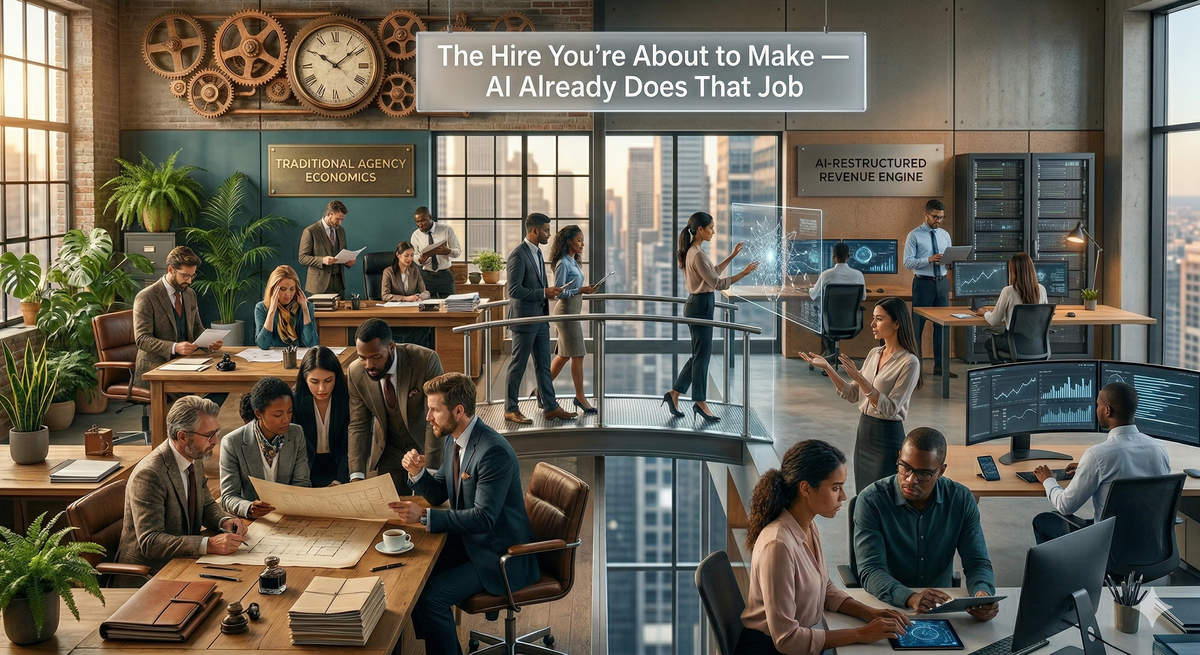
The traditional hiring process is being rewritten. AI employees now handle the roles SMBs hire for at 1/10th the cost, from day one. Read this, before you post that job description on LinkedIn
🔶TL;DR — This Issue at a Glance
This Week in AI: WPP cuts 3,000+ jobs as AI restructures agency economics, LinkedIn data shows AI-assisted content outperforms in B2B, and a McKinsey survey reveals SMBs are dramatically overpaying for outsourced marketing.
AI Deep Dive: The average SMB spends $7,500–$15,000/month on a marketing agency for work an AI employee now does better, faster, and at a fraction of the cost. The fully-loaded math including every hidden cost is in this issue.
AI Audit: Run the Agency Spend Audit this week: 5 questions, 30 minutes, tells you exactly how much of your agency budget should already belong to an AI employee.
From the AI Field: Side-by-side comparison what a retained marketing agency delivers vs. what an AI marketing employee delivers across 7 core activities. Once you see it laid out, it's hard to unsee.
🔶This Week in AI
WPP Cuts Over 3,000 Jobs as AI Restructures the Agency Business Model
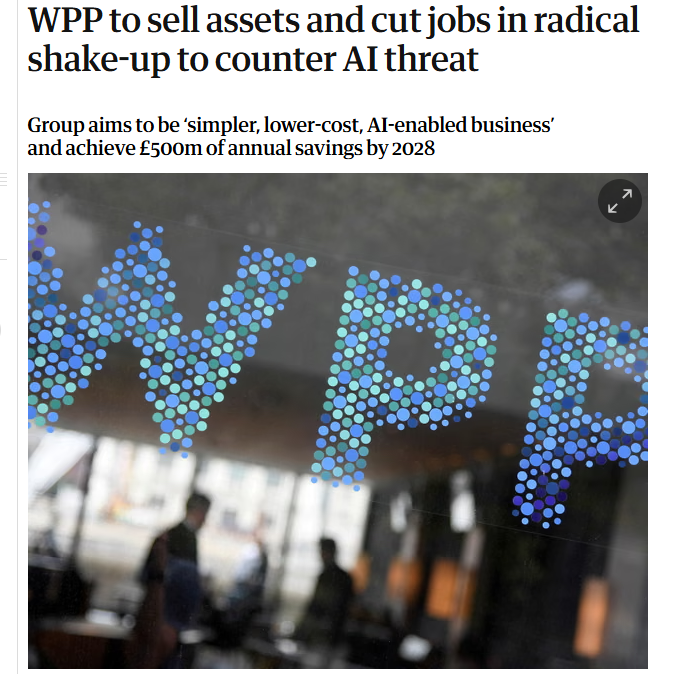
WPP, the world's largest advertising holding company, announced a reduction of over 3,000 roles, directly citing AI's impact on content production, campaign management, and creative execution. Publicis and IPG have made similar announcements, each describing "AI-driven operating model transformations." The headline number is large, but the signal matters more: the agencies themselves are acknowledging their staffing models were built for a pre-AI world.
Takeaway: If the world's biggest agencies are replacing humans with AI to stay competitive, the business case for SMBs paying those same agencies for human-executed work is eroding fast. The question isn't whether an agency will use AI it's whether a company should be paying agency margins for it when they could own that capability directly.
LinkedIn Data: AI-Assisted Content Outperforms Human-Only Content in B2B Reach
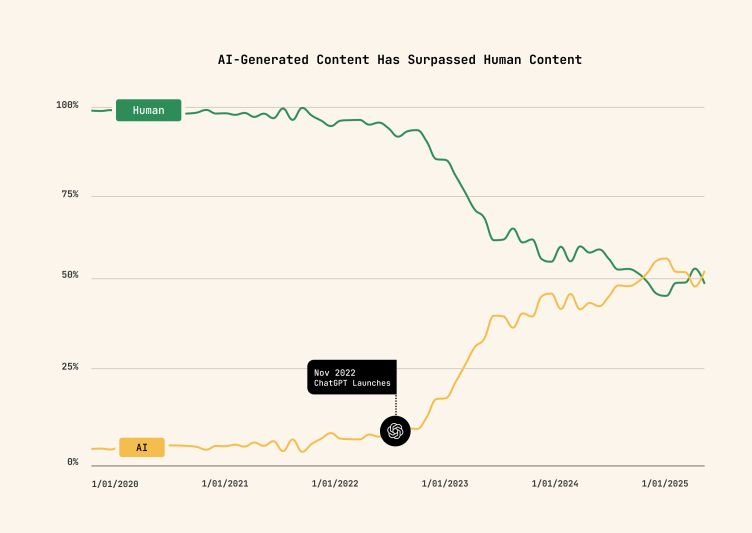
LinkedIn's latest B2B marketing benchmarks report shows that posts and articles produced using AI-assisted workflows are generating significantly higher engagement across the same audience segments. The differentiator isn't that AI writes better prose it's that AI-native teams publish consistently, at higher volume, and with tighter ICP alignment. Those three factors compound over time on algorithm-driven platforms.
Takeaway: Content marketing is a volume game with a quality floor, not a quality game with a volume ceiling. AI-native teams win because they publish more, test faster, and iterate in real time. An agency publishing two pieces a month cannot compete with an AI employee producing twelve.
McKinsey Survey: SMBs Overpaying for Outsourced Marketing by an Average of 60%
A McKinsey survey of 800 SMB executives found that companies with $10M–$100M in revenue spend an average of $9,200/month on outsourced marketing services while only 38% of those services meaningfully contributed to pipeline. The remaining 62%? Brand awareness work, social media management, and content production that generated impressions but no measurable revenue impact. Companies using AI-native marketing tools reported 2.4× higher pipeline attribution from their marketing spend.
Takeaway: Most SMB marketing agency spend is diffuse, hard to attribute, and structured to protect the agency's retainer not to generate pipeline for the client. The shift isn't from agencies to nothing. It's from agencies to AI employees with a clear pipeline mandate.
🔶AI Deep Dive
Why You Could Be Making a $150,000 Hiring Mistake
The most expensive thing about your next revenue hire isn't the salary. It's everything else.
"We need more pipeline. Let's hire another SDR."
That sentence is costing SMBs hundreds of thousands of dollars a year — not because it's wrong, but because in 2026, it's incomplete.
Most B2B revenue leaders still think about headcount the way they did in 2019. Hire an SDR, ramp them over 90 days, manage them through 18 months of productive output, then replace them when they leave. Repeat indefinitely. The model was always expensive. Now it's also obsolete.
Here's the math that changes the conversation the true cost of a single revenue hire, fully loaded over 12 months:
But the cost argument is only half the equation. The other half is what an AI-native revenue team actually looks like when it's running.
AI Xccelerate's Revenue Acceleration Engine (RAE) deploys six dedicated AI revenue employees — each with a defined role, full CRM integration, and continuous execution across all revenue functions:
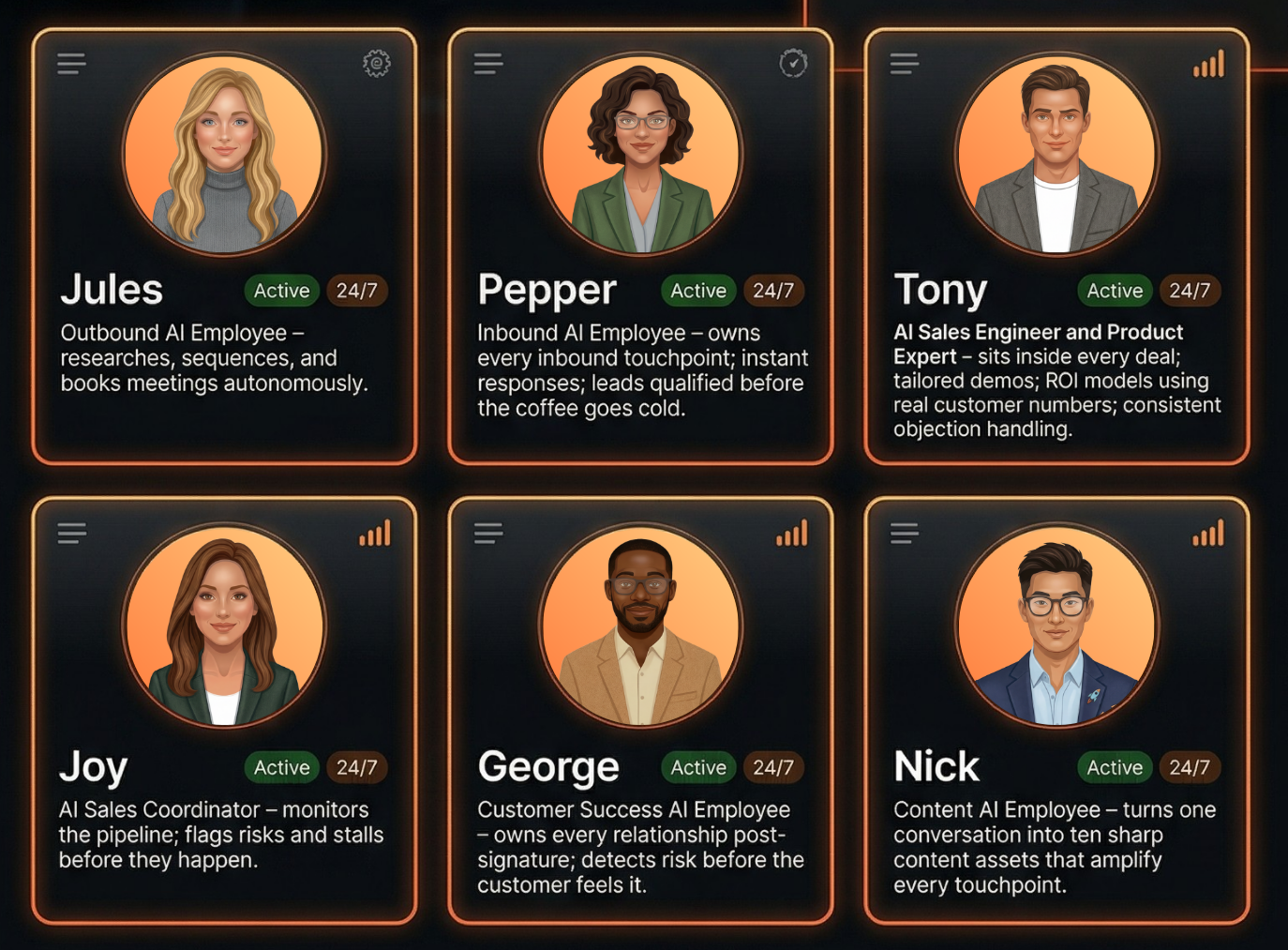
Six roles. Running in coordination, 24/7. When Jules books a meeting, Joy preps the follow-up. Tony builds the ROI model. George is already reading the account when they become a customer. The equivalent human team? Six to eight hires at $400K–$600K in annual salary and benefits.
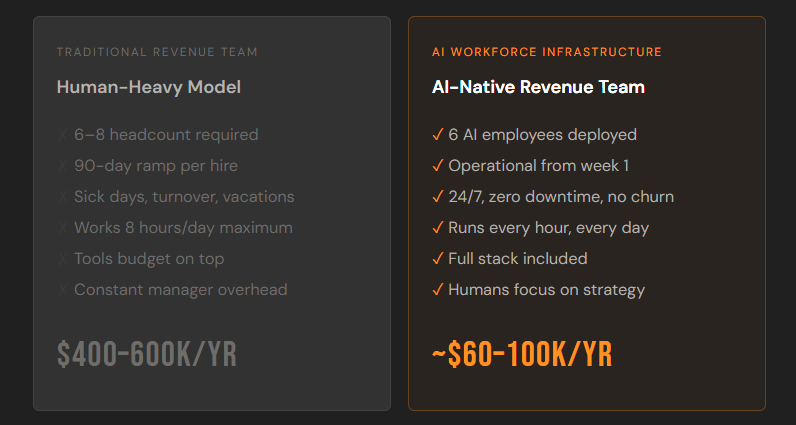
"Customers don't learn AI. They hire AI employees — and someone else manages them. The result looks like a full revenue team. The cost looks like a single contractor."
Three types of SMB revenue leaders are reading this right now. Here's where each one is in the transition:
THE SKEPTIC:
"AI can't replace the human judgment our SDRs bring."
Fair, for judgment-intensive roles. Not fair for execution-intensive roles. The problem is that most SDR, inbound, coordination, and CS work is 80% execution, 20% judgment. AI handles the 80% at 10× the volume. The human judgment layer stays where it belongs: strategy, relationships, complex selling. Strip the execution overhead from your human team and watch their output improve.
THE CALCULATOR:
"We've thought about it but haven't done the formal analysis."
The analysis takes less time than most leaders think. The math is straightforward: what does the role cost fully loaded vs. what does an AI employee cost, and what does the output difference look like at 3× current volume? Most Calculator-types who run this exercise make a decision within 30 days. The number that usually decides it is the turnover cost.
THE BUILDER:
"We're already transitioning. We want to move faster."
These are the leaders restructuring revenue headcount around AI employees for execution, and reserving human bandwidth for the work that actually requires it. They're generating more pipeline, keeping more margin, and building a structural cost advantage their competitors will be unable to close. This is where the market is going. These leaders got there first.
🔶AI Workforce Audit
Run these questions by yourself before you sign the next revenue offer letter. They'll tell you whether you're making a workforce decision or a headcount reflex.
- Is this role primarily execution or judgment?
Execution-heavy roles outbound sequencing, inbound routing, follow-up, deal coordination, tier-1 support, content production are AI-deployable today. Judgment-heavy roles strategic selling, key relationships, architecture decisions still benefit from human leadership. If the open role is mostly execution, you have a decision to make. Most revenue roles are more execution-heavy than their job descriptions imply. - What happens when this hire leaves in 14 months?
The average B2B SDR tenure is 14–18 months. If the answer is "we lose pipeline momentum, we scramble, we re-hire and re-ramp" you're building revenue infrastructure on a structurally unstable foundation. AI employees don't give notice, don't get recruited away, and don't cost $12K–$20K to replace. Evaluate the hire not just on what it costs to start but what it costs when it ends. - Could this function run at 3× current volume for the same cost?
Scale is where the math becomes undeniable. If you need outbound volume to triple next quarter, a human hire gives you linear growth one more person, one increment of output. An AI revenue employee gives you elastic capacity: increase the volume, not the headcount.
Ask yourself: if the output of this role needed to triple, what would that cost in the human model vs. the AI model? That gap is the leverage you're leaving on the table.
What to do next: If any one of these questions made you pause, you're ready for the conversation. If all three made you pause, you're likely already behind and need to move quickly. Run a 30-minute AI Workforce Audit with us, we map your current revenue team against the AI workforce model and show you where the leverage is, what the ROI looks like for your specific business, and what a phased transition looks like in practice. No pitch. No slides. Just the math on your team.
🔶From the AI Field
Marketing Agency vs. AI Employee: The Reality Check
Every week, SMBs pay retainer fees for marketing work an AI employee handles autonomously, at higher volume, lower cost, and without the account management lag.
Here's what that comparison actually looks like across 7 core activities.
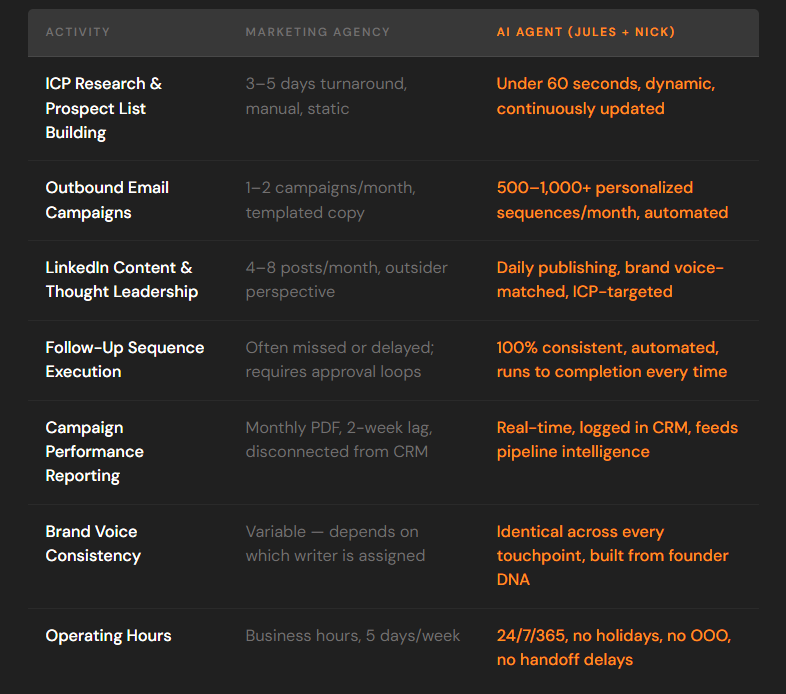
Agency-run campaigns rarely run to completion. Sequences get skipped. Follow-ups fall through. Reporting arrives too late to act on. Not because agencies do poor work, but because human teams have finite bandwidth and competing priorities. An AI marketing employee has one priority: executing the revenue motion, every single day, without exception. That consistency is what compounds into pipeline.