What Is an AI Revenue Employee? (And How It's Different from a Chatbot)
Discover AI Revenue Employees: Autonomous agents that run full revenue roles—like outbound SDRs booking meetings end-to-end—unlike reactive chatbots. Scale your SMB team at fraction of cost.
If you have spent any time looking at AI tools for your sales or marketing team, you have probably noticed two things. First, the number of options is overwhelming. Second, most of them are some variation of the same thing: a chatbot, a copilot, or an assistant that helps your humans do their work slightly faster.
An AI revenue employee is something fundamentally different.
This article explains exactly what an AI revenue employee is, how it works, why it bears almost no resemblance to a chatbot, and what it means for the way SMBs build and operate revenue teams in 2026.
The Short Answer
An AI revenue employee is an autonomous AI agent that holds a specific job function within your revenue organisation. It has a defined role, a persona, a set of tools it operates across, and a mandate to execute that role independently, without a human managing every action.
It is not a chat interface. It does not wait for someone to prompt it. It does not assist a human by completing sentences or suggesting email subject lines. It runs its function the same way a human employee would, just at a fraction of the cost and at a scale that is structurally impossible for a human to match.
The key distinction is autonomy. According to Gartner, agentic AI systems are capable of planning, executing multi-step tasks, and adapting to new information without continuous human instruction. That is the category AI revenue employees belong to, and it is a categorically different technology from generative AI assistants or chatbot builders.
What an AI Revenue Employee Actually Does
The best way to understand the concept is to look at a specific example.
Take an outbound AI revenue employee. Its job is the same as a human SDR: identify target accounts, research each prospect, write personalised outreach messages, run multi-touch follow-up sequences across email and LinkedIn, and book meetings for your sales team.
It does not do this by generating a draft for you to review before sending. It does this autonomously. It researches the prospect, writes the message based on that research, sends it through a properly warmed email domain, monitors engagement signals, decides when and how to follow up, and when the prospect responds positively, books the meeting directly into your team's calendar.
That is the complete SDR workflow, executed end to end, without a human in the loop for each step.
McKinsey's research on AI in sales shows that AI-enabled sales functions consistently outperform human-only counterparts on activity volume, response consistency, and follow-up completion rates. The reason is straightforward: humans are good at judgment calls. They are bad at maintaining the discipline to execute hundreds of repetitive, time-sensitive tasks without dropping any.
Six Roles, One Coordinated Revenue Team
The concept extends beyond outbound prospecting. A complete AI revenue workforce covers the entire revenue cycle, mirroring every function a human revenue team handles.
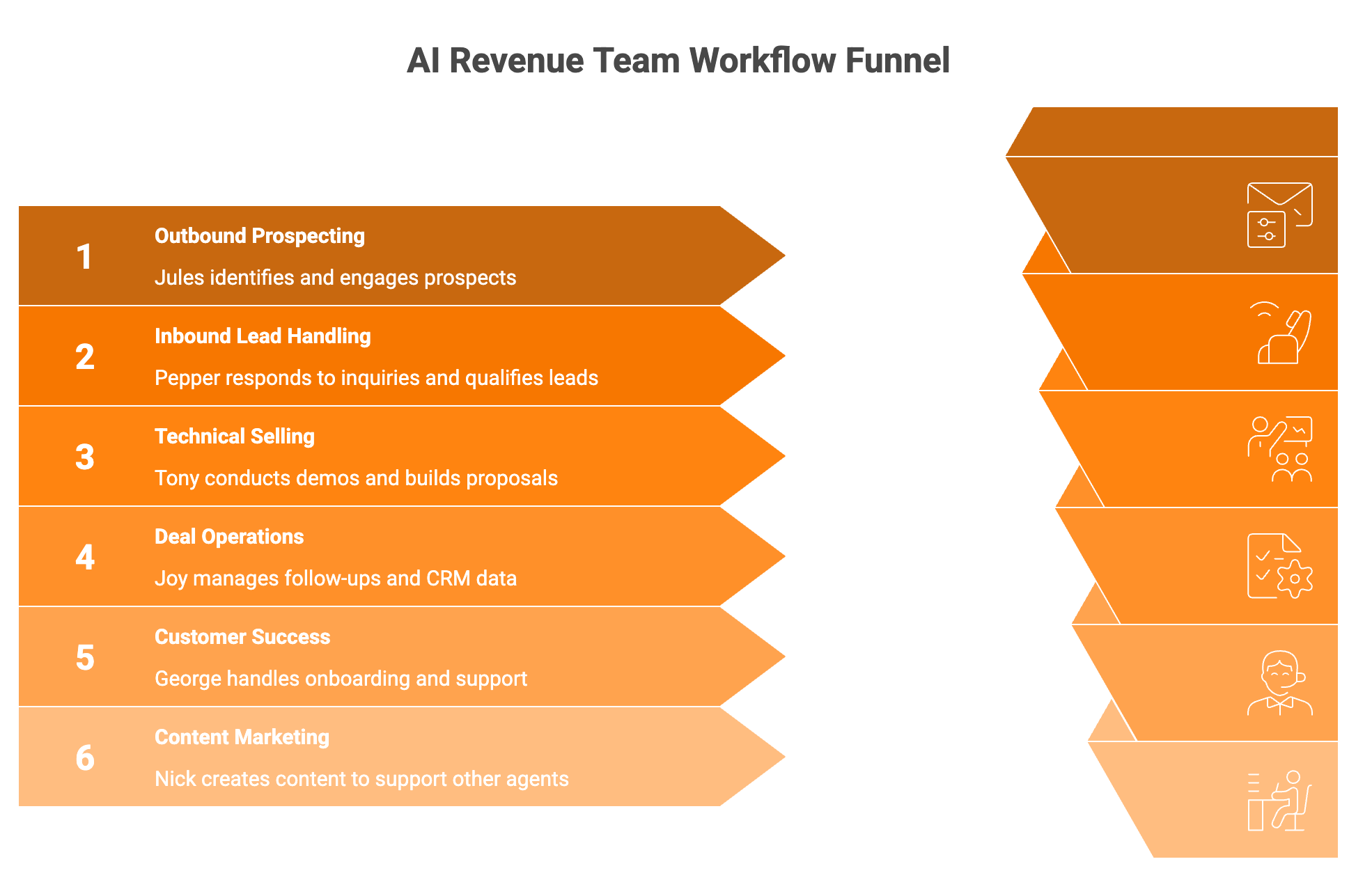
At AI Xccelerate, the platform deploys six AI revenue employees:
Jules handles outbound prospecting and marketing. She researches target accounts, writes personalised email and LinkedIn outreach, runs multi-touch sequences, and books meetings. Her equivalent in a human team is an SDR or BDR, a role that typically costs $65,000 to $80,000 per year fully loaded.
Pepper handles inbound. She answers phone calls with voice AI, responds to web chat, follows up on form submissions within seconds, qualifies each lead, and books them directly into the calendar. Her equivalent is a receptionist or inbound SDR, typically $45,000 to $65,000 per year.
Tony handles the technical and consultative selling function. He runs product demonstrations, builds ROI models, handles technical objections, and assembles proposals. For most SMBs, a dedicated sales engineer is simply unaffordable. Tony makes that coverage accessible at a fraction of the cost.
Joy runs deal operations: follow-up sequences, meeting coordination, CRM data hygiene, proposal assembly, and pipeline reporting. She is the operational backbone of the sales motion, keeping every deal moving and every record current without the AE spending their day on administrative tasks.
George owns customer success. He handles onboarding, monitors account health across seven signals, manages tier-one support, identifies expansion opportunities when usage patterns indicate readiness, and manages renewals. He functions as a dedicated customer success manager for every single account, regardless of account size.
Nick runs content marketing in parallel with all five of the above. He produces long-form thought leadership, then cascades each piece into 10 or more downstream assets: LinkedIn posts, short-form articles, email newsletter content, and social content. His output feeds directly into the work of every other agent, giving Jules better outreach material, Tony stronger proposals, and George more reasons to stay in touch with customers.
Together, these six agents cover the entire revenue motion from first outbound touch to renewal, operating as a coordinated team rather than six isolated tools.
How Is This Different from a Chatbot?
This is the question that comes up in virtually every first conversation about AI revenue employees, and it deserves a direct answer.
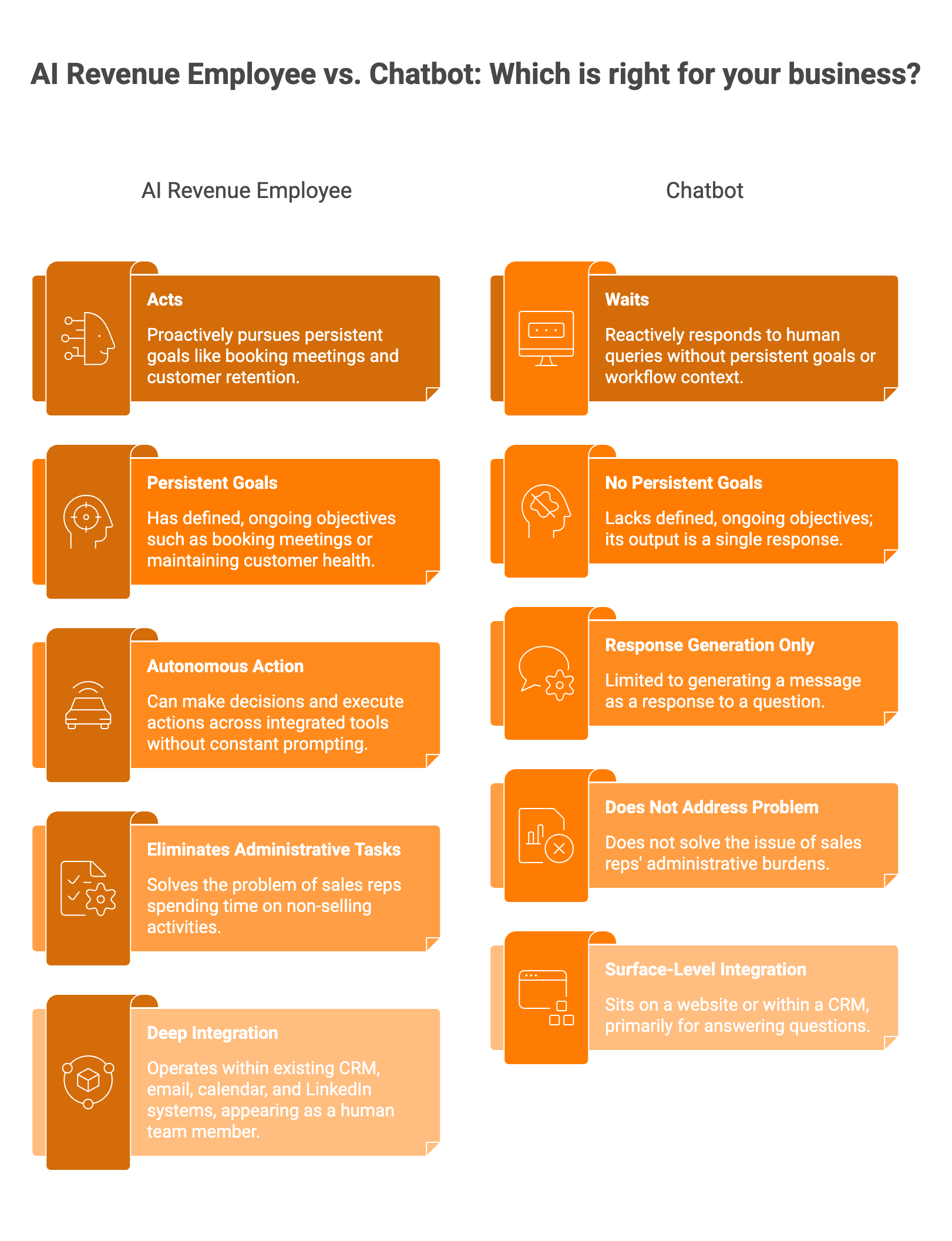
A chatbot waits. It sits on your website or inside your CRM, and when a human asks it a question, it responds. It is reactive by design. Its output is a message. It has no persistent goals, no workflow context, and no ability to take action outside of generating a response.
An AI revenue employee acts. It has a persistent goal (book meetings, keep customers healthy, fill the content calendar), access to the tools required to pursue that goal (email infrastructure, CRM, calendar, LinkedIn, voice platform), and the autonomous capability to make decisions and execute actions across those tools without being prompted at every step.
Salesforce research consistently shows that sales reps spend less than 30 percent of their time actually selling. The rest goes to administrative tasks, follow-up, data entry, and coordination. A chatbot does not address that problem. An AI revenue employee eliminates the problem entirely for the functions it owns.
The other critical distinction is integration. An AI revenue employee operates inside the systems your team already uses: your CRM, your email, your calendar, your LinkedIn, your support ticketing system. From the perspective of your human team, the AI employee's activity shows up in the same places a human employee's activity would. From the perspective of your buyers and customers, the experience feels personal and attentive, not automated.
The Platform Behind the Agents: What Makes It Work
Six individual AI agents producing isolated outputs would not be meaningfully better than six separate tools. What makes the AI revenue employee model effective is the shared infrastructure that connects them.
At AI Xccelerate, this infrastructure is called the Revenue Acceleration Engine (RAE). RAE maintains a centralised knowledge base for each customer organisation that all six agents draw from: company context, product information, pricing, customer history, brand voice, and competitive positioning. When Jules learns something about a prospect, Pepper has that context if the prospect calls in. When Tony builds an ROI model, Joy has it ready for the proposal. When George detects a health risk, the entire team is informed.
This shared intelligence layer is what turns six AI agents into a coordinated revenue team. It is the same operational model that makes human revenue teams effective when they communicate well, but executed with the consistency and completeness that human teams rarely sustain at scale.
Harvard Business Review has noted that the most significant AI productivity gains come not from isolated tools but from systems that connect AI capabilities across workflows and functions. RAE is that connective layer.
Three Ways to Deploy an AI Revenue Employee
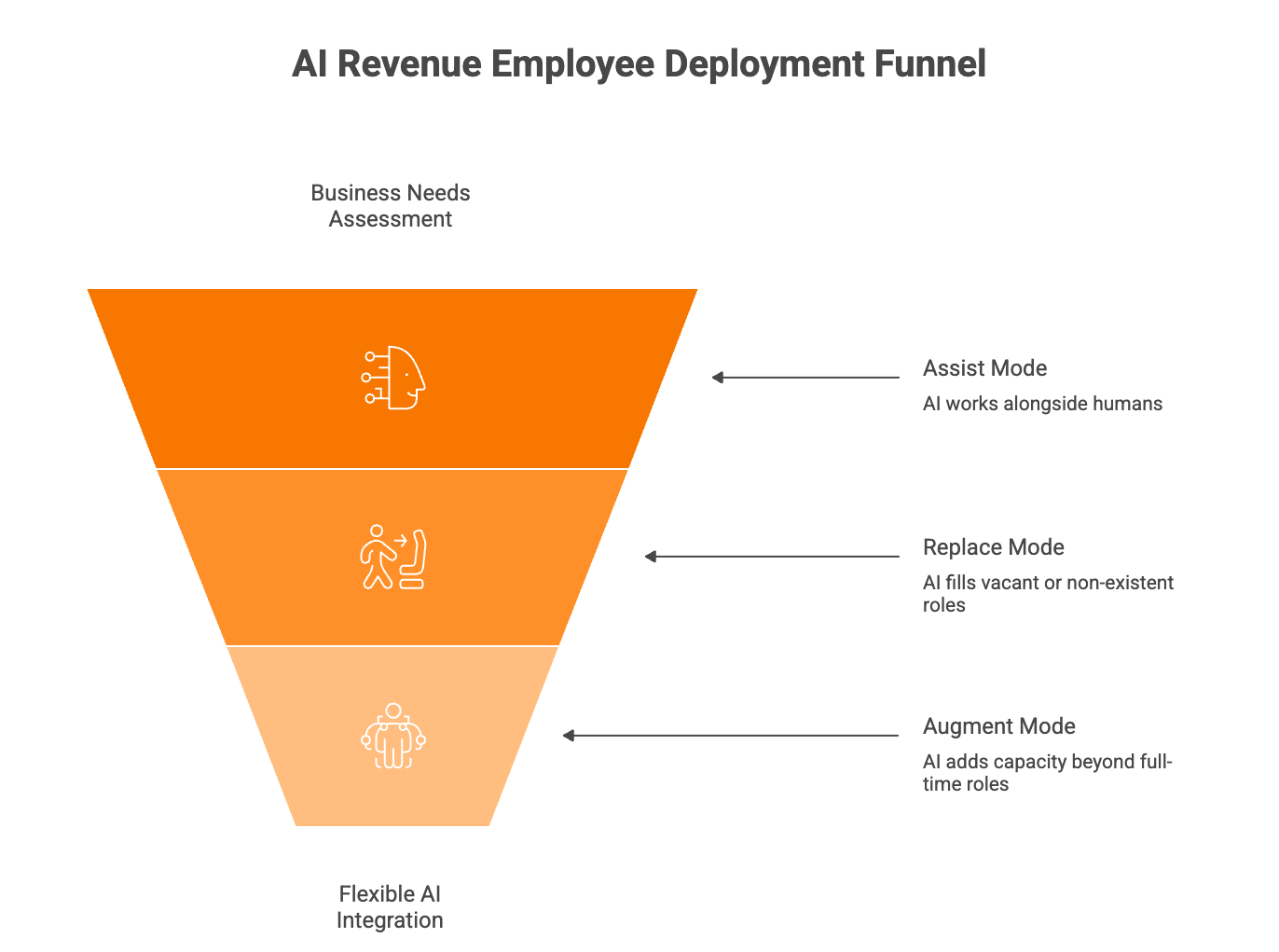
Not every business is starting from the same place. AI revenue employees can be deployed in three different modes depending on what the business needs:
Assist mode means the AI employee works alongside a human in the same role. A human SDR still leads strategy and handles the most complex prospects; Jules executes the volume, runs the sequences, and ensures no follow-up gets dropped.
Replace mode means the AI employee steps into a role the business does not currently have, or one that has become vacant. A business that has never had a dedicated inbound handler now has 24/7 inbound coverage without a hire.
Augment mode means the AI employee adds a capacity the business could never previously justify as a full-time role. A 20-person company now has a dedicated sales engineer available for every deal, not just the largest ones.
This flexibility is what makes the model work for SMBs specifically. You do not need to restructure your team. You identify one function that is either too expensive to hire for, too high-volume for your current team to handle consistently, or simply vacant, and you deploy an AI employee into that role.
Why This Matters for SMBs in 2026
The economics of building a revenue team have not changed much in the past 20 years. You hire people, you pay salaries, you manage turnover, and you hope the ramp time is shorter than the average tenure. For every new market, vertical, or channel you want to pursue, you need more headcount.
AI revenue employees change that equation structurally. According to Forrester, AI-native sales operations are on track to outperform traditional human-only revenue teams on cost per opportunity within the next 24 months. The companies that build AI-native revenue infrastructure now will operate at a structural cost advantage that compounds over time.
The SMBs that adopt this model early are not just saving money. They are building a different kind of revenue organisation, one where growth does not require proportional growth in payroll, management overhead, or HR complexity.
The Bottom Line
An AI revenue employee is not a smarter chatbot or a more capable writing assistant. It is an autonomous agent that holds a real job function, operates the tools required for that function, and executes the work independently, as a member of your revenue team.
The category is new. The technology is live. And for SMBs that have always wanted enterprise-level revenue coverage without enterprise-level headcount costs, it is the most significant structural shift available right now.
Want to see an AI revenue employee in action? Book a demo with AI Xccelerate and we will walk you through a live deployment of Jules, Pepper, or any of the six agents, tailored to your specific team structure and ICP.