Why B2B SaaS Companies Under $10M ARR Can't Afford the Sales Team They Need
Most B2B SaaS founders discover the sales team math is broken only after they've already hired. Here's why the numbers don't work under $10M ARR—and what smart founders are doing instead.
You ran the numbers on hiring a sales team, and something didn't add up.
B2B SaaS companies under $10M ARR face a structural problem: the sales team required to accelerate growth costs more than the business can sustainably fund. Most founders only discover this after making the hire. This post breaks down exactly why the math doesn't work, what it costs when you try anyway, and how companies at this stage are covering the gap.
TL;DR
- A minimal B2B SaaS sales team—one SDR, one AE, and basic tooling—runs $278,000–$380,000 per year before closing a single deal.
- At under $10M ARR, that single sales pair consumes 15–40% of your available growth budget, depending on ARR, before anyone is ramped.
- AE ramp takes 3–6 months. You're burning cash for half a year before seeing any return.
- Premature sales scaling is one of the top three reasons SaaS companies stall between $3M and $10M ARR—founders hire before the pipeline engine is proven.
- Companies navigating this well use a layered model: fractional sales leadership, one human AE on inbound, and AI-assisted tooling handling the SDR function.
What does a fully loaded B2B SaaS sales hire actually cost?
The number founders cite is always the base salary. That's the wrong number.
A mid-market Account Executive in the US carries a base of $80,000–$110,000 and a total on-target earnings package of $160,000–$220,000. Add payroll taxes, health benefits, and 401(k) match, and you're looking at $185,000–$250,000 per year in fully loaded cost—before they've sourced a single lead.
Now add the SDR they need to book meetings for them. A Sales Development Rep runs $75,000–$100,000 fully loaded. Then factor in your sales stack: CRM, sales engagement platform, data enrichment, and a prospecting tool. Budget $18,000–$30,000 annually for a lean setup.
The total for one functional sales unit—one SDR feeding one AE—is $278,000–$380,000 per year. That's the floor. That's before a sales manager, a VP of Sales, or any quota miss.
Why does this math break specifically under $10M ARR?
At $10M ARR with a 75% gross margin, you're generating $7.5M in gross profit. That sounds like room to hire. It isn't.
Engineering, product, and infrastructure have to be funded. Customer success—the team that keeps you at 75% margins—has to be funded. G&A, marketing, and the founder who is still personally closing deals all need resources. By the time you account for those commitments, most sub-$10M SaaS companies have $1.5M–$2.5M left to allocate to growth before going cash-flow negative.
A full sales pair burns through that fast. At $350,000 per year, you've consumed 15–23% of your available growth budget on two people who won't be fully ramped for six months.
At $5M ARR, the math is worse. Your gross profit is roughly $3.75M. That same SDR/AE pair now represents 9% of total ARR—before you've paid anyone else, and before they've closed anything.
What actually happens when you hire too soon?
The playbook goes like this: founder closes the first $2M–$5M ARR themselves, then hires a sales team to "take it off their plate." The AE spends months learning the product. The SDR books meetings that don't convert because the ICP isn't sharp enough yet. Pipeline looks full. Qualified pipeline is thin.
Six months in, the AE is at 40% of quota. The founder starts closing again to make up the gap. The SDR has high activity but low output. The cost is real. The return isn't.
Meanwhile, existing customers get less attention. Onboarding slips. Time-to-value stretches. A customer who paid $50,000 per year doesn't renew because no one followed up consistently. That's $50,000 in ARR lost—roughly what the SDR costs for seven months.
This pattern repeats enough that it has a name: premature sales scaling. It's one of the top three reasons companies stall between $3M and $10M ARR, and most founders only recognize it in retrospect.
What does this look like with real numbers?
Here's a scenario worth walking through.
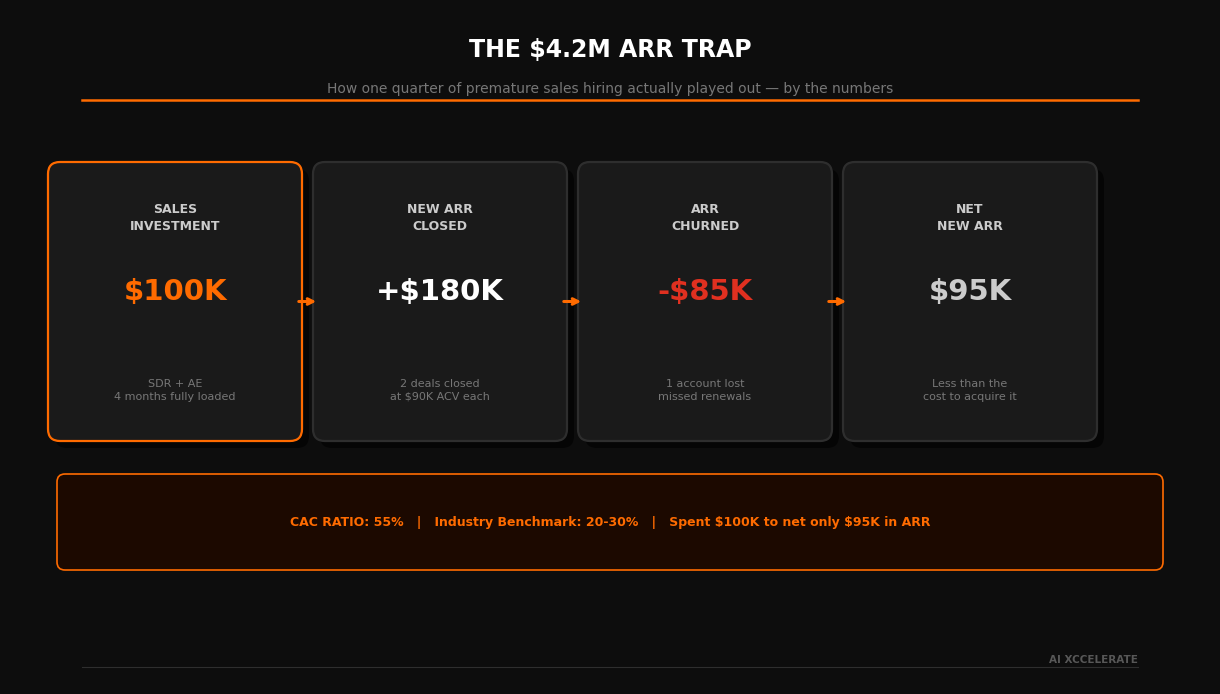
A B2B SaaS company sits at $4.2M ARR. The founder has been the primary closer for three years. She has 42 customers, an average contract value of $100,000, and a churn rate of 8%—manageable but not great. She hires an AE in January and an SDR in February.
By April, the AE has closed two deals worth $180,000 in new ARR. Promising—but the four-month fully loaded cost to get there was $75,000 in AE salary alone. The SDR sent 2,400 outreach emails, booked 14 meetings, and 3 progressed to pipeline. Cost for two months: $25,000.
Total spent to close $180,000 in new ARR: $100,000. That's a 55% CAC ratio on new bookings alone—well above the 20–30% benchmark for SaaS at this ARR level.
But here's where it gets worse. The founder missed four renewal check-in calls while onboarding the new hires. Two accounts flagged risk at QBR. One churned at $85,000 ARR. Net new ARR for the quarter: $95,000.
The company paid $100,000 to grow by $95,000. This isn't an outlier. It's the median outcome when companies scale sales headcount before the pipeline machine is proven.
The Sales Coverage Gap: An AIX Framework
To visualize the problem, think about your Sales Coverage Ratio (SCR)—the percentage of ARR you're allocating to sales headcount relative to your growth rate.
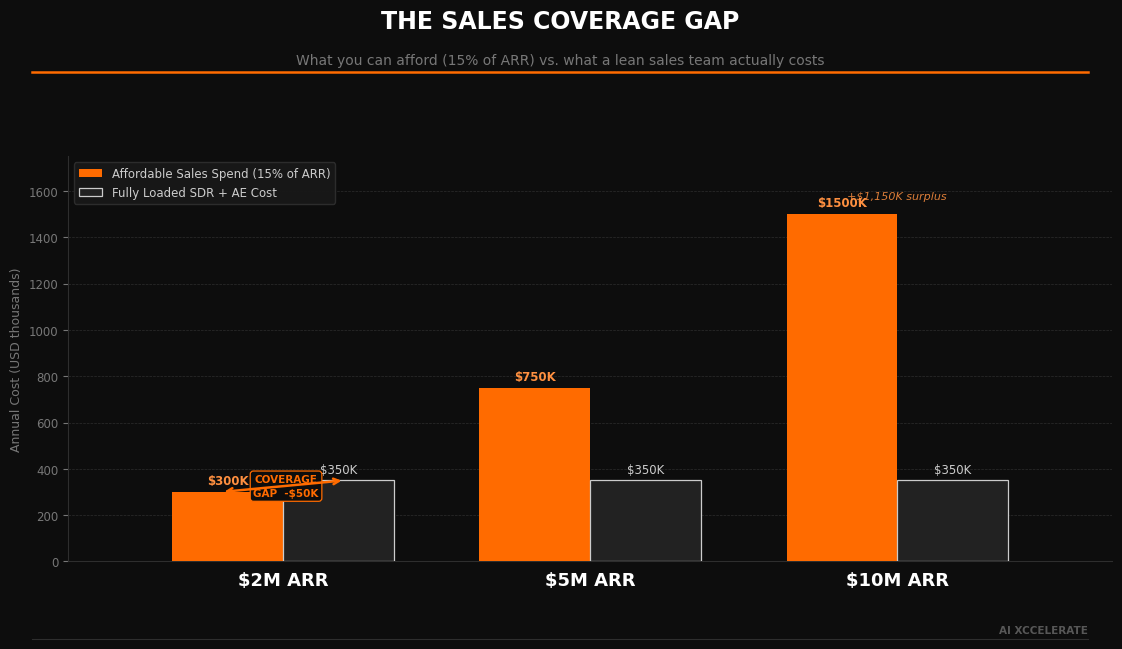
| ARR Stage | Realistic Growth Rate | Affordable Sales Spend (15% of ARR) | Fully Loaded SDR + AE Cost | Coverage Gap |
|---|---|---|---|---|
| $2M ARR | 80% | $300,000 | $350,000 | –$50,000 |
| $5M ARR | 60% | $750,000 | $350,000 | +$400,000 |
| $10M ARR | 40% | $1,500,000 | $350,000+ | +$1,150,000 |
At $2M ARR, even a lean sales pair exceeds what you can responsibly spend. At $5M, the math starts working—but only if your pipeline is proven and ramp risk is managed. Below $5M, the coverage gap is real and structural.
If you're at $2M–$8M ARR and trying to figure out the right sales motion for your stage—whether to hire, contract, or use AI coverage—a 30-minute assessment call is the fastest way to get clarity on what the numbers actually look like for your business.
→ Book your assessment
What are the structural limits founders rarely talk about?
There are three constraints that make this worse than it looks.
Quota math assumes ramp doesn't count. AE quotas are typically set at 4–6x OTE. An AE with $100,000 OTE is expected to close $400,000–$600,000 in new ARR annually. But a 6-month ramp means you should realistically model Year 1 contribution at $200,000–$300,000. If your ACV is $25,000, that's 8–12 deals. Your SDR needs to book 25–40 meetings to generate those—a serious pipeline machine you may not have yet.
Attrition resets the clock. The average SDR tenure is 14 months (Bridge Group, 2024). The average AE tenure at a startup under $10M ARR is closer to 18 months. You may be rebuilding from scratch every year and a half. Every new hire restarts the ramp period and the cost curve.
Sales leadership costs more than founders expect. A VP of Sales to manage your pair adds $200,000–$280,000 in fully loaded cost. If you skip that hire, you manage the team yourself—which defeats the purpose. There's no free option at this stage.
What are B2B SaaS founders under $10M ARR actually doing instead?
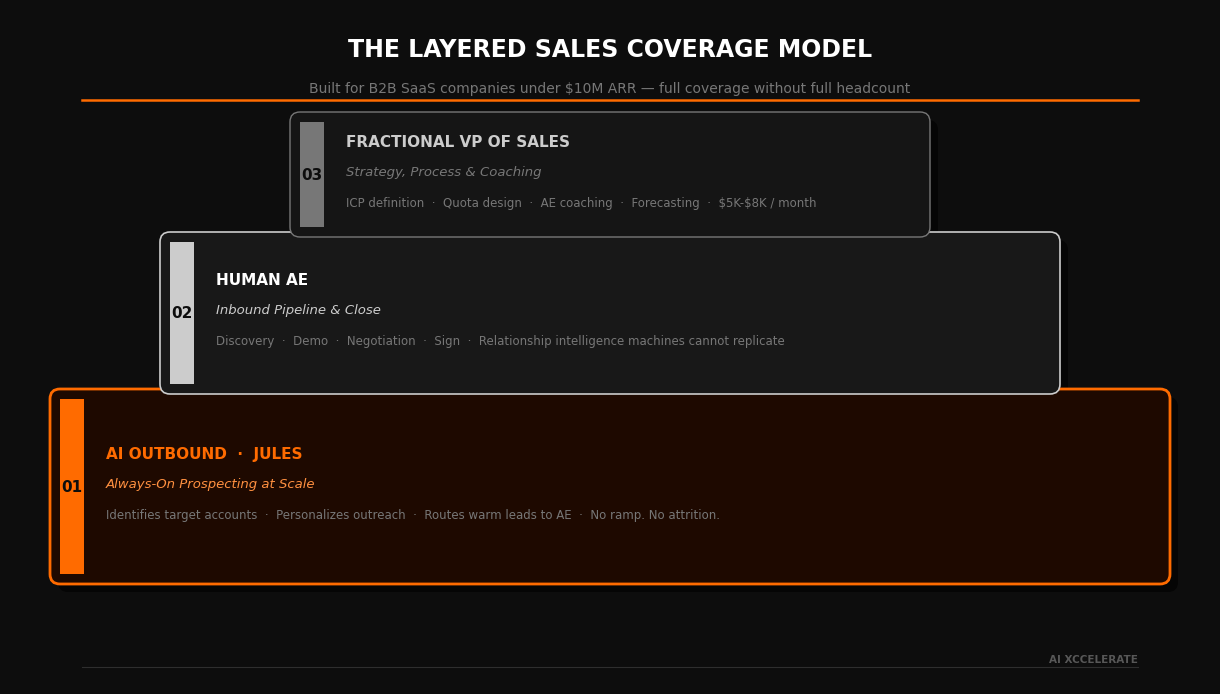
The companies navigating this well aren't choosing between "hire a full team" and "the founder closes everything." They're building a layered coverage model.
It looks roughly like this: a fractional VP of Sales sets process and coaches the motion for $5,000–$8,000 per month. One full-time AE handles inbound and founder-sourced pipeline. Outbound prospecting—the work a full-time SDR would have done—is handled by AI-assisted tooling that runs sequences, qualifies inbound leads, and flags accounts showing buying signals.
This is where Jules, AI Xccelerate's outbound AI agent, enters the picture. Jules runs the prospecting function that companies at this stage can't afford to fully staff—identifying target accounts, personalizing outreach at scale, and routing warm, qualified leads to the human AE. The economics look meaningfully different: instead of a $90,000 SDR who ramps over four months and leaves in fourteen, you're getting consistent, always-on pipeline coverage at a fraction of the cost.
This model doesn't replace the AE. It replaces the SDR function at the stage where that hire is prohibitively expensive and the failure rate is high. Companies using AI-assisted outbound at the sub-$10M ARR stage are reporting CAC payback periods 30–40% shorter than those running fully staffed SDR teams—though results vary based on ICP clarity, ACV, and sales cycle length.
The founders making this work aren't abandoning human selling. They're using AI coverage for volume prospecting so their human AE can focus on what actually requires a human: discovery, objection handling, and close.
Where does this leave you?
If you're under $10M ARR and feeling the pull to hire a sales team because that's what scaling SaaS companies do, the question worth asking first is: do you have a pipeline problem or a conversion problem?
If your pipeline is thin, an SDR might make sense—but the cost is real, the ramp is long, and attrition risk is high. If your pipeline is adequate but close rates are low, another AE won't fix the underlying issue. And if existing customers are churning faster than you're closing new ones, no sales team will outrun that math.
The companies that break through $10M ARR without blowing their budget don't hire their way to growth. They get precise about what sales function they actually need—and then find the most efficient way to cover it.
If this post described a situation that felt familiar, the next step is a conversation. In 30 minutes, we can look at your current ARR, pipeline, and sales costs and show you exactly what a coverage model built for your stage would look like—and what it would cost compared to a traditional hire.
→ Book your assessment
Frequently Asked Questions
How much does it cost to build a B2B SaaS sales team? A minimal viable B2B SaaS sales team—one SDR and one AE—costs $278,000–$380,000 per year in fully loaded compensation and tools. That figure doesn't include a sales manager or VP of Sales. For most companies under $10M ARR, this represents 15–40% of available growth budget before a single deal closes.
When should a B2B SaaS company hire its first salesperson? Most operators recommend hiring your first AE when you have repeatable, founder-independent pipeline, a defined ICP, and a documented sales process with a proven close rate. If those conditions aren't met, an AE will struggle to ramp and you'll spend more on salary than you recover in new ARR. For most companies, this happens somewhere between $3M and $6M ARR.
What is a realistic AE ramp time for a SaaS startup? The standard ramp for a mid-market AE is 3–6 months. During ramp, realistic quota attainment is 25–50% of full quota, meaning Year 1 contribution will typically be 50–70% of the annual number you modeled. For companies with complex products or long sales cycles, ramp can extend to 9 months.
Why do SDRs have such high turnover at SaaS startups? SDR tenure at startups averages 14 months (Bridge Group, 2024). The role is high-volume and repetitive, career progression is often unclear, and quota expectations frequently outpace the company's actual pipeline infrastructure. For sub-$10M ARR companies where ICP and messaging are still evolving, this attrition risk is particularly costly.
What is premature sales scaling in SaaS? Premature sales scaling is when a SaaS company hires salespeople before the pipeline engine, ICP, and messaging are proven. The typical result is low quota attainment, inflated CAC, and churn from neglected customer success. It's among the most common reasons B2B SaaS companies stall between $3M and $10M ARR.
Can AI tools replace an SDR at the sub-$10M ARR stage? AI outbound agents can handle the volume-based functions of an SDR—prospecting, sequencing, lead qualification, and signal monitoring—at a fraction of the cost and without ramp time or attrition risk. They don't replicate the judgment or relationship nuance of an experienced SDR in a complex enterprise sale. The strongest use case is at the sub-$10M ARR stage, where the SDR budget is hard to justify and the sales cycle doesn't require deep pre-meeting engagement from a human.
What is a good CAC payback period for B2B SaaS under $10M ARR? A healthy CAC payback for B2B SaaS is 12–18 months. Companies under $10M ARR often run payback periods of 24+ months due to high ramp costs relative to ACV. Reducing CAC payback—either by cutting acquisition cost or increasing ACV—is one of the highest-leverage moves a founder can make at this stage.